
“Well,” I’d reply, “I did run a company for forty years.”
“That’s right,” Taylor would laugh, as if this were news to her despite having been part of the family for over a decade. “We forget you were such a businesswoman. This must be easy for you compared to all those contracts with trucking companies and warehouses.”
But they never mentioned that my name was on everything. That legally, I wasn’t just paying for the wedding—I was hosting it. That distinction would matter later, though I didn’t know it yet.
There were other signs I should have noticed, little red flags waving in the peripheral vision of my hope and generosity. Like the time in June when I suggested meeting with the wedding planner together. “Oh, Mrs. Rivers, that’s sweet,” Taylor had said with a dismissive wave, “but you’d be bored to tears. It’s just going over table arrangements and timeline details. Super tedious stuff.”
Or when I asked about my role in the ceremony—what I should wear, where I’d be sitting, whether I might say a few words. “We’re still figuring out all those details,” Avery had replied vaguely. “Don’t worry, Mom. You’ll know everything in plenty of time.”
The most painful moment came when I asked about a grandmother-granddaughter lunch with Sophie, just the two of us, so I could share some wisdom about marriage and life. “She’s so swamped right now, Mom,” Taylor had said, not quite meeting my eyes. “Between finishing school and planning the wedding and her new job starting in October, she barely has time to breathe. But she loves you so much. She talks about you all the time.”
But Sophie never called. Never texted. Never stopped by. I told myself it was normal, that young people were busy, that I was lucky to be included at all—to be able to give my granddaughter this extraordinary gift.
Then came the phone call that changed everything. It was mid-July, and I was watering the plants on my terrace when my phone rang. “Mrs. Rivers, this is Jessica Martinez from Green Valley Estate. I’m calling about your event on September 14th.”
“Yes,” I said, setting down my watering can. “Sophie’s wedding. Is everything all right?”
“Everything’s fine. I just wanted to confirm a change to our records. Your son requested that we update the billing contact information to his name and email address. He said there might be some last-minute changes to the order and it would be easier if the invoices came directly to him. I wanted to make sure that’s accurate before I process it.”
My stomach dropped. “He requested what? When did he make this request?”
“Let me check… It was two weeks ago. July 19th.”
Two weeks ago. They’d been at my apartment that very day, showing me photos of the centerpieces, thanking me for being so generous. “Mrs. Rivers, should I make the change?”
“No,” I said firmly, my voice steadier than I felt. “Please keep all billing information under my name. I’m the one managing the finances for this event.”
“Of course. I’ll make a note in the file. Thank you for clarifying.”
After I hung up, I sat very still on my terrace, the July sun beating down, the sounds of the city rising from sixteen floors below. They were trying to erase me from my own event. I opened my laptop and checked my email, finding messages from vendors I didn’t recognize—the photographer asking about timeline adjustments, the florist confirming changes to the bouquet design, the caterer asking about dietary restrictions. All of them addressed to Avery and Taylor. None to me.
I pulled out the folder labeled “Sophie’s Wedding” and reviewed every contract I’d signed, every receipt, every payment confirmation. Every single one bore my name, my signature, my account numbers. That’s when I called Martin Hayes, my late husband’s best friend and our longtime attorney.
“Amelia,” he answered warmly. “Haven’t heard from you in a while. How are you?”
I explained everything—the wedding, the contracts, the vendors being redirected. Martin listened without interrupting, one of his best qualities. When I finished, he asked quietly, “Amelia, I need you to really think about this answer. Do you trust your son?”
The question should have been simple. He was my son, my only child, the boy I’d raised. But I thought about the distance that had grown between us, the way his visits always coincided with needing something, the fact that he’d never once asked how I was coping with being a widow. “I don’t know,” I whispered.
“Send me copies of all those contracts,” Martin said gently. “Every single one. I’m going to review them. Just to be safe.”
Three days later, Martin called me back with news that made my blood run cold. I’d been overcharged by at least fifteen thousand dollars. The venue package included services I didn’t need and wouldn’t notice. The catering was inflated. And Taylor had registered a business last November called “Sophie’s Dream Events”—a wedding planning company. They’d been using Sophie’s wedding as a portfolio piece, inflating the costs, building a business on my dime while systematically cutting me out of communications.
“There’s something else,” Martin said, his voice heavy. “Two weeks ago, Avery sent emails to every vendor requesting they remove you from their communications and direct everything to him and Taylor. He’s cutting you out of an event you’re paying for.” He paused. “Amelia, when was the last time Sophie called you?”
I tried to remember. “Easter,” I whispered. Four months ago.
“I think you need to prepare yourself,” Martin said gently, “for the possibility that they don’t want you at this wedding.”
Those words echoed in my head as Martin drafted a legal letter clearly stating that I was the financial sponsor and legal host of the event, that all communications must include me, and that no changes could be made without my written approval. “Send it,” I told him, and I meant it. I was done being an ATM that walked and talked.
The letter went out on a Friday afternoon. By Saturday morning, I had twenty-three missed calls from Avery. I didn’t answer any of them. Instead, I went to my volunteer shift at the animal shelter, walking dogs and cleaning kennels while my phone vibrated endlessly in my locker. When I finally listened to the messages that evening, they ranged from confused to angry to almost threatening.
The most painful message was from Sophie: “Grandma, I don’t understand what’s going on. Mom and Dad are really upset. They said you sent some kind of legal letter about the wedding. I thought you were happy to help us. If there’s a problem, can’t we just talk about it? Please call me back. I’m worried about you.”
She was worried about me—not because she cared, but because her parents were upset and the money supply might be threatened.
Sunday morning, Avery and Taylor showed up at my door. I kept the chain lock on. “Mom, we need to talk,” Avery said desperately. “That letter was insulting. We would never try to exclude you.”
“Then why did you request that vendors stop communicating with me?” I asked through the gap in the door.
The silence was damning. Eventually, they left, but not before the confrontation revealed the ugly truth—they’d been using my money to fund Taylor’s business, they’d overcharged me by thousands, and they’d planned all of it before ever asking for my help.
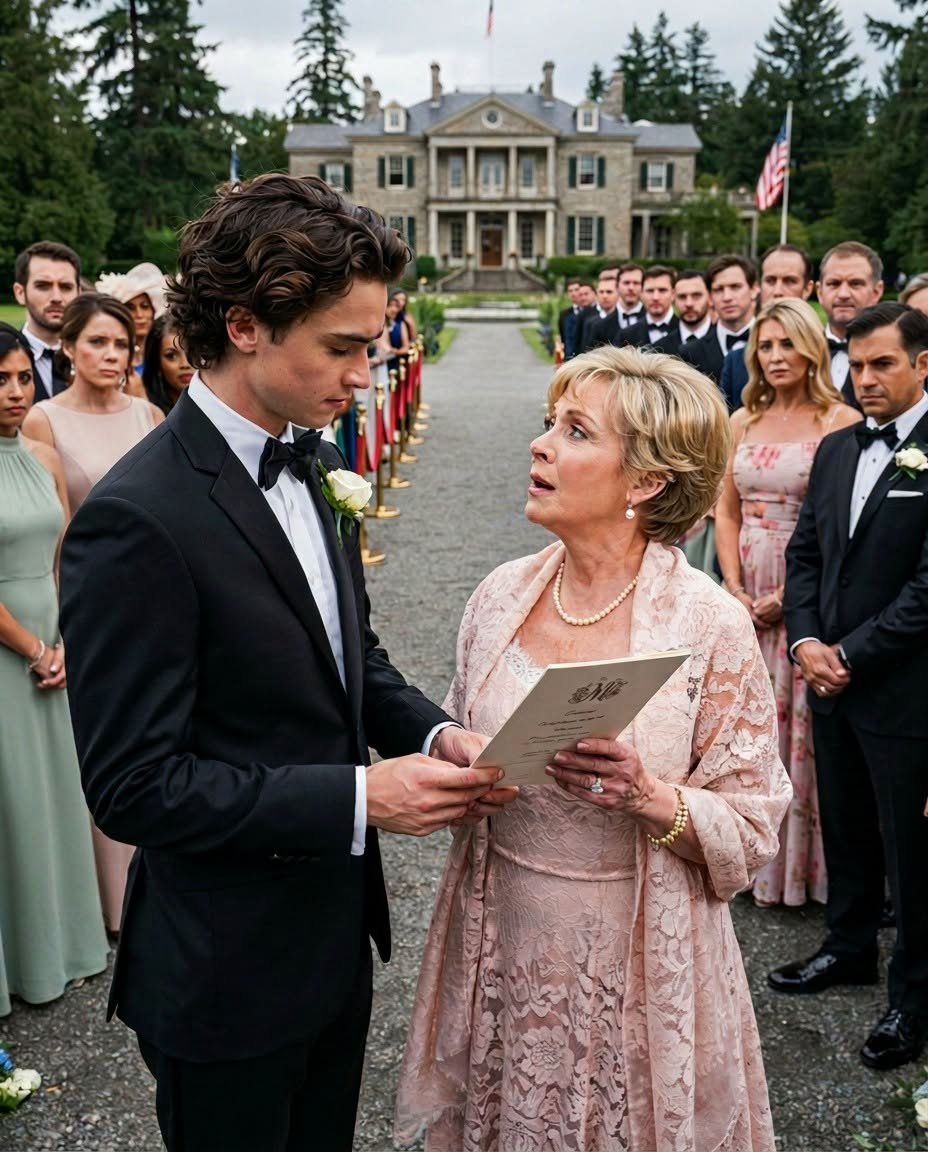
Now, standing at the entrance to Green Valley Estate on September 14th, wearing my pink silk dress and my mother’s pearls, watching Avery block my way into a wedding I’d paid for, I understood the full scope of their betrayal. Two hundred guests stared as I stood there, an elderly woman being turned away from her own granddaughter’s wedding.
“Mom, you’re not on the guest list,” Avery said, his voice carrying that apologetic tone that didn’t match his firm hand on my shoulder. “There must be some mistake.”
For a moment, I considered making a scene. Demanding entry. Reminding everyone within earshot that I’d paid for every flower, every plate, every note of music they’d hear today. But as I looked at my son’s face—at the calculation behind his apparent regret—I realized something important. This wasn’t a mistake. This was deliberate.
“It’s okay, sweetheart,” I said quietly, patting his hand. “I understand.”
I turned and walked back to my car, my spine straight, my head high. The driver who’d brought me looked shocked. “Mrs. Rivers, is everything all right?”
“Take me home, please,” I said, settling into the back seat. As we pulled away from Green Valley Estate, I pulled out my phone and called Martin.
“Martin,” I said when he answered, “I need you to draft a lawsuit. Fraud. Breach of contract. Elder financial abuse. Everything we discussed.”
“What happened?” he asked, concern evident in his voice.
“They didn’t put me on the guest list,” I said simply. “I just paid one hundred twenty-seven thousand dollars for a wedding I wasn’t allowed to attend.”
Martin was quiet for a moment. Then: “I’ll have the papers ready by tomorrow morning. Amelia, I’m so sorry.”
“Don’t be sorry,” I said, surprised by the steadiness in my own voice. “Just make sure they understand what they’ve done.”
That evening, while Avery and Taylor were celebrating at the reception I’d funded, while Sophie was dancing in her twelve-thousand-dollar dress to music played by a seven-thousand-dollar band, while two hundred guests enjoyed filet mignon and lobster tail I’d paid for, I sat in my penthouse apartment overlooking Central Park with Martin and his colleague, a forensic accountant named Patricia.
We went through everything—every contract, every receipt, every email. Patricia’s analysis revealed even more than we’d initially discovered. The total overcharge was closer to twenty thousand dollars. Taylor’s business account showed deposits that corresponded exactly with the inflated amounts. They hadn’t just excluded me from the wedding. They’d systematically defrauded me to fund a business startup.
“This is textbook elder financial abuse,” Patricia said, shaking her head. “Using family relationships to manipulate and exploit. The fact that they barred you from an event you legally hosted makes it even worse.”
“What are my options?” I asked.
Martin laid out several documents. “Civil suit for fraud and breach of contract. Criminal complaint for theft by deception—which is a felony over three thousand dollars. Restraining order preventing contact. And we file all of this publicly, which means it becomes part of the court record. Searchable. Permanent.”
I thought about Sophie, about the young woman who’d spent countless afternoons in this apartment, who I’d taught to bake and helped with homework. I thought about the grandmother-granddaughter relationship I’d hoped to have. Then I thought about being turned away at the entrance while two hundred people watched.
“File everything,” I said.
The next morning, my phone started ringing at dawn. I let every call go to voicemail. By noon, I had forty-seven messages. I listened to them all once, taking notes. Avery’s voice progressed from confused to angry to desperate. Taylor’s messages were defensive, then accusatory, then almost pleading. Sophie called twice, her voice thick with tears, asking why I was trying to ruin her happiness.
The only call I returned was to my accountant. “I need you to move my assets into a protected trust,” I told him. “Everything except one million in liquid funds. And I need you to cancel all automatic payments to Avery Rivers and anyone associated with him.”
“May I ask why?” he said carefully.
“Because my family has been stealing from me,” I said simply. “And I’m done funding my own abuse.”
The lawsuit hit the news three days later. “Advertising Executive Accused of Defrauding Elderly Mother of Wedding Funds” read the headline in the New York Post. The Daily News went with “Son Bars Mom from $127K Wedding She Paid For.” Within hours, it was trending on social media. Taylor’s Instagram comments filled with outrage. Sophie’s LinkedIn showed connection requests from reporters.
They tried to settle within a week. Martin fielded the call from their attorney. “They’re offering to repay the twenty thousand in overcharges,” he reported. “They want all charges dropped and a non-disclosure agreement.”
“No,” I said. “No settlement. No NDA. This goes to trial.”
“Amelia,” Martin said gently, “are you sure? This will be public. Painful. It could take years.”
“I have nothing but time,” I said. “And I want everyone to know what they did. Not for revenge. For the next elderly person whose family tries this. So they know they’re not alone. So they know they can fight back.”
The trial took eight months. During that time, I rebuilt my life. I started a foundation for victims of elder financial abuse. I went to Italy with Lorenzo, my Italian teacher, who’d been quietly courting me for months. I volunteered more at the shelter. I made new friends who valued me for who I was, not what I could provide.
Sophie tried to reach out twice. I didn’t respond. Not out of cruelty, but out of self-preservation. She’d made her choice at that wedding entrance, and I’d made mine.
The day the verdict came in, I sat in the courtroom between Martin and my cousin Margaret. The jury found Avery and Taylor liable for fraud, breach of fiduciary duty, and financial exploitation of an elderly person. The judge ordered them to repay the full $127,000 plus the $20,000 in overcharges, plus interest and legal fees. Total: $183,000.
“Furthermore,” the judge said, looking directly at Avery and Taylor, “I’m ordering this case file to remain unsealed and publicly accessible. What you did to your mother should serve as a cautionary tale about the abuse of trust and family relationships.”
After the verdict, reporters swarmed outside the courthouse. One shoved a microphone in my face. “Mrs. Rivers, how does it feel to win?”
I looked directly into the camera. “This isn’t about winning,” I said. “This is about dignity. About refusing to accept abuse just because it comes from family. I’m seventy-three years old, and I’m here to tell every older person watching: you don’t have to accept being treated as an ATM. You matter. Your dignity matters. Don’t let anyone—not even your own children—make you feel otherwise.”
The clip went viral. Within days, I received thousands of emails from elderly people sharing similar stories. Many had been too ashamed to speak up. My foundation’s website crashed from traffic. Donations poured in.
Six months after the trial, I sat in my apartment with Sophie. She’d reached out through Martin, asking for one meeting. Just one. I’d finally agreed.
“Grandma,” she said, and she looked older than twenty-six should look, tired and worn, “I’m so sorry. I didn’t know about the overcharges. I didn’t know Dad and Mom were planning to keep you out. I thought—” Her voice broke. “I thought you just didn’t want to come.”
“Did you look for me?” I asked quietly. “When I wasn’t there?”
She shook her head, ashamed. “Mom said you’d decided not to attend. That you were mad about something. I believed her. I should have called you, but—” She wiped her eyes. “I was so caught up in my perfect day that I didn’t even think about you until after the honeymoon.”
“That’s the problem, sweetheart,” I said gently. “You didn’t think about me at all.”
“I know,” she whispered. “And I’ve been thinking about it every day since the lawsuit. About how I used you. How I took you for granted. How I didn’t even invite you to my dress fitting or my bridal shower because Mom said it would be awkward.” She looked up, tears streaming down her face. “Can you ever forgive me?”
I studied my granddaughter—this young woman who’d been manipulated by her parents but who’d also made her own choices. “I forgive you,” I said. “But Sophie, forgiveness doesn’t mean things go back to how they were. You have to earn back trust. That takes time.”
“How long?” she asked.
“As long as it takes,” I said. “We can have coffee once a month. We can talk on the phone. But slowly. Carefully. Building something real instead of something based on obligation and money.”
She nodded, understanding. “I left Marcus,” she said suddenly. “The marriage. It only lasted four months. When he found out you’d cut Mom and Dad off financially, when he realized I didn’t actually come from money, he changed. Became cruel. I realized his love was as conditional as—” She stopped.
“As conditional as your love for me was?” I finished gently.
“Yes,” she whispered.
We talked for two hours that afternoon. It wasn’t comfortable. It wasn’t easy. But it was honest—maybe the first truly honest conversation we’d ever had.
As for Avery and Taylor, I haven’t spoken to them since the trial. They declared bankruptcy to avoid paying the full judgment. Avery lost his job when the publicity made him toxic to clients. Taylor’s Instagram influencer career ended when sponsors dropped her. They’re living in a one-bedroom apartment in Queens now, struggling.
Part of me feels guilty about that. The part that’s still a mother, that remembers rocking Avery to sleep as a baby. But the larger part—the part that values dignity and self-respect—knows I made the right choice.
My foundation has helped over three hundred elderly people recover from financial abuse by family members. We’ve partnered with law firms, social services, and senior advocacy groups. Every time I meet someone who’s been exploited by their children, I tell them my story. I show them it’s possible to fight back.
I’m seventy-four now. Lorenzo and I spend weekends together, traveling, enjoying life. Sophie and I have coffee twice a month, and slowly, carefully, we’re building something real. I volunteer at the animal shelter three times a week. I’m learning to paint. I’m writing a memoir about the experience.
My life is smaller now in some ways—fewer family dinners, no big holiday gatherings. But it’s also bigger. Richer. More authentic. I wake up every morning knowing I chose myself, that I refused to be diminished, that I showed others they could do the same.
The wedding I wasn’t allowed to attend turned out to be the best gift my family could have given me. It showed me exactly who they were. And it forced me to remember who I was—not just a checkbook, not just a convenient source of funds, but a woman with dignity, strength, and the courage to demand respect.
Sometimes the most important “I do” isn’t the one you say at a wedding. It’s the one you say to yourself when you finally choose your own worth over someone else’s comfort. That’s the vow I made standing outside Green Valley Estate on September 14th, watching my son turn me away from a wedding I’d funded.
And it’s the vow I’ve kept every day since.