
Something alive.
Something that turned a year of legal arguments, certified letters, and stress into more than a victory on paper.
By late summer, Tyler’s pool project finally resumed.
The design had to change.
The pool became smaller.
Its orientation changed.
Contractors had to redo part of the excavation.
I heard that Tyler paid substantial redesign and delay costs.
I did not celebrate.
His mistake became expensive because he kept making it more expensive.
That was not my victory.
My victory was a fence in the correct place.
A clean title.
A recorded boundary.
And a garden growing on land that nobody could ever again pretend belonged to someone else.
I thought that was the end.
Then, almost a year after the dispute began, Tyler knocked on my door.
He looked tired.
Older, somehow.
“Ashley and I are selling,” he said.
“I saw the sign.”
He glanced toward the blueberry bushes.
“My agent says we have to disclose the boundary dispute.”
“Yes.”
“She says buyers keep asking about it.”
“That’s what disclosures are for.”
Tyler gave a bitter laugh.
“You really got everything you wanted.”
“No.”
He looked genuinely surprised.
“What didn’t you get?”
I thought before answering.
“A neighbor I could trust.”
Tyler looked down.
For once, there was no smile.
“I screwed up,” he said.
I waited.
“I thought if I finished the fence quickly enough, you wouldn’t spend the money fighting me.”
There it was.
The truth.
A year late.
“You were counting on me deciding it wasn’t worth the trouble.”
“Yes.”
“Why?”
He shrugged.
“I wanted the bigger yard.”
“That’s it?”
His face tightened with embarrassment.
“The pool looked better with the extra space. My designer showed me a rendering. It looked incredible.”
I stared at him.
Months of legal bills.
Court hearings.
Construction delays.
A damaged relationship with his wife.
A forced redesign.
All because a swimming pool looked better in a computer rendering.
“You know what bothered me most?” I asked.
“The fence?”
“No.”
He waited.
“When I showed you the survey, you told me I had plenty of yard.”
Tyler remembered immediately.
“I shouldn’t have said that.”
“It wasn’t your decision how much of my property was enough for me.”
He slowly nodded.
“No,” he said. “It wasn’t.”
That was the closest thing to a real apology I ever received from Tyler.
Two months later, he and Ashley sold the house.
Final — The Boundary
A family named the Carters moved in next.
Ben and his wife had two young children and a golden retriever that spent its first week barking at everything—the mail truck, birds, passing cars, and once even its own reflection in the sliding glass door.
The first Saturday after they moved in, Ben found me trimming the blueberry bushes.
“Jason?”
“Yeah?”
He pointed toward the fence.
“Our survey says the fence sits about six inches inside our property.”
“That’s correct.”
“I just wanted to make sure we agreed before we did any landscaping or put up a shed.”
I almost laughed.
Not at him.
At how easy the conversation was.
“We agree,” I said.
He looked at the blueberry bushes.
“Those yours?”
“Every inch.”
He smiled.
“Good-looking berries.”
“Help yourself when they’re ripe.”
That was how normal neighbors handled boundaries.
They checked.
They asked.
They respected the answer.
No attorneys.
No certified letters.
No county inspectors.
No courtrooms.
A five-minute conversation accomplished what Tyler had turned into a year-long legal battle.
The following summer, Emma came home from college.
We picked blueberries together one warm July evening.
She balanced a bowl on one hip while eating berries faster than she collected them, exactly as she had when she was a child in my father’s garden.
“Remember when I asked if fighting for this was worth it?” she said.
“Yes.”
“It was.”
I smiled.
“Because of the berries?”
“Obviously.”
We sat beneath the red maple afterward.
It had grown large enough to cast a small patch of shade across the lawn.
Looking across the yard, I could barely tell where Tyler’s fence had once stood.
The boundary had disappeared back into the ordinary shape of the property.
Exactly the way boundaries should disappear when everyone respects them.
But I never forgot what happened.
Property disputes sound petty until somebody decides that your rights depend on whether defending them is convenient.
Eight feet becomes four.
Four becomes two.
Years pass.
Owners change.
Memories fade.
And silence begins to look like permission.
I almost stayed silent that first Saturday.
I hated conflict.
Tyler knew that.
In fact, he was counting on it.
People like him do not always need to prove they are right.
Sometimes they only need the other person to decide that proving them wrong is too expensive or exhausting.
That is what Tyler misunderstood.
A boundary may look insignificant.
A metal pin buried beneath grass.
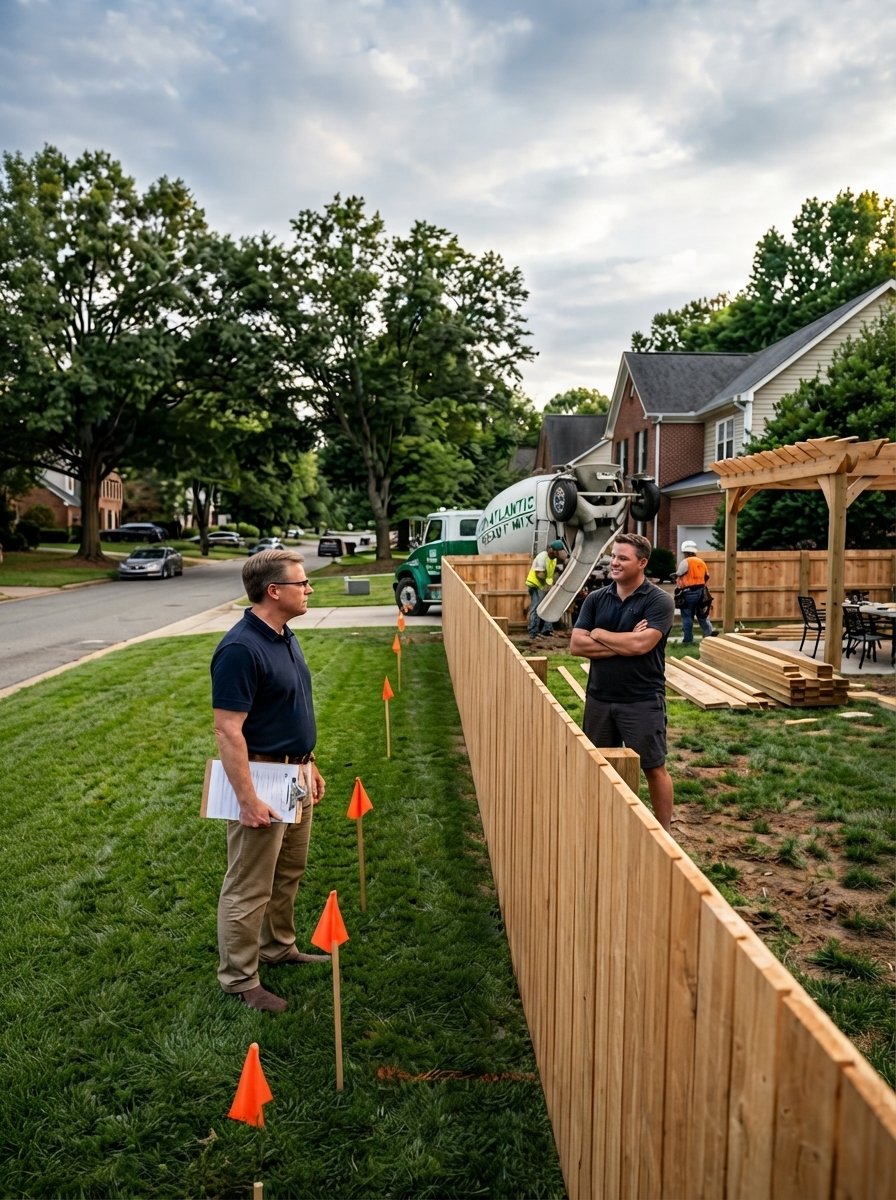
An orange survey flag.
A line on a piece of paper.
A cedar fence.
Or even a single word:
No.
They seem small until someone crosses them.
Then they can define everything.
I never tore Tyler’s fence down myself.
I never damaged his pool.
I never trespassed onto his property at night.
I never planted anything ugly simply to punish him.
I did something that frustrated him far more.
I documented everything.
I hired a surveyor.
I kept the permit.
I kept the certified letter.
I used the deed.
I followed the legal process.
And because facts did not change simply because Tyler refused to accept them, eventually the fence had to move.
Years later, when the blueberry bushes had grown thick enough to hide much of the fence, Ben asked why the garden followed such a perfectly straight line.
I told him the short version of the story.
He laughed in disbelief.
“So Tyler basically thought the land became his because he built a fence around it?”
“Pretty much.”
Ben shook his head.
“That’s not how property works.”
“No,” I said. “It never was.”
I picked a blueberry from the nearest bush and rolled it between my fingers.
“That’s what the survey was trying to tell him the whole time.”
I ate the berry.
“He just didn’t want to listen.”
The orange survey flags are gone now.
The documents are stored safely in a folder I rarely need to open.
My mower follows the same line it followed for eleven years before Tyler ever arrived with his contractors, pool renderings, and confident smile.
Emma still steals blueberries before they are completely ripe, just as she did in her grandfather’s yard.
And every spring, the little red maple grows a little taller over the strip of land Tyler once stood in my kitchen and told me I had no reason to defend.
In the end, Tyler had been right about one thing.
Someone really did need to learn where the boundary was.
It just wasn’t me.
THE END