
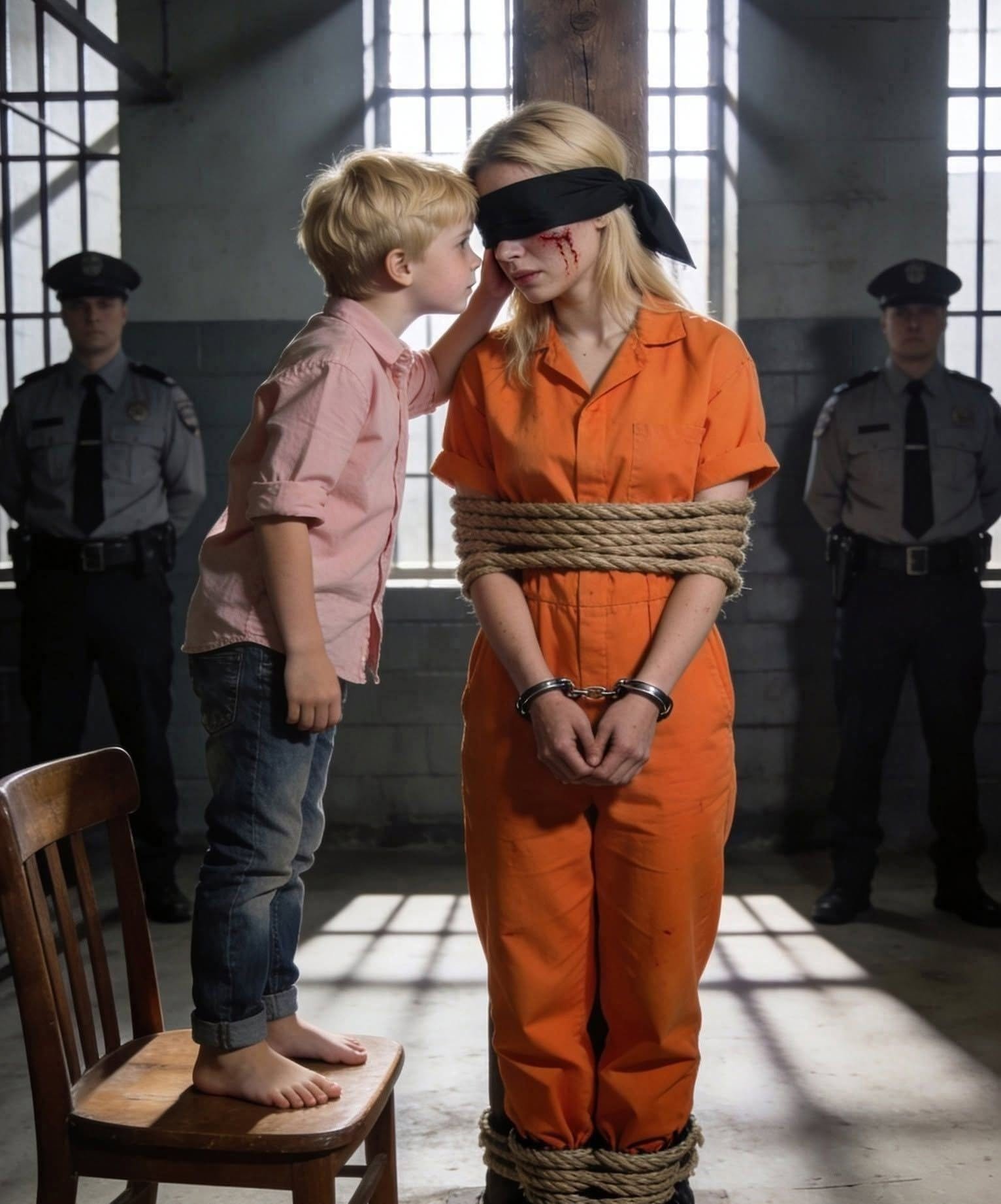
The local newspaper headlines read like psychological horror fiction:
“STAY OF EXECUTION: Convicted Mother Spared Five Minutes Before Lethal Injection as Eight-Year-Old Son Accuses Brother-in-Law.”
“THE HAYES FILE REOPENED: How a Grief-Stricken Uncle Concealed Six Years of Murder.”
Caroline Hayes was released from maximum security under an emergency judicial order pending a full evidentiary hearing and a motion to vacate her conviction. The release wasn’t cinematic or graceful; there were no balloons or cheering crowds outside the prison gates. Just a damp Tuesday afternoon, a gray drizzle falling from an overcast sky, and the heavy iron gates sliding open to release a woman who had spent two thousand one hundred and ninety days staring at a concrete wall waiting for the state to end her life.
When she walked out, she looked less like a person and more like an apparition—a skeleton draped in oversized civilian clothes provided by the public defender’s office.
Ethan and I were waiting by the curb.
I didn’t run to her at first. My feet felt glued to the wet asphalt, the weight of six years of cowardly silence pressing down on my shoulders like a lead vest. I had doubted her. I had let the world convince me that my own mother was a cold-blooded killer.
Mom stopped a few feet away. She looked at me, her hazel eyes glistening with unshed tears, and then she opened her arms.
I broke. I stumbled forward, crashing into her embrace, sobbing so hard my ribs ached.
“I’m sorry,” I choked out into her shoulder, the words tearing through my throat. “I’m so sorry, Mom. I didn’t believe you. I let them tell me—I let myself think—”
“Hush, sweetheart,” she whispered, holding me so tightly I could feel the sharp ridge of her collarbone against my cheek. “You were a child. They built a cage out of lies so heavy even I almost believed I was trapped in it. But we’re out now. We’re out.”
Ethan squeezed in between us, wrapping his small arms around both our waists, completing a circle that had been brutally broken six years ago.
With Caroline out, the state’s investigative machinery, spurred by relentless public scrutiny and the sudden, undeniable confession of an eyewitness, tore into Victor Hayes’s life with a ferocity that left nothing standing.
What they uncovered was a masterclass in deception, greed, and cold, calculated malice.
Two nights before my father’s murder, Arthur and Victor Hayes had a violent, unrecorded confrontation in the study of our home. My father, who managed the family’s agricultural equipment business, had discovered a massive financial discrepancy—over eight hundred thousand dollars embezzled from corporate accounts over a five-year period.
Victor had been systematically bleeding the company dry to fund high-stakes underground gambling debts and a lavish lifestyle with a secret mistress in a neighboring county.
When Arthur threatened to go to the police and cut him off completely, Victor didn’t panic. He planned.
On the night of the murder, Victor used his own spare key—a relic from when he used to housesit during our family vacations—to slip into the house quietly through the back mudroom while everyone was asleep. He walked into my parents’ bedroom, where my mother lay in a deep, medically induced sleep (she had taken a mild prescription sleeping pill that evening for chronic migraines).
Using a kitchen knife he had retrieved from downstairs, Victor murdered his own brother with ruthless efficiency. Then, in a stroke of chilling psychological warfare, he wiped his own prints clean, took my mother’s hand while she was fast asleep, and deliberately pressed her fingers around the textured handle of the blade before sliding it deep under her bed. He even wiped a microscopic smear of blood onto the hem of her silk robe as he stepped out of the room.
He had counted on the police taking the path of least resistance. He had counted on the circumstantial evidence being so overwhelming that no jury would look any further. And most of all, he had counted on silence.
For six years, Victor had played the role of the devoted, self-sacrificing uncle with chilling perfection. He funded the legal defense teams just enough to look supportive, while quietly ensuring that none of the private investigators dug too deeply into his own financial records. He sat in our living room, ate our food, patted Ethan on the head, and looked us in the eye with a smile while carrying the secret of his brother’s blood on his hands.
And he would have gotten away with it—clean, untouchable, and wealthy—if not for an eight-year-old boy who couldn’t sleep.
Part V: Confrontation and Justice
Two weeks after her release, Caroline and I sat across from Detective Miller in a sterile interview room at the police precinct. The detectives had finally broken Victor’s stoic, arrogant silence by confronting him with forensic DNA sweep matches found on the underside of the knife handle—touch DNA that had been too degraded to sequence in 2020, but which modern familial profiling in 2026 matched unequivocally to Victor Hayes.
Victor was currently being held in the county detention center without bail, facing charges of first-degree murder, perjury, and evidence tampering.
“He’s refusing to speak without a plea deal,” Detective Miller said, sliding a thick manila folder across the metal table. “He wants life without parole in exchange for avoiding the death penalty. The District Attorney is inclined to take it to spare the family a grueling trial, but before we sign off, Mrs. Hayes… the prosecutor wanted you to have full transparency on his recorded statement.”
Caroline didn’t open the folder immediately. She sat straight and tall, her hands folded neatly on the table, her face carved from stone.
“Play it,” she said quietly.
Detective Miller clicked a small recorder on the desk.
The tinny, distorted audio filled the small, quiet room. Victor’s voice came through the speaker—smooth, arrogant, devoid of even a shred of remorse.
“You think you’re so smart, Miller? You think you solved a grand mystery? Arthur was a fool. He was going to ruin everything I built over a ledger book that didn’t even matter in the grand scheme of things. I didn’t want to kill him. I really didn’t. But he backed me into a corner. As for Caroline… well, she was just collateral damage. It was poetic, really. Everyone loves a domestic murder mystery. The husband dies in the kitchen, the wife is asleep upstairs with her fingerprints on the knife—it practically wrote itself. If that little brat Ethan hadn’t woken up to sneak a glass of water down the hall… I would have been a free man today. Kids see too much. That’s why you can’t trust them.”
The recording clicked off.
The silence in the room was absolute, heavy enough to crush bone.
Caroline didn’t cry. She didn’t shout. She simply reached out, picked up the pen from the table, and slid the prosecutor’s consent form toward herself.
“Sign it,” she said to the detective, her voice as cold and clear as mountain ice. “Let him rot in a box until his dying day. I don’t want him executed. Execution is too clean for what he stole from us. I want him to wake up every single morning in a concrete cell, knowing that everyone in the world knows what a pathetic, cowardly little thief he truly is.”
The formal legal proceedings concluded a month later in a packed, suffocating courtroom.
Victor Hayes entered the courtroom in an orange jumpsuit of his own, his hair uncombed, his once-distinguished posture completely collapsed. He refused to look toward the gallery where Caroline, Ethan, and I sat in the front row.
When the judge formally sentenced him to consecutive life sentences without the possibility of parole, the gavel came down with a sharp, echoing crack that sounded like final thunder.
As the bailiffs led Victor away in chains, he glanced back over his shoulder for a fraction of a second. His eyes met mine—not with the chilling grin he had flashed in the prison lobby, but with a vacant, hollow terror. He was a ghost long before the door slammed shut behind him.
Part VI: Epilogue – Healing the Fractured Soul
Six months after the trial ended, the leaves outside began to turn amber and gold once more.
We moved back into the old family house on the edge of town. It wasn’t easy at first. Every floorboard creaked with ghosts; every corner of the kitchen seemed haunted by the lingering shadow of that terrible night. For the first few weeks, Ethan woke up screaming from nightmares, clinging to his blue sweater as if the dark were coming to take him, too.
And I fought my own private demons—the gnawing, corrosive guilt of having doubted the woman who gave me life, of having let the silence of suspicion poison my heart when she needed my belief the most.
One evening, as the sun dipped below the tree line, painting the sky in bruised shades of purple and orange, I sat on the back porch steps with my mother.
She was shelling peas into a wooden bowl, her hands moving with a rhythmic, calming grace. The color had slowly returned to her cheeks, and though the silver threads in her hair remained as permanent scars of the six years she lost, the light in her hazel eyes burned brighter than ever.
“Mom,” I whispered, breaking the quiet stillness of the evening.
She paused, looking over at me with a soft, patient smile. “What is it, sweetheart?”
“I never apologized,” I said, my voice cracking slightly as the weight I had carried finally began to dissolve into the autumn air. “Back then… when everyone said she did it… I let myself believe it, too. I didn’t write back. I let doubt win.”
My mother set the bowl down on the wooden planks. She reached out, her warm, steady hand covering mine, her fingers calloused but gentle.
“Clara,” she said softly, her voice carrying the entire weight of our shared survival. “Doubt is what they designed the cage to do. It’s natural to be afraid of the dark when the whole world is telling you the sun has gone out. What matters isn’t that the shadow fell over us for a while.”
She squeezed my hand tightly, her eyes shining with unshed tears of profound, unconditional grace.
“What matters is that when the light finally broke through… we were standing in it together.”
Inside the house, we heard the sound of Ethan laughing as he chased the family dog across the living room rug, his heavy footsteps thudding against the floorboards.
For the first time in six years, the house didn’t feel haunted. It felt like home.