
Diane came into the kitchen smiling. “That must be Melissa,” she said. She had dressed for victory, not moving day. Her silver hair was sprayed into place, her lipstick was bright, and she wore the quilted vest again as if it were some family uniform.
Eric appeared behind her, phone in hand.
I was already at the breakfast table. The blue folder sat beside my coffee.
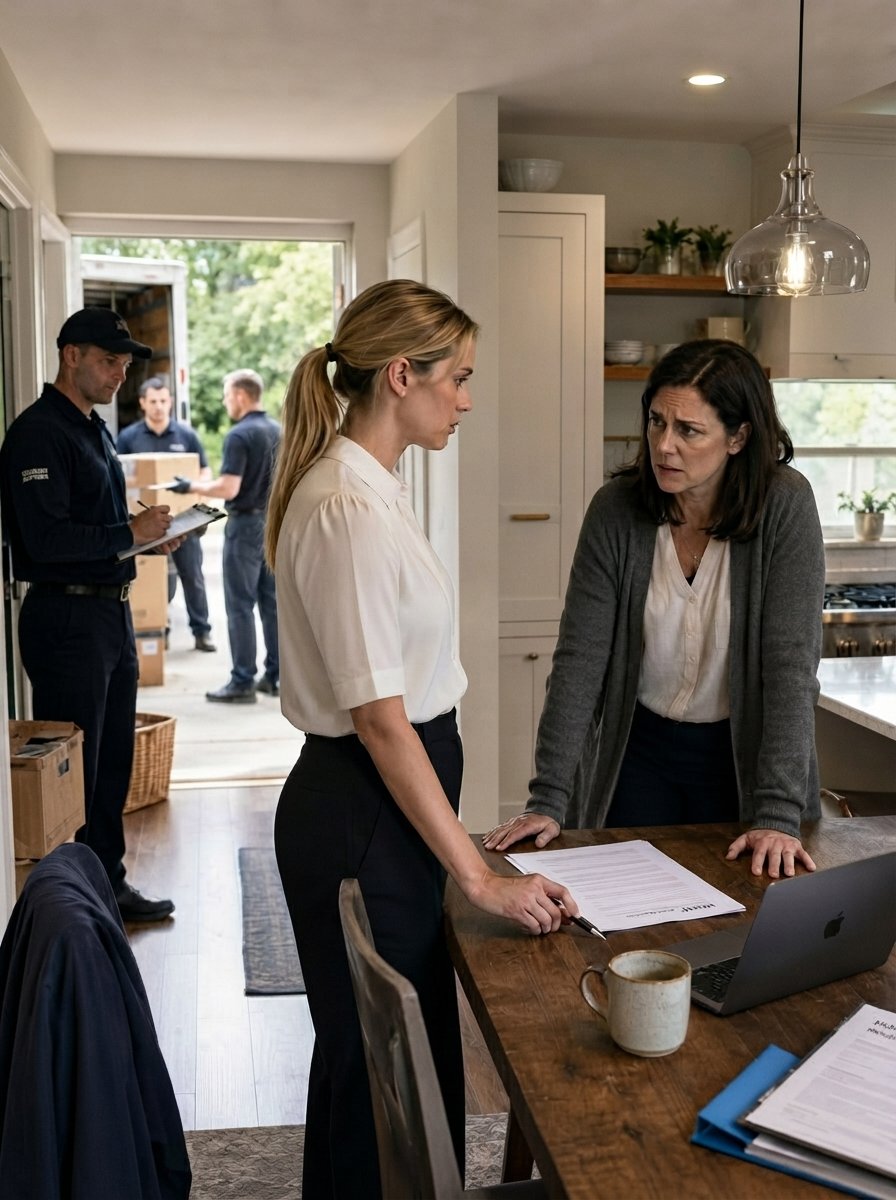
The moving truck rolled fully into the driveway, but it did not stop at the curb the way Melissa’s rented truck would have. It backed toward the garage with the care of professionals who had been given instructions.
Diane’s smile flickered.
The driver stepped out holding a clipboard with my name on the work order. Behind him were two movers and a woman in a navy blazer carrying a sealed envelope.
“What is this?” Diane asked.
I placed my hand on the blue folder. The sound of the cardboard cover against the table was barely anything, but the room heard it.
“This,” I said, “is the part where everyone stops pretending.”
Eric took one step forward. “Can we not do this in front of people?”
I almost laughed. He had been willing to let his mother throw me out in the kitchen, but witnesses offended him. That is another thing about cowards. They are less afraid of wrongdoing than of an audience.
The woman in the navy blazer introduced herself as a legal courier from Mr. Caldwell’s office. She asked Eric if he would accept service at the residence.
Eric stared at her. “For what?”
She did not answer the way he wanted. She handed him the envelope and documented the delivery on her clipboard.
Diane reached for the blue folder, then hesitated. I opened it myself.
The first page was the certified copy of the deed. My name was the only name listed as owner of record. The second page was the mortgage statement. My name again. The third was the insurance declaration. The fourth was the Wake County property tax receipt. The fifth was a spreadsheet of recurring household payments from my account, arranged by month and category. Mortgage. Power. Water. Insurance. Groceries. Every invisible bill that kept their lives comfortable.
Diane stared at the pages as though paper had betrayed her. “My son bought this house,” she said, but her voice did not carry conviction anymore.
“No,” I said. “He moved into it.”
Eric looked at the deed. Then he looked at me. His mouth opened, but nothing useful came out.
The legal courier did not move. The movers waited by the driveway, suddenly more polite than my family had been in years.
Diane’s face hardened again. “You cannot just throw family out.”
“I am not throwing anyone out this morning,” I said. “That would be illegal, and I was raised better than that.”
She blinked.
“But Melissa is not moving in,” I continued. “No new occupant is entering this house without my written permission. That notice is in the folder.”
Eric whispered, “Mom, stop.”
Diane ignored him. “You agreed to two weeks.”
“I agreed that two weeks sounded fair,” I said. “So I used them.”
Melissa arrived ten minutes later in a borrowed SUV with boxes visible behind the back seats. I saw the children in the back and felt a weary sadness I did not want. They had not created this. Adults had used them as camouflage.
Melissa came up the walk smiling, then slowed when she saw the movers, the legal courier, and Diane standing rigid in the kitchen window. She came inside without knocking, because that had become normal too.
“What’s going on?” she asked.
Diane said, “Your brother’s wife is being cruel.”
I turned to Melissa. “You were told this house was available to you.”
Melissa’s eyes flicked to Eric. He looked down.
“That was never true,” I said.
Her face changed then, and I saw something I had not expected. Not guilt exactly. Calculation.
“How was I supposed to know?” she asked.
“You could have asked the person living here,” I said.
She looked toward the folder. I did not offer it to her.
The legal courier explained, in a voice without drama, that I was the sole owner of the property and that no new resident had permission to move in. She also explained that any attempt to move personal property into the home after notice would be documented.
Melissa’s mouth tightened. “I have kids.”
“I know,” I said. “I have helped them before. I am not helping you take my house.”
That was the first sentence I said that made me feel clean.
Eric finally found his voice. “Can we talk privately?”
“No,” I said. The word came out calm, but it landed harder than yelling.
Diane sat down. Not gracefully. She lowered herself into the chair as if her knees had remembered the surgery all at once.
The movers began loading the items I had marked. My files, my mother’s china, my office furniture, the pieces I would not leave behind for people who thought gratitude was optional. I was not abandoning the house. I was removing what was vulnerable while the legal process began. Mr. Caldwell had advised me to spend the first weeks elsewhere, because the house had stopped being a home the moment my husband let his mother call me a guest.
He was right. A home requires more than a deed. It requires safety. That morning, the kitchen had plenty of paperwork and no safety at all.
I left Eric with copies of the notices. One explained that Melissa did not have permission to move in. One addressed Diane’s status in the home and the timeline to resolve it legally. One required Eric to arrange his own insurance, billing, and household expenses. One was the divorce petition.
He read that last one. His face went pale before he finished the first page.
“You’re divorcing me?” he asked.
“I think you divorced me when you stood by the refrigerator and let your mother assign my home to your sister.”
Diane made a sound. Eric looked wounded, which would have mattered more if he had ever looked brave when I needed him to.
Melissa left first. She did not apologize. She said she had to “figure out what to tell the kids,” as if the children were an audience she had not prepared for the truth.
Diane went upstairs to her room and closed the door. Eric stayed in the kitchen with the papers spread across the table, staring at the folder as if it were a stranger sitting where his breakfast should have been.
I moved into a short-term furnished apartment that afternoon. It was not pretty. The sofa was stiff, the art was generic, and the refrigerator made a clicking noise at night. But every bill in that apartment had my name on it because I had chosen it. That mattered more than beauty.
Over the next weeks, the magic stopped happening at the Raleigh house. The grocery deliveries did not arrive unless Eric paid for them. The lawn crew did not show unless someone updated the card. The pharmacy called Diane directly. The internet bill became a topic, because the streaming services no longer felt like harmless extras when Eric had to pay them himself.
Diane called me once from a number I did not recognize. I let it go to voicemail. She said I had misunderstood her. She said she had only meant family should help family. She said Melissa was embarrassed. She never said she was sorry.
Eric sent longer messages. At first, they were practical. Then apologetic. Then angry. Then practical again. He wrote, “I should have said something.” That was true, but it was not enough.
A marriage can survive many hard things, but it cannot survive one person learning that the other will trade her dignity for convenience and call it peace.
The legal process was not instant. Nothing real is. Diane did not disappear in a satisfying movie-scene exit. She had time to move out properly. Eric had time to consult his own attorney. There were forms, statements, negotiations, household inventory lists, and a tedious review of what was separate property and what might be argued about. Mr. Caldwell had been right. The law is rarely as clean as the moment you finally decide to protect yourself.
But Diane never had the power she believed she had. Melissa never moved in. Eric never gave his sister my house. Eventually, Diane left to stay with a cousin while she found a smaller rental. Eric moved out after the first formal agreement was signed.
The house was quiet when I returned to walk through it alone. The porch swing was still there. The oak tree had dropped acorns all over the front walk. Inside, the kitchen smelled faintly of dust and lemon cleaner. The legal pad was gone. The blue folder was in my bag.
I stood at the breakfast table and remembered the exact place where Diane had said, “You’re just a guest here.”
The strange thing is that I did not feel triumphant. I felt tired. I felt sad for the woman I had been, the one who thought swallowing small humiliations was the price of being generous. I felt sadder for how long I had confused silence with kindness. But I did not feel guilty.
I sold the house after the divorce settlement was finalized. Some people thought that was extreme. They imagined ownership as attachment and moving on as defeat. They did not understand that a house can be paid for by one person and still become haunted by everyone else’s entitlement.
When the sale closed, I kept the porch swing. It sits now on the back patio of a smaller place where the bills are fewer and the silence belongs to me. Janet came over the first week with takeout and a bottle of sparkling water, because she said a woman who survives financial foolishness deserves bubbles even if she does not want champagne. We ate from paper plates on moving boxes. I laughed harder than I had in months.
Sometimes Eric’s messages still arrive. They are shorter now. He asks how I am. He says he hopes I know he never meant for it to go that far. I believe that, in a limited way. Most people who benefit from unfairness do not mean for it to go as far as consequences. They only mean for it to continue.
I still think about that morning often. My mother-in-law stood in my kitchen and looked at the house I had been quietly paying for as though the invisible bills had somehow paid themselves. She called me a guest because my work had been quiet enough for her to mistake it for nothing.
But there is a difference between helping family and becoming the floor they stop noticing beneath their feet.
The day the moving truck arrived, I stopped being the floor.
I became the owner again.