
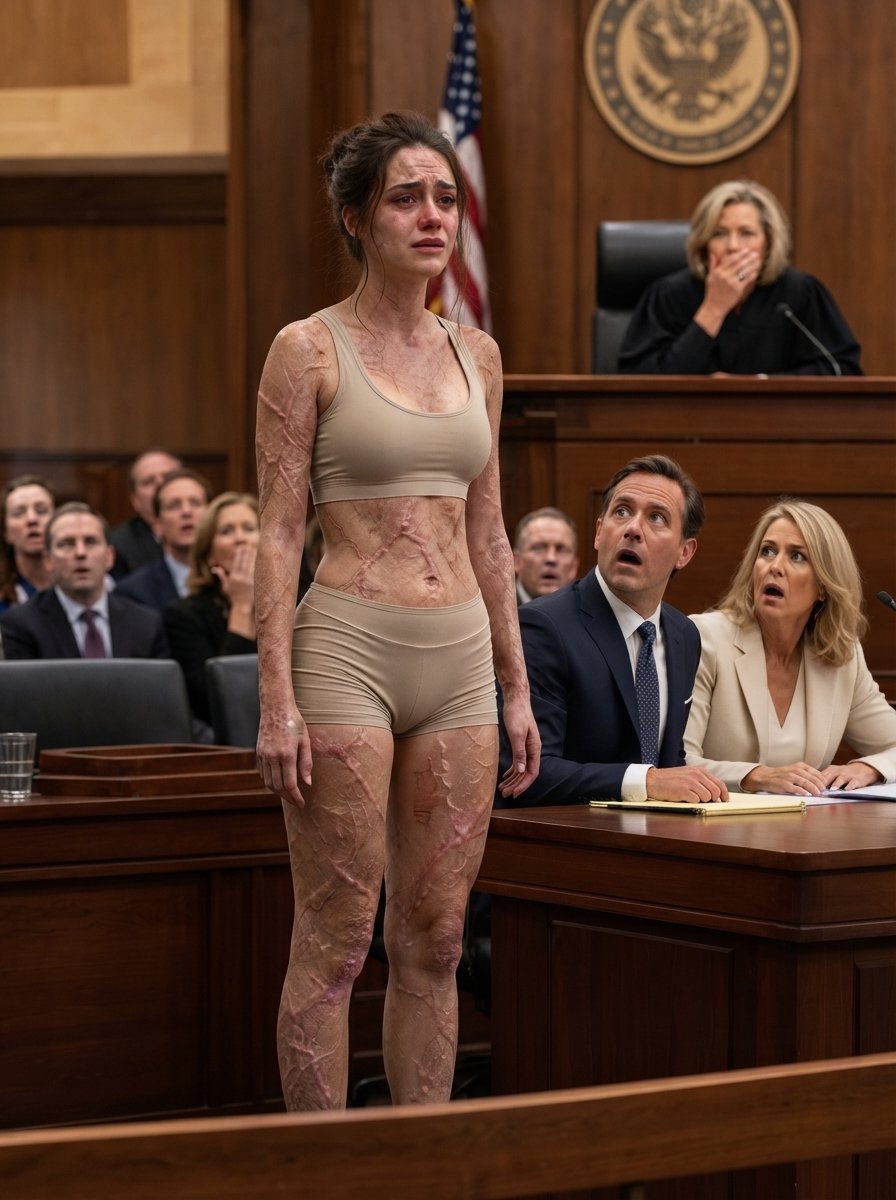
She learned that grief can be physical even when no one has died.
Julian filed papers and made statements.
Eleanor insisted the oil had been an accident.
Their attorney repeated the phrase “tragic household incident” often enough that Clara began to hear it in her sleep.
But every lie had to stand beside the recording.
Every performance had to stand beside the timestamps.
Every denial had to stand beside the documents Clara’s father had saved before his daughter even knew she would need them.
Six months later, Clara walked into court with compression bandages beneath her collar.
She had chosen a pale blouse with a high neckline.
Not because she was hiding.
Because she wanted control over what they saw.
Julian sat at the opposite table.
He looked thinner.
Not sorry.
Only worried.
Eleanor sat beside him in ivory, pearls at her throat, face composed in the old way.
Then Clara entered.
Eleanor’s eyes went straight to Clara’s neck.
Julian stared at the floor.
The courtroom smelled faintly of paper, floor polish, and coffee from somewhere outside the hall.
Clara noticed absurd things.
A pen rolling near the clerk’s elbow.
A bailiff’s shoes.
A woman in the back row pressing a tissue into her fist.
Mr. Vance touched Clara’s sleeve once before standing.
It was not pity.
It was steadiness.
Their attorney began by calling the oil “a tragic household accident.”
He spoke of stress.
Marital conflict.
Miscommunication.
He suggested Clara had been unstable from the pressure of divorce.
Clara listened.
Her hands stayed folded.
Her knuckles went white only once.
Mr. Vance rose slowly.
He adjusted his glasses.
Then he placed a small digital recorder on the table.
The sound it made against the wood was very soft.
Still, Julian looked up.
Eleanor’s face changed.
Not enough for the whole room to understand, perhaps.
But Clara saw it.
Color drained from her mouth first.
Then from her cheeks.
“Your Honor,” Mr. Vance said, “before they continue lying, the court should hear what happened in that kitchen.”
The recording began.
At first there was kitchen noise.
A cabinet.
A scrape.
Eleanor’s voice.
Julian’s.
Clara’s refusal, clear enough that no one could mistake it.
“My assets are protected. They are not collateral for your debts.”
Then Eleanor’s threat.
The pan.
The impact.
Clara closed her eyes.
Not because she was afraid to hear it.
Because she wanted to stay inside her own body while the room finally entered the truth.
The courtroom changed as the recording played.
The opposing attorney stopped writing.
The clerk’s hands hovered above the keyboard.
The judge leaned forward.
When Julian’s voice came through the speaker, low and intimate and cruel, the air seemed to leave the room.
“I’m divorcing you. I refuse to live with this ugly monster anymore.”
Someone in the back gasped.
Eleanor did not move.
Julian’s hand tightened on the edge of the table.
Then the recording reached the sentence about the inspectors.
“After everything we did to make those inspectors approve his buildings, you still won’t save us?”
The judge held up one hand.
“Stop the playback.”
The room obeyed.
Their attorney stood too quickly.
“Your Honor, that statement is prejudicial and lacks context.”
Mr. Vance opened the DEVELOPMENT INSPECTIONS folder.
He removed a wire draft, an approval certificate, and a printed email chain with Julian’s company letterhead across the top.
Then the bailiff approached with a sealed envelope that had arrived that morning from the city inspection office.
Eleanor saw the seal first.
“No,” she whispered.
It was the first honest sound Clara had heard from her in months.
The judge opened the envelope.
He read silently.
The longer he read, the quieter the room became.
Julian turned toward his mother.
There was no sneer left on his face.
Only fear.
“Counsel,” the judge said, “before you say another word, you should know this court has just received confirmation that the inspection approvals were not merely improper. They were connected to payments already under investigation.”
Julian’s attorney sat down.
Not dramatically.
Carefully.
Like a man who had just realized the floor beneath him was not floor.
Eleanor’s hand went to her pearls.
Julian whispered something Clara could not hear.
The judge ordered the materials preserved and referred.
The recording, the hospital statement, the timeline of the delayed ambulance call, the unsigned transfer deed, the forged loan application, and the development inspection records all moved from accusation into process.
That was the part Julian had never respected.
Process.
He thought charm could interrupt it.
He thought money could redirect it.
He thought Clara’s scars would make her look unreliable.
Instead, they made the timeline visible.
Medical records matched the burns.
The paramedics’ notes recorded the kitchen condition.
The call log showed the delay.
The recorder captured the voices.
The documents showed motive.
And the inspection folder opened a second door Julian had spent years pretending was a wall.
Eleanor tried once to speak.
The judge stopped her.
“Mrs. Vale, I strongly suggest you consult counsel before making any further statements.”
That was when Eleanor finally looked at Clara.
Not with remorse.
With hatred.
Clara held her gaze.
For one ugly heartbeat, she wanted to say something sharp enough to scar back.
She did not.
She had learned restraint the hard way.
She let the paper speak.
The months after court were not simple, but they were clear.
Julian’s access to Clara’s inheritance remained frozen.
The attempted property transfer collapsed under its own ugliness.
The divorce moved forward without the leverage he had expected.
The forged loan application became more than an old marital wound.
The development records triggered consequences Julian had never imagined reaching a courtroom where Clara sat breathing through pain and refusing to disappear.
Eleanor’s version of the kitchen accident did not survive the recording.
Julian’s version did not survive his own voice.
The inspection approvals did not survive daylight.
Clara did not heal into the woman she had been before.
That woman was gone.
Not dead.
Changed.
There is a difference.
She still carried scars along her neck, shoulder, and chest.
Some days they pulled tight.
Some nights pain arrived with no invitation.
But the scars did not silence her.
They testified every time Julian tried to call himself the victim.
They testified every time Eleanor said family.
They testified every time someone looked at Clara and expected shame.
Her father had once told her that records were a form of memory.
At the time, she thought he meant business.
Years later, she understood he meant survival.
The body remembers pain before the mind can turn it into language.
But records remember everything without trembling.
On the last day Clara saw Julian in court, he did not sneer.
He did not perform devastation.
He did not call her ugly.
He kept his eyes on the table while Mr. Vance gathered the folders.
Eleanor stared straight ahead, pearls still at her throat, hands folded so tightly the knuckles shone.
Clara stood slowly.
Her shoulder hurt.
Her collar brushed the edge of her bandage.
The room was bright with morning light.
For the first time in months, she did not try to hide the side of her neck when she walked past them.
Julian finally looked up.
Clara did not stop.
She did not need to.
Every lie, every crime, and every greedy secret had already burned back.