
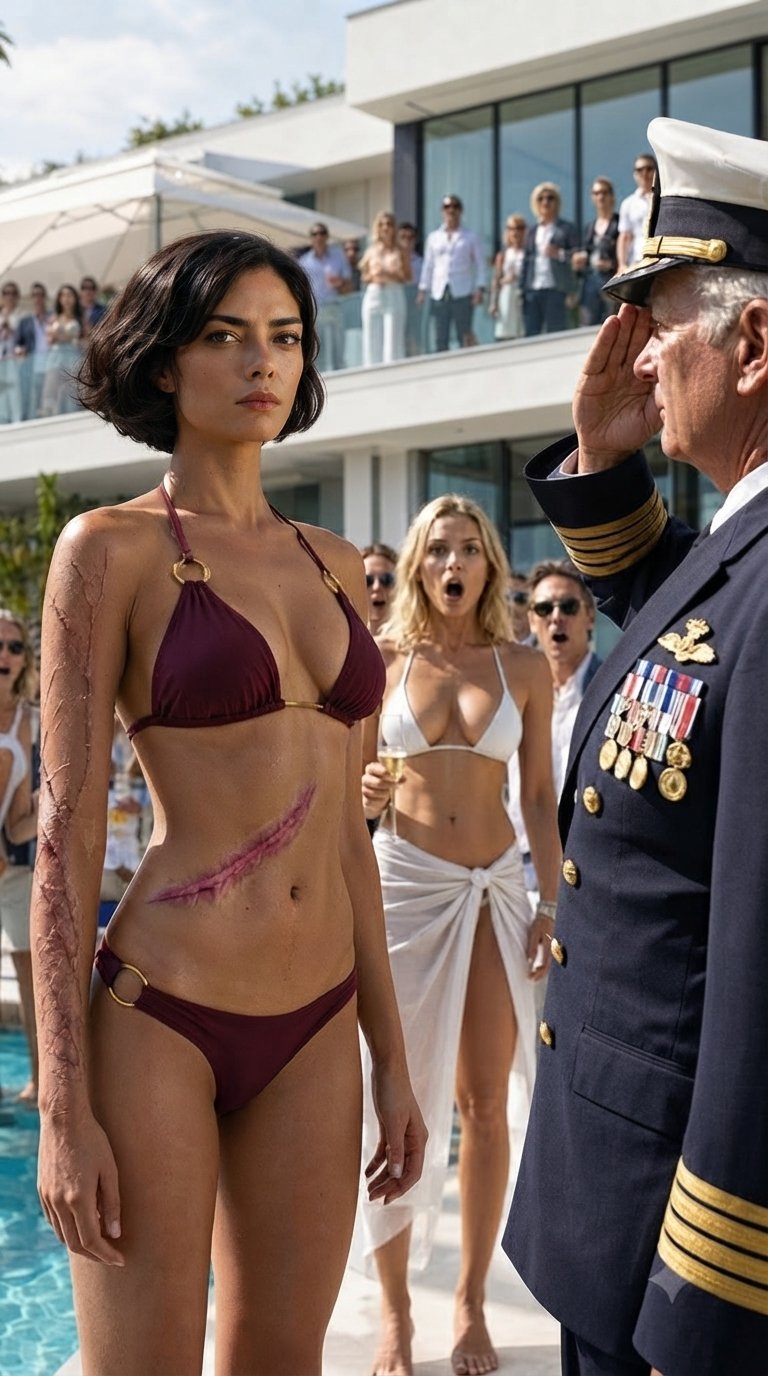
She never knew she had helped create a murder.
Her perfect world didn’t merely collapse.
It rearranged itself.
Ross looked at Hale.
“Congratulations.”
His eyes narrowed.
“You just acquired a murder charge.”
He said nothing.
She turned toward Victoria.
“And so may you.”
Victoria stopped fighting.
Stopped speaking.
Stopped performing.
She simply stared at the floor as police led her away.
The party ended at 11:43 p.m.
Not with fireworks.
Not with the celebrity DJ Victoria had flown in from Ibiza.
Not with the champagne toast printed in gold on every table.
It ended with evidence technicians photographing a torn dress.
Federal agents confiscating computers.
Detectives interviewing guests.
And catering staff quietly packing untouched lobster into refrigerated vans while wealthy people escaped through side doors hoping nobody had photographed them.
I found Julian alone on the beach.
His tuxedo jacket lay in the sand.
The ocean reached within inches of his shoes.
I walked toward him.
He didn’t turn.
“You should probably avoid getting saltwater on those.”
He laughed once.
Brokenly.
“Twenty-eight hundred dollars.”
“For shoes?”
“Victoria bought them during our marriage.”
“Then walk into the ocean.”
That got a real laugh.
Barely.
Then silence returned.
He turned.
His eyes landed on my scar.
I had used a shawl someone gave me to cover the torn dress.
Julian’s face folded.
“I’ve touched that scar a thousand times.”
I looked down.
“I know.”
“And every time I asked…”
“I told you I was shot at work.”
“You never said saving me.”
“I didn’t know it was you.”
He covered his face.
I waited.
Finally he whispered, “You almost died because of me.”
“No.”
His hands dropped.
“Evelyn—”
“Because of Hale. Because of Victoria. Because of corruption. Not because of you.”
“I gave the police information.”
“And you should have.”
“If I hadn’t—”
“Then people would have kept dying.”
He shook his head.
“I remember someone dragging me.”
My breath caught.
“I remember rain. I remember a woman shouting at me.”
I smiled faintly.
“I was probably swearing.”
“You were.”
“Sounds right.”
He stepped closer.
“I remember you telling me to stay awake.”
Something tightened behind my ribs.
“I told everyone that.”
“You said something else.”
“What?”
His eyes filled.
“You said, ‘If I have to stay here, so do you.’”
I remembered.
Barely.
He laughed through his tears.
“For years, I thought I invented that.”
“You were concussed.”
“You saved my life.”
I swallowed.
“Yes.”
Then he looked toward the pavilion.
“And six years later I married you.”
“Your taste improved.”
He laughed again.
Then suddenly he wrapped his arms around me.
Carefully.
As if the old injury might still break.
I held him.
For a long time, neither of us said anything.
Finally:
“Was our meeting really random?” he asked.
“Yes.”
“You’re sure?”
“I spilled coffee on you at a bookstore.”
“You accused me of standing too close to the counter.”
“You were blocking the napkins.”
“That doesn’t sound like fate.”
“It was aggressive logistics.”
He kissed my forehead.
Then he pulled back.
“There’s something I never told you.”
I stared.
“If tonight produces another federal conspiracy, I’m sleeping for a week.”
“No conspiracy.”
“That’s reassuring.”
“When I first saw you at that bookstore…”
“Yes?”
He hesitated.
“You felt familiar.”
My smile disappeared.
“I couldn’t place it.”
“Julian…”
“I heard your voice and something inside me just…”
He touched his chest.
“Stopped.”
The beach blurred.
Maybe bodies remembered things minds could not.
Maybe coincidence was simply the name we gave patterns too large to understand.
Or maybe it meant nothing.
At that moment, I didn’t care.
He kissed me.
Behind us, police lights pulsed blue across Victoria Sterling’s two-million-dollar pavilion.
The arrests dominated the news for months.
Sterling Enterprises lost billions in market value during the first week.
Charles Sterling was charged with bribery, money laundering, obstruction, and conspiracy.
Adrian Hale was indicted for the murder of Detective Thomas Keene, attempted murder, racketeering, and a list of federal offenses long enough to require two pages.
Victoria faced conspiracy charges tied to the ambush, evidence tampering, obstruction, illegal access to sealed files, and several financial offenses connected to the Sterling Foundation.
Her defense team initially tried to portray her as Hale’s manipulated victim.
Then prosecutors recovered twelve years of deleted messages.
That strategy died quickly.
She had known about bribery.
She had known about shell corporations.
She had authorized payoffs.
And during her divorce from Julian, she had repeatedly instructed investigators to locate Witness Seventeen because she wanted to know “what Julian told them.”
But the fake criminal records she created for me destroyed her most effectively.
Why?
Because the documents contained timestamps.
Metadata.
Internal case codes.
And one altered spreadsheet copied from a server her attorneys had spent years claiming never existed.
Victoria did not merely fail to frame me.
She authenticated the government’s evidence.
The screen she rolled out to humiliate me became Exhibit 117.
Her microphone speech became Exhibit 118.
Footage of her saying the server had been destroyed became Exhibit 119.
She had invited four hundred witnesses to her own obstruction case.
Including three federal judges.
Julian called that “aggressive self-sabotage.”
I called it efficient.
But none of it brought Tom Keene back.
Six months after the party, Chief Mercer invited me to a small ceremony.
Tom’s mother attended.
So did his sister.
A bronze plaque was unveiled in the precinct lobby.
DETECTIVE THOMAS KEENE
END OF WATCH — JUNE 14
HE SAW THE TRUTH AND REFUSED TO LOOK AWAY.
I stood in the back.
Tom’s mother found me afterward.
She touched my arm.
“I heard what happened at the party.”
I braced myself.
She smiled.
“Tom would have laughed his ass off.”
I laughed unexpectedly.
“He hated rich parties.”
“He hated shrimp.”
“He said shrimp looked like insects with marketing.”
Her eyes filled.
“That sounds like him.”
Then she looked toward my ribs.
“Did it hurt?”
“Yes.”
“I mean when she showed everyone.”
I understood.
I thought about Victoria’s hand ripping the silk.
The laughter.
The whispers.
The instinctive shame that had risen even though I knew I had nothing to be ashamed of.
“Yes,” I said.
Tom’s mother nodded.
Then she squeezed my hand.
“Good thing scars don’t belong to the people who caused them.”
I stared at her.
She walked away before I could answer.
I never forgot it.
One year after the party, Victoria Sterling was sentenced.
I did not attend.
Reporters seemed disappointed.
They wanted photographs of me staring her down.
They wanted poetic justice.
A triumphant victim in the gallery.
I had no interest.
I spent that morning eating pancakes with Julian.
At 10:17, Chief Mercer texted me.
Twenty-three years. Hale got life. Charles Sterling eighteen.
I stared at the message.
Julian watched me.
“Well?”
I handed him the phone.
He read it.
Then placed it face down.
“That’s it?”
“What else is there?”
“I thought you’d feel something.”
I considered the question.
Relief?
Yes.
Grief?
Always.
Victory?
Not really.
“I think I’m hungry.”
He smiled.
“That’s deeply profound.”
“Pass the syrup.”
He did.
And strangely, that ordinary morning felt more powerful than any courtroom could have.
Victoria had expected to become the central villain of my life.
Instead, she became something smaller.
A chapter.
A terrible one.
But a chapter nonetheless.
Three months later, a package arrived.
No return address.
Inside was a dress.
Emerald silk.
Almost identical to the one Victoria tore.
I immediately called Julian.
“Did you buy this?”
“No.”
“Your mother?”
“She thinks emerald is unlucky now.”
There was a note inside.
No signature.
Some things deserve to be seen whole.
I checked the label.
Custom.
Handmade.
Then I noticed something sewn inside the left seam.
A tiny name.
Marisol Vega.
I knew that name.
One of the waitresses from Victoria’s party.
The woman Hale knocked to the ground when he ran.
I found her online.
She owned a small alterations shop.
When I called, she laughed.
“You weren’t supposed to find me that quickly.”
“You stitched your name inside.”
“Oh.”
“Terrible criminal instincts.”
“That’s why I make dresses.”
I smiled.
“Why?”
She went quiet.
“My daughter saw the video.”
I waited.
“She has a surgical scar from here to here.”
I could hear fabric moving on the other end.
“She’s fourteen. She stopped swimming last year because girls at school asked questions.”
My throat tightened.
“After your party went viral, she asked me why everyone laughed at your scar.”
I closed my eyes.
“What did you tell her?”
“I said sometimes people laugh because they’re terrified someone else survived something they couldn’t imagine surviving.”
I sat down.
Marisol continued.
“Then she asked if you were embarrassed.”
“What did you say?”
“I said you looked angry.”
I laughed.
“Accurate.”
“She wore a bathing suit two weeks later.”
I couldn’t speak.
“So,” Marisol said, “I made you a dress.”
I ran my fingers over the silk.
“There’s one difference.”
“I noticed.”
The original dress had covered my scar.
This one didn’t.
The left side was deliberately cut lower.
Open.
Elegant.
Unhidden.
Marisol said softly:
“I thought maybe the scar deserved better lighting.”
That autumn, Chief Mercer retired.
His final ceremony was held outside headquarters.
Hundreds of officers attended.
So did Julian.
Mercer found me afterward.
“You ever think about coming back?”
“To police work?”
“You were good.”
“I got shot.”
“Technicality.”
“I have better health insurance now.”
“Coward.”
I smiled.
He handed me a small velvet box.
Inside was my old badge.
I stared at it.
“I thought this was departmental property.”
“It was.”
“Daniel.”
“Call the new chief.”
“You are the chief.”
“For another eleven minutes.”
I laughed.
Then he became serious.
“There’s something else.”
Apparently my life had trained me to fear those words.
He reached into his coat.
Another envelope.
Old evidence inventory.
My stomach tightened.
“Please tell me we’re done uncovering conspiracies.”
“This isn’t one.”
He handed it to me.
Inside was a photograph of the wrecked patrol vehicle.
I had seen plenty.
But never this angle.
The rear door was open.
Rain blurred the lens.
On the pavement lay my body.
Beside me, Julian.
And in the distance stood Tom.
Still alive.
Looking back toward us.
The timestamp showed the photograph had been taken less than thirty seconds before the second attack.
I stared.
“Who took this?”
“A traffic camera.”
“Why have I never seen it?”
“Classified with the witness file.”
I looked closer.
Tom’s arm was extended.
Pointing.
Not at Hale.
At something behind the vehicle.
A second person.
Barely visible.
A woman.
My breath stopped.
Blonde hair.
White coat.
“No.”
Mercer nodded.
“We enhanced it after Victoria’s arrest.”
My stomach turned.
Victoria had been there.
Not merely at home authorizing payments.
Not merely receiving updates.
There.
At the ambush.
“Why?”
“Prosecutors believe she followed Hale.”
“Did Hale know?”
“No.”
I looked again.
Victoria stood perhaps sixty yards away beneath an overpass.
Watching.
“She watched?”
“Yes.”
“Julian almost died.”
“Yes.”
“She was married to him.”
“Yes.”
I could barely process it.
Mercer continued.
“We think she wanted to make sure Hale frightened him enough to stop cooperating.”
“And when people started shooting?”
“She ran.”
I stared at the photograph.
The final cruelty.
Victoria had spent years insisting Julian belonged to her.
Yet when bullets tore into the vehicle carrying him, she had watched from a distance.
The woman who later accused me of stealing her husband had abandoned him in the rain while a stranger bled trying to save him.
Mercer watched my face.
“You okay?”
“Yes.”
“Sure?”
I handed the photograph back.
“Actually, I think I finally understand her.”
He raised an eyebrow.
“She didn’t love Julian.”
“What did she love?”
“Being chosen.”
Mercer considered that.
Then nodded.
“Maybe.”
I looked toward Julian across the plaza.
He was speaking to Tom’s mother.
Laughing about something.
Alive.
The man Hale had been hired to terrorize.
The man Victoria had watched bleeding from sixty yards away.
My husband.
I walked toward him.
Halfway there, Mercer called after me.
“Evelyn.”
I turned.
He raised his hand.
One last salute.
This time I returned it.
That evening Julian and I went home.
No gala.
No cameras.
No chandeliers.
We opened a bottle of cheap wine and ordered pizza.
The emerald dress hung upstairs.
Marisol’s version.
Scar uncovered.
Beautiful.
Julian sat beside me on the couch.
“Mercer told me about the photograph.”
I looked at him.
“Of course he did.”
“He has no concept of confidentiality in retirement.”
“Apparently not.”
Julian stared at his glass.
“She was there.”
“Yes.”
He nodded slowly.
“I spent years wondering when our marriage died.”
I waited.
“I thought maybe it was when I discovered the shell companies. Or when she realized I was talking to investigators.”
He looked toward me.
“But I think it died before that.”
“When?”
“When I started becoming someone she couldn’t control.”
I understood that better than he knew.
He took my hand.
“Do you know what the strangest part is?”
“What?”
“If she hadn’t done any of it…”
He gestured vaguely.
“The corruption. The ambush. Tonight—well, that night. All of it.”
“Yes?”
“I probably never would have met you.”
I shook my head immediately.
“No.”
“No?”
“We are absolutely not thanking Victoria for our marriage.”
He laughed.
“Fair.”
“We met because you blocked the napkins.”
“Still disputing that.”
“You were practically annexing the condiment station.”
“Revisionist history.”
I smiled.
Then his thumb brushed lightly over the scar beneath my shirt.
“You hate when I call it beautiful.”
“I do.”
“I’m going to say something worse.”
“Dangerous.”
“I’m grateful for it.”
I stared at him.
He continued before I could object.
“Not because you got hurt.”
His voice softened.
“Because it means you survived.”
That silenced me.
For years, whenever I looked at the scar, I saw the bullet.
The wreck.
Tom dying.
A career ending earlier than I wanted.
Pain.
Victoria had seen ugliness.
Marisol’s daughter saw courage.
Julian saw survival.
Maybe scars were mirrors.
They revealed more about the person staring than the person carrying them.
I leaned against him.
Outside, rain began tapping the windows.
Once, that sound pulled me instantly back to June 14.
That night, it didn’t.
It was just rain.
Six weeks later, we attended a charity fundraiser.
My first major event since Victoria’s party.
Marisol’s emerald dress fit perfectly.
The left side exposed the scar entirely.
When Julian saw me coming down the stairs, his mouth opened.
“Say anything stupid and I’m changing.”
“You look terrifying.”
“Good answer.”
At the fundraiser, people noticed.
Of course they did.
Some stared.
Some whispered.
One older woman approached and said quietly, “My husband was shot in Afghanistan. He still won’t take his shirt off at the beach.”
I told her about Marisol.
Another woman showed me a mastectomy scar hidden beneath her neckline.
A young man lifted his trouser leg to reveal burns from a house fire.
A senator I had once assumed was made entirely of polished granite told me he had a transplant scar from childhood.
By midnight, I had heard twenty-seven stories.
None of them were trash.
None of them were shameful.
Every scar meant something had happened.
Every person standing beside it meant something else had happened too.
They lived.
Julian and I walked outside after midnight.
The ocean was dark.
The air smelled like salt.
I thought of Victoria’s party.
The ripping silk.
Her laughter.
The giant screen.
The police chief forcing his way through the crowd.
The salute.
For a long time, I believed that was the moment everything changed.
It wasn’t.
The real change had happened one second earlier.
Before Mercer appeared.
Before anyone knew who I had been.
Before the truth saved my reputation.
Victoria had torn my dress.
Four hundred people stared.
And I had smiled.
Because for the first time in years, I understood something completely.
I did not need the room to know the truth in order for the truth to remain true.
Mercer’s salute had exposed Victoria.
The FBI had destroyed her lies.
The evidence had destroyed her empire.
But none of those things restored my dignity.
Victoria had never possessed it.
She could tear silk.
She could fabricate records.
She could buy journalists.
She could spend two million dollars building a stage.
She could invite four hundred powerful people to watch me fall.
But she could not humiliate a woman who had stopped accepting shame that didn’t belong to her.
Julian squeezed my hand.
“Ready to go?”
I looked once more toward the ocean.
Six years earlier, a bullet entered my ribs because a corrupt man needed silence and a frightened woman wanted control.
One year earlier, that frightened woman ripped open my dress because she believed the scar would prove I was beneath her.
Instead, the scar connected everything.
The ambush.
The murdered detective.
The hidden witness.
The offshore money.
The encrypted files.
The husband she had tried to frighten into obedience.
The officer who unknowingly saved him.
The woman he later married.
Victoria believed she was exposing the ugliest chapter of my life.
She had actually exposed the first page of her own indictment.
I smiled.
“Yes.”
Julian and I walked away from the lights.
And behind us, reflected faintly in the glass doors, I caught one last glimpse of myself in the emerald dress.
The scar was completely visible.
I did not cover it.
Not then.
Not ever again.