“I was trying to keep the peace.”
“No. You were trying to keep control.”
He looked toward Aurora.
“Ava needed stability after the divorce. Aurora was already comfortable with everyone. I didn’t want things to become awkward.”
Aurora immediately stepped forward.
“Do not blame this on Ava or me.”
Nathan turned toward her.
“Aurora—”
“No. You told me Claire wanted distance. If I had known you were deliberately excluding Sophie and Caleb, I never would have accepted this.”
I squeezed Sophie’s hand.
“Ava deserved stability. But Sophie and Caleb deserved grandparents too.”
Nathan rubbed his forehead.
“I didn’t know how to fix it once it started.”
“You knew exactly how. Tell the truth.”
Thomas looked directly at his son.
“Were Claire and the children ever actually invited?”
Nathan looked at his father, then at me, then down at the table.
He said nothing.
His silence answered everything.
Sophie stepped forward.
“When I was little, I thought Grandma didn’t like me.”
Nathan’s face crumpled.
“Sophie, sweetheart—”
“Then I got older, and I started wondering if maybe you didn’t like me either.”
He reached toward her, but she stepped back.
“Did you know I stopped asking to come because I couldn’t stand hearing no anymore?”
“I love you.”
Caleb pressed against my side.
“Mom, can we go home?”
“Yes.”
Nathan panicked.
“Claire, wait. We need to talk.”
“We have talked. For years. You just called it nagging whenever I asked questions you didn’t want to answer.”
Linda looked at her son.
“You’re not staying here tonight.”
“I’m your son.”
“And those are my grandchildren. All of them.”
Thomas nodded.
“From now on, if we want to see Sophie and Caleb, we call Claire directly.”
Aurora took Ava’s hand.
“We’re leaving too.”
Ava looked at Sophie.
“I thought you didn’t want to know me.”
Sophie swallowed.
“I thought you were the reason Dad didn’t want us here.”
“I didn’t know.”
“I know.”
Sophie placed the old pink shovel on the floor beside her.
It wasn’t forgiveness.
But for the first time, it was the truth.
—
PART 3
Nathan followed us onto the porch.
“Claire, please don’t do this.”
I opened Caleb’s car door.
“I didn’t do this.”
“You’re destroying our family.”
I turned toward him.
“No, Nathan. You damaged it every summer you packed a suitcase and drove away while our children watched. I’m simply finished pretending it was still whole.”
The following morning, I contacted a family lawyer. I asked about separation, custody, support, our home, and the accounts. For the first time in years, I made decisions without wondering how uncomfortable they might make Nathan.
By the end of the week, he was living somewhere else.
Linda began calling regularly, but she didn’t demand forgiveness or force herself into the children’s lives. Caleb occasionally answered. Sophie needed more time, and Linda respected that.
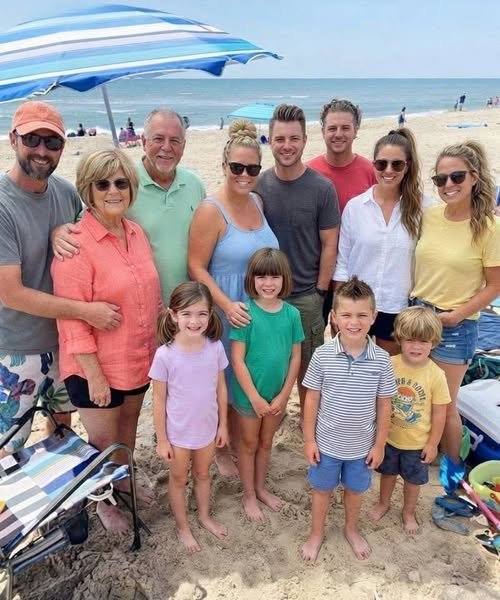
A month later, Linda and Thomas arrived at my house carrying three neatly folded blue shirts—the same style everyone had worn in the beach photograph.
Linda placed them on the table.
“I don’t expect any of you to wear these. I only wanted you to know there were always supposed to be enough.”
Sophie unfolded one.
“You brought one for Mom too?”
Linda’s eyes filled with tears.
“Your mother should have been in those pictures from the beginning.”
Caleb appeared from the living room.
“Are we taking a picture now?”
I looked at both my children.
“Only if everybody wants to.”
Sophie gathered the shirts.
“Backyard.”
A few minutes later, Thomas held up my phone while I stood between Sophie and Caleb. Linda stood beside us. For once, I wasn’t behind the camera taking a photograph of everyone else.
We weren’t at the beach. There was no huge blue umbrella or carefully coordinated vacation backdrop. We were simply standing together in my backyard.
But for the first time in eleven summers, my children weren’t staring at another family through a phone screen and wondering why they had been excluded.
They were finally inside the picture.
The hardest truth wasn’t that Nathan had lied about a vacation. It was that he had spent years separating people who might have loved one another if he had simply allowed them to speak directly. He told me his parents didn’t want us. He told his parents I wanted distance. He told Aurora that I was uncomfortable with her. And he allowed three children to grow up believing the rejection was somehow their fault.
Once we finally spoke to each other, his entire story collapsed in a single day.
Sophie never asked for another beach vacation. What she had wanted all those years wasn’t sand, matching shirts, or a place under an umbrella.
She wanted to know she belonged.
Caleb wanted the same thing, even though he had learned to hide it behind shrugs and the words, “I don’t care.”
And I had wanted peace so badly that I had mistaken silence for it.
I know better now.
Peace built on lies isn’t peace. Protecting someone from accountability isn’t protecting a family. And sometimes the kindest thing you can do for your children is stop accepting explanations that teach them their hurt doesn’t matter.
Nathan had spent eleven summers telling us where we belonged.
That summer, my children and I finally decided for ourselves.