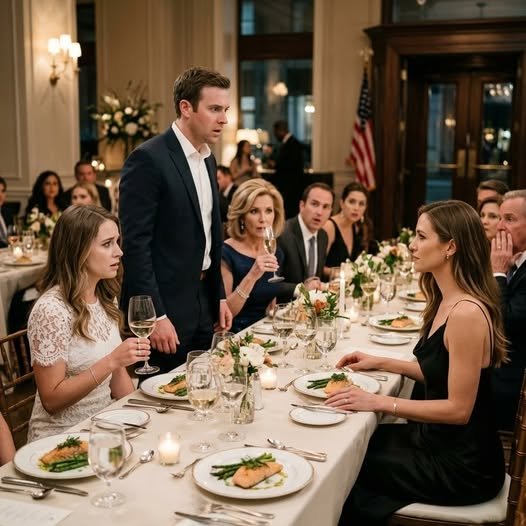
I let the silence hang, then replied, “You humiliated me for years, Rachel. I just let the truth sit down at the table.”
She scoffed.
“Daniel’s barely spoken to me since. He keeps asking questions about what we’ve said, about what we didn’t say about you.”
“Maybe try telling the truth for once. See how that feels.”
“You’re not better than me, Olivia.”
“I didn’t say I was.”
“Then why do you sound like it?”
Click.
She hung up.
But that wasn’t the last I heard from her or from anyone else.
2 days later, my mother showed up outside my office building.
I didn’t even know she remembered where I worked.
She looked out of place, too polished, too desperate, standing in a world she never believed I belonged in.
I watched her through the tinted glass of the lobby for five full minutes before I decided to meet her.
She stood when she saw me, eyes tired, voice soft.
“Olivia, can we talk?”
“Say what you came to say.”
“Rachel’s engagement is on the rocks. Daniel’s confused, hurt. We told him things that weren’t entirely accurate.”
“You told the world I was a failure.”
“We were just trying to protect her image. You’ve always been so private. People filled in the blanks.”
“No, you handed them the pen.”
She looked away, then back.
“Can you talk to him? Just explain. He respects you now.”
I almost laughed.
“You want me to fix Rachel’s engagement?”
Her silence was answer enough.
I took a step closer.
“You erased me for years. Turned me into a cautionary tale. Now you want me to play savior.”
“We made mistakes.”
“No, you made choices.”
“Then let me make another,” she said quickly. “Let’s fix this as a family.”
I stepped back.
“That’s not a family. That’s damage control.”
I turned and walked away.
I didn’t look back.
That night, Rachel’s Instagram account went dark.
By morning, the engagement photos were gone.
No announcement, no explanation, just silence.
People whispered. Friends gossiped.
Her perfect image cracked in the most public way possible.
And me, I went back to work.
I signed three more licensing deals.
I hired a marketing strategist and told her to make my name known, not for revenge, but for visibility.
I was tired of being the girl they used in their fiction.
I was ready to be the woman they couldn’t deny.
In one interview, a tech journalist asked, “You’ve stayed private for so long. What made you finally speak out?”
I looked into the camera and said, “Sometimes the truth needs no defense. It just needs a platform.”
They tried to bury me in shame, but they forgot.
I was the seed.
A month after the engagement collapsed, I received an anonymous envelope at my office.
Inside was a handwritten note.
“He left. Said he couldn’t marry into a family built on lies. You win, Rachel.”
I folded the paper once, then again, and dropped it into the shredder without a second thought.
It wasn’t about winning.
It was about building.
And I was just getting started.
Oh, Reed Innovations exploded into the global market after my name went public.
The same firms that ignored my pitches 2 years ago now lined up to invest.
Suddenly, the girl with no blazer was the keynote speaker at cyber security summits.
But it wasn’t just about me anymore.
I remembered every time someone like me was dismissed, too quiet, too odd, too cold.
So I created a fund, the Legacy Code Initiative.
We mentored young women in tech from underrepresented communities.
Paid internships, travel stipens, laptops, mentorship, everything I never got, handed out like gold.
I hired women who’d been told, “You don’t look like a CTO.”
Women whose resumes were stronger than their voices because no one ever listened.
One of them, a brilliant Nigerian developer named Ioma, built a fireproof identity layer on our existing architecture.
It made the news.
When asked who inspired her, she said, “Olivia Reed taught me to code past the noise, to let my silence do the talking until the world was ready to listen.”
I sat in my car and cried when I read that.
Not because I was sad, but because for the first time I felt like the ashes were blooming into something real.
Then came the doer’s request.
A producer from Netflix called.
They were developing a feature anonymous.
The women behind the firewalls.
I said yes on one condition, that my story wasn’t just about revenge.
It had to be about rebirth.
We filmed in my first apartment. The cafe where I pitched my company, even the old house, now sold with a fresh coat of paint and no trace of my childhood inside.
I stood outside it for the final scene.
The wind caught my curls and I said, “They left me out of the picture. So, I built the frame and now I don’t need them to see me. The world already does.”
The episode aired 2 months later.
It went viral in under 24 hours.
My inbox flooded with messages, some from strangers, others from ghosts, including my father.
He wrote a threeline email.
“I watched the show. I was wrong. We all were. You deserved better. I hope you found peace.”
I didn’t reply.
Forgiveness isn’t always loud.
Sometimes it’s the quiet choice not to engage.
Rachel.
She went silent, deleted social media, moved cities.
But people don’t forget the girl they once mocked, especially when she becomes the name on their firewalls credits.
And me, I… I kept building.
Not out of spite, but because when people burn your foundation, you don’t rebuild the house.
You design the skyline.
The keynote was at a global leadership conference in Geneva, an arena filled with world leaders, innovators, press, and dreamers.
I stood backstage, my hands calm.
No index cards, no speech, just a name badge.
Olivia Reed, founder, architect, survivor.
The announcer called my name and I stepped into the lights.
A woman once erased now filled a stage she built herself.
I spoke about technology, about ethics, about vision, but mostly I spoke about truth.
“I was told I failed,” I said. “But I didn’t fail. I grew in the dark. Where no one could interrupt.”
They didn’t know it, but I was talking about them.
My family.
Every table where I sat unseen.
Every whisper that shaped my silence.
“We don’t always get the family we deserve. But we always have the choice to become the future someone else needs.”
Applause thundered.
I smiled.
But not for them.
For the girl I used to be.
The girl they laughed at, the one who held on to dignity when all they gave her was doubt.
Later that night, I took a walk through the city.
No bodyguards, no fans, just me and my name.
I passed a news stand with a magazine cover featuring me midspech.
The headline read, “Olivia Reed, the woman who coded her way out of silence.”
I picked up a copy.
I didn’t need it, but something about holding it in my hands felt full circle.
When I got back to my hotel, there was one last surprise.
An envelope slipped under the door.
No return address, no handwriting.
Inside, just a photo, old and curling at the edges.
It was me at 15, standing awkwardly at one of Rachel’s birthday parties, holding her cake while she posed.
My mother’s hand on Rachel’s shoulder.
No one looking at me.
On the back, written in perfect cursive:
“I see you now. I’m sorry, Mom.”
I sat down on the edge of the bed, the photo trembling in my hand.
For a moment, I let the ache rise, not because I wanted her apology, but because I’d spent so long needing it.
I placed the photo back in the envelope and slid it into the drawer.
Then I picked up my laptop, opened a doc, typed the title of my next initiative, the Read Legacy Fund for girls who are ignored, fully funded, open worldwide, accepting dreams no one else wanted to hear because that’s the legacy I chose.
Not a spotlight, not revenge, but quiet justice paid forward in opportunity and dignity.
I closed the laptop, stood, and whispered to no one, but maybe to that girl in the photo.
“We didn’t just survive. We redefined the story.”
Outside the window, the lights of Geneva shimmerred like code waiting to be written.
And this time it was my name on every…