
PART 4 — The Evidence Hidden in Her Homework
Ms. Porter asked whether Emma had difficulty finding a quiet place to complete her oral-reading homework while staying at Daniel’s house.
I forced myself to keep my voice neutral.
“Why do you ask?”
“Some assignments arrive very late,” she explained. “And the background sounds unusual.”
The school used an application that recorded every child reading aloud. The files uploaded automatically so teachers could check fluency and pronunciation.
Ms. Porter could not discuss all the details without following district procedures, but she told me one recording had ended after a loud metallic sound.
I asked the question that changed the entire case.
“Are the original recordings stored on the tablet?”
“No,” she answered. “They are stored on the district server.”
I did not call Daniel.
I did not send Lauren an angry message.
Instead, I called Mara, my attorney.
She told me not to write or say anything that might warn them.
Mara sent a formal preservation request to the district and asked the court to authorize the release of Emma’s activity logs.
Then we compared the school records with my custody calendar.
The first match occurred at 10:43 on a Saturday night.
My journal entry from the following morning read:
Emma returned without her sweater. Refused to enter the storage room. Asked whether police could arrest a mother for lying.
A second assignment had been uploaded two weeks later at 9:58 p.m.
My journal entry from the next day read:
Emma cried when the telephone rang. Said she did not want Dad to know she missed me.
There were six matches in total.
Six recordings.
Six late-night uploads.
Six weekends at Daniel’s house.
I had still not heard the complete files. The school district would not casually release a child’s records, and Mara wanted the recordings introduced by someone who could officially authenticate them.
That was why Ms. Porter came to court carrying the sealed envelope.
Daniel believed my folder contained the same collection of fears and observations he had mocked for a year.
He did not know that certified timestamps were sitting beside them.
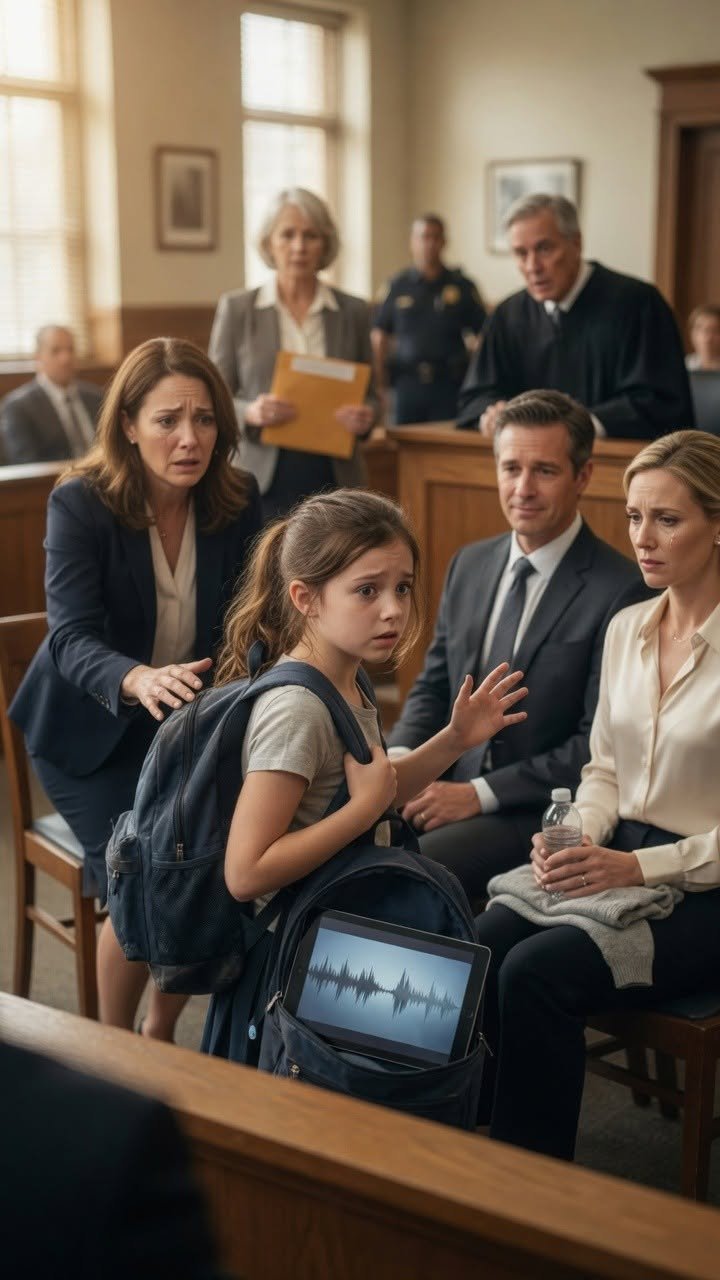
Back in the courtroom, Ms. Porter identified each assignment.
The clerk displayed the list on a monitor.
Six files.
Six late-night uploads.
Six weekends during Daniel’s parenting time.
My custody journal lay open beside the certified activity report.
Daniel’s attorney objected to the comparison.
Mara did not argue.
She simply pointed to Daniel’s sworn statement from the previous month.
“My daughter has never been confined in the garage or left there alone,” Daniel had written.
The judge read the sentence twice.
Then she ordered the clerk to play the next excerpt.
Emma’s recorded voice asked, “Can I get my sweater?”
Lauren answered.
“You know the rule. You can come inside when you speak respectfully about this family.”
“I only asked to call Mom.”
“You already have a mother here.”
Emma inhaled sharply beside me.
I turned toward her, but she was staring at Lauren.
Lauren began to cry.
They were not the quiet tears of someone hearing a child’s suffering.
They were frightened tears.
“I never locked her anywhere,” Lauren said. “Daniel handled the discipline. I was only trying to support my husband.”
The judge looked directly at her.
“You will speak through your attorney.”
The third recording began.
There was no door slamming this time.
Instead, it captured Lauren taking Emma’s telephone.
“You don’t need to call Rebecca every time you’re upset.”
“She said I can call whenever I want.”
“Your mother says many things that make your father look bad.”
Then Daniel’s voice entered from farther away.
“If she keeps making accusations, the judge can take her away from you. Do you understand?”
Emma’s recorded voice became very small.
“Take Mom away?”
“If you keep giving her stories.”
At that moment, I finally understood why my daughter had stopped speaking.
It was not because she did not trust me.
Daniel had convinced her that telling the truth would make me disappear.
My vision blurred, but I kept my shoulders straight.
Daniel watched me, possibly waiting for an emotional outburst he could use against me.
I gave him nothing.
Mara placed one hand on my open journal.
“Mrs. Shaw wrote this the morning after the recording,” she said.
She read a single line aloud.
Emma asked whether telling the truth could make a mother go to jail.
Dr. Keller raised her hand.
“Your Honor, I need to clarify something.”
The judge allowed her to speak.
Dr. Keller admitted that Emma had used nearly identical language during their private interview.
At the time, she believed the words showed fear created by conflict between Emma’s parents.
She had not known Daniel had personally threatened her with losing her mother.
“Were you completely alone with Emma during the interview?” Mara asked.
Dr. Keller hesitated.
“Lauren was in the adjoining room. The door was partially open.”
Lauren’s face lost all color.
Then the court played the final recording.
PART 5 — Their Own Voices Exposed Them
The final recording had been made the night before Dr. Keller’s visit.
Lauren’s voice sounded gentle.
“We’re going to practice what you tell Dr. Keller tomorrow.”
Emma said she did not want to lie.
“It isn’t lying,” Lauren replied. “It’s helping everyone understand.”
“What do I say?”
“Say your mother asks questions until you give her the answer she wants.”
Daniel’s voice came from the background.
“And tell her your mother taught you to be afraid of the garage.”
“But I am afraid of the garage,” Emma answered.
A long silence followed.
Then Daniel said, “You can sleep in your bedroom when you get this right.”
No one needed Mara to explain what the recording proved.
Daniel had repeatedly accused me of coaching Emma.
But the evidence showed that Daniel and Lauren had done exactly that.
They had created my daughter’s fear.
They had trained her to deny it.
Then they used her denial to build a custody case against me.
Daniel tried to stand once more.
“This is a family misunderstanding being turned into a criminal accusation.”
The judge looked directly at him.
“You swore under penalty of perjury that none of these incidents occurred.”
Daniel opened his mouth.
Nothing came out.
The man who had entered the courtroom asking the judge to restrict my access to Emma now sat silently while his own words became part of the official record.
Before the hearing ended, the judge issued a temporary emergency order.
Emma would remain with me.
Daniel would have no unsupervised contact with her while the investigation continued.
Neither Daniel nor Lauren could communicate with Emma except through arrangements approved by the child advocate.
The school district was ordered to preserve every original audio file and device record.
Child protective services received an immediate referral.
Dr. Keller’s recommendation was suspended until an independent evaluation could be completed.
Daniel was not dragged away in handcuffs.
Real consequences rarely arrive as perfectly as they do in movies.
But as we left the courtroom, the bailiff stood between Daniel and Emma.
For Daniel, that physical boundary was the first consequence he could not explain, charm or argue away.
The investigation lasted four months.
School district technicians authenticated every recording. They confirmed that the files had been uploaded from Emma’s tablet during Daniel’s parenting time.
Child protective services inspected the detached garage workshop.
Inside was a small storage room.
The interior latch had been removed during a renovation. There was no heating vent, no bathroom and no safe way for a child to escape once the exterior deadbolt had been locked.
Lauren eventually admitted that she knew Daniel used the room as punishment.
She claimed she had been afraid to oppose him.
That might have explained her silence.
It did not excuse her voice on the recordings.
Dr. Keller amended her report and acknowledged that the original custody evaluation had been compromised.
She recommended that Daniel receive no unsupervised contact until he completed a full risk assessment and Emma’s therapist believed visits could occur safely.
At the final custody hearing, Daniel’s attorney no longer described my journal as obsessive.
The judge called it consistent documentation.
Daniel lost his request for primary custody.
His visits became supervised and depended on his compliance with treatment.
The district attorney separately reviewed the confinement and Daniel’s false sworn statements.
Lauren moved out before that investigation ended, but the court still prohibited her from contacting Emma without approval.
When the judge signed the final custody order, I did not feel victorious.
I only felt tired.
Justice could not return the nights Emma had spent reading inside a cold room, hoping someone might hear her.
It could not erase the belief that loving her mother could be punished.
But it gave us a safe place to begin healing.
PART 6 — FINAL: “I Heard Every Word”
On the first night after the emergency hearing, Emma entered my apartment without removing her backpack.
She ate half a bowl of tomato soup while it remained strapped to her shoulders.
At bedtime, she stood in the hallway.
“Do I have to go back tomorrow?” she asked.
“No.”
“What about next week?”
“Not unless the court decides it is safe,” I assured her. “And no one is taking you anywhere tonight.”
Emma studied my face carefully, checking for the part adults sometimes left unspoken.
Then she walked into her bedroom.
A few minutes later, I heard the zipper of her backpack opening.
She removed her reading book and placed it on the desk.
Then her sweater.
Her toothbrush.
Finally, she pulled out a small stuffed rabbit I had not seen in months.
One object at a time, my daughter unpacked.
When the backpack was empty, she placed it on the chair.
“Can the door stay open?” she asked.
“As wide as you want.”
Emma climbed into bed and opened the school reading application.
That night’s assignment was a story about a girl finding her way home.
She began reading.
Her voice was shaky at first.
Then it slowly became steadier.
The tablet recorded the quiet hum of the heater, the turning of a page and the sound of my footsteps stopping outside her open bedroom door.
There was no deadbolt.
No heavy metal door.
No cold garage.
No one telling her that she had to earn the right to come inside.
When Emma reached the end of the paragraph, she looked up at me.
“Did you hear me?”
I smiled.
“I heard every word.”
She smiled back—small, tired and finally safe.
Then she closed her eyes beneath the warm blanket while the bedroom door remained wide open.
For the first time in months, my daughter fell asleep without her backpack on her shoulders.