
The Fallout Happened Quickly
The European cruise was canceled.
Not by me.
By Eric.
He was able to recover much of the money.
The expensive ring was returned too.
A few days later, Patricia called me.
I expected anger.
Instead, she sounded humiliated.
“Carol, I didn’t know.”
“I know.”
“She told me she received a large work bonus.”
“I know.”
There was a long silence.
Then Patricia said:
“I don’t need a twenty-thousand-dollar ring.”
“I didn’t think you did.”
Then she surprised me.
“She spends a lot of energy trying to impress me.”
“Yes.”
“I wish she understood that I was already impressed she was raising Emma while working.”
That conversation changed my opinion of Patricia.
Rachel had spent thousands of dollars buying approval from a woman who had never demanded it.
Meanwhile, she treated my support like a household utility.
Like electricity.
Something that would always be there.
Until one day, the switch was turned off.
Rachel and Eric entered marriage counseling.
Their financial situation was worse than I realized.
Credit-card debt.
A home-equity line.
Car debt.
Personal loans.
Nothing impossible to recover from.
But enough that without my regular financial help, their lifestyle had to change.
Emma moved to a good public school the following year.
They sold one car.
They stopped taking expensive vacations.
They canceled memberships.
Rachel found a better-paying job.
And every month, I received a repayment through my attorney.
At first, $750.
Then $1,000 after Rachel received a raise.
It took almost two years for her to repay the money taken from the property account.
The credit-card charges were more complicated because I had legally authorized her to use the card.
I chose not to pursue every dollar.
But that choice was mine.
Not hers.
That distinction mattered.
For almost six months, Rachel barely spoke to me.
My granddaughter Emma still visited.
Usually, Eric brought her.
I never discussed Rachel’s financial problems with Emma.
Children should not have to carry adult consequences.
Six Months Later, Rachel Came Back
One Saturday morning, Rachel showed up at my house alone.
No expensive purse.
No dramatic speech.
She was holding something behind her back.
“Can I come in?”
I let her inside.
We sat in my kitchen.
For a while, neither of us spoke.
Then she placed something on the table.
The plastic flower.
I stared at it.
“You kept it?”
“I found it in a drawer when I was cleaning.”
She swallowed.
“I remember buying it.”
I waited.
“I stopped at the pharmacy on the way to brunch.”
That hurt, even though I had already suspected it.
“I had spent weeks planning Patricia’s gift,” she continued.
“I know.”
“I bought yours while Eric was getting gas.”
I looked away.
Rachel began crying.
“I kept telling myself you wouldn’t care.”
“I cared.”
“I know.”
She wiped her face.
“I think that’s what I counted on.”
That was the first truly honest thing she had said about the flower.
Then she reached into her bag.
Not for another gift.
For papers.
She placed a printed spreadsheet on the table.
It listed every payment from me she had been able to reconstruct.
Wedding.
House.
Tuition.
Repairs.
Emergency transfers.
Credit-card charges.
Everything.
At the bottom was a number.
$143,782.
I stared at it.
“Is that accurate?”
“Probably not.”
My stomach tightened.
She gave me a sad smile.
“It’s probably low.”
For years, I had been so careful with my finances and so careless with my generosity.
Rachel looked at me.
“I don’t think I understood what I was doing because you never said no.”
I shook my head.
“Don’t make that my responsibility.”
“I know.”
She nodded quickly.
“That’s not what I mean.”
Then she took a breath.
“You made helping me look easy, so I started treating it like it cost you nothing.”
That sentence landed differently.
Not as an excuse.
As an explanation.
“I thought because you had money, asking didn’t hurt you.”
“It wasn’t the money that hurt the most.”
“The flower?”
“No.”
She looked confused.
“The assumption.”
“What assumption?”
“That I would accept anything from you because I’m your mother.”
Her eyes filled again.
“You were right.”
“About what?”
“I thought you’d always be there no matter how little I gave back.”
I nodded.
“I probably will always love you.”
She looked at me.
“But those are different things.”
Love and access are not the same thing.
It took me sixty-one years to learn that.
The Following Mother’s Day
Rachel didn’t buy me jewelry.
She didn’t buy me a cruise.
She didn’t buy me a designer handbag.
She came to my house at nine in the morning carrying grocery bags.
“What are these?” I asked.
“Breakfast.”
“I can cook.”
“I know.”
She made pancakes.
She burned the first batch.
Emma laughed at her.
After breakfast, Rachel handed me an envelope.
Inside wasn’t money.
It was a letter.
Three pages long.
She thanked me for things I had almost forgotten.
Driving three hours to her college when she had pneumonia.
Sitting beside her after her first serious boyfriend broke her heart.
Taking night shifts with newborn Emma so Rachel could sleep.
Helping her prepare for job interviews.
Paying bills too, yes.
But mostly, she thanked me for showing up.
Near the end of the letter, she wrote:
I spent years confusing the fact that you would always help me with the idea that you existed to help me. I’m sorry.
I read that sentence twice.
Then I folded the letter.
Rachel looked nervous.
“Do you like it?”
“Yes.”
“More than the flower?”
I laughed.
“Marginally.”
She laughed too.
I Still Have the Plastic Flower
People assume I threw it away.
I didn’t.
It sits in a small vase on my desk beside Thomas’s photograph.
Not because it was a beautiful Mother’s Day gift.
But because it became one of the most valuable things my daughter ever gave me.
It cost $1.99.
But that plastic flower made me open my financial records.
It helped me discover almost one hundred thousand dollars I had stopped noticing.
It exposed nearly eighteen thousand dollars that should never have been redirected from my commercial property.
It forced Rachel to confront the lifestyle she had been financing with my silence.
And it forced me to understand something important too.
Being generous does not mean making yourself available for exploitation.
Being someone’s mother does not mean becoming their permanent emergency fund.
And love does not become more genuine simply because money is attached to it.
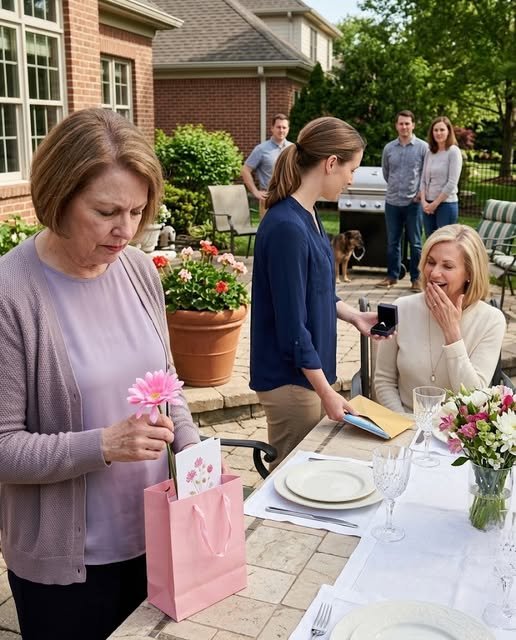
That Mother’s Day, Rachel gave Patricia a ring worth nearly twenty thousand dollars and a European cruise.
Then she handed me a plastic flower and said:
“Thanks for everything, Mom.”
At the time, those words felt insulting.
Years later, I realized they were accidentally the most honest words she could have chosen.
Because I really had given her everything.
Too often without questions.
Too often without limits.
Too often without noticing what it was costing me.
The plastic flower didn’t teach my daughter to appreciate me.
Consequences eventually did that.
The flower taught me something more important first:
I could love my daughter deeply without continuing to pay for the privilege.