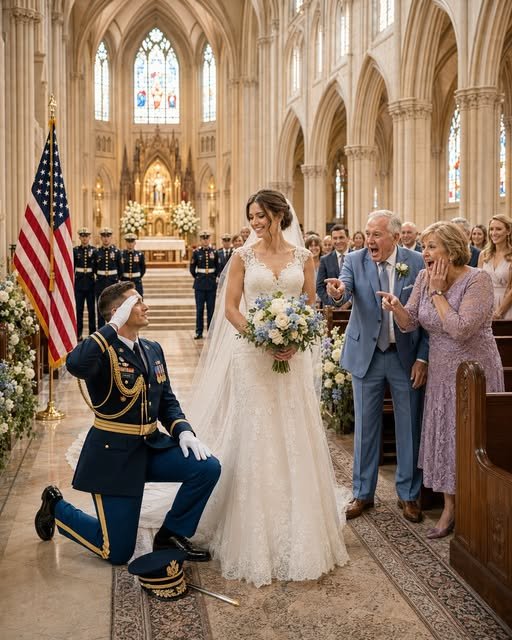
Thirty veterans stood in formal uniforms because the man I loved had once stood beside them when doing so brought him no reward.
Our friends and relatives waited.
The flowers were still beautiful.
The candles were still burning.
The cake was sitting somewhere in the reception hall.
But the wedding I had imagined no longer existed.
I looked at the minister.
“Could everyone give us a few minutes?”
The guests slowly began leaving.
The veterans filed out with them.
Marcus was last.
As he passed me, he paused.
“Whatever you decide about Ethan, decide it because of who he is with you. Not because of what we think he is.”
Then he walked away.
Soon only Ethan and I remained.
I sat in the front pew.
After a moment, he sat on the opposite end.
For nearly a minute neither of us spoke.
Finally, I asked, “When did this start?”
“Six months ago.”
“The same time Dad started pushing me to cancel the wedding.”
“Yes.”
I looked at him.
“You think he knew?”
“I think he became suspicious that someone was looking into Valor Trust.”
“Did he know it was you?”
“Probably not at first.”
I remembered dinners when Dad suddenly began asking Ethan strange questions about his cases.
Whether attorney-client privilege could be overridden.
Whether prosecutors could subpoena charity records.
Whether anonymous complaints really stayed anonymous.
I had thought Dad was trying to intimidate him.
Maybe he had been fishing for information.
“Why didn’t you withdraw from the investigation?”
Ethan stared at the floor.
“Because then people like Luis would still have no answers.”
“And me?”
“That was the part I couldn’t solve.”
I laughed bitterly.
“So you chose them.”
He looked at me.
“No.”
“It feels like you did.”
“I chose the evidence.”
“That’s almost worse.”
“I know.”
I studied him.
“What would you have done if I had been involved?”
His answer came immediately.
“I would have told investigators whatever the evidence required.”
Pain shot through me.
He saw it.
“But I would still have loved you.”
“That’s supposed to make me feel better?”
“No. It’s supposed to be the truth.”
I looked away.
My father would have lied.
He would have protected me if protecting me benefited him.
Ethan was telling me he would have let me face consequences if I were guilty.
At that moment, strangely, that was how I knew he respected me more than my father ever had.
I stood.
Ethan stood too.
“I can’t marry you today.”
His face tightened, but he nodded.
“I understand.”
“I’m too angry.”
“You should be.”
“I might stay angry for a while.”
“I understand.”
“And if we stay together, you don’t decide what truth I can handle ever again.”
“I won’t.”
“I mean it.”
“So do I.”
I looked toward the altar.
“This wedding is postponed.”
He nodded.
Then I looked at him.
“But I’m not ending us.”
His eyes closed.
His shoulders shook once as he exhaled.
I walked out of the chapel without a husband.
But Ethan walked beside me.
Not ahead of me.
Not behind me.
Beside me.
The next six months changed everything.
Federal agents searched Dad’s dealerships, his office, our family home, two storage units, and a vacation property outside Hilton Head.
They found years of records.
The numbers were worse than anyone expected.
Valor Trust had raised more than nine million dollars over fourteen years.
More than three million had been diverted through consulting agreements, fabricated service contracts, inflated invoices, and companies connected directly or indirectly to my father.
Some money paid legitimate expenses.
Just enough to make the charity look real.
But hundreds of veterans had received less assistance than Valor Trust publicly claimed.
Dad hired three defense attorneys.
He told reporters he was the victim of a politically motivated investigation.
Then he blamed a former accountant.
Then he blamed Ethan.
Then he blamed Caleb.
Finally, he blamed me.
That one hurt.
His attorneys suggested I had been actively involved in several corporate entities.
For forty-eight terrifying hours, television stations showed my photograph beside headlines mentioning charity fraud.
I received hateful messages from strangers.
Parents at my school whispered.
One morning, someone left a note on my windshield calling me a thief.
I sat in my car and cried until I couldn’t breathe.
Ethan did not tell me everything would be fine.
He knew better.
He simply sat beside me.
When I finished crying, he asked, “What do you need?”
“Coffee.”
He got coffee.
“And maybe a lawyer.”
He nodded.
“A lawyer who isn’t you.”
Despite everything, I laughed.
“Definitely not me,” he said.
My attorney, Rebecca Shaw, was relentless.
Within weeks, forensic analysis confirmed that several signatures had been copied from documents I signed years earlier.
Metadata from Dad’s office computers showed employees had created files using my personal information.
Emails revealed instructions from Dad.
One message read:
Use M.W. as manager. She won’t notice and it creates distance.
I read that sentence fifteen times.
She won’t notice.
That was my father’s opinion of me.
Not trustworthy.
Not beloved.
Useful.
Ignorant.
Disposable.
I printed the email.
Then I put it in a drawer.
Not because I needed evidence.
Because whenever I started missing the father I thought I had, I needed to remember the man he chose to be.
Mom filed for divorce three months after the wedding that never happened.
She moved into a small townhouse.
For the first time in forty years, she opened a bank account in only her name.
The first evening I visited, she stood in the kitchen holding a crooked chocolate cake.
“I baked this myself.”
I looked at the lopsided frosting.
“You’ve baked before.”
“No.”
I blinked.
She smiled sadly.
“Your father always hired people for parties. He said homemade things looked cheap.”
We ate terrible cake at her tiny kitchen table.
It was one of the best meals we ever shared.
Eventually, Mom told me something I had never known.
Years earlier, she had suspected Dad was moving money.
She asked questions.
He convinced her she was confused.
He told her she didn’t understand finance.
Whenever she pushed, he threatened to cut her off from joint accounts.
“I should have left,” she whispered.
“Why didn’t you?”
“I was scared of having nothing.”
I thought about Dad refusing to walk me down the aisle because Ethan supposedly had nothing.
Maybe wealth had never made my father powerful.
Maybe convincing everyone else that they would be helpless without him had.
Caleb left the family business.
He took an entry-level operations job at a logistics company in Savannah.
Dad called it humiliating.
Caleb loved it.
“Nobody knows my last name here,” he told me.
For the first time since childhood, my brother and I became friends instead of competitors in a contest Dad had invented.
And Ethan?
Ethan waited.
He never asked when we would reschedule the wedding.
He never acted like exposing Dad’s crimes entitled him to forgiveness.
We went to counseling.
We fought.
We had conversations that lasted until two in the morning.
I told him secrecy was not protection.
He told me he had spent so many years protecting clients from dangerous information leaks that he had started treating our relationship like another case.
“I forgot you weren’t someone I needed to manage,” he admitted.
“I need a partner.”
“I know.”
“Do you?”
“I’m learning.”
So was I.
Nine months after the chapel incident, Dad agreed to plead guilty to multiple federal charges rather than face trial on every count.
The agreement required restitution and the sale of several assets.
His dealerships were placed under independent management and eventually sold.
Our family home was sold.
The Hilton Head property was sold.
Cars disappeared.
Artwork disappeared.
The lifestyle Dad had used to measure human worth vanished item by item.
Some of the recovered money was distributed through a restitution process to victims and organizations assisting veterans.
Dad was sentenced on a rainy Tuesday morning.
I attended.
So did Mom.
So did Caleb.
Ethan offered to come.
I told him I needed to face Dad with my own family.
He understood.
Before sentencing, Dad was permitted to speak.
He stood in a dark suit, looking older than I remembered.
For once there were no photographers he had invited.
No dealership logo behind him.
No stage.
No American flag positioned for effect.
Just a courtroom.
He apologized.
Sort of.
He talked about pressure.
He talked about employees depending on him.
He talked about wanting to maintain the charity’s image during difficult financial years.
He talked about bad decisions.
Then his eyes found me.
“I also deeply regret that my daughter became caught in circumstances she didn’t understand.”
Something inside me snapped.
Not loudly.
Quietly.
Cleanly.
Caught in circumstances.
Even now, he could not say it.
He had used me.
I had spent months wondering whether I should speak.
I stood.
My attorney touched my arm.
“You sure?”
“Yes.”
The judge allowed me to address the court.
I walked toward the front.
My hands trembled.
But not my voice.
“My father spent my entire life teaching me that people’s value could be measured by what they owned.”
Dad stared at me.
“He taught me that wealthy people deserved respect and struggling people deserved suspicion. He believed a man working as a public defender was a nobody because that man didn’t have the kind of money he respected.”
I looked toward Dad.
“Then my father used the names of veterans to raise millions of dollars. And when he needed someone to stand between himself and the consequences, he used my name too.”
Dad lowered his eyes.
“I spent months asking myself how my father could do that to me.”
The courtroom stayed silent.
“Eventually I realized I was asking the wrong question. He didn’t do it because I meant nothing to him. He did it because he believed loving someone meant owning the right to decide what happened to them.”
Mom began crying.
I continued.
“He decided what my mother was allowed to know. He decided what my brother was supposed to become. He decided what kind of man I was allowed to marry. He decided I was too foolish to notice my name on his companies.”
I took a breath.
“He was wrong.”
Dad finally looked up.
“The man he called a nobody taught me something my father never could.”
I paused.
“Character is what you do when protecting someone costs you something.”
Then I returned to my seat.
Dad received his sentence.
When officers led him away, he looked at me one last time.
I expected hatred.
Instead, he looked confused.
As if he still could not understand how the daughter who once signed whatever he placed in front of her had become someone he could no longer control.
A year after my first wedding date, Ethan took me back to the chapel.
There were no guests.
No flowers.
No uniforms.
He unlocked the door with permission from the minister and led me inside.
The afternoon sun came through the stained glass.
For a moment, I was standing there again in my wedding dress, bouquet shaking in my hands, listening to Dad laugh from the back row.
Ethan stood beside me.
“I’ve hated this place ever since that day,” I admitted.
“I know.”
“Why bring me here?”
He reached into his pocket.
My original wedding ring rested in his palm.
“I’ve carried it every day.”
I looked at him.
He did not kneel.
I was glad.
This did not feel like a new proposal.
It felt like finishing a conversation.
“Maya, I want to marry you. But only if the woman you are now still wants to marry the man I am now.”
I stared at the ring.
“What changed about the man you are now?”
He smiled slightly.
“He tells you things even when he’s afraid of what you’ll do with the truth.”
“Good answer.”
“I practiced.”
I laughed.
Then I looked down the aisle.
“Do you know what I kept thinking about?”
“What?”
“That I walked alone.”
His expression softened.
“You didn’t have to.”
“Yes, I did.”
I turned to him.
“And I’m glad.”
He seemed surprised.
“My father refusing to walk me down that aisle felt like the cruelest thing he had ever done to me.”
I looked toward the chapel doors.
“But it was a gift.”
“How?”
“Because for the first time, I learned that being alone and being abandoned aren’t the same thing.”
Ethan said nothing.
“I walked alone because Dad wanted to punish me. But I finished that walk because I chose you.”
Tears filled Ethan’s eyes.
I touched his cheek.
“And when everything exploded, you let me choose again.”
Six weeks later, we married.
This time there were only sixty guests.
Mom sat in the front row.
Caleb stood beside Ethan.
Marcus Bell attended with his wife.
Luis Mendoza came with his teenage daughter.
Several veterans Ethan had helped filled the chapel.
But there was no sword canopy.
I had asked them not to.
I wanted something simpler.
When the chapel doors opened, I stood with my bouquet.
Mom approached me.
“So,” she whispered, “who’s walking you down the aisle?”
I smiled.
“Nobody.”
Her face fell.
Then I laughed.
“I mean nobody needs to.”
She understood.
Mom kissed my cheek and took her seat.
The music began.
I started walking.
Alone.
Not because anyone had abandoned me.
Because I wanted to.
Halfway down the aisle, I stopped.
Ethan looked surprised.
Then I smiled at him.
He smiled back.
I held out my hand.
This time he understood.
He left the altar and walked toward me.
We met in the middle.
Then we walked the rest of the way together.
Marcus later told me Dad had once called Ethan “a nobody” because he believed status was something people gave you.
A title.
A bank balance.
A building with your name on it.
But the people lining those pews understood something Dad never had.
A somebody was not the loudest person in the room.
Not the richest.
Not the person who demanded respect.
A somebody was Luis, learning to walk again after losing his leg and still showing up for his daughter’s soccer games.
A somebody was Marcus, who spent his retirement helping veterans navigate systems that exhausted them.
A somebody was my mother, signing a lease in her own name at sixty-three and learning how to live without asking permission.
A somebody was Caleb, choosing an honest paycheck over an inheritance built on deception.
And Ethan?
Ethan was simply Ethan.
That was enough.
After our vows, the minister asked for the rings.
Caleb handed them over.
Ethan slid mine onto my finger.
His hands trembled.
“So,” I whispered, “still nervous?”
“Terrified.”
“Good.”
He laughed.
The minister pronounced us husband and wife.
Applause filled the chapel.
Outside, sunlight poured across the stone steps.
Our guests gathered for photographs.
Marcus approached me.
“I have something for you.”
He handed me a small envelope.
Inside was a photograph from the first wedding attempt.
Someone had taken it just after the veterans entered.
I was standing in the aisle.
Dad was visible in the background.
Ethan was at the altar.
And on both sides of me stood men and women in Dress Blues.
At first, I hated the picture.
Then I saw something.
I wasn’t looking at Dad.
I wasn’t looking at the veterans.
I was looking forward.
At Ethan.
Marcus smiled.
“Thought you might want to remember that part.”
I hugged him.
“I do.”
Years later, that photograph sits on the bookshelf in our living room.
Not our formal wedding portrait.
That one is on the wall.
The photograph from the ruined wedding stays on the shelf because it reminds me where everything changed.
Dad eventually wrote me letters.
The first blamed Ethan.
I returned it unopened.
The second blamed his business partners.
I returned that one too.
The third was ten pages long.
I read three paragraphs and stopped.
The fourth arrived nearly three years after the chapel.
It was only one page.
For the first time, Dad wrote four words I had never heard him say without attaching an explanation.
I was wrong, Maya.
I sat with the letter for an hour.
Then I called Mom.
“Do you think he means it?”
She was quiet.
“I think he wants to.”
“That isn’t the same.”
“No.”
I folded the letter.
I did not forgive him that day.
Forgiveness, I learned, is not a door you either open or keep locked forever.
Sometimes it is a hallway.
Sometimes you walk a few steps.
Sometimes you stop.
Eventually, I began answering some of his letters.
I told him about my work.
I told him Caleb had gotten married.
I told him Mom had joined a community garden and grown tomatoes so enormous she bragged about them to strangers.
I did not send photographs of my children when they were born.
Not at first.
I needed to see whether Dad could respect boundaries he had no power to break.
Over time, he did.
Maybe prison humbled him.
Maybe losing everything he worshiped finally forced him to understand that money had never made him untouchable.
Or maybe age simply gave him enough silence to hear himself clearly.
I don’t know.
I stopped needing to know.
One evening, years later, Ethan and I sat on our porch while our daughter chased fireflies across the yard.
Our son was asleep inside.
Ethan had left the public defender’s office by then and helped start a nonprofit legal clinic serving veterans, military families, and low-income defendants.
He still drove an old pickup.
It was a different old pickup, but apparently some habits were permanent.
Our daughter ran up holding her hands together.
“Daddy! I caught one!”
Ethan crouched beside her.
“Let me see.”
She opened her hands.
Nothing was there.
“It escaped!”
“That means it was smarter than both of us.”
She laughed and ran back into the yard.
I watched him.
“What?” he asked.
“Nothing.”
“That look is never nothing.”
I smiled.
“I was remembering my dad calling you a nobody.”
Ethan leaned back.
“Technically, he said it a lot.”
“He really did.”
“Impressive commitment.”
I laughed.
Then my eyes drifted toward the photograph visible through our living-room window.
The chapel.
The uniforms.
The aisle.
Me standing alone.
“I used to think that day ruined our wedding.”
Ethan reached for my hand.
“And now?”
“It saved our marriage.”
He looked at me.
I squeezed his fingers.
“If we had gotten married that morning without everything coming out, we would have started our marriage with your secret, Dad’s secret, Caleb’s secret, Mom’s silence, and my ignorance.”
“That would’ve been crowded.”
“Very.”
He smiled.
I rested my head against his shoulder.
My father had believed humiliation would teach me a lesson.
He was right.
Just not the lesson he intended.
When he told me to walk myself down the aisle, he wanted me to feel small.
Instead, I discovered I could stand without him.
When thirty veterans walked through those chapel doors, Dad thought Ethan had arranged some theatrical act to embarrass him.
Instead, those men and women revealed what worth actually looked like.
And when federal agents entered behind them, my family’s carefully polished image shattered in less than an hour.
For years, Dad had hidden behind money, prestige, charity galas, luxury cars, expensive suits, and a famous last name.
Ethan had none of those things.
What he had was a reputation built quietly, one person at a time.
There were no newspaper advertisements announcing the nights he stayed late preparing appeals.
No gala dinners honoring the weekends he spent helping veterans file paperwork.
No television cameras when he sat beside frightened families in courthouse hallways.
He never needed anyone to know.
That was the difference.
My father performed goodness because he wanted the world to admire him.
Ethan practiced goodness when nobody was watching.
And the strangest part?
Dad had been right about one thing.
I did walk myself down the aisle.
Twice.
The first time, I walked because the man who raised me refused to stand beside me.
The second time, I walked because I finally understood I didn’t need anyone to give me away.
I wasn’t property.
I wasn’t a transaction.
I wasn’t a daughter being transferred from one man to another.
I was a woman choosing the person beside whom I wanted to build a life.
And halfway down that second aisle, I asked Ethan to meet me.
Because strength was never about proving I could walk alone forever.
It was about knowing I could walk alone and still choosing someone worthy of walking beside me.
The man my father called a nobody became the husband who never asked me to shrink so he could feel bigger.
The mother who once lowered her eyes learned to raise her voice.
The brother who once feared disappointing Dad built a life that belonged entirely to him.
And me?
I stopped confusing approval with love.
I stopped believing wealth made someone important.
Most of all, I stopped measuring my worth by whether my father was proud of me.
Years later, when my daughter asked about our wedding photograph, she pointed toward Marcus and the veterans.
“Mommy, why are all those soldiers there?”
I looked at Ethan.
He smiled.
I pulled her onto my lap.
“That was from the day Daddy and I almost got married.”
Her eyes widened.
“Almost?”
“Almost.”
“Why didn’t you?”
“Because sometimes grown-ups find out important things at inconvenient times.”
She frowned seriously.
“Like what?”
I thought about how to explain fraud, betrayal, secrecy, courage, and forgiveness to a six-year-old.
Finally I said, “I found out that someone I thought was very important wasn’t acting like a good person.”
“Grandpa?”
Children are terrifyingly observant.
I laughed softly.
“Yes.”
She pointed at Ethan.
“And Daddy?”
“I found out Daddy had made a mistake too.”
Her mouth dropped open.
“Daddy makes mistakes?”
Ethan called from the kitchen, “Constantly.”
She giggled.
Then she asked, “But you married him later?”
“Yes.”
“Why?”
I looked at the photograph again.
“Because when Daddy made a mistake, he told the truth about it. He didn’t blame somebody else. And then he worked hard not to make the same mistake again.”
She considered this.
Then she nodded.
“That makes sense.”
Simple.
Children often understand what adults spend years avoiding.
That night, after we put her to bed, Ethan stood beside the bookshelf.
He picked up the old photograph.
“You ever wish Marcus hadn’t shown up?”
I thought about it.
“No.”
“Not even for five minutes?”
“Maybe five.”
He laughed.
I walked toward him.
“Do you?”
“No.”
“Really?”
He looked at the image.
“If Marcus hadn’t shown up, I would’ve married you while keeping something enormous from you. Even if I believed I was protecting you, it would have been wrong.”
I leaned against him.
“That day forced us to start over.”
“Best terrible day of my life.”
“Mine too.”
Outside, the porch light flickered.
Our daughter had left one of her shoes in the yard.
Our son began crying upstairs.
The dishwasher beeped.
Real life.
Messy.
Ordinary.
Wonderful.
Ethan set down the photograph.
“I’ll get him.”
“I’ll get the shoe.”
He kissed my forehead.
We moved in opposite directions, each handling our part.
Then I stopped.
“Ethan?”
He turned.
“Yes?”
“You’re still a nobody.”
His eyes widened.
Then he saw my smile.
“Oh, really?”
“To everyone who thinks money is the only thing that makes somebody matter.”
He walked back and kissed me.
“Good.”
“Good?”
“I’d rather be nobody with you.”
I smiled.
And as he climbed the stairs toward our crying son, I looked once more at the photograph of that impossible day in Charleston.
My father sat frozen in the back row.
Thirty veterans lined the aisle.
A frightened bride stood beneath raised swords.
And a public defender waited at the altar.
Dad had thought he was teaching everyone in that chapel who mattered.
Instead, the chapel doors opened.
And the truth walked in.