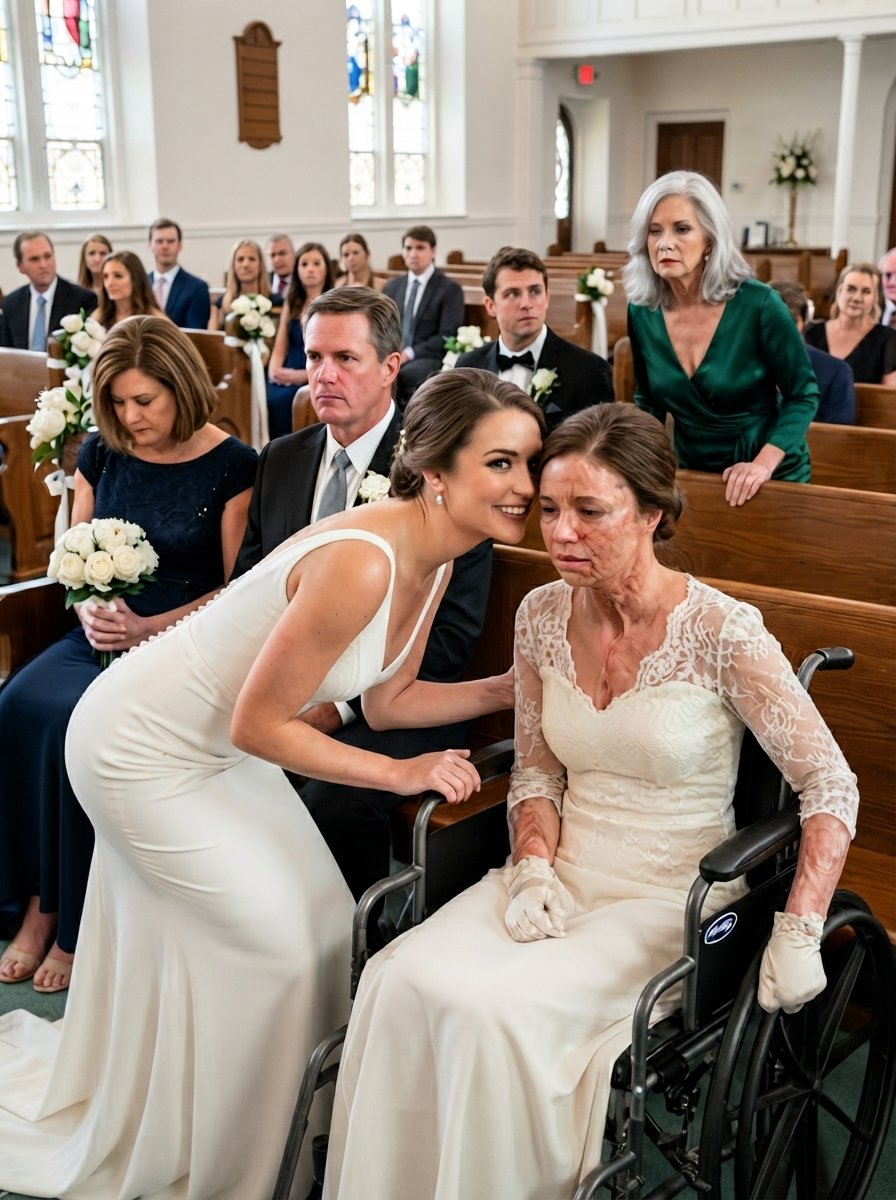
Eventually, Mom and Dad went to find her.
Margaret insisted on taking me home.
Three days passed.
Then four.
Then a week.
Emily did not call.
And I decided I would not call first.
That might sound cruel.
It wasn’t.
For most of my life, loving Emily had meant chasing after her whenever she pulled away.
I apologized for things I had not done.
I constantly reassured her that I did not blame her for the fire.
Whenever someone mentioned my scars and she became uncomfortable, I comforted her.
I told her again and again that she owed me nothing.
But I had never asked the most important question.
What did Emily believe she owed me?
Apparently, she believed my sacrifice had created a debt she could never repay.
And rather than confronting that guilt, she had tried to erase the reminder.
Me.
Two weeks after the wedding, someone knocked on my apartment door.
When I opened it, Emily was standing outside.
She wore no makeup.
Her hair was not styled.
There was no pearl-white wedding gown.
She wore jeans, sneakers, and an oversized sweatshirt.
For the first time in years, she looked young.
Not like the flawless bride from the church.
She simply looked like my little sister.
Something was in her hands.
A stuffed rabbit.
The same stuffed rabbit she had been clutching when I found her inside the burning house.
Its fur was still slightly stained by smoke, and one of its ears had been partially burned.
I stared at it.
“I thought Mom threw that away.”
Emily shook her head.
“I kept it.”
I moved my wheelchair aside and let her enter.
For several seconds, neither of us spoke.
Emily sat on the sofa and stared at the rabbit.
“I hated this thing for years,” she finally said.
“Why?”
“Because every time I looked at it, I remembered you screaming.”
My chest tightened.
Emily’s voice became quieter.
“I remember you putting your body over mine.”
She swallowed.
“I remember your hair burning.”
I stared at her.
I had never known she remembered that much.
“I remember waking up outside and asking where you were,” she continued.
Tears filled her eyes.
“Mom kept telling me the ambulance had taken you.”
She wiped her face.
“I heard Dad tell someone that you might die.”
The apartment fell silent.
“For years,” Emily whispered, “everyone told me you saved me.”
She stared at her hands.
“And every time they said it, all I heard was that your life had been destroyed because of me.”
“Emily—”
“I know.”
She shook her head.
“I know you never said that.”
She looked at me.
“But I said it to myself.”
I remained silent and allowed her to continue.
“I started hating the way people looked at me after they heard what happened. I thought they were asking themselves the same question I asked myself every day.”
“What question?”
Her lips trembled.
“Why did Anna deserve that instead of me?”
That was when I finally understood.
Beneath Emily’s cruelty was guilt.
It did not excuse what she had done.
But it explained something I had never understood before.
Emily looked at my face.
“Instead of getting help, I became angry at you for surviving visibly.”
She wiped another tear away.
“I thought that if nobody saw your scars, maybe I wouldn’t have to remember what happened.”
Her hand moved toward mine, then stopped.
“At the wedding, when I saw you sitting in the second row, all I could think about was people asking questions.”
Her voice broke.
“And I chose pictures over my sister.”
She began crying.
“I’m sorry.”
I had imagined hearing those words many times.
In my imagination, I always forgave her immediately.
Reality was more complicated.
“I love you,” I said.
Emily nodded.
“I love you too.”
“But I’m still hurt.”
“I know.”
“And saying sorry does not erase what happened.”
“I know.”
I looked at her carefully.
“If we’re going to have a relationship again, you need to stop asking me to hide.”
“I will.”
“No more asking me to wear long sleeves because somebody might stare.”
She nodded.
“No more putting me behind columns.”
Another nod.
“And no more pretending the fire was just an accident because telling the truth makes you uncomfortable.”
Emily covered her mouth and cried.
“I promise.”
I paused.
“And you need help.”
She looked at me.
“Therapy.”
For years, I had attended physical therapy, reconstructive appointments, and counseling.
Emily had received almost none.
Everyone had been so relieved that she was physically unharmed that nobody had stopped to consider what kind of guilt could grow inside a child who knew her sister had almost died saving her.
Emily took a breath.
“I already made an appointment.”
I was surprised.
“With someone who works with childhood trauma,” she added.
I exhaled slowly.
“Good.”
Then Emily held out the stuffed rabbit.
“I think this belongs to both of us.”
For the first time that afternoon, I smiled.
We sat silently for a while.
Then I finally asked the question I had been avoiding.
“What happened with Daniel?”
Emily looked at the floor.
“We called off the wedding.”
“I’m sorry.”
She shook her head.
“Don’t be.”
I raised an eyebrow.
“He said he still loves me. But he also said love isn’t enough if I’m willing to hurt people just to protect an image.”
I could not disagree.
“He told me I needed to figure out who I was before I tried to become somebody’s wife.”
“That sounds like Daniel.”
Emily almost smiled.
“He also said his mother terrifies him.”
I laughed.
And for the first time since the wedding, Emily laughed too.
Six months later, Daniel and Emily slowly started seeing each other again.
There was no engagement ring.
No wedding planner.
No discussion of venues.
Just dinners.
Counseling.
Honest conversations.
And a lot of difficult work.
One year after the church incident, Emily called me.
“Daniel asked me again,” she said.
“To marry him?”
“Yes.”
“And?”
“I said yes.”
I smiled.
“When is the wedding?”
“October.”
She hesitated.
“Anna?”
“Yes?”
“I want you beside me.”
My chest tightened.
“Beside you where?”
“At the altar.”
I became completely silent.
“I don’t want bridesmaids this time,” Emily said. “I want one person standing with me.”
Her voice trembled.
“My sister.”
The second wedding was nothing like the first.
There were fewer flowers.
Fewer guests.
No elaborate seating arrangement.
Margaret wore deep green again because Emily specifically asked her to.
And I wore a sleeveless burgundy dress.
For the first time at a major family event, every scar on my arms was visible.
When I entered the church, people looked.
This time, I let them.
Emily saw me from the altar.
She did not look embarrassed.
She smiled.
Then she surprised everyone by leaving the altar and walking toward me.
The photographer raised his camera.
Emily reached me and gently took both of my hands.
“Before we start,” she said loudly enough for everyone to hear, “there’s something I need to say.”
The church became completely silent.
Emily looked at me.
“When I was ten years old, my sister carried me out of a burning house.”
Tears appeared in her eyes.
“For years, I treated her scars like something that made my life harder.”
Her voice cracked.
“But those scars are the reason I have a life at all.”
Tears began running down my cheeks.
Emily knelt beside my wheelchair.
“I spent years wishing people wouldn’t see what happened.”
She squeezed my hands.
“Now I hope they never stop seeing what you did.”
Then she wrapped her arms around me.
The photographer captured the moment.
It wasn’t taken from the perfect angle.
Nothing was perfectly symmetrical.
My scars were clearly visible.
Emily’s mascara was running.
Daniel was crying.
Margaret was crying harder than anyone.
And somehow, it became Emily’s favorite wedding photograph.
She framed it and placed it near the entrance of her home.
Years later, whenever anyone asked about the photograph, Emily never tried to change the subject.
She simply pointed toward me and said:
“That woman saved my life.”
People sometimes ask if I regret going back into the house that night.
The answer is complicated.
I regret the pain.
I regret the surgeries.
I regret the years I spent learning how to live inside a body people often stared at before they bothered to see the person inside it.
But I have never regretted saving my sister.
What I eventually learned was something different.
Sacrifice does not mean surrendering your dignity forever.
Love does not require becoming invisible.
And forgiveness does not mean pretending someone never hurt you.
Sometimes forgiveness means giving someone the opportunity to become better while finally refusing to make yourself smaller.
Emily spent years trying to hide my scars.
Eventually, she understood something I had spent half my life learning.
The scars were never the ugliest part of our story.
The shame was.
And once we finally stopped hiding the truth, even that began to heal.
THE END