I took the final document from Victor.
“This concerns the foundation.”
Beatrice went very still.
The Whitmore Family Foundation had been her territory for fifteen years. Scholarship programs, museum wings, hospital wings, gala committees, her name on donor walls in buildings all over the city. She had loved philanthropy best when it came equipped with seating charts and engraved plaques. She served as chair because I had allowed it, because my wife Caroline had believed that responsibility might soften her. Caroline had been wrong, but I had not corrected it.
“At nine this morning,” I said, “Mrs. Harlan used security services retained through a foundation-adjacent vendor to remove a grieving widow and minor child from trust property under false claim of authority. She used family stationery, family staff, and the family’s name to create the appearance of an official decision that no one had sanctioned.”
Beatrice’s voice sharpened.
“That is a grotesque distortion.”
Victor lifted a single sheet.
“The bylaws permit immediate suspension of a chair for conduct exposing the foundation to reputational or legal harm, pending board review. Mr. Whitmore, as founder and principal donor, may initiate emergency action.”
Peter Shaw, the second board member, rubbed his forehead and looked at Beatrice.
“Tell me you didn’t put this in writing.”
I held up the cream stationery with the family crest.
The room went absolutely quiet.
It is a particular quality of cruelty written down that it cannot negotiate with itself afterward. Cruelty spoken can be reframed, minimized, attributed to emotion. Cruelty on paper just sits there in good font, wearing its own letterhead, looking exactly like what it is.
Beatrice stared at the note and for the first time since I walked in, something uncertain moved behind her eyes.
“You are all being absurd,” she said. “I did what Raymond was too sentimental to do.”
I looked at my sister then. Truly looked, for a long moment.
I knew the child she had been. The little girl who cried when our father’s praise landed somewhere other than on her, who learned early that money could buy attention where warmth was unavailable. I knew the young woman who married a name she thought would make her feel safe. I knew the shape of the disappointment she had been carrying her whole life and had never once examined.
I had excused too much of it because I understood the wound.
That ended today.
“You did what cruel people always do,” I said quietly. “You found someone with less power than you and called it duty.”
Her mouth opened.
I didn’t let her find the words.
“As of this moment, you are suspended from any role in the Whitmore Family Foundation. Your access to family offices, staff, accounts, vendors, and security services is revoked pending board review. Your personal belongings will be removed from the east office by the end of the week, under supervision.”
“You cannot do that.”
“I have already done it.”
“This family is not yours alone.”
“No,” I said. “It belongs to the living and to the dead and to the children who will one day remember how we treated their mothers.”
Her face twisted.
“You would choose her over your own blood?”
I heard footsteps in the hall.
Soft and careful.
Then Elena appeared in the doorway with Leo on her hip.
She had washed her face. Her eyes were still red but her posture had changed, some inner door closed and braced. Marjorie stood just behind her, one hand resting near the doorframe with the quiet steadiness of a person holding a line.
Leo had a cookie in each hand.
Beatrice saw them and stiffened.
I walked to Elena.
“I’m sorry,” I said.
She looked startled.
“You don’t have to—”
“Yes,” I said. “I do.”
The room was silent at my back.
“I am sorry I left you vulnerable in a house where my name should have protected you. I am sorry you sat in an airport with your child and had to wonder whether grief had made you disposable. I am sorry my son trusted us to love you and we failed to make that trust visible enough to matter.”
Elena’s face crumpled, but she did not cry this time. She pressed her lips together and nodded once, a small, deliberate motion.
Leo looked from her to me with the careful attention of a four-year-old trying to read a room.
“Are we in trouble?”
“No, buddy,” I said.
Beatrice shifted as if to speak.
I turned.
“Say one word to him,” I told her, “and the car outside will take you to a hotel tonight.”
Her eyes widened.
“You would remove me?”
“I would remove anyone who frightened my grandson.”
A silence that felt like it could have lasted years.
Then Leo held one of his cookies out toward me in the gracious manner of a child who has not yet learned to be stingy with comfort.
“Grandpa Ray, can Mommy stay?”
I crouched so we were eye level.
“Your mommy can stay as long as she wants.”
“And me?”
“And you.”
“In Daddy’s house?”
I looked at Elena.
Then back at Leo.
“Yes,” I said. “In Daddy’s house.”
He considered this with the gravity of someone for whom dinosaur hierarchies and sleeping arrangements carry equal moral weight.
“Can we put my dinosaurs back?”
Elena made a sound halfway between a laugh and a sob.
“Yes, sweetheart,” she whispered. “We can put your dinosaurs back.”
Beatrice did not apologize that evening. She did not recognize the room had turned until everyone in it confirmed it for her. Judith Pell announced she supported immediate suspension before buttoning her coat. Peter Shaw nodded beside her. Malcolm stood and looked at his wife and said, “Beatrice, enough,” with the flatness of a man who has run out of a particular kind of patience. Then he left. Cecily followed him, murmuring something she did not finish. Grant slipped out without looking back.
Within minutes, the room emptied until only Beatrice, Victor, Elena, Leo, Marjorie, and I remained.
Beatrice stood alone beside the fireplace. For the first time since I could remember, the room made her look small.
“She will take everything,” Beatrice said. Her voice had lost its architecture.
Elena spoke before I could.
“I never wanted everything.”
Beatrice looked at her.
Elena stood straighter.
“I wanted my husband back. I wanted my son to sleep through the night without asking where his father was. I wanted to go one day without feeling like a guest who had overstayed by the simple fact of still being alive.” She did not raise her voice. “I wanted to keep Liam’s mug in the cabinet without someone moving it to storage because grief made the kitchen look untidy.”
She paused.
“I don’t want your world, Beatrice. I don’t want the committees or the seating charts or the friends who say terrible things with good napkins in their laps. I wanted my child to have the family his father promised him. That morning, you made him believe he was being sent away because I wasn’t enough. I can forgive a great many things eventually. But not that. Not today.”
Leo pressed his face into her neck.
Beatrice looked at him then. Not as a name or an heir or a chess piece to be positioned for the family’s benefit. For one fraction of a moment, she looked at him as a child.
Then she looked away.
I had Marjorie bring the car around.
Beatrice picked up her handbag from the sofa with a sharp motion that rattled the chain strap and walked to the door. She stopped once.
“You will regret this.”
“I regret not doing it sooner,” I said.
She left without another word.
The house stayed quiet after she was gone. Not peaceful, not yet. A house cannot be violated in the morning and restored by evening. But the quiet changed its quality. It stopped feeling like fear being carefully maintained and started feeling like everyone had stopped pretending.
Elena carried Leo to the library, where he fell asleep on the sofa under the old plaid blanket Liam had dragged around as a boy. She sat beside him with one hand on his back, and I poured her tea because I did not know what else to do with my hands. She accepted the cup but sat with it.
“She used to correct the way I said things,” Elena said after a while. “Little things. Supper instead of dinner. Couch instead of sofa. Once she told me my Christmas cookies were charming because they looked homemade.”
“They were homemade.”
“I know.”
Outside the windows, late afternoon was turning the light blue. Someone walked quietly past the hall carrying Leo’s dinosaur backpack, and in the distance a vacuum started and then stopped, as if the house had remembered it should be careful tonight.
“Liam told me once,” Elena said, “that you were kinder than you looked.”
I smiled a little.
“He exaggerated.”
“He said you didn’t always know where to put love, so you put it into arrangements. Trusts. Insurance. Repairs. Things people didn’t notice until something broke.”
I looked toward Leo’s sleeping shape.
“That sounds like him.”
“He loved you. He was angry with you sometimes too.”
“I know.”
“He wanted Leo to know you. Not the family name. You.”
That one took a moment to find its way in.
“I should have been here more,” I said.
Elena looked at me steadily.
“Yes.”
The honesty of it was clean, not cruel. Just true.
I nodded.
“I will be.”
She studied me, deciding whether to believe it.
“Not because of today. Not because of guilt.”
“No.”
“Because he needs steadiness. I can’t have people appearing when there’s a crisis and disappearing when it’s time for preschool pickup.”
There she was. Not the frightened woman from the airport bench. Liam’s Elena.
“You’re right,” I said.
“I know you’re busy.”
“I am.”
“Leo is four.”
“Yes.”
“Four-year-olds don’t understand economic summits.”
“No,” I said. “They understand cookies.”
“And dinosaurs.”
“And dinosaurs.”
Her mouth finally curved, fully, for the first time since I had found her.
The following week was unpleasant in the way that necessary corrections often are. Victor moved efficiently. Beatrice’s foundation access was formally revoked. The security company’s apology arrived in language so carefully lawyered it had clearly passed through several panicked revisions. Every staff member in the household was spoken to with clarity rather than threat: no one on that property would ever again act on an instruction that affected Elena or Leo without hearing directly from me.
Marjorie restored the guest house before Elena returned to sleep there. She put Leo’s dinosaurs back on his shelf in the precise chaotic arrangement he maintained was a parade. She found Liam’s boots in a storage bin where someone had deposited them and returned them to the back door without commentary.
Elena saw them and had to sit down.
That night I ate dinner in the guest house kitchen.
Not the formal dining room with its oil paintings of men who had never once washed a dish. Elena made chicken soup because Leo had a cough, and I brought bread from the bakery in town, and Leo wore pajama pants with rockets on them and delivered a twenty-three-minute lecture on the moral hierarchy of his plastic dinosaurs.
“This one bites bad guys,” he said, holding up a green tyrannosaurus.
“Useful.”
“This one protects Mommy.”
“Very useful.”
“This one protects you because you are old.”
Elena looked horrified.
I laughed harder than I had in months.
After dinner, Leo fell asleep on the couch and Elena washed the bowls while I dried them with a lemon-printed dish towel. It had been decades since anyone had let me dry dishes without acting as though I might break something valuable.
“Beatrice called,” Elena said.
My hands stilled.
“She didn’t apologize,” Elena continued. “But she said she wanted to see Leo.”
“No.”
It came out too fast.
Elena turned off the water.
“I said no too. Not forever. I don’t want to teach him that people are permanently beyond reach. But not now. Not until she understands that seeing him is not a right she can demand. It’s trust she has to earn.” She looked at me over the dish towel. “I don’t want revenge to become the family hobby.”
I looked at her in that warm kitchen, sleeves pushed up, grief still in her face and something much harder underneath it.
“You are stronger than this family deserves,” I said.
She shook her head.
“I’m just tired of being polite to people who are hurting my son.”
That sentence stayed with me for a long time afterward.
Two weeks later the foundation board convened in Manhattan. Beatrice arrived in navy wool and diamonds with counsel beside her and the expectation that the family’s old habit of smoothing over harm would reassert itself. She did not expect Elena.
I had advised against it. Elena listened politely and came anyway.
She wore a simple black dress and Liam’s wedding ring on a chain beneath it, and she sat beside me at the conference table with her hands folded and her face calm. Beatrice did not look at her.
Victor presented the facts. Times, names, documents, the airline ticket, the confiscated phone, the misuse of security authority, the legal exposure. He did it without raising his voice.
Then the board asked Elena if she wished to speak.
She stood.
I saw the airport bench for a moment. The same woman. An entirely different weight in the room.
“I don’t know most of you,” she said. “You know me mostly as Liam’s widow, or as the woman Beatrice believed didn’t belong.”
Beatrice studied the table.
“I can’t speak to foundation bylaws or donor confidence. But I can tell you what your family name looked like to my son last Tuesday. It looked like two men at the door while he was still in his pajamas. It looked like his mother crying in the back of a car. It looked like a ticket he didn’t understand and a woman he trusted telling him he would be better off far away from me.”
The room was absolutely still.
“He is four,” Elena said. “He still thinks airplanes are exciting. Beatrice made one frightening. That is what happened.” Her voice quieted further. “Liam believed this family could be better than its worst habits. I am asking you to prove him right.”
She sat.
The vote was not close.
Beatrice was removed as chair.
The announcement used careful language: leadership transition, governance standards, renewed mission focus. Elena refused a public accounting of the details. “I don’t want this to be what we’re known for,” she said. But the consequences came anyway, quiet and permanent. The museum committee stopped calling. Invitations thinned. Malcolm moved to their house in Connecticut and, from what I heard, began for the first time in years to answer his own phone.
Spring came slowly to Long Island that year.
I changed my schedule. Not dramatically, not in a way that merited an announcement, but in ways that required saying no to things I had previously treated as immovable. I stopped accepting overseas travel without sufficient recovery time between trips. I moved two standing calls to free up Wednesday afternoons and used the time to pick Leo up from preschool. I learned where the tiny jackets were kept and which bakery had the cookies with rainbow sprinkles and that sandwiches cut into triangles were objectively more trustworthy than sandwiches cut into rectangles.
On the first Wednesday I picked him up, he ran toward me across the school yard carrying a paper bag covered in glue and feathers.
“Grandpa Ray! I made a bird but it’s also a dragon.”
“That seems extremely practical.”
His teacher smiled at me.
“He talked about you during circle time.”
I braced myself.
“He said you’re very old but you know about contracts.”
Elena laughed for five minutes when I told her.
One Sunday she invited me for breakfast. Pancakes, slightly burned, exactly the way Liam had always made them. On the table was a framed photograph I had never seen before: Liam and Elena at a county fair in Ohio, both laughing, powdered sugar on his shirt, her hair blowing across her face. He looked younger in it, not in age but in some quality of being fully present.
“He was happy there,” I said.
“He liked that no one cared who his grandfather was.”
“He needed that.”
“So did I.”
After breakfast, Elena handed me an envelope. For one terrible second, catching the shape of it, I thought of Beatrice’s cream stationery.
It was plain white.
Inside was a letter in my son’s handwriting.
Dad. If you’re reading this because something happened to me, I need you to do two things.
First, don’t disappear into work. I know you. You’ll try to build a wall out of meetings and call it strength. Don’t. Elena will say she’s fine before she actually is. Leo will need more than money. He’ll need someone who remembers me without making him carry my ghost.
Second, protect them from the family. Not all of them. But you know who I mean. Elena is tougher than people think, but she shouldn’t have to be tough every day just to earn a chair at the table.
I married her because she made me feel like a person before she ever knew I was a Whitmore. If this family is worth anything, make sure she never regrets joining it.
I love you. Even when you’re impossible.
Liam.
I read it twice.
The paper blurred.
Elena stood near the counter, giving me the particular dignity of not watching too closely.
“I failed the second part for a while,” I said.
“You corrected it.”
“That doesn’t erase it.”
“No. But it matters.”
I folded the letter carefully and asked if I could keep it.
“It’s yours,” she said.
I put it in my jacket pocket and carried it home.
In May, the estate held its annual garden luncheon for the children’s literacy fund. Elena and Judith chaired it together. There were no ice sculptures. There were folding tables under white tents and lemonade in glass pitchers and children running across the lawn while donors tried not to look annoyed about grass stains. Elena moved through the crowd with a ease she had not yet learned she possessed, talking to young mothers and old veterans and librarians and board members, not performing anything, simply present.
Leo wore his navy blazer for exactly eighteen minutes before losing it behind a chair.
I found him near the rose garden explaining the green dinosaur’s protective responsibilities to two other children who appeared deeply invested in the briefing.
“Grandpa Ray!” he shouted.
Every head within ten feet turned.
I opened my arms and he ran full speed into my knees.
Across the lawn, Elena was watching us.
She smiled.
Not the brave smile from the airport, the one she had constructed to keep herself upright while everything collapsed. Not the careful smile she wore in rooms where she had to survive.
A real one. Unguarded. Belonging entirely to the moment she was in.
Then I saw Beatrice at the edge of the terrace.
She had come without invitation or announcement, wearing gray without her pearls, standing uncertainly with her hands at her sides. Elena saw her too.
I started toward them.
Elena lifted one finger.
Wait.
So I waited.
Elena walked to her, unhurried, and they stood together near the hydrangeas for less than two minutes. I could not hear what passed between them. I watched Elena’s face. Calm. Guarded. Not cruel, not warm. Whatever Beatrice said, Elena answered, and then Beatrice nodded once and turned and walked back to the drive.
Later I asked what had happened.
“She asked if she could say hello to him.”
“And?”
“I said not today.”
“How did she take it?”
Elena looked toward the driveway where the car had gone.
“She said she understood.” A pause. “Maybe for the first time.”
Three months after the airport, we took Leo to the beach at Montauk because Liam had once promised him they would build the biggest sand fort in New York. Leo had no memory of the promise. Elena did. So did I, because Liam had called me afterward to ask whether four was too young to grasp basic principles of structural integrity.
We drove out early with towels and sandwiches and a bucket shaped like a turtle. Elena wore sunglasses and a blue sweater. Leo spent half the drive asking whether sharks respected grandfathers.
“I’ve generally found them reasonable,” I told him.
“Please don’t tell him that,” Elena said over her coffee, without looking up.
At the beach, Leo charged toward the water and then immediately retreated when it touched his shoes. Elena chased him, laughing. I carried the bags and thought about how long I had confused provision with presence, how thoroughly I had believed that arranging things from a sufficient distance was the same as being there for them.
Money could build safety nets. It could secure houses and fund trusts and retain attorneys and ensure that the people you loved were protected while you were away earning the money to protect them. But it could not, by itself, make a child feel chosen. That required showing up with sand in your shoes and letting a four-year-old overrule your structural decisions.
We built the fort badly.
Leo required three towers, a moat, and a dedicated dinosaur guard position on the southern wall. Elena dug with both hands. I handled reinforcement and was overruled repeatedly. By noon, the fort leaned at an angle that defied explanation.
“It’s perfect,” Leo declared.
Then a wave came in and took the eastern wall completely.
He stared at it with the genuine betrayal of someone who has not yet made peace with impermanence.
Elena pulled him into her lap.
“That happens,” she said. “We build again.”
He thought about that with the seriousness it deserved.
Then he handed me the shovel.
“Grandpa Ray, you fix it.”
I looked at Elena.
She smiled.
So I did.
Not perfectly. Not the way I would have engineered it if precision were the point. With my grandson beside me and my daughter-in-law laughing in the wind and my son’s letter folded safely in my wallet, I rebuilt what I could with the time I had and the people I still had left.
That was the lesson Beatrice never understood.
Power is not the ability to remove someone from a house. Power is knowing who belongs there when others try to erase them. Power is a frightened young widow standing in a conference room and choosing to tell the truth anyway. Power is a child asking if his mother can stay, and an old man finally having the presence of mind to answer correctly.
My sister stood in that airport and believed she had already won. She believed grief made people disposable. She believed the family name was something she could guard like a gate and that I would come home tired and accept the story she had prepared.
She was wrong.
By sunset that evening, Elena and Leo were back under the roof Liam had chosen for them.
By the end of the month, Beatrice no longer held the foundation she had used as a throne.
And by summer, my grandson could run through the garden calling for his mother without checking whether his joy required anyone’s permission.
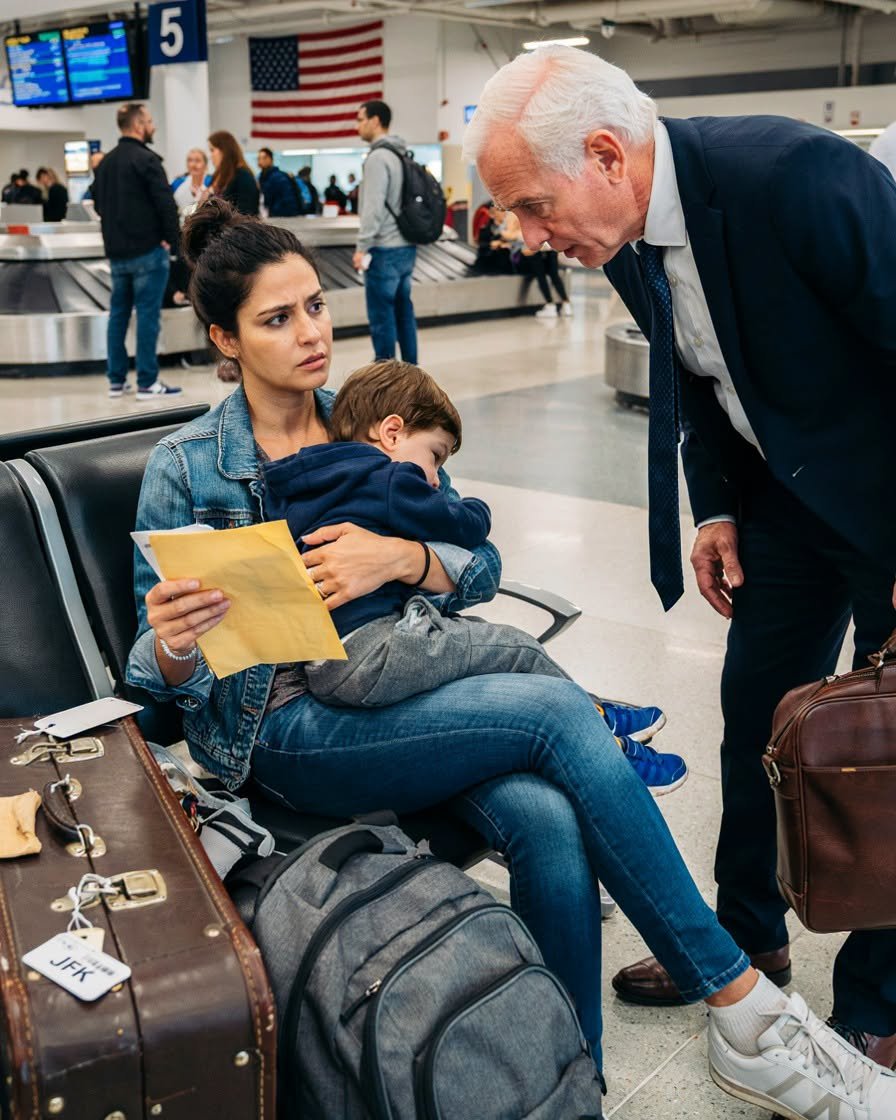
Sometimes when I pass through JFK now, I still see that bench in my mind. A young mother holding herself together with both arms. A small sleeping boy. Three suitcases. A crumpled envelope that was supposed to send them somewhere they could be forgotten.
But I also see what came after.
The car door opening.
Whitmore House’s front door standing wide.
Marjorie saying Mrs. Whitmore, and meaning it.
Leo asking for his dinosaurs.
Elena lifting her chin.
These are the things that stayed.
My sister believed she could determine who belonged to our family and who did not. She never understood that belonging is not assigned by the person holding the family stationery. It is confirmed by every ordinary moment, every burned pancake, every plastic dinosaur on a shelf in a small boy’s room.
Elena had belonged from the moment Liam chose her.
Once I understood that, I made sure no one was ever permitted to suggest otherwise again.