
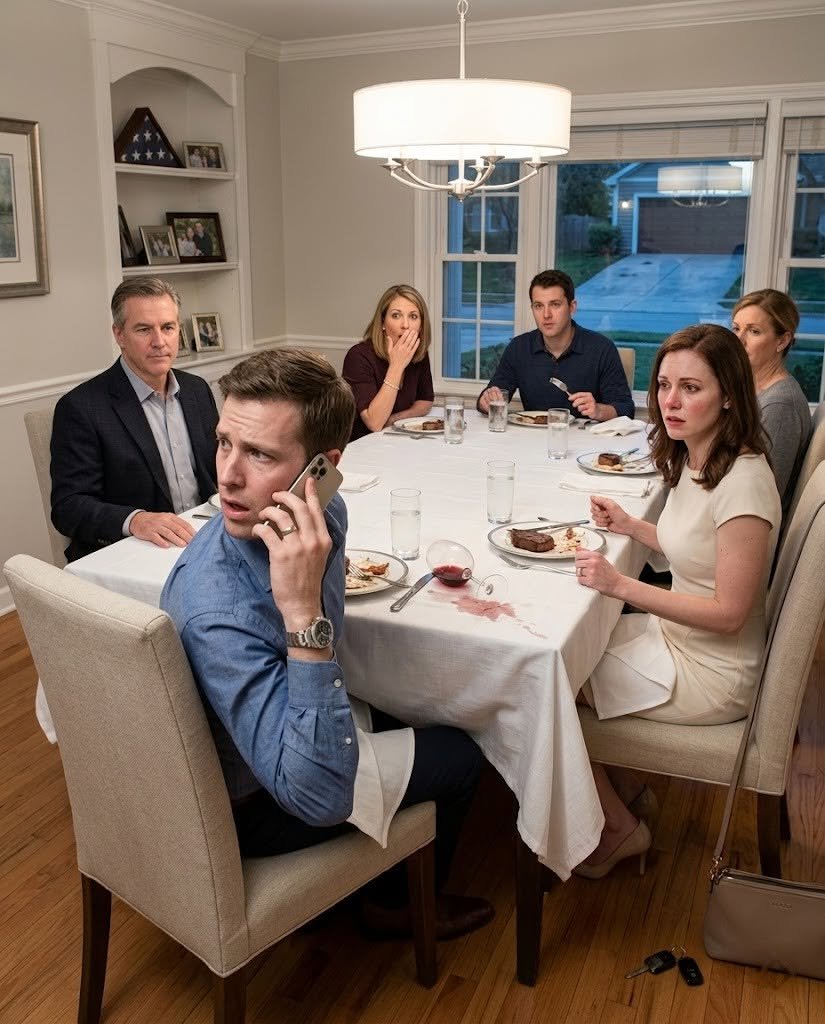
As if my identity were another household responsibility he could manage without permission.
I removed my wedding ring.
Then I placed it beside my untouched lemon tart.
My mother began crying.
Patrick stared at the ring.
I told him I would not return home and that, until I had legal advice, he should contact me only in writing.
He laughed.
“You’re divorcing me because I tried to help my mother?”
“No.”
I looked at him.
“I’m divorcing you because you stole my identity and still believe generosity explains it.”
Patrick left.
No one stopped him.
An hour later, Rebecca called me upstairs with another discovery.
Donnelly Strategic Ventures was not new.
It had existed for nearly eighteen months.
Patrick had been using it throughout most of our marriage.
The company had borrowed repeatedly.
It had defaulted twice.
Its liabilities were approaching $200,000.
And my identity appeared everywhere.
Guarantor.
Co-owner.
Household-income contributor.
Applications contained signatures I had never made.
One falsely doubled my salary.
Another listed Grandma’s cabin as an available asset.
Another claimed I jointly owned my parents’ house.
Rebecca warned me that this had moved far beyond a marital dispute.
The next morning, Dad drove me to the townhouse.
A police officer accompanied us while I collected clothing and essential belongings.
Patrick was gone.
So was his laptop.
His office drawers had been emptied.
My passport was missing.
My birth certificate was gone.
The folder containing the deed to Grandma’s cabin had disappeared.
So had documents and jewelry from our bedroom safe.
Police documented everything.
Ten minutes later, Patrick texted me.
He said he had moved “important documents” somewhere safe because emotions were running too high.
Rebecca told me not to answer.
A formal theft and fraud investigation began that afternoon.
Patrick’s mother called fifteen times.
Eventually, after speaking with my attorney, I answered one call.
Her first word was not sorry.
It was:
“Selfish.”
She accused me of turning against Patrick after everything he had supposedly done for me.
According to her, marriage made ownership “technical.”
I asked whether she knew the Civic belonged legally to me.
She avoided the question.
I asked whether she knew my signature had been forged.
Silence.
Then I mentioned Donnelly Strategic Ventures.
The silence grew longer.
“Ask your husband,” she finally said.
That answer was enough to make investigators look more closely at her role.
The luxury SUV was recovered the following day.
Patrick’s mother had hidden it in a friend’s garage after the dealership demanded its return.
Three days later, my Honda came home.
I thought I would feel victorious.
Instead, when Dad handed me the keys, I cried.
That car suddenly meant something different.
Dad had not bought it because he thought I was incapable of caring for myself.
He had bought it because he noticed how exhausted I had become.
Before the Civic, Patrick had sold my previous car without discussing a replacement and insisted we could save money by sharing his.
I ended up arranging my life around public transportation.
Six months later, Dad quietly bought the Civic.
Only my name appeared on the title.
“I suspected something was wrong,” he admitted.
“Why didn’t you say anything?”
Dad looked ashamed.
“Because I thought if I pushed too hard, you would defend him and pull away from us.”
I knew immediately that he was right.
I probably would have.
That realization hurt.
Financial control does not always begin with someone emptying a bank account.
Sometimes it starts much smaller.
You explain every purchase.
Your income becomes “our money,” while your partner’s debts remain private.
Your credit becomes family credit.
Saying no becomes evidence that you do not care enough.
For three years, Patrick taught me to treat boundaries as selfishness.
The investigation showed how far that had allowed him to go.
He had used my information for at least seven credit applications.
Several succeeded.
Others failed.
A credit card in my name had even been mailed directly to his mother’s apartment.
She used it for furniture, travel, beauty treatments, and church-event expenses.
More than $40,000 passed through the account.
Investigators later found statements carrying my name inside her closet.
Patrick eventually hired a criminal defense attorney.
Then his messages changed.
The anger disappeared.
The apologies began.
He had been under pressure.
His business had failed.
His mother depended on him.
He was afraid of disappointing me.
He planned to repay everything.
Again and again, he used the same phrase:
Before you discovered it.
As if what he had done became wrong only because I learned about it.
Then investigators found the laptop Patrick had removed from our home.
It was inside a storage unit rented under his mother’s name.
What they discovered ended every remaining doubt.
Copies of my identification.
Scanned signatures.
Account lists.
Loan projections.
And a spreadsheet titled:
Jenna Capacity.
It calculated how much more debt Patrick believed my financial profile could support.
My salary.
My credit score.
My inherited property.
My father’s gifts.
Everything I considered part of my life had become borrowing capacity in my husband’s spreadsheet.
The largest planned loan was $150,000.
Collateral:
My grandmother’s cabin.
Purpose:
Business expansion.
Internal note:
Mother relocation.
Patrick had planned to buy his mother a condominium.
Using my inheritance.
Without telling me.
The lender rejected the application only because Grandma’s trust required notarized, in-person consent.
That weekend, Dad drove with me to the cabin.
The old porch still leaned slightly.
Grandma’s faded recipe cards remained in the kitchen.
The lake still turned silver in the morning.
I sat on the dock and realized how close I had come to losing something irreplaceable simply because my husband viewed my refusal as an obstacle requiring better paperwork.
And for the first time, I understood that getting away from Patrick was not about punishing him.
It was about protecting whatever remained of my life.
Part 3 — Final: The Day My Life Became Mine Again
The investigation lasted months.
Patrick faced serious allegations involving identity theft, forgery, fraudulent loan applications, theft, and falsified financial documents.
His mother also became involved in the legal case after investigators examined the stolen records, fraudulent accounts, and the attempt to conceal the luxury SUV.
Their attorneys offered explanations.
She trusted her son.
Patrick intended to repay everything.
Nobody meant for the situation to become permanent.
But records are difficult to argue with.
So are signatures.
So are spreadsheets.
My divorce lasted almost as long as the criminal case.
Repairing my financial life was exhausting.
My credit report looked like a crime scene.
Every fraudulent account required letters.
Affidavits.
Police reports.
Identity verification.
Phone calls.
More documents.
Some lenders removed the false debts quickly.
Others fought every step.
My father helped me through all of it.
But something important had changed.
He never took control.
Before calling an attorney, he asked.
Before paying an expense, he asked.
Before contacting a financial institution, he asked.
After years with Patrick, being asked for permission felt almost strange.
Eventually, prosecutors offered Patrick a plea agreement.
It required restitution, admission of specific fraudulent acts, surrender of disputed assets, and years of financial restrictions.
He accepted.
His mother accepted a smaller agreement after cooperating and returning property connected to the investigation.
I expected justice to feel bigger.
I imagined some dramatic moment where everything Patrick had taken would suddenly return and everyone would finally understand what he had done.
Reality was quieter.
My credit improved slowly.
Fraudulent debts disappeared one by one.
Grandma’s cabin remained mine.
My Honda remained mine.
My passport was recovered.
Some jewelry was not.
My trust did not return either.
That required much more time.
Fifteen months after the dinner at my parents’ house, the divorce became final.
Patrick asked to speak privately afterward.
I refused.
We spoke in a courthouse conference room with attorneys nearby.
He looked older.
Tired.
He told me losing me had changed him.
I looked at him.
“Losing access to me is not the same thing as loving me.”
He asked whether I remembered our first apartment.
The nights we ate noodles sitting on the floor.
The promises we made before money became such a problem.
Of course I remembered.
That was the painful part.
Patrick had not always been the man who forged my signature.
But becoming that man had required hundreds of decisions.
Nostalgia could not erase them.
Then Patrick apologized.
“For the car.”
I almost laughed.
The Honda was the smallest part of what happened.
“The Civic only created an audience,” I told him.
“Everything else was already happening when nobody could see it.”
Patrick looked down.
Then he said perhaps the most honest thing he had ever said to me.
“I thought you would always forgive me.”
I was quiet for a moment.
“So did I.”
Then I walked away.
After the divorce, my family changed too.
Aunt Lauren apologized for the times she noticed Patrick belittling me at family gatherings and decided it was not her place to interfere.
Uncle Mark remembered hearing Patrick once joke that marriage was the easiest way for a man to improve his credit profile.
At the time, no one understood what he meant.
Now we did.
But eventually, I stopped being angry at everyone for missing the signs.
I had missed more signs than any of them.
What mattered was what we did after we finally saw the truth.
I kept the Honda Civic for another six years.
Not because it was valuable.
Not because I loved the car itself.
I kept it because every time I sat behind the wheel, I remembered the woman who had arrived at dinner in a taxi believing her husband’s behavior was something she needed to hide.
That woman had spent years protecting Patrick from the consequences of his own actions.
Then, one night, he told the truth for her.
“I gave it to my mother.”
And instead of rushing to create an excuse, I allowed his words to remain exactly as ugly as they were.
Years later, when I finally decided to sell the Civic, I did it myself.
I read every document.
I reviewed every line.
I signed my own name.
I watched the dealer verify my identity.
Twice.
Then I used part of the money to restore Grandma’s lake cabin.
I repaired the porch.
Updated the kitchen.
And replaced the old wooden dock.
The following summer, Dad came to visit.
We sat beside the lake drinking coffee while morning fog slowly lifted from the water.
After a while, he smiled.
“Do you remember what I asked you that night at dinner?”
I did.
Of course I did.
Where is the car I gave you?
That question had uncovered far more than a missing Honda.
It exposed a marriage where anything given to me eventually became something Patrick believed he could control.
It exposed loans.
Forged signatures.
Hidden companies.
Stolen documents.
Fraudulent debts.
And a plan to use my inheritance to buy his mother a home without my consent.
But more importantly, that question exposed how practiced I had become at protecting the person who was hurting me.
Patrick thought answering for me would prove he was in control.
Instead, his answer gave my father enough reason to look closer.
One text beneath a dinner table led to the title.
The title led to the loan.
The loan led to Donnelly Strategic Ventures.
And the company exposed years of fraud.
Patrick gave his mother my car because he believed anything belonging to his wife ultimately belonged to him.
He was wrong.
The Civic came back.
My credit came back.
My cabin stayed mine.
And slowly, my life became mine again.
The biggest thing I recovered was not property.
It was my voice.
Because after that night, whenever something belonging to me disappeared, changed, or crossed a boundary I had never agreed to, I never again invented a lie to protect the person responsible.
THE END