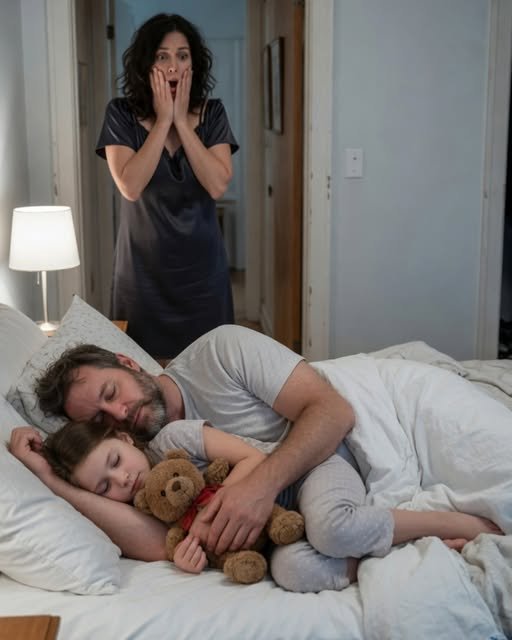
Daniel’s face twisted with pain.
“Yes,” he whispered. “I’m sorry, baby. I thought you were asleep.”
“I was asleep,” she answered. “But children can hear crying.”
Neither of us knew how to respond.
Emily stepped closer and touched his trembling hand.
“Does it hurt?”
“Not very much,” Daniel said. “Mostly, it scares me.”
She nodded seriously.
Then she said, “You can be scared in Mommy’s room. My bed is too small.”
I almost laughed and sobbed at the same time.
Daniel pulled her into his arms, and Emily hugged him with the complete forgiveness only a child could possess.
I did not forgive him as quickly.
Love does not erase betrayal simply because the betrayal came from fear.
A Life Beyond Surgery
The next morning, Daniel called the hospital board.
I sat beside him while he reported the diagnosis and requested medical leave.
His voice shook more than his hand.
When he ended the call, he looked like a man who had just signed away his identity.
I placed my hand over his.
“You are still here,” I said.
He stared at our joined hands.
“I don’t know who I am if I’m not operating.”
I looked toward the living room, where Emily was drawing a picture of our family with wildly purple hair.
“You’re the man she drew with the crooked smile,” I told him. “Start there.”
The following weeks were not beautiful or inspirational in the way movies often portray difficult times.
They were ugly.
Daniel became angry over small things.
I cried alone in the laundry room.
Emily asked questions that adults were often too afraid to ask.
“Will Daddy forget me?”
“No.”
“Will his hands fall off?”
“No, sweetheart.”
“Can he still make pancakes?”
“Yes,” I told her. “But they may look strange.”
That made her laugh.
Daniel heard the laughter from the doorway.
On the first Saturday of his medical leave, he decided to make pancakes.
They were terrible.
One looked like the country of Brazil. Another looked like an old shoe. A third broke in half when he tried to flip it.
Emily clapped as though he had just performed surgery on the moon.
“Best ugly pancakes ever!” she announced.
Daniel bowed dramatically.
For three minutes, the disease did not control our kitchen.
But every night, I continued checking Emily’s camera.
Not because I distrusted Daniel.
Fear had simply become a habit, and peace did not yet feel believable.
One night at two in the morning, Emily’s bedroom door opened again.
I immediately sat up and grabbed my phone.
Daniel stood in her doorway.
This time, he did not enter.
“Goodnight, sweetheart,” he whispered.
Then he turned and walked back toward our room.
A few seconds later, he appeared beside our bed with shame and hope in his eyes.
“Can I sleep here?” he asked softly.
I pulled back the blanket.
“You were always supposed to.”
Daniel lay beside me and broke down as though the fear of the last three months had finally been given permission to leave his body.
I held him.
Not as a nurse.
Not as someone trying to fix him.
Not as a woman pretending she was not afraid.
I held him as his wife.
And in the room down the hall, Emily slept peacefully in her enormous bed.
A Different Kind of Surgeon
A month later, Daniel began treatment openly.
He stopped performing surgeries and started teaching younger surgeons instead.
He guided their hands so they could continue the work his own hands could no longer safely perform.
At first, he hated teaching.
He believed standing outside the operating room meant he had failed.
Then one evening, a young resident called him.
The resident thanked Daniel for helping save a patient through instructions he had given from outside the operating room.
Daniel sat alone in his car afterward, unable to speak.
When he finally entered the house, Emily ran toward him holding a new drawing.
The picture showed Daniel wearing a superhero cape.
But he was not holding a scalpel.
He was holding a flashlight.
“What is this?” he asked.
“You help other people see,” Emily explained.
Daniel looked at me over her head.
That night, he cried again.
But this time, he did not hide inside a child’s bedroom.
The Birthday Letter
On Emily’s ninth birthday, Daniel gave her another envelope.
It was not the secret white envelope he had hidden beneath her pillow.
This one was bright yellow, covered with colorful stickers, and handed to her openly at breakfast.
Emily opened it cautiously.
Inside was a short letter.
Dear Emily,
I am still here.
Today, we eat cake.
Love, Daddy.
She read it twice before throwing her arms around him so hard that he nearly dropped his coffee.
“What about the other letters?” she asked.
Daniel looked at me.
We had already discussed what to do with them.
He went upstairs and returned carrying a small wooden box.
Inside were all the letters he had written out of fear.
Letters for her sixteenth birthday.
Her eighteenth birthday.
Her graduation.
Her wedding day.
Her first heartbreak.
Her first failure.
Her first great dream.
Emily gently touched the box.
“Are these sad letters?”
Daniel sat beside her.
“They were sad when I wrote them,” he said. “Now they are reminders.”
“Reminders of what?”
“That I don’t have to say goodbye before it is time.”
Emily thought carefully about his answer.
“Can we keep them anyway?”
“Of course.”
“Can I write one too?”
Daniel blinked.
“To whom?”
“To future Daddy,” she said. “In case he gets scared again.”
I left the room before they could see me cry.
These were not silent tears.
They were real tears.
Loud enough to belong to someone who was still living.
That evening, after Emily blew out her birthday candles, she climbed into her own bed.
Daniel and I stood together in her doorway.
She placed her rabbit beside the pillow and looked at us suspiciously.
“Both of you,” she said, “do not sneak into my room tonight.”
Daniel raised both hands.
“Understood.”
I smiled.
“Anything else, ma’am?”
“Yes,” Emily replied. “If someone is sad, they have to knock first.”
Daniel’s expression softened.
“That is a very good rule.”
She nodded.
“And my bed is big, but it is not for secrets.”
In the hallway, I felt Daniel’s fingers find mine.
The old fear was still with us, but it no longer controlled us.
“Goodnight, baby,” I said.
“Goodnight,” Emily answered. “Leave the door open a little.”
We did.
Later that night, Daniel and I sat downstairs with the camera feed open on the coffee table.
Emily was sleeping peacefully, stretched diagonally across her bed like a queen claiming her kingdom.
Daniel watched her for a long time.
“I almost made her carry my fear,” he whispered.
I rested my head against his shoulder.
“But you stopped.”
He shook his head.
“You stopped me.”
“No,” I said. “She did. All because she honestly told us that her bed felt too small.”
Daniel laughed softly.
“Her bed felt too small,” he repeated.
Somehow, the words no longer sounded frightening.
They sounded like the moment our family finally realized that one of us had been disappearing into silence.
No Room Felt Too Small
Months passed.
Daniel’s tremor remained.
Some days were better than others. On difficult days, he dropped spoons or struggled with buttons and cursed quietly under his breath.
Emily learned not to panic when his hand shook.
She would simply move things closer and say, “Teamwork.”
Daniel slowly learned to accept help without treating it as defeat.
And I learned that a marriage is not saved because two people never break.
It is saved when they choose not to break alone.
People still occasionally praised Daniel as a brilliant surgeon.
He would smile and say, “I teach now.”
At first, that sentence hurt him.
Eventually, it became true without causing him pain.
One rainy night, I found Emily standing outside our bedroom with her white rabbit tucked under one arm.
“Mommy,” she whispered, “Daddy sounds sad.”
Daniel was sitting on the edge of the bed, staring at his trembling hand.
Emily climbed between us without asking for permission.
“This bed is bigger,” she said. “Sad people can fit here.”
Daniel looked at me.
I nodded.
The three of us lay together without hiding, pretending, or performing bravery for anyone.
Emily fell asleep first.
Daniel’s hand trembled against the blanket.
I covered it with mine.
The house was quiet.
Safe.
Honest.
And for the first time in months, no room in our home felt too small.