
Under certain conditions, the remote diagnostic network could cause the fire-suppression valves to lock instead of opening.
Fixing the problem properly would delay production by nearly two years.
Arthur refused.
Sterling Defense was far less financially stable than outsiders believed.
Behind the luxury offices, political donations, expensive parties, and private jets was an enormous amount of hidden debt.
Arthur needed the Navy contract immediately.
So he created Project Anchor.
It was supposed to be a controlled demonstration.
My vessel had been selected because the classified trial meant most technical records would remain sealed from the public.
The plan sounded simple on paper.
Temporarily disable part of the suppression system.
Create a manageable emergency.
Allow Sterling Defense’s backup technology to reactivate the system.
Then present the company as the hero that saved the vessel.
A successful demonstration would almost guarantee the contract.
There was only one problem.
Arthur had built the entire demonstration on falsified safety data.
When the electrical failure began, it spread faster than expected.
The backup software failed.
The suppression valves locked.
The fire spread through the lower compartments.
Thirty-two sailors became trapped.
Twenty-three were injured.
Six died.
I survived.
My father’s lawyers argued that Arthur never intended anyone to die.
At trial, the prosecutor answered with a sentence I would never forget.
“You do not get to manufacture danger, falsify safety records, disable emergency equipment, and then call the deaths an accident.”
Carter eventually testified against Arthur.
Not because he suddenly became courageous.
He wanted a reduced sentence.
He admitted approving false safety reports.
He admitted ordering employees to destroy engineering warnings.
He admitted helping company officials remove evidence after the fire.
Then prosecutors asked him about me.
That was when another part of the story finally became clear.
Arthur began destroying my reputation while I was still recovering in a military hospital.
My family told friends that I had suffered a psychological breakdown.
They told business partners that I had developed an addiction.
They quietly removed me from family photographs.
Arthur even paid a private public-relations firm to spread rumors that I had been discharged dishonorably.
None of it was true.
My service record had been sealed because I had been assigned to assist with the classified investigation.
Arthur saw the silence around my career and assumed it protected him.
In reality, it protected me.
For five years, he did not know how much evidence investigators had collected.
He did not know I had the data recorder.
He did not know my mother had begun sending information.
And he did not know I was coming back.
My mother became one of the prosecution’s most complicated witnesses.
She admitted entering Arthur’s code.
She admitted disabling the system.
She admitted helping him hide certain information afterward.
But she also provided years of secretly copied recordings.
Arthur had recorded meetings and conversations because he believed information gave him power over people.
Those recordings became some of the strongest evidence against him.
The court accepted that Arthur had manipulated and controlled my mother for decades.
But manipulation did not erase responsibility.
She pleaded guilty to charges connected to the unauthorized shutdown and the later obstruction.
Before sentencing, she asked to see me.
I almost refused.
Then I went.
We met in a small courthouse room.
There were no chandeliers.
No champagne.
No expensive gowns.
Just my mother sitting behind a plain wooden table.
She looked much older than she had at the retirement party.
“I’m sorry,” she whispered.
I sat across from her.
“For which part?”
Her eyes filled.
“All of it.”
I waited.
Then she said the one thing I had always needed her to understand.
“For choosing Arthur every time I should have chosen my children.”
That hurt more than I expected.
Because it was true.
She had chosen comfort.
Silence.
Fear.
Arthur.
Again and again.
“You helped expose him,” I said.
Hope appeared in her eyes.
I stopped it immediately.
“But exposing him afterward doesn’t erase helping him cause the fire.”
Her face fell.
“I know.”
“Six people are still dead.”
“I know.”
“My scars are still there.”
She nodded.
Then she asked:
“Will you ever forgive me?”
I thought about it for a long time.
“I don’t know.”
It was the most honest answer I could give.
Then I left.
Harper was never criminally charged.
But consequences found her anyway.
Sponsors disappeared.
Friends who loved the Sterling name stopped returning her calls.
Her social-media accounts went silent.
Months later, she sent me one message.
Three words.
I was wrong.
I never answered.
Some apologies come because people understand the damage they caused.
Others arrive because the damage finally reaches them.
I had no interest in discovering which kind hers was.
Meanwhile, Arthur Sterling prepared for trial.
For the first time in his life, money could not rewrite reality.
Because this time, the truth had recordings.
Documents.
Witnesses.
And a daughter he had failed to erase.
Part 4: Final End — I Took Back My Name
Arthur Sterling’s trial lasted seven weeks.
The evidence was overwhelming.
Emails.
Bank transfers.
Engineering reports.
Recorded conversations.
Carter’s testimony.
My mother’s flash drive.
And the data recorder I had carried out of the burning vessel beneath my uniform.
The same device Arthur believed had disappeared forever.
The jury found him guilty on every major count.
Fraud.
Conspiracy.
Obstruction.
Evidence tampering.
And criminal offenses directly connected to the sailors who died aboard my vessel.
Arthur Sterling was sentenced to spend the rest of his life in federal prison.
The man who had spent decades controlling everyone around him was led from the courtroom in handcuffs.
He never looked at me.
I was glad.
I did not need his apology.
I did not need him to understand.
And I did not need him to be proud of me anymore.
Sterling Defense collapsed within months.
Government contracts were suspended.
Several divisions were sold.
Executives resigned.
Federal investigations spread through Arthur’s subsidiaries.
The empire he had spent forty years building disappeared faster than anyone expected.
But the moment that mattered most to me came almost a year later.
The Navy organized a private memorial ceremony for the six sailors who had died in the fire.
Their families attended.
So did many of the men and women who had survived.
For the first time since the disaster, I stood before them in full uniform.
My scars were visible above the back of my collar.
I did not hide them.
Admiral Reed approached the podium.
He spoke about the sailors we had lost.
Their families.
Their courage.
Then he began talking about the investigation.
Finally, he called my name.
“Captain Evelyn Sterling.”
I stepped forward.
Reed looked toward the audience.
“Five years ago, Captain Sterling entered a burning compartment three times.”
The room became completely silent.
“On the first trip, she brought out two injured sailors.”
My throat tightened.
“On the second, she returned for members of an engineering team trapped below deck.”
Someone behind me began crying.
“On the third trip, despite severe burns and an order to evacuate, Captain Sterling returned for the vessel’s data recorder.”
I closed my eyes for half a second.
I could still smell the smoke.
Still hear the alarms.
Still feel the heat tearing through my uniform.
“That recorder,” Reed continued, “became the foundation of an investigation that exposed one of the most serious military procurement conspiracies in recent history.”
Then he turned toward me.
He raised his hand.
And saluted.
One by one, the other officers stood.
Then they saluted too.
I looked across the room.
For years, Arthur had taught me that the Sterling name belonged to him.
His company.
His money.
His influence.
His rules.
But standing among the families of the sailors we lost, I finally understood something.
A name does not belong to the person with the most money.
It belongs to the person who carries it.
And I had carried mine through fire.
After the ceremony, I walked alone toward the harbor.
The evening sun reflected across the water.
Five years earlier, doctors told me that many of my scars would never disappear.
They were right.
For years, I hated them.
Every mirror reminded me of the ship.
Every scar reminded me of someone we failed to save.
I covered my back whenever possible.
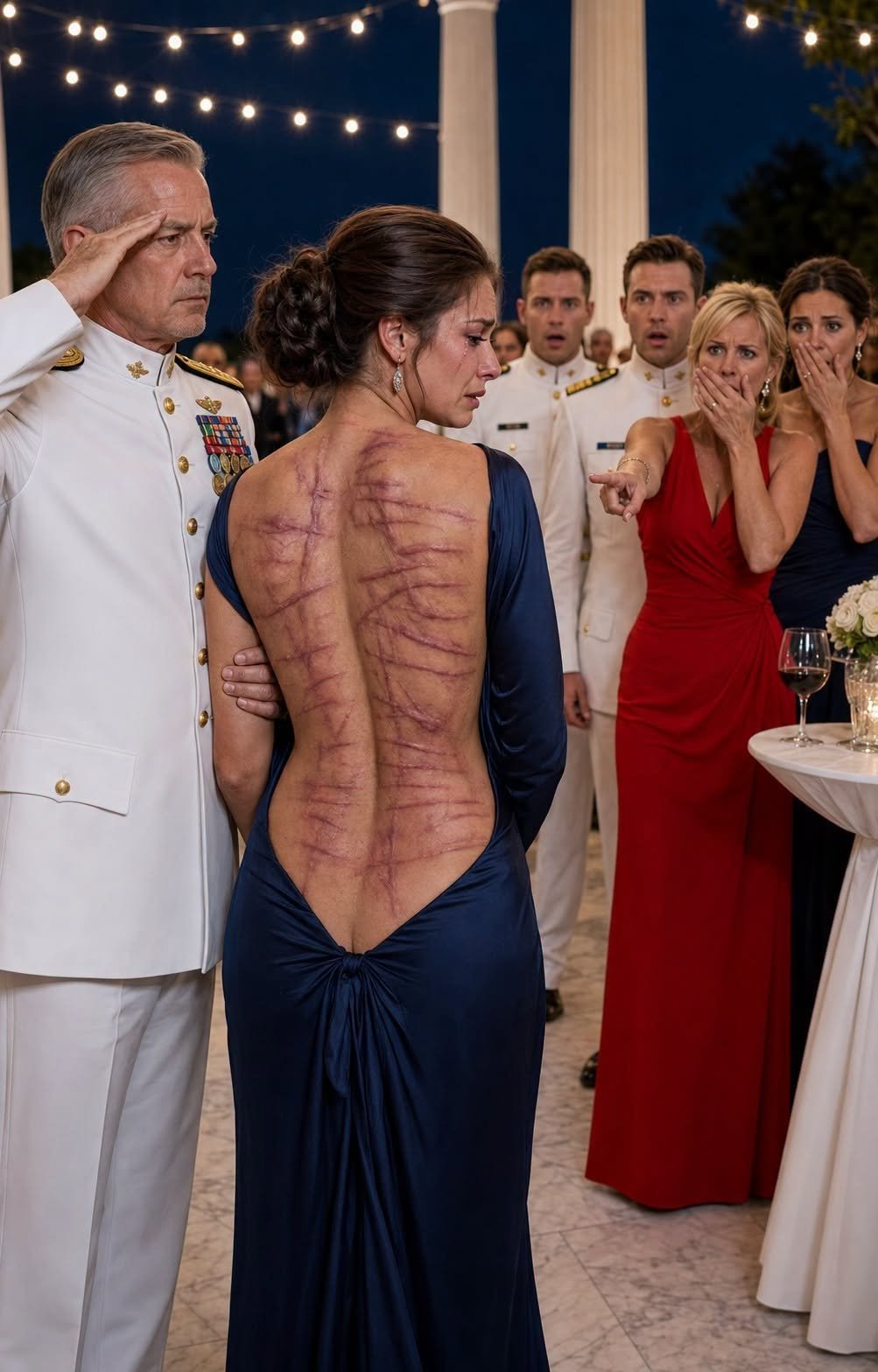
Then Harper ripped open my blouse in front of two hundred people.
She thought she had exposed the ugliest part of me.
Instead, she forced me to understand something.
Those scars were not evidence that I had been destroyed.
They were evidence that I had gone back.
Again.
And again.
And again.
When other people were running from the fire, I returned for sailors who could not save themselves.
When Arthur believed the evidence would burn with the vessel, I carried it out.
And when he spent five years telling the world that I was unstable, disgraced, and missing, I let him believe his lies had worked.
Sometimes the safest place for the truth is inside the person everyone has stopped watching.
I reached the end of the pier.
Footsteps sounded behind me.
Admiral Reed stopped beside me.
“What now, Captain?”
I looked across the harbor.
For five years, almost every decision I made had been connected to Arthur Sterling.
Investigate him.
Expose him.
Survive him.
Now it was finished.
“I think I finally go home.”
Reed smiled.
“Where is home?”
I watched the ships beyond the harbor lights.
Then I smiled.
“I haven’t decided yet.”
For the first time, uncertainty did not frighten me.
It felt like freedom.
Arthur had spent five years telling people I disappeared.
He was wrong.
I had never disappeared.
I had been serving.
Recovering.
Watching.
Collecting evidence.
Waiting.
Waiting for the day when Arthur became confident enough to believe I would never come back.
Then I returned to the one room where losing control would destroy him most.
His retirement party.
My sister tore open my blouse because she wanted two hundred important people to see a broken woman.
Instead, they saw the scars of an officer who had walked through fire.
My father ordered security to remove me because he considered me an embarrassment.
Instead, federal agents removed him.
Arthur Sterling spent forty years building an empire around his name.
I needed only one night to begin taking mine back.
Captain Evelyn Sterling.
Not Arthur Sterling’s missing daughter.
Not the Sterling family embarrassment.
Not the scarred woman they tried to hide.
Not the daughter they tried to erase.
A survivor.
An officer.
A captain.
And finally—
free.
THE END