
After she marries Daniel, we may lose access.
The final message was dated two weeks before my wedding.
Chloe’s dinner has to happen that day. The family needs to be with us, not with him.
I stared at that sentence until the words blurred.
The empty chairs had not been accidental.
The timing had not been careless.
My mother had scheduled Chloe’s engagement dinner during my wedding because she wanted to prove she could still command the family—and command me.
She believed I would see the empty chairs, panic, cancel the ceremony, and return to them.
Then I would keep paying.
Instead, I married Daniel.
And by sunrise, I closed every door they had left open into my life.
The legal process lasted months.
My mother insisted she had acted with my permission.
Chloe blamed my mother.
My father claimed he never read the documents, despite emails showing he had discussed the guarantor form.
Aaron cooperated in exchange for leniency on the expenses linked to him. He admitted he had known the line of credit existed but believed our mother when she said I had approved it.
I did not forgive him.
Cooperation is not repentance.
It is sometimes only self-preservation wearing a cleaner shirt.
Preston ended the engagement three days after the confrontation.
His parents withdrew from the venue contract and paid the cancellation fee themselves rather than remain connected to fraud.
Chloe posted online that I had destroyed her happiness because I could not stand seeing her loved.
For six hours, strangers called me bitter.
Then Aunt Rebecca posted the truth.
Not every detail.
Only the wedding invitation, the timestamp of my mother’s postponement email, and a photograph of the three empty rows.
Her caption was simple.
Grace’s wedding was never postponed. We were lied to.
Other relatives began commenting.
Uncle Thomas.
Cousins.
Family friends.
People who had spent a month believing I wanted silence finally understood that silence had been manufactured around me.
Chloe deleted her post.
My mother deleted her account.
The criminal case ended with restitution agreements, probation, mandatory financial counseling, and a permanent record for my mother and Chloe related to identity theft and forgery. My father avoided the most serious charges, but he was held responsible for part of the debt because he had knowingly benefited from it.
The truck was repossessed before the case concluded.
Aaron moved into a smaller apartment and began paying his own rent.
My parents switched to prepaid phones.
Chloe took a job at a medical office and postponed every wedding plan indefinitely.
I recovered most of the fraudulent debt through the bank’s identity-theft process. The remaining losses took time, paperwork, and more patience than my family deserved.
But the money was not the hardest part.
The hardest part was grieving people who were still alive.
I grieved the father I thought would walk me down the aisle.
The mother I kept trying to impress.
The brother I rescued whenever he fell.
The sister whose future I had been saving for while she planned to steal mine.
Some mornings, anger woke before I did.
Some nights, I dreamed I was back in the bridal suite, staring at Chloe’s text while the roses fell again and again.
Daniel never told me to move on.
Elise never told me blood was thicker than water.
Aunt Rebecca never asked me to keep the peace.
They let me heal without demanding that I become convenient.
Six months after the wedding, Daniel’s grandmother invited us to her backyard for what she called “a little family lunch.”
When we arrived, white chairs were arranged beneath maple trees.
Every chair was filled.
Aunt Rebecca was there.
Uncle Thomas.
Elise.
Daniel’s parents.
His cousins.
Coworkers who had sent flowers after hearing what happened.
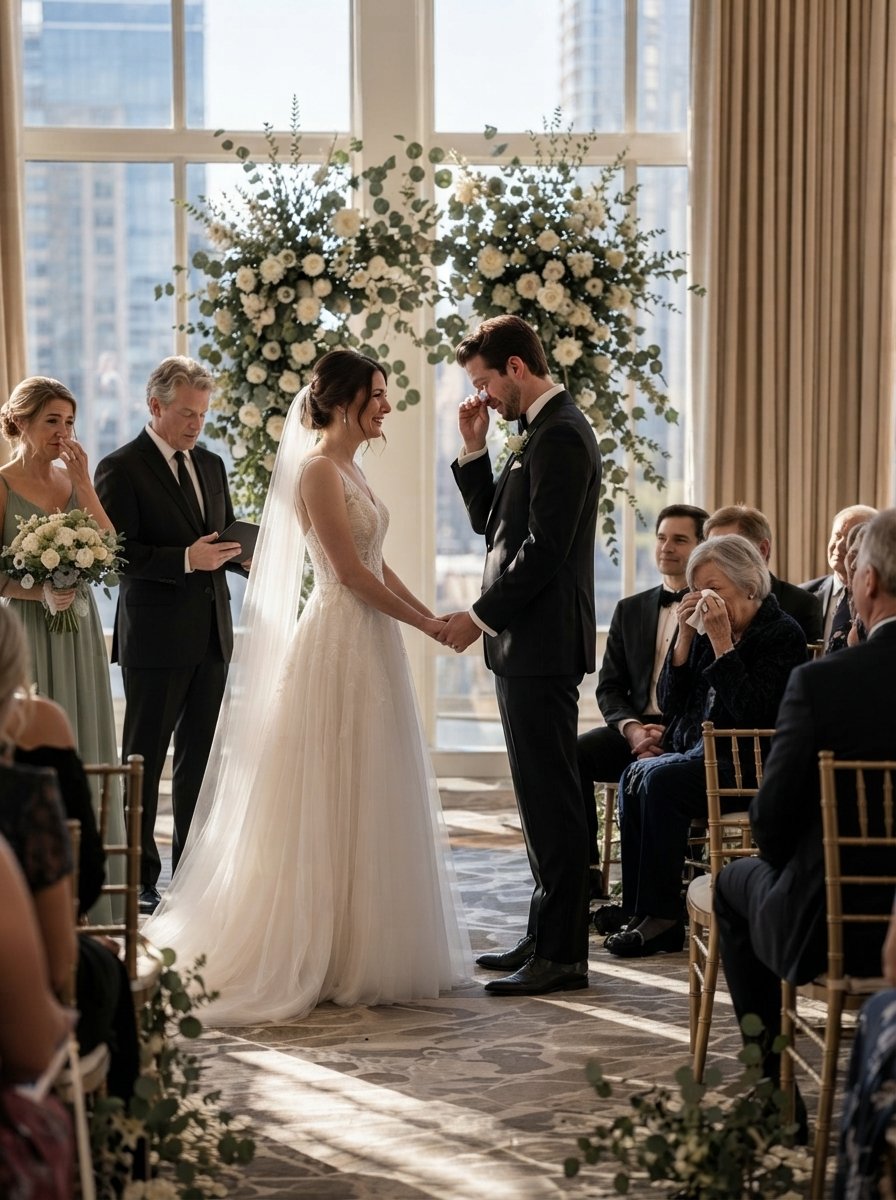
Even the hotel officiant stood near a small wooden arch covered in white roses and eucalyptus.
I stopped walking.
Daniel squeezed my hand.
“What is this?”
His grandmother smiled.
“A correction.”
The officiant stepped forward.
“We are not repeating the wedding,” he said. “The marriage was complete the first time. We are only replacing one memory.”
Elise handed me a bouquet.
White roses.
Eucalyptus.
The same flowers that had hit the floor at 1:43.
My hands began to shake.
Then I looked at the chairs.
No empty rows.
No blue dress.
No phone glowing with cruelty.
Only people who had chosen to come.
Daniel and I stood beneath the arch and read our vows again.
This time, when I looked toward my side, Aunt Rebecca was crying openly. Uncle Thomas had one arm around her. Elise was already ruining her mascara.
When I finished, Daniel leaned close.
“You were never alone,” he whispered. “They just wanted you to believe you were.”
That was the final truth my family had tried to steal from me.
They had mistaken dependence for love.
They had mistaken my generosity for weakness.
They had mistaken access for ownership.
Most of all, they had believed that leaving three rows empty would make me crawl back to them.
Instead, those empty chairs showed me exactly where my real family should sit.
After the ceremony, Daniel’s grandmother cut a small vanilla cake. We ate beneath strings of warm lights as evening settled across the yard.
At 7:14, exactly six months after I had opened my laptop in the hotel room, my phone vibrated.
A message from my mother.
We have done everything the court required. When are you going to stop punishing us?
I read it once.
Then I looked around the yard.
At Daniel laughing with Elise.
At Aunt Rebecca holding my bouquet.
At people gathering folding chairs before the night rain came.
For years, I had believed boundaries were punishments.
That saying no was cruel.
That love required me to absorb every cost.
But a boundary is not revenge.
It is a locked door after someone has repeatedly entered without permission.
I typed one response.
I am not punishing you. I am living without being used.
Then I blocked the number.
The rain began a few minutes later.
Everyone rushed beneath the porch roof, carrying plates, flowers, and half-empty glasses. Daniel pulled me against him while thunder rolled somewhere beyond the trees.
I watched the white roses darken beneath the rain.
This time, none of them fell.
And for the first time in my life, I understood that losing a family and escaping one can feel exactly the same at first.
The difference comes later.
It comes when the calls stop making your heart race.
When your bank account belongs only to you.
When holidays no longer feel like invoices.
When love arrives without a payment schedule.
When the chairs beside you are filled by people who came because they wanted to witness your happiness—not because they expected to profit from it.
My family had left me alone at my wedding.
By sunrise, I had taken away the money they thought made me theirs.
But the greatest thing I reclaimed was not thirty-four thousand dollars, a forged signature, or an account balance.
It was the right to decide who deserved a place in my life.
And unlike the seats they abandoned, that place would never again be reserved simply because someone shared my blood.