
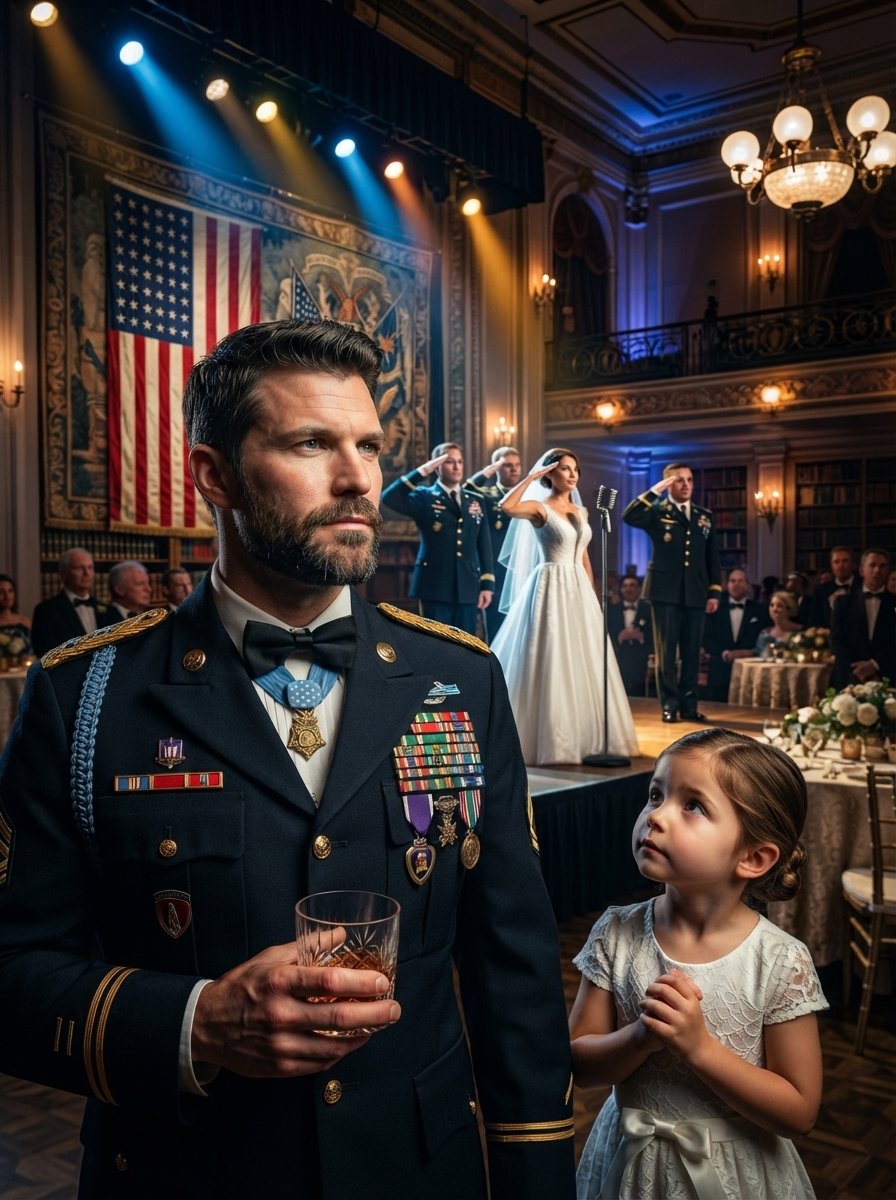
My father choked, stumbling backward into a waiter. “Major… General? That’s impossible. He washes trucks! He’s an enlisted failure!”
“He commands the 10th Mountain Division, Robert,” a guest at a nearby table—a retired federal judge—whispered in awe, slowly standing up. “Do you have any idea how many stars that is? He answers directly to the Pentagon.”
I took a breath. I let the “Gray Man” drop. I straightened my spine—a reflex honed over two decades of command, of leading men into fire. My posture shifted from the invisible servant to the apex predator in the room.
I returned Sophia’s salute. Sharp. Precise.
“As you were, Captain,” I said softly, recognizing her former rank. In the dead silence of the room, my voice carried like a thunderclap.
Before the shock could fully settle, the door to the private room swung wide open. Richard Vance stepped out, his face twisted in a snarl, his bodyguard looming behind him.
“What is this circus?” Vance demanded, looking at my father. “Handle your family, Robert, or the deal is off.”
I didn’t look at my father. I walked directly toward Vance. The crowd parted instantly. People who had ignored me ten minutes ago were now practically pressing themselves against the walls to get out of my way.
“The deal is already off, Mr. Vance,” I said, stopping three feet from him.
Vance sneered, looking me up and down. “And who are you supposed to be? Some glorified boy scout in a cheap suit? Step aside before my associate moves you.”
The bodyguard took a threatening step forward. I didn’t even flinch. I reached into my jacket and pulled out the encrypted datapad, tapping the screen once.
“I am the man who has spent the last six months tracking your money laundering operations through the Cayman Islands,” I stated, my voice low enough for only him and my family to hear, but laced with absolute zero coldness. “I am the man holding a sealed federal indictment with your name on it, signed by the Attorney General two hours ago. And I am the man who has a tactical FBI strike team waiting at the perimeter of this hotel.”
Vance’s arrogant sneer vanished. The color drained from his face, leaving him looking like a wax figure.
“You’re lying,” he whispered, but his eyes betrayed his absolute terror.
“Check your phone, Richard,” I suggested mildly. “Your offshore accounts were frozen exactly four minutes ago.”
Vance didn’t check his phone. He looked at the exits. He looked at his bodyguard, who was suddenly looking very nervous. Without another word, Vance turned on his heel and fast-walked toward the service elevator, abandoning my father, abandoning the deal, running like the rat he was.
Vance was gone, but the true parasite remained. I turned slowly to face my father, the datapad still heavy in my hand. It was time to settle the family debt.
My father was shaking. He looked from the retreating back of Richard Vance to me, his mind desperately trying to process the collapse of his reality.
“Thomas… I don’t… what did you just do?” he stammered, his voice cracking. “Vance was my investor! He was going to save the logistics company! You just ruined me!”
“There was no investment, Robert,” I said, dropping the title of ‘father’ permanently. “Vance was going to use your trucks to traffic contraband, let the feds raid your warehouses, and leave you holding the bag for twenty years in federal prison. I didn’t ruin you. I saved you from dying behind bars.”
Aunt Linda pushed her way to the front of the crowd. Her face was a mask of frantic, desperate fawning.
“Thomas! A General!” she shrieked, reaching out to grab my arm. “Oh, we knew you were destined for greatness! We need to redo the portrait! We must get a photo with you!”
I stepped back. A simple, smooth motion. I let her hand grasp empty air.
“You only want successful people in the shot, Linda,” I said coldly. “And I have a mess to clean up. I wouldn’t want to stain your silk.”
She recoiled as if I had slapped her.
I turned my attention back to my father. He was sweating profusely, trying to salvage his pride in front of the Senator and the wealthy elite who were now watching him with undisguised pity.
“But… Sophia said you paid for this,” my father wheezed. “And the house… Vanguard Holdings. That was you?”
“Vanguard is my private trust,” I replied. “I invested my hazard pay in defense tech startups fifteen years ago. I got lucky. Then I got smart.”
“You paid off the mortgage?” he asked, a glimmer of greedy hope returning to his eyes. “Son, that’s wonderful. With your capital and my experience, we can rebuild. ‘Davis & Son’. Think of the legacy!”
It was pathetic. The frantic clawing of a man falling off a cliff, trying to grab onto the very person he had pushed.
“I didn’t pay it off,” I corrected him, my voice carrying no malice, only absolute, chilling fact. “I bought the debt from the bank. Which means I own the mortgage. I own the estate. You are drinking champagne in a house that belongs to the ‘grunt’ you shoved out of your life.”
I reached into my breast pocket and pulled out a thick, manila envelope. I walked past my father, ignoring him completely, and approached Michael and Sophia.
Michael was crying. He hugged me, holding on tight. “I didn’t know, Tommy. I swear I didn’t know you did all this.”
“I know you didn’t,” I said softly, returning the embrace. I pulled back and handed him the envelope. “This is for you. Both of you.”
“What is it?” Sophia asked, standing close to Michael.
“It’s the deed to the estate,” I said loudly enough for my father to hear. “I transferred it into your names this morning. It’s a wedding gift. Free and clear.”
My father let out a strangled cry. “You gave it to him?! But I live there! That is my house! You can’t do this to me!”
I slowly turned to look at him. He was shorter than I remembered. Smaller.
“You live there at their pleasure,” I said, my voice echoing in the silent ballroom. “Michael is the master of the house now. If he wants to let you stay in a guest room, that is his choice. But you will never hold a roof over his head again. You will never threaten him with inheritance again. Because you have absolutely nothing left to give.”
I looked at Sophia and offered a respectful nod. “Thank you for the salute, Captain. But you shouldn’t have blown my cover.”
She smiled, a fierce, beautiful expression. “Honor must be paid, General. And bullies must be stopped.”
“Indeed,” I said. I checked my watch. “My leave ends at 0800. I have a flight to catch.”
I turned toward the grand exit. The crowd parted silently, a sea of wide eyes and shocked whispers. But this time, my departure would not be quiet.
I walked out the heavy brass doors of the Pierre Hotel and stepped into the cool, humid night air of New York City. The transition from the suffocating atmosphere of the ballroom to the open sky was a physical relief.
Behind me, I heard the frantic footsteps of my father. He burst through the doors, his tuxedo disheveled, his face red with a mix of rage and absolute desperation.
“Thomas! Wait!” he screamed, running down the steps. “You can’t just leave! I am your father! I made you!”
I stopped on the sidewalk. I didn’t turn around right away. I let the silence stretch. Then, I looked over my shoulder.
“No, Robert,” I said, my voice barely above a whisper, yet carrying the weight of twenty years of war. “The Army made me. The fire made me. You just made me leave.”
Before he could respond, a low, rhythmic thumping sound began to echo off the skyscrapers. It started as a vibration in the pavement and quickly escalated into a deafening roar.
The guests began spilling out of the hotel lobby, drawn by the noise. They looked up at the sky in shock.
Descending rapidly from the night sky, its navigation lights cutting through the darkness, was a matte-black UH-60 Black Hawk helicopter. It didn’t belong in the city. It belonged in a war zone. And it was landing right on the hotel’s expansive, manicured lawn.
The downdraft from the massive rotors hit the ground like a hurricane. It whipped across the entrance, tearing the $15,000 floral arrangements to shreds. White lilies and orchids were blasted into the air like confetti. The wealthy guests shrieked, covering their faces as their expensive hairstyles and designer gowns were violently blown apart by the sheer, unadulterated power of the military machine.
My father was forced to his knees by the wind, shielding his face with his arms. He looked tiny. A broken king amidst a storm he couldn’t control.
The side door of the Black Hawk slid open. My aide, Captain Lewis, stood in the doorway in full tactical gear. He snapped a crisp salute.
I didn’t look back at my father. I didn’t look at Aunt Linda, who was clutching a pillar for dear life. I walked into the storm, the wind tearing at my suit, and climbed aboard.
“Eventful night, General?” Lewis shouted over the roar of the engines.
“Mission accomplished, Captain,” I replied, strapping into the canvas seat. “Hostile neutralized. Asset secured.”
“Where to, sir?”
“Base,” I said. “We have a war to win.”
The helicopter banked hard, pulling away from the earth. I looked down through the open door one last time. The hotel looked like a dollhouse. The people were just specks of dust. I saw my father, still on his knees on the ruined lawn, watching his son—the asset he threw away, the savior he didn’t deserve—disappear into the night.
I pulled out my phone. The screen lit up with a single notification.
Friend Request: Robert Davis.
I looked at the name. I remembered the boy who had begged for approval. I remembered the teenager who was told he was worthless. I remembered the man who was ordered to wipe up a spilled drink.
I pressed Delete.
Then I pressed Block.
Some bridges are burned for a reason—to keep the enemy from following you home. I slipped the phone into my pocket, leaned back against the canvas netting, and let the rhythmic beating of the rotors carry me toward my real family.