Eight years after my husband walked out just days after I told him I was pregnant, he invited me to Christmas dinner to show off the “perfect life” he had built without me.
So I arrived with the four eight-year-old children he had never known existed.
His fiancée went silent.
Then his mother opened a locked desk and pulled out a letter that explained why the truth had been buried for eight years.
PART 1 — THE CHRISTMAS DINNER MY FORMER HUSBAND THOUGHT WOULD HUMILIATE ME
Eight years after my husband walked out of our marriage, he invited me to Christmas dinner.
I knew immediately that the invitation had nothing to do with forgiveness.
It was about proving something.
On a cold December afternoon, I stood beside the wide windows of my office in Phoenix, Arizona, watching the sunlight stretch across the city when my phone vibrated on the desk.
The name on the screen stopped me.
Conrad Ashby.
My former husband.
I had not heard from him in years.
His message was short.
“My family is gathering for Christmas in Montana. Mom thinks enough time has passed. You should come. It might be good for everyone to see that we’ve all moved forward.”
I read the final sentence twice.
Moved forward.
Conrad had always known how to make a challenge sound polite.
Eight years earlier, I had been twenty-nine, terrified, newly pregnant, and desperately trying to save a marriage that was already falling apart.
When I told Conrad I was expecting, I thought the news might bring us closer.
Instead, he stared at me as though I had handed him a problem he wanted no part of.
“The timing is too convenient, Cecily.”
I never forgot those words.
I asked what he meant.
He accused me of using the pregnancy to stop him from leaving.
No doctor’s appointment, medical record, or explanation could change his mind because he had already decided what he wanted to believe.
Within days, he was gone.
And he never learned the whole truth.
My chief of staff, Delaney Frost, entered my office carrying a folder.
She saw my expression and stopped.
“What happened?”
I handed her the phone.
She read the message and slowly looked up at me.
“Please tell me you’re deleting this.”
I smiled.
“I’m going.”
Her eyebrows rose.
“Why would you give these people another chance to hurt you?”
I turned toward the windows.
“Because I’m not going there as the woman Conrad remembers.”
Delaney studied me for a moment.
Then she smiled.
“He has absolutely no idea, does he?”
“Not even close.”
PART 2 — THE FOUR CHILDREN HE NEVER STAYED LONG ENOUGH TO MEET
The morning of December twenty-fifth arrived bright and clear.
Before sunrise, my four children were already moving around the house, checking bags, searching for gloves, and arguing gently over who would sit closest to the helicopter window.
Parker was the oldest by eleven minutes.
He loved reminding everyone.
Miles had been born seven minutes after him and believed the difference meant absolutely nothing.
Then came Audrey.
And finally, Willa.
Two boys.
Two girls.
Four eight-year-old children who had entered my life on the same remarkable day.
Quadruplets.
When Conrad left me, even I did not yet know there were four babies.
Those first weeks had been confusing and overwhelming.
By the time the doctors confirmed everything, my marriage was already over, and every attempt I made to contact Conrad disappeared into silence.
Eventually, I stopped trying.
I built another life.
It was not glamorous at first.
There were sleepless nights.
Bills covering the kitchen table.
Four infant carriers.
Endless laundry.
And more fear than I ever admitted.
But there was also joy.
So much joy.
My small consulting company grew slowly at first.
Then rapidly.
Eight years later, it had offices in three states and contracts I once would have considered impossible.
Money made some things easier.
But money did not raise my children.
Love did that.
Consistency did that.
Showing up every morning did that.
As we prepared to leave, Parker looked at me.
“Mom, are these people our relatives?”
I paused.
Children deserved honesty.
But they did not deserve to carry adult resentment.
“Technically, some of them are connected to you.”
Audrey frowned.
“That sounds complicated.”
I laughed.
“It is complicated.”
Miles zipped his coat.
“Are we meeting our father?”
The room became quiet.
I had never hidden Conrad’s identity from them.
They knew his name.
They had seen old photographs.
But I had never pushed them to feel anything they did not naturally feel.
“Yes,” I said. “You are.”
Willa slipped her small hand into mine.
“Is he nice?”
That was harder to answer.
“I think today you should meet him and decide for yourselves.”
Parker nodded thoughtfully.
“Are you nervous?”
I looked at all four of them.
“A little.”
Audrey smiled.
“Then we’ll stay close to you.”
That simple promise almost broke my composure.
For years, I had believed I was the one protecting them.
Sometimes I forgot how much strength they gave me in return.
PART 3 — OUR ARRIVAL IN MONTANA
Conrad’s family owned a winter estate outside Big Sky, Montana.
Calling it a house would have been ridiculous.
It was a sprawling mountain property built from stone, timber, and enormous walls of glass overlooking snow-covered peaks.
Christmas wreaths hung beside the entrance.
Garlands wrapped around the porch railings.
Tall pine trees glittered with white lights.
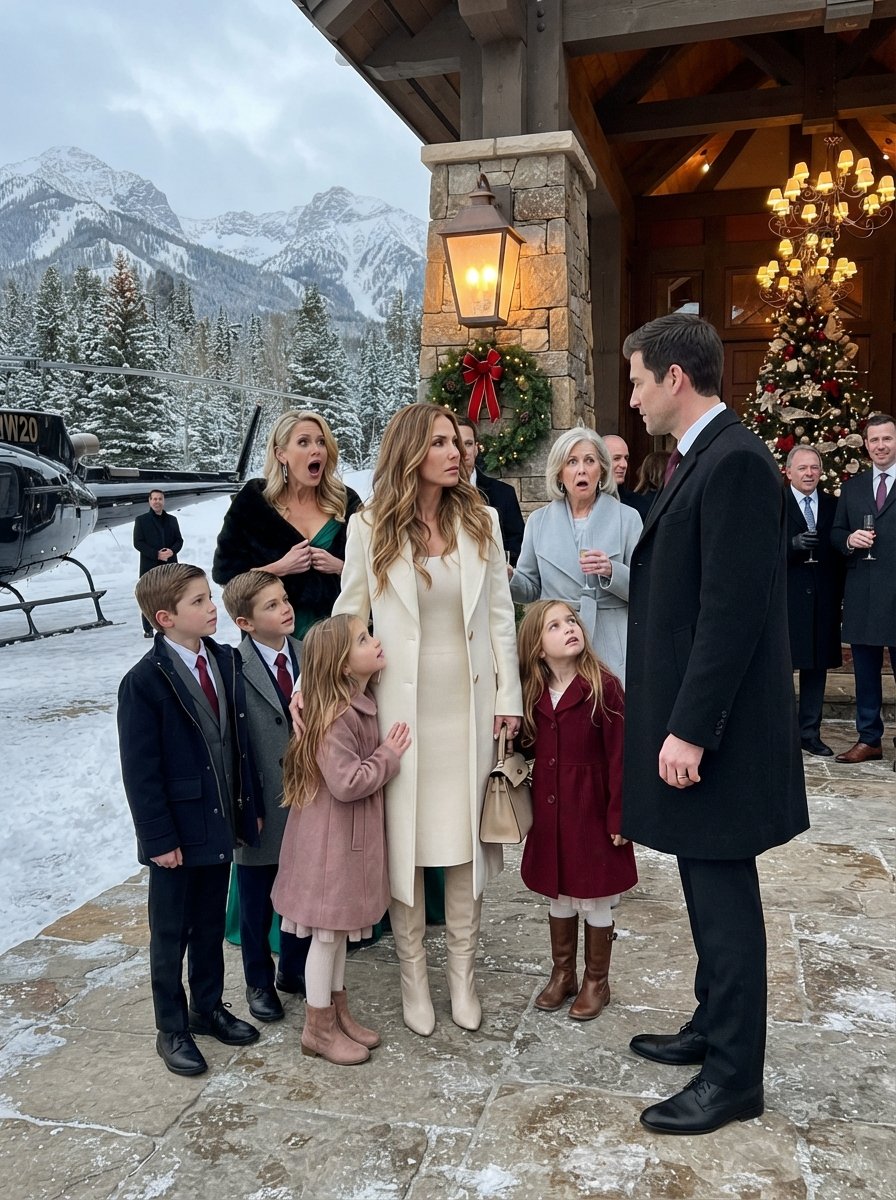
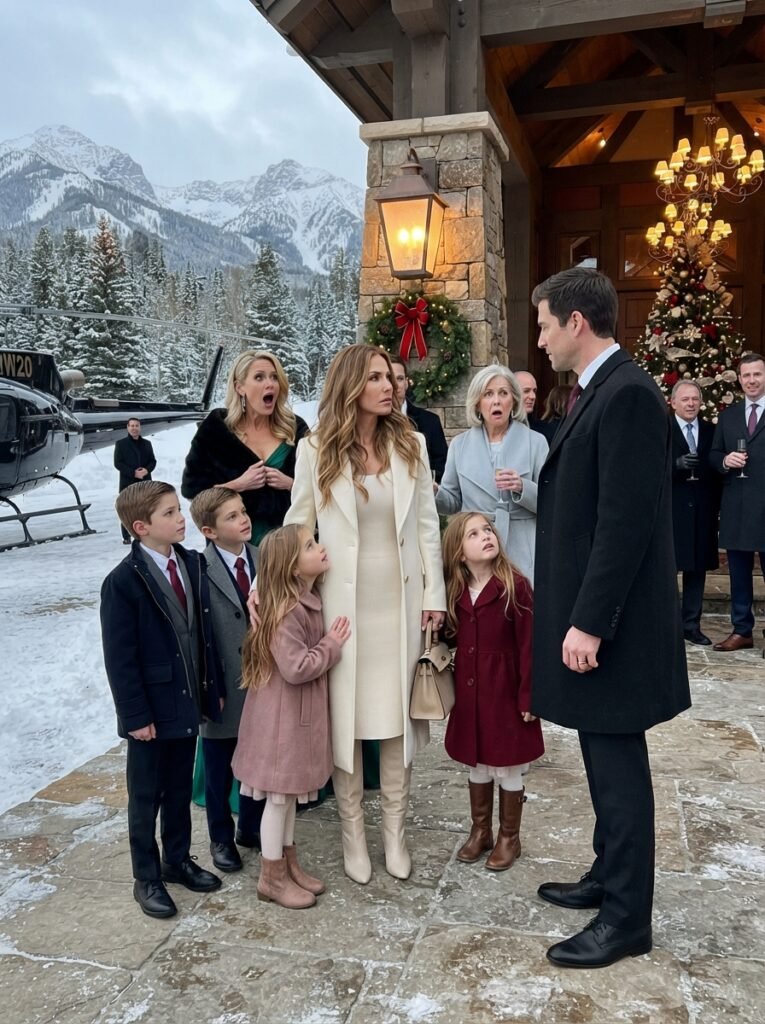
Our helicopter landed on a private pad near the main residence shortly after noon.
The children climbed out one by one.
I followed.
Parker and Miles wore dark wool coats.
Audrey wore a cream winter coat.
Willa insisted on wearing the dusty-rose coat she had chosen herself.
The front door opened before we reached the steps.
Eleanor Ashby appeared first.
My former mother-in-law.
She looked almost exactly as I remembered her, only older.
Perfect hair.
Elegant clothing.
The unmistakable posture of a woman accustomed to rooms adjusting themselves around her.
Her polite smile remained until she noticed the children.
Then she froze.
Her eyes moved from Parker to Miles, then Audrey, then Willa.
Her champagne glass slowly lowered.
Several relatives behind her turned toward us.
Then Conrad appeared.
For one suspended moment, neither of us moved.
He was forty-one now.
There were faint lines around his eyes and a little gray at his temples.
Otherwise, he looked like the same handsome man I had once believed I would grow old beside.
A beautiful blonde woman in an emerald-green dress stood next to him.
Her hand rested naturally on his arm.
A diamond sparkled on her finger.
His fiancée.
Conrad’s eyes left mine and settled on Parker.
Then Miles.
Then Audrey.
Finally Willa.
His expression changed.
Recognition came before understanding.
The resemblance was impossible to ignore.
Parker had Conrad’s gray-blue eyes.
Miles had his jawline.
Audrey’s expressions sometimes reminded even me of Conrad’s younger photographs.
And Willa had his crooked half-smile.
The woman beside him whispered:
“Conrad, who are these children?”
He did not answer.
I walked closer.
“Merry Christmas.”
Conrad looked at me.
Then back at the children.
“Cecily…”
His voice barely carried.
I remained calm.
“You invited me to show everyone how well your life turned out.”
His expression tightened.
“I didn’t mean it like that.”
I glanced at my children.
“Either way, I thought I should bring the four people who became my life after you left.”
Eleanor’s hand trembled.
“Four?”
I met her eyes.
“Yes. Four.”
PART 4 — THE QUESTION NO ONE COULD ANSWER
Silence spread through the entryway.
Willa studied Conrad longer than the others.
Then she stepped forward slightly.
“Are you Conrad?”
He nodded.
“Yes.”
She looked at him carefully.
Then she turned to me.
“Mom, is he the man in that old picture in your desk?”
Several guests quietly looked away.
I nodded.
“Yes, sweetheart.”
Willa turned back toward Conrad.
“Then you’re our dad?”
His fiancée slowly removed her hand from his arm.
Conrad’s face turned pale.
“I… I didn’t know about you.”
Parker asked immediately:
“Didn’t Mom tell you?”
Conrad looked at me.
There are moments when a person suddenly realizes that the version of the past they have repeated for years can no longer survive.
This was one of them.
“She told me she was expecting,” he admitted.
Miles frowned.
“So you knew there was a baby.”
Conrad swallowed.
“I didn’t believe her.”
Audrey’s expression changed.
She was usually the quietest of the four.
But whenever something felt unfair, she could suddenly become fearless.
“Why wouldn’t you believe our mom?”
Conrad had no answer.
Not one he could say in front of them.
His fiancée stared at him.
“You told me you had never had children.”
“I didn’t think I did.”
She shook her head.
“That’s different from never being told.”
For the first time since arriving, I almost felt sorry for him.
Almost.
PART 5 — WHAT ELEANOR HAD BEEN TOLD
Eleanor finally invited us inside.
The children gathered near the enormous Christmas tree while the adults attempted to continue conversations that had clearly lost all importance.
Several minutes later, Eleanor approached me.
Her voice was softer than I remembered.
“Cecily, I need to ask you something.”
“Go ahead.”
“Why didn’t you contact me?”
I stared at her.
“I did.”
She blinked.
“No. You didn’t.”
“I called your home twice. I emailed you. I sent a letter.”
The color slowly disappeared from Eleanor’s face.
“I received nothing.”
Conrad stepped closer.
“Mom, don’t do this.”
She turned sharply toward him.
“Do what?”
He remained silent.
Eleanor looked back at me.
“Conrad told us you admitted the pregnancy wasn’t real.”
My chest tightened.
“I never said that.”
She stared at me.
Then at him.
“He also told me you wanted no further contact with the family.”
I gave a quiet, humorless laugh.
“Apparently we were both given very convenient versions of the truth.”
Conrad rubbed one hand across his forehead.
“I was angry. I handled things badly.”
“Badly?” Eleanor repeated.
“There are four children standing in my living room whom I didn’t know existed.”
The room fell silent again.
PART 6 — THE APOLOGY MY SON ASKED FOR
Later that afternoon, Conrad tried talking to the children.
I stayed nearby but allowed them to decide how much interaction they wanted.
He asked Parker about school.
He asked Audrey what she liked to read.
Miles told him about baseball.
Willa explained that she wanted a dog even though I kept reminding her that four children already made our house busy enough.
For a few moments, everything almost looked normal.
That was the strange part.
Normality could appear even after years of absence.
But appearance was not trust.
Eventually, Miles crossed his arms.
“You should say sorry to Mom.”
Conrad looked surprised.
“I already apologized to her.”
Miles shook his head.
“I didn’t hear it.”
I almost interrupted.
But Conrad raised his hand.
“He’s right.”
He turned toward me.
Everyone nearby became quiet.
“Cecily, I was selfish. I chose what I wanted to believe because it made leaving easier. I should have listened. I should have checked. I should have given you the respect you deserved.”
Then he looked toward the children.
“And because I didn’t, I missed eight years I can never get back.”
I appreciated the apology.
But I also understood something important.
An apology could acknowledge the past.
It could not automatically create a future.
“Thank you for saying it,” I replied.
Parker looked at Conrad.
“Mom always says words matter more when your actions match them.”
Conrad gave a sad smile.
“Your mom is right.”
PART 7 — THE ENVELOPE IN THE LIBRARY
I thought the biggest surprise of the day had already happened.
I was wrong.
After dinner, Eleanor quietly asked me to follow her into the library.
Conrad came with us.
She closed the door and walked toward an antique writing desk near the fireplace.
From a locked drawer, she removed a yellowed envelope.
“I haven’t looked at this in years.”
She handed it to me.
Inside was a letter supposedly written by a physician.
It claimed that I had never been pregnant and had used the pregnancy story to delay the divorce.
I read it twice.
“This is not real.”
Eleanor slowly sat down.
“I believed it was.”
Conrad stared at the page.
“Where did you get this?”
“It arrived shortly after you moved out.”
I immediately photographed the letter and sent it to Delaney.
She had an eye for inconsistencies.
A few minutes later, my phone rang.
“Cecily, don’t leave that document there.”
My stomach tightened.
“What did you find?”
“The physician named at the bottom could not have written it.”
“Why?”
“He retired years earlier and died before the date printed on the letter.”
I looked at Eleanor.
Delaney continued.
“There is another problem. The clinic’s administrative company was connected to an old family trust.”
“Whose trust?”
There was a pause.
“The Ashby family trust.”
I slowly lowered the phone.
Eleanor looked stunned.
Conrad turned toward his mother.
“Did you know about this?”
Her voice trembled.
“No.”
For the first time that day, I believed her completely.
Someone had deliberately wanted both sides of the family to believe the other had closed the door.
Whoever created that letter had succeeded for eight years.
But not anymore.
PART 8 — WHAT I CHOSE BEFORE LEAVING
Snow began falling after sunset.
The children pressed their faces against the windows as large white flakes covered the terrace.
Eleanor packed homemade Christmas cookies into four boxes.
Before handing them to the children, she quietly asked me:
“May I hug them?”
That question mattered more than she probably understood.
She was not assuming a relationship.
She was asking permission to begin one.
I nodded.
“Ask them.”
Audrey hugged her first.
Then Willa.
Parker followed.
Miles waited a little longer.
Eventually, he stepped forward too.
Conrad stood near the doorway as we prepared to leave.
There was regret on his face.
But I no longer needed his regret to heal anything inside me.
He looked toward the children.
“Would it be all right if I saw you again?”
Parker looked at me.
I did not answer for him.
Finally, he said:
“Maybe. But you have to actually show up.”
Conrad nodded.
“I will.”
I put on my gloves.
“Don’t promise them anything you aren’t prepared to keep.”
He met my eyes.
“I understand.”
“I hope you do.”
FINAL — THE LIFE I HAD ALREADY WON
As the helicopter lifted above the mountains, the estate grew smaller beneath us.
Willa leaned against my shoulder.
Miles talked excitedly about the snow.
Audrey opened her cookie box even though I reminded her that we had just eaten.
Parker quietly stared out the window.
Then he turned toward me.
“Mom?”
“Yes?”
“Are you happy you came?”
I thought about it.
I had entered that house believing I was returning to one of the most painful chapters of my life.
Instead, I discovered something completely different.
I no longer belonged to that old story.
I had outgrown it.
“Yes,” I said. “I am.”
Parker smiled.
“Me too.”
Eight years earlier, Conrad’s departure had made me believe my future had disappeared.
I had been wrong.
My future had simply taken a form I could not yet imagine.
Four children.
A career I built myself.
A home filled with noise and laughter.
Friends who became family.
Confidence that came slowly, one difficult day at a time.
That Christmas, I did not leave Montana feeling victorious because Conrad regretted losing me.
I left feeling peaceful because his regret no longer determined my worth.
That was the real victory.
Sometimes, the moment that feels like the end of your life is simply the beginning of a chapter you are not yet strong enough to imagine.
The people who underestimate you may remember the version of you they once knew while completely missing the quiet years when you learned to stand on your own.
Real family is not created by wealth, bloodlines, impressive houses, or shared last names.
It is created by people who repeatedly choose honesty, kindness, responsibility, and presence.
An apology can matter.
But trust must be rebuilt through consistent actions, not only emotional words spoken in one powerful moment.
Children should never have to carry resentment that belongs to adults.
They deserve the freedom to form relationships based on truth and their own experiences.
Walking away from someone may feel easy in the moment, but the consequences of avoiding responsibility can keep growing long after the person who left has stopped looking back.
Healing does not require forgetting what happened.
It does not require pretending painful choices were acceptable.
Sometimes healing simply means the past no longer controls your future.
There is a special kind of strength in building a beautiful life without needing the people who once doubted you to approve of who you have become.
The most satisfying answer to rejection is rarely revenge.
It is reaching a place where your happiness, purpose, and self-respect no longer depend on whether someone else recognizes your value.
And sometimes, the greatest Christmas gift is not reconciliation, money, or even an apology.
Sometimes it is finally seeing your own journey clearly and realizing that the life you fought so hard to build was already the happy ending you once believed someone else had taken away from you.