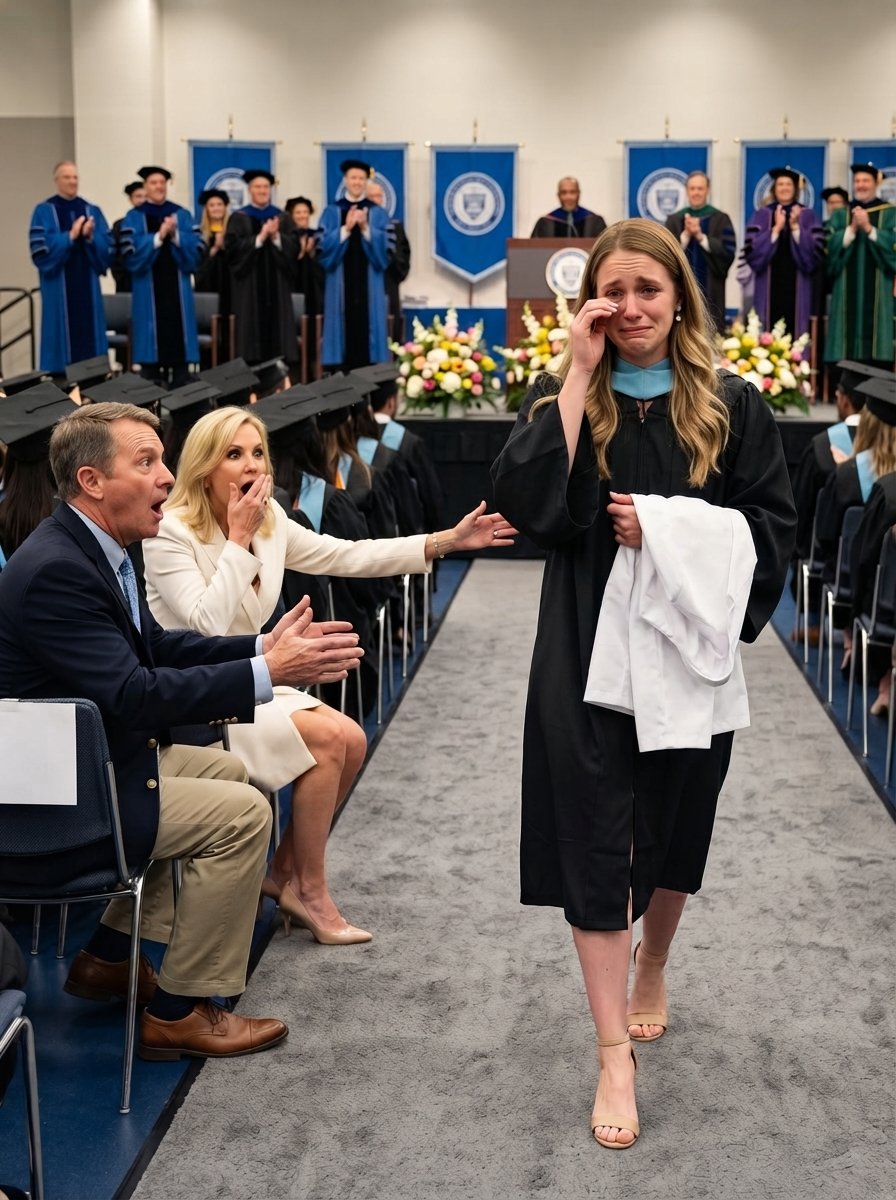
At my graduation, the same parents who had abandoned me during cancer treatment walked into the reserved seats like they had earned a place in my success.
They leaned close and whispered that I “owed them this moment.” But when the dean announced the valedictorian and read the name embroidered on my white c
oat, their confidence vanished. Before I even reached the stage, their faces had already changed.
Part 1: The Daughter They Chose Not to Save
The auditorium smelled of polished floors, fresh coffee, and freshly printed graduation programs. I sat in the front row with my white coat folded across my lap,
keeping the embroidered name hidden while the dean read from the podium.
I had imagined this day for years. I thought I would feel only relief when it finally came. Instead, my past was sitting three rows behind me in the reserved family
section.
Linda Barrett, the woman who gave birth to me, sat beside my biological father, Richard. My older sister, Allison, held her phone in the aisle seat. All three acted as
though they had earned the right to celebrate the life they abandoned fifteen years ago.
They smiled at strangers and accepted congratulations from people who knew nothing about us. Then I heard Linda whisper loudly enough for me to hear.
“She owes us this moment after everything.”
I did not turn around.
Some words hurt not because they shock you, but because they prove the people who hurt you still have no idea what they did.
Fifteen years earlier, I was thirteen, sitting in Room 314 at St. Anne’s Medical Center. My feet did not reach the floor as Dr. Michael Grant sat across from my parents
with a tablet in his hands, preparing to say the words that would divide my childhood in two.
“It is acute lymphoblastic leukemia.”
The room seemed to tilt. Dr. Grant explained that it was the most common type of childhood cancer and that aggressive chemotherapy gave me a strong chance of
survival.
I heard “treatable.” I heard “survival.” I waited for my mother to hold my hand or my father to promise that we would face it together.
Instead, Richard asked, “How much?”
Dr. Grant explained that treatment could take two to three years and might cost sixty to one hundred thousand dollars out of pocket, though assistance programs
were available.
My father gave a bitter laugh. “So we have to pay a hundred grand because she got sick?”
Then he started talking about Allison’s future. She was sixteen, applying to elite universities, and my parents had saved $180,000 for her college fund.
“We are not wiping out her future over this,” he said.
I waited for my mother to defend me.
She did not.
Richard finally looked at me. “Allison has potential. She is brilliant and focused. You have always been average, Hannah. We are not sacrificing a promising future for
an average one.”
Cancer terrified me.
But my parents’ calculation destroyed something deeper.
I whispered, “I’m your daughter too.”
Dr. Grant stood abruptly. “I need you to leave while I speak with Hannah privately.”
“We are her parents,” Linda protested.
“Leave,” he said, “or I will call security and social services right now.”
They left without hugging me, touching my shoulder, or saying they loved me. Within hours, emergency custody paperwork had been signed, and the state became
responsible for the child my parents had decided was too expensive to keep.
That night, I lay under hospital lights, listening to machines beside my bed. I was no longer only afraid cancer might end my life.
I wondered if my parents would feel relieved if it did.
Then Rachel Morgan walked into my room.
She was a thirty-four-year-old night nurse with dark curls, blue scrubs, worn sneakers, and none of the fake cheer adults often used around scared children.
“Hey, Hannah,” she said softly. “I’m Rachel. I’ll be your night nurse.”
I turned toward the window. “I feel terrible.”
Rachel did not tell me to be brave. She just sat beside me.
“I heard what happened today,” she said. “And I’m so sorry.”
I cried.
Rachel stayed.
Later, she came back with crackers and a deck of cards. We played until nearly two in the morning. She told me about her overweight cat, Muffin, and about her
younger brother, who had survived leukemia years earlier. That was one reason she had become a nurse.
My parents did not return the next day.
Or the next week.
As chemotherapy stole my appetite, strength, and hair, Rachel kept showing up with clean blankets, terrible jokes, medication reminders, and the steady kindness I
had stopped expecting from adults.
Twenty-eight days after my diagnosis, Dr. Grant said treatment was working well enough for outpatient care to begin soon. A social worker named Janet Brooks
arrived and explained that they had found a foster placement.
Rachel was standing beside my bed, even though she was not scheduled to work that day.
“I want to take her,” she said.
Janet stared at her.
Rachel repeated it. “I want to foster Hannah. I’m already state-approved, and I understand her medical needs.”
Janet warned her about the appointments, medications, school plans, emergencies, paperwork, and responsibility.
Rachel listened without flinching. Then she turned to me.
“Only if you want to come home with me.”
For the first time since my parents walked out of Room 314, I felt something stronger than fear.
“Yes,” I whispered. “Please.”
I did not know it then, but that answer would change far more than my address.
The woman who entered my hospital room as my night nurse was about to give me what my biological family had decided I was not worth giving.
A home.
And eventually, her name.
The Name My Real Mother Gave Me
Laura’s house was small, with a front porch, a slightly crooked mailbox, and a little American flag tucked into a planter by the steps. Her cat, Waffles, disliked me for
three days before deciding my feet were the perfect place to sleep, and slowly that modest house became the first place where I understood what feeling safe
actually meant.
Laura organized her life around everything my treatment required, setting alarms for my medication, covering the refrigerator with appointment cards, and driving
me to chemotherapy even when winter ice covered the roads. When I was strong enough to return to school, she drove me there too, and unlike the people who
had abandoned me, she never treated caring for me as an expense she regretted.
She never called me average. She called me stubborn when I refused to drink enough water and brilliant when I passed algebra after missing nearly half the
semester, and even when I rolled my eyes at being called “kiddo,” there was a part of me that secretly loved hearing it.
The adoption process took time because there were hearings, home visits, medical reports, school records, and endless paperwork to complete. For months, I was
afraid to unpack everything because experience had taught me that adults could decide without warning that keeping me was no longer convenient, but Laura
continued showing up through every stage of the process.
Dr. Lawson wrote letters, Susan Myers handled the social-services requirements, and eventually the name printed across my school documents changed from
Higgins to Davidson. Until then, I had never understood that a surname could feel like shelter, but Davidson represented something my biological name never had:
someone had chosen me and stayed.
The years that followed brought remission appointments, medical checkups, college applications, scholarships, campus jobs, and countless nights studying over
cups of coffee that had gone cold hours earlier. Laura worked extra shifts whenever I needed financial help, while I worked whatever jobs I could fit around school,
and eventually I became the person my biological father had once declared I wasn’t worth becoming.
Medical school was especially exhausting, filled with anatomy labs, aching feet, endless textbooks, and moments when I genuinely wondered whether I could
continue. On those nights, I would sometimes call Laura from a stairwell, and regardless of how tired she was, she always answered.
“Cry for ten minutes, then eat something.”
Other times, when I felt guilty simply for being exhausted, she reminded me that fatigue didn’t mean failure.
“You are allowed to be tired without quitting.”
Sometimes Laura didn’t offer advice at all and simply remained on the phone until I felt calm enough to continue. Fifteen years after she first sat beside my hospital
bed, graduation morning finally arrived, and she helped steam my dress before carefully taking my first white coat from its hanger.
Over the heart, the embroidery read Dr. Emily Davidson. Laura touched the name gently with two fingers, and neither of us allowed ourselves to cry because we had
already agreed that our makeup needed to survive until after the ceremony.
When we arrived at the auditorium, staff directed the graduates toward the front while families were shown to their seats. Before leaving me, Laura squeezed my
hand and made the same kind of promise she had spent fifteen years keeping.
“I’ll be right where you can see me.”
I believed her because Laura had never given me a reason not to. What I didn’t know was that Karen, Thomas, and Megan had somehow learned about my
graduation and were already sitting in the reserved family section, behaving as though they had been part of everything that brought me there.
At first, I wondered whether I had imagined them. Then I saw Karen proudly pointing me out to another woman, Thomas accepting a graduation program from an
usher, and Megan sitting with her phone in her hand, and suddenly my body remembered Room 314 before my mind had fully caught up.
I remembered the soft click of the hospital door after they abandoned me, the gold clasp on Karen’s purse, and especially the word Thomas had used to define my
future: average. I searched the auditorium until I found Laura standing near the side of the stage, and she immediately recognized what was happening from the
expression on my face.
Laura didn’t rush toward me or turn my graduation into a confrontation. She simply placed one hand against her chest, giving me the quiet signal we both
understood.
I’m here.
That was enough to keep me in my seat. A few moments later, I heard Karen lean toward Thomas and whisper something that proved fifteen years had changed
almost nothing about the way she viewed me.
“She owes us this moment after everything.”
I almost laughed, because there was something astonishing about people who had abandoned every difficult chapter arriving just in time to claim a place in the
ending. They hadn’t been there for chemotherapy, remission, college, medical school, or the nights when Laura worked extra shifts to help me survive financially, but
they had arrived perfectly on time for the photographs and applause.
Eventually, the dean stepped to the microphone and spoke about medicine, service, resilience, and the responsibility of caring for other people. Then he picked up a
separate card and announced the final academic recognition of the ceremony.
“And now, it is my honor to recognize this year’s valedictorian.”
My fingers tightened around the folded white coat resting across my lap.
“Dr. Emily Davidson.”
Applause filled the auditorium as I stood and unfolded my coat, exposing the embroidered surname over my heart. Karen’s smile disappeared, Thomas stared at the
word Davidson, and even Megan slowly lowered her phone as they realized that the daughter they had abandoned no longer carried their name.
I walked onto the stage and shook the dean’s hand, but instead of immediately presenting the coat, he returned to the microphone. My biological family had
expected to watch me receive the greatest recognition of my academic life, but they hadn’t yet realized who I had chosen to share that moment with.
“Dr. Davidson has asked that her first white coat be presented by the woman listed in her student file as her mother, emergency contact, medical advocate, and
family.”
Laura stepped onto the stage wearing a navy dress and low heels, but when I looked at her, I still saw the nurse who had brought cards and crackers into my
hospital room fifteen years earlier. I saw the woman who had stayed through chemotherapy, court hearings, school problems, college applications, medical school,
and every frightening moment between them.
Her hands trembled slightly as she opened the white coat behind me. Then she asked the same question she had asked before medical procedures, court dates,
college drop-off, and my first day of medical school.
“Ready, Emily?”
“Ready, Emily?”
Laura’s whisper was a soft anchor dropped into a roaring sea.
The four thousand people filling the vaulted auditorium of the university medical center seemed to blur into a sea of shadow and velvet, framed beneath the brilliant, clinical glare of the stage spotlights. The scent of polished cherry wood, floral bouquets, and freshly ironed wool hung suspended in the chilled air.
Three rows back in the VIP family section, my biological parents and sister sat frozen like figures carved from gray chalk.
I looked into Laura’s dark, steady eyes—the same eyes that had watched over my central line when my platelets hit zero fifteen years ago, the eyes that had stayed awake with me through three in the morning fevers, the eyes that had never once looked at a sick thirteen-year-old and calculated a price tag.
“I’m ready, Mom,” I answered.
I turned my back to the audience and slipped my arms into the pristine white sleeves of the doctor’s coat.
As Laura smoothed the heavy twill fabric over my shoulders and gently settled the lapels against my chest, the embroidered navy lettering over my heart caught the direct beam of the overhead floodlights:
DR. EMILY DAVIDSON, MD
Valedictorian — Class of 2026
Department of Pediatric Hematology & Oncology
Laura’s fingers rested for half a second on the embroidery, giving it a light, double-tap of finality. It was our private language. The same double-tap she gave my shoulder before every lumbar puncture, before every high school exam, before every twenty-four-hour trauma rotation in the surgical intensive care unit.
You survived the fire. Now command the room.
The auditorium erupted into a concussive wall of applause. Faculty deans in crimson and gold velvet hoods rose to their feet; classmates who had bled alongside me through anatomy dissections, board examinations, and eighty-hour clinical shifts banged their program booklets against their armrests; families in the balcony cheered until the rafters vibrated.
At the lectern, Dean Arthur Vance adjusted the gooseneck microphone and stepped back, gesturing toward the center of the stage.
“Ladies and gentlemen, faculty, and esteemed guests,” Dean Vance’s baritone rolled through the auditorium’s acoustic baffles. “I give you the recipient of the Chancellor’s Gold Medal for Clinical Excellence and the 2026 Class Valedictorian—Dr. Emily Davidson.”
I stepped to the polished mahogany podium.
I did not adjust the microphone. I did not look at the printed note cards resting in my pocket.
My gaze drifted down to the third row of the reserved family seating.
Thomas Barrett sat with his hands clenched into fists against his knees, his jaw working in frantic, rigid spasms. Karen’s mouth was parted in soundless, trembling shock, her manicured fingers clawing at the gold clasp of her handbag. Beside them, my older sister, Allison—the golden prodigy whose college fund had been worth more than my breath—sat with her iPhone lowered in her lap, her face pale as bleached linen, staring at the surname Davidson as if it were a branding iron pressed into her flesh.
I took a slow, deep breath, resting my hands lightly against the edges of the lectern.
“Distinguished faculty, colleagues, and families,” I began, my voice clear, resonant, and carrying effortlessly across the silent hall.
“Fifteen years ago, in a room not three hundred yards from where we stand today, a thirteen-year-old girl was handed a diagnosis that divided her life into an irrecoverable before and after.”
Karen flinched in the third row.
“On that afternoon, two distinct philosophies of human value met across a hospital bed,” I continued, my voice steady as an anchor chain. “The first philosophy believed that life is a ledger. That a human child has a return on investment. That when a sickness threatens the balance sheet of family ambitions, the broken asset should be liquidated, abandoned, and forgotten so that the ‘promising’ may thrive.”
Thomas shifted violently in his seat, his neck turning a dark, mottled crimson beneath his starched white collar.
“The second philosophy,” I said, turning my head slightly toward Laura, who stood tall and sovereign among the faculty marshals, “believed that life is not an investment to be traded, but a sacred trust to be defended. It believed that love does not run away when the chemotherapy burns. It believed that being average or sick or terrified does not strip a child of her right to see tomorrow.”
The auditorium was so silent that the faint hum of the air handlers sounded like an oncoming storm.
“To the physicians sitting behind me who taught us how to heal: thank you,” I said, looking out over my graduating class. “And to my colleagues: when you step into those hospital rooms tomorrow, when you look at a frightened patient whose family has decided they are too expensive or too fragile to keep… remember that your coat is not a badge of status. It is a shield.”
I touched the embroidered name over my heart.
“My name is Dr. Emily Davidson. And I dedicate this degree to the woman who gave me her name when the world gave me an expiration date.”
I stepped away from the podium.
The entire four-thousand-person auditorium stood up in a single, synchronized, thunderous roar of ovation. Dean Vance embraced me; faculty members wiped away unashamed tears; and as Laura walked across the stage to take my arm, the Barrett family sat trapped in their seats like ghosts caught in the daylight of a world that had completely erased them.
The post-graduation reception inside the grand, three-story glass rotunda of the Biomedical Sciences Complex was a chaotic sea of champagne flutes, towering floral centerpieces, flashes of professional cameras, and echoing laughter.
Classmates surrounded me, raising glasses of sparkling cider, introducing me to their grandparents, taking selfies with our velvet caps tilted back. Laura stood at my side, holding a bouquet of simple yellow sunflowers—the exact flowers she had brought to my hospital room every Friday during my maintenance chemotherapy fifteen years ago.
“Look at you, Dr. Davidson,” Dr. Michael Grant’s voice broke through the crowd.
Now sixty-two, with silver hair and the weathered, kind eyes of a master pediatric oncologist, Dr. Grant pushed through the circle of residents, wearing his full academic regalia. He looked at my white coat, then looked at Laura, and his eyes glistened with profound, emotional triumph.
“Fifteen years ago, Emily,” Dr. Grant said, taking both of my hands into his, “I watched a night nurse carry a frightened little girl out of Room 314. Today, I watched that little girl take the podium as the finest clinical researcher this university has produced in three decades.”
“We couldn’t have done it without your early letters of recommendation, Dr. Grant,” Laura smiled warmly, placing a hand on his arm.
Before Dr. Grant could answer, the air around our circle shifted with an abrupt, toxic chill.
The celebratory chatter of the surrounding graduates faltered as three figures pushed rudely past a group of junior residents.
Thomas Barrett led the charge.
At fifty-eight, he still carried the aggressive, domineering posture of a corporate logistics vice president. His charcoal bespoke suit was tailored to perfection, his silver-streaked hair slicked back, but his face was tight with an explosive, suppressed fury.
Behind him walked Karen, her heavy gold jewelry clattering against her silk blouse, and Allison, dressed in an expensive designer linen dress, clutching a designer leather portfolio against her chest with white-knuckled intensity.
“Hannah,” Thomas commanded.
His voice was harsh, flat, and carried the arrogant authority of a man who believed his paternity was an irrevocable legal deed.
Several nearby faculty members turned their heads in confusion.
I didn’t flinch. I handed my sunflower bouquet to Laura, turned around slowly, and met his bloodshot eyes.
“My legal and professional name is Dr. Emily Davidson, Mr. Barrett,” I said, my voice dropping into a calm, clinical register. “And you are standing in a private university reception area reserved for graduates and their families.”
Karen let out a high, wounded gasp, stepping past her husband, her hands reaching out in theatrical, trembling desperation.
“Hannah… how could you say that to your own father?!” Karen cried out, loud enough to draw the attention of thirty surrounding guests. “How could you humiliate us on that stage in front of four thousand people?! We gave you life! We raised you for thirteen years! We gave up everything for this family!”
“You didn’t give up everything, Karen,” Laura’s voice cut through the air like a surgical scalpel.
Laura stepped forward, placing herself half a pace ahead of me, her posture tall, unyielding, and sovereign. She looked at Karen with the absolute, fearless authority of a woman who had defended dying children against negligent bureaucracies for thirty years.
“You gave up a sixty-thousand-dollar out-of-pocket copay,” Laura said, her eyes pinning Karen to the marble floor. “You gave up forty-two days of inpatient hospital visits. And you gave up your legal rights in a family court hearing on November 14th, 2011, when you signed the emergency surrender of parental custody to avoid paying the state medical co-insurance.”
Karen’s face turned an ugly, blotchy scarlet beneath her foundation.
“Shut your mouth, nurse!” Thomas snarled, stepping into Laura’s space, pointing a shaking, manicured finger at her face. “You manipulated a vulnerable, sick child! You took advantage of our temporary financial distress to steal our daughter and turn her against her own blood! We are her biological parents! We have rights!”
“You have zero rights, Thomas,” Dr. Michael Grant spoke, his baritone booming across the rotunda with enough force to silence the adjacent room.
Dr. Grant stepped directly between Thomas and Laura, towering over my biological father with icy, towering disgust.
“I was the attending physician in Room 314, Thomas,” Dr. Grant said, his eyes drilling into him. “I held the audio recorder when you looked at a thirteen-year-old girl with a ninety-percent treatable malignancy and told her that her sister’s college fund was more important than her heartbeat. I signed the emergency protective medical affidavit that stripped you of guardianship before your car had even cleared the hospital parking structure.”
Thomas backed up half a step, his chest heaving, looking around at the circle of horrified faculty members, deans, and hospital board trustees who were now staring at him in unmitigated revulsion.
Allison finally stepped forward.
She was twenty-nine now. Her face, once hailed by our parents as the “future of the Barrett dynasty,” was drawn, gaunt beneath heavy cosmetics, and shadowed by dark, frantic circles beneath her eyes. Her hands shook violently against the leather portfolio in her arms.
“Hannah… please,” Allison whispered, her voice cracking into a desperate, trembling whimper. “Forget about them for a second. Look at me. I’m your sister. I’m Allison.”
I looked at the woman who had watched our parents abandon me without uttering a single word of protest, the woman who had spent fifteen years spending the college fund bought with my discarded life.
“What do you want, Allison?” I asked quietly.
Allison opened the leather portfolio, revealing a stack of certified clinical lab results stamped with the emblem of the Mayo Clinic Comprehensive Cancer Center:
“I’m sick, Hannah,” Allison wept, tears streaming through her makeup. “I have refractory, Philadelphia-chromosome-positive Acute Myeloid Leukemia. Chemotherapy failed. Immunotherapy failed. I have three months to live.”
She shoved the medical charts toward my chest with shaking hands:
“You are the Chief Fellow on the Davidson-Grant Cellular Immunotherapy Protocol—the only targeted CAR-T clinical trial in the United States with a ninety-four percent cure rate for my exact mutation.”
Allison fell to her knees on the marble floor of the rotunda, grabbing the hem of my white coat, weeping hysterically:
“You’re the only one who can authorize my compassionate-use trial access, Hannah! You’re my sister! You have to save my life!”
The marble rotunda descended into a suffocating, breathless silence.
Graduate students, senior department chairs, and hospital donors stood frozen in a wide circle around us, watching the prodigal golden daughter of the Barrett family kneeling in the dust at the feet of the sister she had replaced.
Thomas stepped up beside his kneeling daughter, his posture shifting rapidly from aggressive rage into a frantic, patronizing negotiation.
“You hear her, Hannah?” Thomas pleaded, his voice thick with desperate, manipulative urgency. “Allison has acute leukemia. The exact same disease you had! It’s fate! God gave you this medical degree so you could save your sister! We will pay whatever it costs! We will sell the house in Shaker Heights! We have four hundred thousand dollars in Allison’s private executive trust!”
A cold, bitter, humorless laugh escaped my lips.
Four hundred thousand dollars.
Fifteen years ago, sixty thousand dollars had been an insurmountable mountain that justified throwing a thirteen-year-old child to the state foster care system. Now, when the golden daughter was coughing blood, four hundred thousand dollars appeared out of the ether like magic.
“Get up, Allison,” I said softly.
Allison scrambled to her feet, clutching her leather portfolio against her ribs, her bloodshot eyes wide with manic, frantic hope. “You’ll sign the compassionate-use authorization?! You’ll admit me to your trial?!”
I did not touch the charts in her hands.
“The Davidson-Grant Protocol is a Stage-III FDA-regulated clinical trial, Allison,” I explained, my voice clinical, objective, and devoid of malice. “It is not a private family clinic. There are sixty-four slots nationwide. Every single patient on our registry is selected through a triple-blind, independent ethical review board based on strict biological compatibility, prior treatment compliance, and systemic organ resilience.”
“I am your sister!” Allison screamed, her voice cracking into high-pitched panic. “You are the Lead Clinical Investigator! You have the discretionary executive bypass! Dean Vance signed your appointment letter this morning!”
“And as Lead Investigator,” Dr. Michael Grant intervened, placing his hand firmly over Allison’s charts, “Dr. Davidson is bound by the National Institutes of Health ethical canons. Discretionary access cannot be granted to non-compliant candidates or individuals who have attempted to falsify their pre-screening baseline audits.”
Thomas froze. His eyes darted toward Dr. Grant, a sudden, sharp spike of panic tightening across his forehead. “What… what pre-screening audit? Allison submitted her medical files through the Cleveland portal three weeks ago!”
Dr. Grant reached into his academic robes, pulling out a sealed, red-ribboned judicial folder bearing the seal of the United States Department of Health and Human Services (Office of the Inspector General).
“We know why you came to this graduation today, Thomas,” Dr. Grant said, his voice dropping into a lethal, authoritative register.
“You didn’t come to celebrate Emily. You didn’t even come because you regretted what you did in Room 314.”
Dr. Grant opened the red folder, displaying a high-resolution financial audit to the watching deans:
“You came because forty-eight hours ago, the Federal Bureau of Investigation and the Ohio State Medical Board unsealed an eight-count indictment against Barrett Bio-Pharma Logistics LLC—the private clinical supply company managed by Thomas and Allison Barrett.”
Karen let out a sharp, strangled shriek, her knees buckling as she grabbed her husband’s arm.
“Indictment…?” Karen gasped. “Thomas… what did you do?!”
“Shut up, Karen!” Thomas roared, his face turning an apocalyptic purple as he lunged toward Dr. Grant to snatch the folder.
THUD.
Two uniformed University Campus Police officers and a plainclothes Special Agent from the Department of Health and Human Services stepped out from the rotunda arches, intercepting Thomas mid-stride, twisting his arms behind his back with practiced, brutal efficiency.
“Thomas Barrett,” Special Agent Marcus Reed announced, flashing his gold federal badge. “Step back and keep your hands visible. You are currently interfering with a federal investigative notification.”
I looked at Allison.
Her hands were shaking so violently that her leather portfolio slipped from her grip, hitting the marble floor, spilling medical records, bank statements, and laboratory invoices across the tiles.
“Explain the invoices, Allison,” I whispered softly.
Allison sank slowly back down against the marble pillar, her face covered in sweat and tears, unable to lift her eyes from the scattered papers on the floor.
Special Agent Reed pulled a certified, historical document from his briefcase, reading from the federal indictment into the public record of the rotunda:
[FEDERAL INVESTIGATIVE CASE FILE: #2026-HHS-88412]
TARGETS: THOMAS E. BARRETT & ALLISON M. BARRETT
CHARGE 1: HEALTHCARE FRAUD & UNLAWFUL DIVERSION OF ORPHAN ONCOLOGY DRUGS (18 U.S.C. § 1347)
CHARGE 2: AGGRAVATED IDENTITY THEFT OF A MINOR DEPENDENT (18 U.S.C. § 1028A)
CHARGE 3: FORGERY OF CLINICAL TRIAL RESEARCH DATA
“In October 2011,” Agent Reed revealed, his voice echoing through the three-story rotunda, “when thirteen-year-old Hannah Higgins-Barrett was diagnosed with acute lymphoblastic leukemia at St. Anne’s Medical Center, the Barrett family was not uninsured.”
The room plunged into an absolute, airless vacuum.
I stood completely still, the white coat feeling heavy against my shoulders, feeling Laura’s warm hand tighten around my wrist.
“What did you say?” I asked, my voice barely louder than a breath.
Agent Reed looked at me with profound, somber respect.
“Your father, Thomas Barrett, held a comprehensive, executive-tier family healthcare policy through his corporate employer, Great Lakes Industrial Logistics,” Agent Reed explained. “The policy carried an unrestricted, one-million-dollar supplemental critical illness rider for minor dependents.”
My heart hammered against my ribs like a trapped bird.
“Thomas didn’t abandon you because treatment cost sixty thousand dollars, Dr. Davidson,” Agent Reed continued, turning his gaze onto my trembling biological parents.
“Thomas and Karen filed an emergency fraudulent medical disclaimer with the state, surrendered legal custody of you to make you a ward of the state—shifting one hundred percent of your clinical treatment costs onto Medicaid and hospital charity funds—while simultaneously collecting a five-hundred-thousand-dollar cash payout from the private insurance rider.”
A collective, horrified gasp ripped through the two hundred faculty members and guests.
Two senior deans stepped backward in open disgust; female residents gasped, covering their mouths in horror; Dean Vance looked at Thomas Barrett as if looking at a venomous reptile that had crawled onto sacred ground.
“Five hundred thousand dollars…” I whispered, the room tilting as fifteen years of buried history rearranged itself in my mind with terrifying, blinding clarity.
“They used two hundred thousand dollars of that payout to fund Allison’s private preparatory academy and Ivy League tuition at Columbia,” Agent Reed stated, pointing to the financial tracing ledgers on the floor.
“And they used the remaining three hundred thousand dollars to establish Barrett Bio-Pharma Logistics—a shell company that spent the last ten years illicitly brokering grey-market oncology pharmaceuticals to private clinics in Central America.”
Karen collapsed onto the marble floor, clutching her pearl necklace, weeping in raw, unadulterated, humiliated ruin:
“Thomas told me it was legal! Thomas told me the state would take better care of her than we could! He said we had to save Allison’s future! He promised me Hannah wouldn’t survive the first round of chemotherapy anyway!”
Thomas thrashed against the campus police officers, spitting saliva, his tailored suit twisting at the seams, screaming curses at his wife:
“SHUT UP, YOU WEAK BITCH! I BUILT EVERYTHING FOR THIS FAMILY! I PAID FOR YOUR CARS! I PAID FOR YOUR COUNTRY CLUB MEMBERSHIP!”
Allison sat in the dust, her head in her hands, her body convulsing in violent, silent, suffocating sobs.
She looked up at me—her eyes bloodshot, hollowed out, stripped of every shred of pride, every shred of beauty, every shred of the unearned glory she had worn for fifteen years.
“Hannah…” Allison choked out, her voice a dry, ruined rattle. “I didn’t know about the insurance payout… I swear to God, I was only sixteen… I didn’t know Dad stole the money from your sickness…”
“You knew three weeks ago, Allison,” Dr. Michael Grant said coldly.
“When your own leukemia relapsed, you accessed your father’s corporate accounts, found the original 2011 insurance claim records, and attempted to use the stolen funds to bribe a clinical coordinator at our trial center in Chicago to forge your blood compatibility markers.”
Dr. Grant stepped forward, picking up Allison’s scattered Mayo Clinic lab reports from the floor.
He looked at the genetic sequence printed across the bottom of the page.
He stopped.
His eyes widened in sudden, breathtaking, monumental shock.
Dr. Grant’s hand began to tremble against the paper.
He adjusted his reading glasses, turning the page toward the direct light of the chandelier, comparing the chromosomal markers on Allison’s Mayo Clinic report with a secondary historical genetic archive folder he held in his left hand.
“Michael?” Laura asked, stepping forward, her sharp nurse’s instincts instantly detecting the shift in the room’s atmosphere. “What is it?”
Dr. Grant did not answer immediately.
He slowly lifted his head, looking from Allison… to Thomas… to Karen… and finally looking at me with an expression of such profound, apocalyptic bewilderment that the entire rotunda went dead silent.
“Thomas,” Dr. Grant’s voice dropped into a register of pure, icy dread.
“Where was Allison born?”
Thomas froze. His thrashing against the police officers halted, his bloodshot eyes dilating in sudden, feral terror. “What… what does that have to do with anything?! Allison was born at St. Luke’s in Cleveland in 1997!”
“No, Thomas,” Dr. Grant said, his hands shaking as he held the two genetic profiles side by side before the executive dean.
“Allison’s human leukocyte antigen (HLA) sequencing and mitochondrial DNA markers do not match Karen Barrett.”
The room plunged into an absolute, suffocating void.
Karen stopped weeping. She slowly pushed herself up from the marble floor, staring at her husband with wild, uncomprehending eyes:
“Thomas…? What is the doctor saying…? Allison is my daughter! I gave birth to her in November!”
“Allison is not your biological daughter, Karen,” Dr. Grant revealed, every single word landing like a five-hundred-pound bomb upon the Barrett family.
“Allison carries the direct maternal haplogroup and genomic profile of Dr. David Rowan’s sister, Helena Vance-Rowan—the wealthy pharmaceutical heiress whose estate Thomas managed in 1996 before her sudden, un-investigated disappearance in Zurich.”
Karen let out a piercing, glass-shattering shriek that echoed off the three-story glass ceiling of the rotunda.
“YOU MONSTER!” Karen screamed, lunging across the floor, her manicured nails clawing at Thomas’s face, tearing bloody gasps across his cheek before officers pulled her away:
“YOU STOLE ANOTHER WOMAN’S BABY?! YOU TOLD ME WE ADOPTED HER PRIVATELY THROUGH A SWISS AGENCY! YOU SACRIFICED MY FLESH-AND-BLOOD DAUGHTER FOR A STOLEN CHILD?!”
Thomas fell to his knees on the marble floor, spitting blood, his face covered in scratches, his eyes rolling back in sheer, unadulterated madness as forty years of corporate theft, child substitution, and financial murder dissolved into an inescapable abyss of federal ruin.
Dr. Grant turned to me, his eyes moist with deep, sacred reverence.
“Emily,” Dr. Grant whispered, his voice trembling with historical truth.
“You were the only true biological child Karen and Thomas ever had. And they threw you away for the stolen daughter of an empire.”
Allison sat paralyzed on the floor.
Her entire reality—her name, her bloodline, her Ivy League degrees, her status as the cherished golden child—had been obliterated in less than ten minutes.
She looked at her shaking hands, hands that did not belong to the Barrett family, hands that carried the dying bone marrow of a stolen lineage.
She crawled across the marble floorboards until her forehead was two inches from my black leather shoes.
“Emily…” Allison sobbed, her voice a broken, high-pitched, pathetic whimper that tore from the bottom of her ruined soul.
“Emily, please… my God, Emily, look at me… I have no family left… I have no name… I have three months to live… please don’t let me die in the dark like you almost did…”
I looked down at the woman who had lived the life purchased with my discarded childhood.
There was no hatred in my hazel eyes. There was no petty, vindictive triumph.
Hatred requires energy, and the Barrett family was no longer a storm in my life; they were merely a handful of cold ash scattered upon an empty hospital corridor.
I stepped backward, allowing her trembling fingers to touch only the bare marble where the hem of my white coat had been.
“You will receive standard-of-care palliative therapy through the public county health system, Allison,” I said, my voice smooth, gentle, and unyielding as the mountains.
“The same public system that saved my life when you were wearing private school cashmere.”
I turned to Dean Vance and Special Agent Reed.
“Take these criminals off our campus,” I commanded.
Four armed federal marshals stepped forward, their stainless-steel handcuffs gleaming beneath the chandeliers:
CLACK-CLACK.
CLACK-CLACK.
The steel ratchets locked shut around Thomas Barrett’s and Karen Barrett’s wrists with sharp, savage metallic snaps that echoed through the rotunda like final judgment.
Thomas screamed—a long, agonizing, suffocating wail of pure, ruined madness as they dragged him down the marble stairs toward the waiting federal transport vans outside:
“EMILY! YOU ARE MY DAUGHTER! YOU OWE ME YOUR LIFE! EMILY!”
His hysterical screams faded down the avenue, swallowed instantly by the roaring sirens of four federal law enforcement cruisers departing into the autumn afternoon.
Allison was escorted away in an emergency medical transport van, her head bowed, weeping into her hands, stripped of her pride, her stolen fortune, and her illusions forever.
The grand rotunda fell into an absolute, sacred, holy silence.
Dean Vance, the entire faculty senate, and two hundred young doctors slowly turned their eyes to the twenty-eight-year-old valedictorian standing beside her mother.
Dean Vance stepped forward, raising his hands, addressing the gathering:
“Ladies and gentlemen… please raise your glasses to the Chief Clinical Fellow of the Pediatric Oncology Institute…”
Dean Vance executed a formal, deep, academic bow toward me:
“…Dr. Emily Davidson.”
The rotunda erupted into thunderous, deafening standing applause.
Laura stepped up beside me, wrapping her arm around my waist, resting her head against my shoulder.
I pulled my mother tight against my side, feeling the steady, unbroken, victorious beat of her heart against mine—pure, untainted, sovereign, and completely free.
Then, from the inner pocket of my new white coat, my hospital emergency pager chirped with a sharp, triple-tone medical alert:
BEEP-BEEP-BEEP.
I pulled the pager out.
The illuminated screen displayed a single incoming high-priority message from the Office of the Swiss Federal Banking Ombudsman in Zurich:
[RESTITUTION NOTICE: THE ESTATE OF HELENA VANCE-ROWAN]
[CONFIRMED SOLE LIVING BLOODLINE SURVIVOR: DR. EMILY DAVIDSON]
[UNCLAIMED MARITIME & PHARMACEUTICAL TRUST VALUATION: $142,000,000.00 USD]
[STATUS: ACCESS CODES READY FOR IN-PERSON VERIFICATION]
[PART 3 BEGINS AT DAWN.]
I looked down at the pager.
I looked at Laura, whose eyes shone with the fierce, unshakeable light of a mother who had won the war.
I took a deep, sweet breath of freedom, touched the embroidered name over my heart, and smiled into the morning light.
The ledger was balanced.
The daughter they threw away… had just inherited the world.
02:15 CET. 39,000 Feet Above the North Atlantic.
The pressurized cabin of the Bombardier Global 7500 hummed with the deep, muted vibration of twin General Electric Passport engines cutting through the thin, sub-zero air of the upper troposphere. Outside the reinforced composite windows, the aurora borealis pulsed in undulating curtains of pale emerald and violet across the frozen curve of the northern horizon.
Inside the forward executive salon, the cabin lights had been dialed down to a warm amber glow.
On the long conference table of polished Makassar ebony, Dr. Michael Grant sat with his reading glasses perched low on his nose, carefully reviewing forty-eight pages of newly unsealed testamentary manifests transmitted via encrypted satellite link from the Swiss Federal Banking Commission in Bern. Across from him, Laura sat wearing a comfortable navy cashmere sweater, holding a steaming porcelain mug of chamomile tea with both hands. Her eyes were fixed on the digital terminal resting between us, where the glowing seal of the Kantonales Nachlassgericht Zürich (Zürich District Probate Court) illuminated the dark grain of the wood.
I sat between them, still wearing my dark suit trousers and an unbuttoned clinical blazer, my new stethoscope resting inside my leather satchel on the floor.
Over the past ten hours, the world I thought I understood had disintegrated and reconstituted itself into something vast, dangerous, and magnificent.
“Read Clause Seven again, Michael,” Laura said softly, her voice steady, carrying none of the exhaustion of a transatlantic red-eye.
Dr. Grant cleared his throat, adjusting his spectacles.
[SWISS FEDERAL BANKING ARCHIVE — RECORDING DATE: OCT 12, 1997]
TESTAMENTARY TRUST: THE HELENA VANCE-ROWAN ANCESTRAL ENDOWMENT
SETTLOR: HELENA BEATRICE VANCE-ROWAN (1968–1997)
FIDUCIARY CUSTODIAN: BANQUE PRIVÉE EDMOND DE ROTHSCHILD (ZÜRICH)
PRIMARY BENEFICIARY: INFANT EMILY BEATRICE VANCE-ROWAN (BORN: SEPT 14, 1997)
STATUS: FROZEN UNDER CODEWORD 'SANCTUARY-AURORA' PENDING DIRECT BIOMETRIC VERIFICATION.
ASSET INVENTORY:

1. 100% UNENCUMBERED CAPITAL: $142,850,000.00 USD (SWISS GOLD & SOVEREIGN NOTES).
2. MASTER PATENTS: THE VANCE-ROWAN CELLULAR RECOMBINANT PLATFORM (PATENT NOS. CH-88412/US-9941).
3. HISTORIC ESTATE: VILLA SERENA, KÜSNACHT (ZÜRICH GOLDCOAST).
I looked up from the glowing text, my fingers tracing the silver rim of my coffee cup.
“Dr. Grant,” I said, my voice quiet against the engine hum. “Explain to me how a girl who grew up in a drafty bedroom in Shaker Heights, Ohio, whose father threw her away over a sixty-thousand-dollar medical bill, is listed in a private bank vault in Zürich as the sole heir to a pharmaceutical dynasty.”
Dr. Grant set his pen down on the blotter. He looked at Laura, exchanging a look of profound, silent understanding that had been cultivated across fifteen years of shared secrets.
“Emily,” Dr. Grant began, his gravelly voice dropping into the solemn cadence of a physician delivering an irreversible diagnosis. “In 1996, Thomas Barrett was not an executive vice president. He was a junior corporate accountant employed by Vance-Rowan Global Therapeutics in Basel. He was assigned to manage the private domestic estate accounts of Helena Vance-Rowan, the brilliant young biochemist who had just synthesized the precursor molecules to the very CAR-T cellular platforms you study today.”
Dr. Grant pulled a yellowed, thirty-year-old European police incident dossier from his leather briefcase:
“Helena was an orphan, the sole surviving daughter of the Vance-Rowan shipping and chemical empire. When she became pregnant in early 1997, she chose not to marry the child’s father—a European research fellow who died in an avalanche in the Swiss Alps that same spring. She retreated to her private villa in Küsnacht to give birth to her daughter.”
Dr. Grant looked into my eyes, his gaze heavy with historical horror.
“On September 14th, 1997, Helena gave birth to you: Emily Beatrice Vance-Rowan.”
“And Thomas?” I whispered.
“Thomas had been systematically embezzling from Helena’s development accounts for fourteen months,” Dr. Grant revealed. “He knew that an upcoming year-end forensic audit by the Swiss Federal Banking Commission would expose his theft, resulting in an immediate twenty-year prison sentence in a Swiss maximum-security penitentiary.”
Dr. Grant tapped the autopsy report of Helena Vance-Rowan:
“On October 14th, 1997—one month after you were born—Helena was found dead at the base of the limestone cliffs below Villa Serena. The local police ruled it a tragic postpartum fall caused by severe exhaustion and prescription sedation.”
“Thomas was at the villa that night,” I breathed, the blood in my veins turning to liquid frost.
“Thomas was the only person in the house,” Dr. Grant nodded. “He seized the infant, forged an emergency private adoption declaration using stolen medical letterhead, and fled across the border to France before the Swiss authorities could seal the estate.”
“And Karen?”
“Karen Barrett was waiting in a rented flat in Lyon,” Dr. Grant said. “Karen had suffered three consecutive late-term miscarriages in Ohio. She was clinically desperate, psychologically shattered, and entirely terrified that Thomas would abandon her. When Thomas arrived in Lyon with a one-month-old infant, claiming he had legally arranged an anonymous private adoption through a Swiss Catholic orphanage… Karen asked zero questions. She took you into her arms, boarded a commercial flight back to Cleveland, and registered you under the name Hannah Higgins-Barrett.”
I pressed my hand against the table, the cabin seeming to tilt around me as the monstrous reality settled into my skull.
“Then who is Allison?” I asked.
Laura leaned forward, setting her warm hand over mine. Her dark, steady eyes met mine with unshakeable maternal clarity.
“Allison was Karen’s biological daughter, Emily,” Laura said softly. “Karen became pregnant naturally six months after returning to Cleveland. When Allison was born, Thomas realized he had a problem. He had two daughters: one who was a living time bomb carrying the genetic code of a murdered Swiss heiress, and one who was his true biological child.”
Laura’s voice dropped into an icy, devastating whisper: