
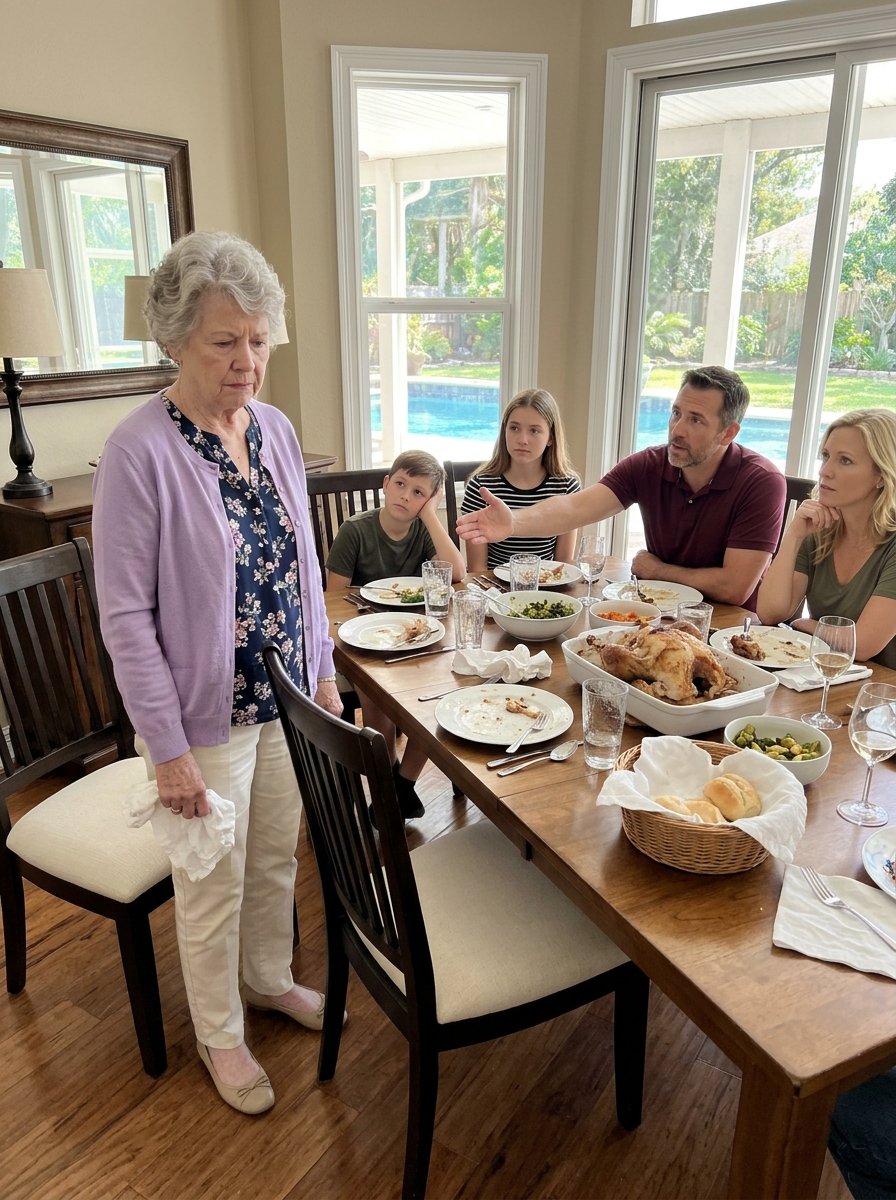
The night my son told me I needed to move out, I was serving roast chicken.
I had spent most of the afternoon preparing dinner. I had seasoned the chicken with rosemary, roasted potatoes, steamed green beans, and made the apple pie my grandchildren loved.
It was a Friday evening, and I thought we were having an ordinary family dinner.
Then Daniel put down his fork.
“Mom, there’s something Renee and I need to talk to you about.”
I looked up.
My son was forty-three years old, but whenever he spoke to me in that careful tone, I still saw the little boy who used to sit at our kitchen table waiting for me to help him with his homework.
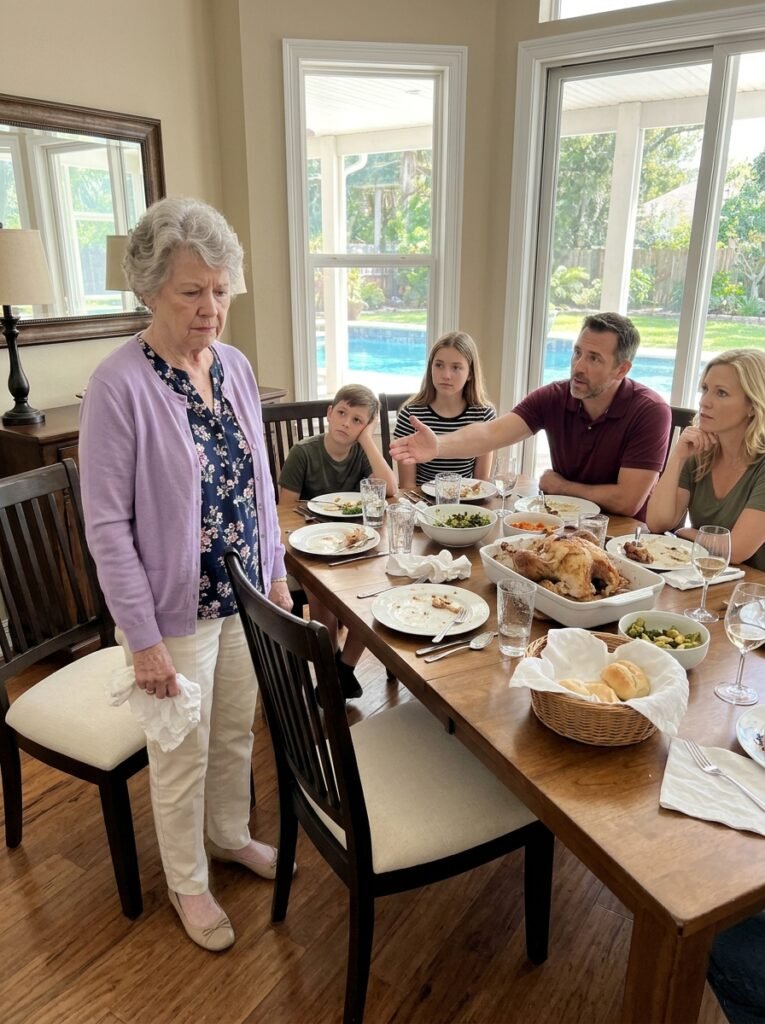
“Of course,” I said. “What’s wrong?”
He glanced at his wife.
Renee took a slow breath before speaking.
“Margaret, we’ve been discussing the future of the household, and we think it’s time for some changes.”
I looked between them.
“What kind of changes?”
Daniel cleared his throat.
“We think you should start looking for somewhere else to live.”
For a moment, I thought I had misunderstood him.
Emily, my eleven-year-old granddaughter, stopped cutting her chicken. Lucas, who was eight, looked from his father to me with his fork halfway to his mouth.
I placed my fork down.
“You’re asking me to leave?”
Daniel rubbed the back of his neck.
“Not immediately, Mom. We’re not trying to put you out on the street. We just think it’s time.”
Renee folded her hands.
“We’re a young family, Margaret. The children are getting older, and they need their own space. Daniel and I need privacy, too. We’ve been talking about moving forward with some plans for the house.”
I stared at her.
“Plans?”
She nodded.
“We want to reorganize the rooms. Maybe turn the downstairs space into a home office. The children need separate study areas, and we’d like to have a guest room for when my parents visit.”
I glanced toward the staircase.
The downstairs space she mentioned was where I had kept my sewing machine and a small bookshelf. I had already moved most of my belongings out of the way when she said she wanted to use the room for work.
I had not complained.
I had spent two years trying not to be an inconvenience.
Now I was apparently the final obstacle.
“Have you both been discussing this for a long time?” I asked.
Daniel looked uncomfortable.
“A few weeks.”
“A few weeks,” I repeated.
Renee leaned forward.
“Please don’t take this as something personal. We love you, but things have become complicated. You understand that, don’t you?”
I looked at my grandchildren.
Emily lowered her eyes. Lucas slowly put down his fork.
I knew those children better than anyone realized. I knew Emily hated the crust on her sandwiches and Lucas pretended not to be nervous before soccer matches. I knew which bedtime stories they asked me to read again and which vegetables they tried to hide beneath their potatoes.
I had packed their lunches, taken them to school, sat beside them through fevers, and helped with their homework.
I had done those things because I loved them.
But now, sitting at that table, I wondered whether my love had become so familiar that everyone had stopped noticing it.
“Where do you expect me to go?” I asked.
Daniel answered quickly.
“We can help you look at places. There are some lovely retirement communities nearby.”
Renee nodded.
“Some have activities, transportation, dining services. You wouldn’t have to worry about maintaining a house.”
I looked at her.
“I’m seventy-one, Renee. I’m not incapable of looking after myself.”
“That’s not what I meant.”
“Then what did you mean?”
She hesitated.
Daniel interrupted.
“Mom, let’s not turn this into an argument. We just want you to have a comfortable place where you can enjoy your retirement.”
I almost laughed.
My retirement.
As if I had spent the last two years sitting in a chair waiting for the end of the day.
I had sold my own home to move into theirs. I had given up a familiar neighborhood, my garden, my routines, and the house where my husband and I had spent thirty-eight years together.
I had done it because Daniel told me he didn’t want me living alone after his father died.
He had said, “Mom, you’ve done enough for everyone. Come stay with us. We’ll look after each other.”
I had believed him.
Now he was telling me that my presence no longer fit into the life he wanted.
“How much time are you giving me?” I asked.
Daniel looked at Renee.
“Maybe a month or two.”
Renee nodded.
“That should be enough time to find somewhere suitable.”
I studied their faces.
Neither looked particularly angry. Neither looked as though they wanted to hurt me.
That almost made it worse.
They had discussed my future, selected a deadline, and decided where I might live without asking what I wanted.
“All right,” I said.
Daniel blinked.
“All right?”
“I understand. I’ll make arrangements.”
Renee’s shoulders relaxed.
Daniel looked relieved.
“Thank you, Mom. I knew we could talk about this reasonably.”
I gave him a small smile.
Then I excused myself and carried my untouched plate into the kitchen.
I rinsed it, placed it in the dishwasher, and went upstairs.
My bedroom was the smallest one in the house, tucked between the laundry room and the children’s bathroom. My belongings occupied two suitcases, a dresser drawer, and a narrow section of closet space.
I sat on the edge of the bed and looked at the framed photograph on my nightstand.
Harold and I had taken it on our thirty-eighth wedding anniversary. He wore his favorite blue shirt, and I was laughing at something he had whispered in my ear.
He had been gone for three years.
I picked up the photograph.
“Oh, Harold,” I whispered. “I wish you were here.”
I cried for a few minutes, quietly enough that nobody downstairs would hear me.
Then I wiped my face and opened the bottom drawer.
Beneath some old letters was a small folder I had kept hidden for three months.
Inside was the document that could have changed everything at that dinner table.
I had won $89 million in the lottery.
Not a small prize. Not enough to pay off a mortgage or buy a comfortable retirement apartment.
Eighty-nine million dollars.
The winning numbers had been announced three months earlier. I had checked my ticket once, then again, and then a third time because I couldn’t believe what I was seeing.
For several minutes, I had simply sat at my kitchen table, unable to move.
I had been a widow living carefully on my savings and retirement income. I had never imagined that anything like that could happen to me.
My first call had been to a lawyer.
His name was Thomas Bennett. He helped me understand the claims process, arrange the necessary financial and legal protections, and work with qualified advisers before making any major decisions.
He had also warned me about something I hadn’t considered.
“Margaret,” he told me during our first meeting, “a sudden fortune can change the way people behave around you. Don’t rush to tell anyone. Take time to decide what you want your life to look like.”
I had followed his advice.
The money was being managed through proper legal and financial arrangements. I had paid the necessary taxes and secured the funds. I had not spent a dollar on anything extravagant.
I hadn’t told Daniel.
At first, I planned to tell him once everything was settled. But then I began noticing things I hadn’t paid attention to before.
Renee’s comments about the grocery bills.
Daniel’s habit of assuming I would take care of the children whenever they needed someone.
The way conversations about family plans increasingly happened without asking me.
None of those things alone seemed important. Renee had a demanding job and two children to raise. Daniel worked long hours. I knew family life could be stressful.
But gradually, I began feeling less like a member of the household and more like a service everyone had become accustomed to receiving.
And now they wanted me to leave.
I closed the folder and took out my laptop.
I had already been considering a house on Willow Creek Lane.
It was a beautiful Craftsman-style property with four bedrooms, a wide front porch, tall trees, and a garden that needed some attention.
I had visited it months earlier, before the lottery win, and fallen in love with it.
Daniel and Renee had wanted the same house.
They had spent months trying to purchase it, but their financing arrangements had fallen through. The property had eventually returned to the market.
When Daniel told me about their disappointment, I remembered how excited he had sounded when he first showed me the listing.
“It’s perfect for us, Mom,” he had said. “The children would have their own rooms, and there’s a garden in the back.”
I had smiled and told him I hoped they would find something suitable.
Now I opened my email and found Thomas’s latest message.
I typed a short reply.
“I’m ready to move forward with the Willow Creek property.”
His response arrived less than ten minutes later.
“Understood. I’ll have the team review the current listing and prepare the appropriate acquisition documents. We will make sure everything is handled correctly.”
I closed my laptop.
I had spent two years trying to make myself fit into someone else’s home.
It was time to find my own.
The following morning, I woke before everyone else.
I made coffee, prepared the children’s lunches, and left a note reminding Emily that her science project was due on Friday.
Old habits did not disappear simply because someone had hurt you.
At breakfast, Daniel seemed almost cheerful.
“Mom, I was thinking Renee and I could help you look at some places this weekend.”
“That’s thoughtful.”
“We can check a few retirement communities online first.”
“I’ll see what I can arrange.”
Renee entered the kitchen, carrying her work bag.
“I found a really nice place yesterday,” she said. “It has a garden and a library. They even have organized trips.”
“That sounds lovely.”
She paused, apparently surprised by my answer.
“Well, I can send you the details.”
“Thank you.”
She gave Daniel a quick look.
I understood that look.
They had expected resistance. Perhaps they had even prepared answers to arguments I hadn’t made.
Instead, I had agreed to leave.
That afternoon, I met Thomas through a secure video call.
He had already reviewed the property.
“The sellers are prepared to consider a cash offer,” he explained. “The previous buyer’s financing failed, so they are interested in a straightforward transaction.”
“Then let’s make an offer.”
“Are you certain this is the property you want?”
I looked through the window at the Arizona sunlight.
“Yes.”
He paused.
“May I ask why this particular house?”
I thought about the front porch, the old trees, and the garden.
“Because I like it. And because I want a place where I can wake up in the morning without wondering whether my presence is causing someone trouble.”
Thomas nodded.
“Then we’ll proceed carefully.”
The acquisition company had already been established as part of my financial arrangements. It was called MHB Heritage Holdings.
The initials came from my husband’s full name: Matthew Harold Briggs.
Harold had once operated a small contracting business. Daniel had grown up seeing those initials on invoices, business records, and old paperwork.
The name meant something to our family.
I signed the documents electronically.
The offer went in that afternoon.
By Thursday, the sellers had accepted.
The following Saturday, the purchase was completed.
Six days after my son had given me two months to leave his home, I became the owner of the property he and his wife had dreamed of buying.
I didn’t tell them.
I continued making breakfast, helping with homework, and folding laundry.
But I also began making plans for my new life.
The first thing I bought for the house was a rosebush.
It had deep red flowers and healthy green leaves. The young man at the nursery asked whether I was planting it for a special occasion.
“Yes,” I told him. “For someone I miss.”
He smiled and helped me load it into the car.
The house on Willow Creek Lane was even more beautiful than I remembered.
The wooden floors creaked softly beneath my feet. Sunlight passed through the tall windows, and the dining room overlooked a garden that needed work.
The kitchen cabinets needed refinishing, one bathroom required repairs, and the back fence leaned slightly to one side.
I loved every imperfection.
I hired a contractor to handle the necessary work. I ordered a comfortable bed, a dining table, and an armchair for the living room.
I chose cream-colored curtains and bought dishes decorated with tiny blue flowers.
I also arranged for a gardener to help restore the flower beds.
The rosebush went near the front porch.
For the first time in years, I was choosing things because I wanted them.
Meanwhile, Daniel and Renee were becoming increasingly frustrated about the house.
I heard them discussing it one evening.
“They must have paid more than we offered,” Renee said.
Daniel was sitting on the sofa, looking at his phone.
“Maybe they made a cash offer.”
“That’s what the agent suggested. We spent months trying to get that house.”
“I know.”
Renee lowered herself into a chair.
“Four bedrooms. A garden. Enough space for the children. We could finally have had the home we wanted.”
Daniel sighed.
“We’ll find something else.”
“With what money? We were already stretching our budget.”
There was a pause.
Then Renee said, “At least once your mother moves out, we’ll have more room here.”
I was folding towels at the dining table.
I kept my eyes on the laundry.
That sentence told me more than she probably intended.
I knew Renee had been under pressure. Her job had become more demanding, the children needed more attention, and she had been trying to manage a household while worrying about their finances.
She had once told me she felt as though she was failing at everything.
“I don’t want to spend my whole life working and still feeling like we can’t give the children what they need,” she had said one afternoon.
I had understood that feeling.
I had raised Daniel while Harold worked long hours. We had struggled through difficult years, and there were times when I had wondered how we would pay every bill.
But I had never believed that another person’s presence was the reason my life was difficult.
Renee had started seeing my help as something that came with complications.
She wanted her own routines, her own space, and the feeling that she and Daniel were in control of their home.
Instead of speaking honestly about those feelings, she had gradually turned me into the problem.
Daniel had allowed it.
That was what hurt most.
Over the next two weeks, I packed my belongings.
I kept Harold’s watch, our wedding photograph, my books, and a small collection of handwritten recipes.
I also bought Emily a notebook with a blue cloth cover because she loved writing stories.
For Lucas, I found a wooden box where he could keep his soccer medals and little treasures.
I wrote each child a letter.
I didn’t want them to think I was leaving because I no longer wanted to see them.
One Friday evening, Daniel found me packing a box.
“You’re really doing this, then?”
I folded a sweater.
“Yes.”
“Have you found somewhere?”
“I have.”
“Where?”
“A house.”
He laughed nervously.
“A house? Mom, those places are expensive.”
“I know.”
“What about maintenance, insurance, property taxes? Owning a house isn’t easy.”
“I’ve considered all of that.”
He leaned against the doorframe.
“I just don’t want you making a decision you’ll regret.”
I looked at him.
“When I sold my old house, did you ask whether I might regret it?”
He went quiet.
“When I moved into this room, did you ask whether I was comfortable?”
“Mom, that’s not what I meant.”
“I know.”
He shifted his weight.
“Well, if you’ve found somewhere, we can help you move.”
“Thank you.”
He watched me pack for a moment.
Then he asked, “Mom, have you been hiding something from us?”
My hands stopped.
“What do you mean?”
“I don’t know. You’ve been different lately. You don’t seem worried about finding a place.”
I looked at him.
“Perhaps I have something to look forward to.”
He frowned.
“Like what?”
“Like a new beginning.”
He waited for more, but I returned to packing.
He eventually left.
Moving day arrived on a clear Saturday morning.
The truck pulled into the driveway just after eight.
Daniel came downstairs wearing jeans and a gray T-shirt. Renee followed with a mug of coffee.
“Looks like you’ve got everything organized,” he said.
“I’ve tried.”
The movers carried my suitcases and boxes downstairs.
My old armchair was the last piece of furniture to leave.
I had spent countless evenings sitting in that chair after Harold died. Sometimes I read. Sometimes I simply stared at the wall and tried to understand how a life could change so completely.
As the movers carried it away, I felt a small pang of sadness.
Then I remembered the new chair waiting for me.
I didn’t need to carry every reminder of my grief into the next chapter.
Emily came running down the stairs.
“Grandma, are you leaving now?”
I knelt and hugged her.
“Yes, sweetheart.”
“Can I visit your new house?”
“Of course.”
“Promise?”
I brushed her hair away from her face.
“I promise.”
Lucas wrapped his arms around my waist.
“Will you still make your pancakes?”
I laughed.
“Every time you ask.”
Renee called the children toward the kitchen.
Daniel stood beside the front door.
For a moment, I thought he might say something meaningful.
Instead, he offered a small smile.
“I hope everything works out for you, Mom.”
I looked at him.
“I hope things work out for you, too.”
Then I climbed into the car.
As we drove away, I watched the house disappear behind us.
I didn’t hate my son.
I didn’t hate Renee.
But I knew I couldn’t continue living somewhere I felt tolerated rather than welcomed.
When we arrived at Willow Creek Lane, the front door was open.
The contractor had finished the urgent repairs, and the house smelled faintly of fresh paint and clean wood.
Sunlight stretched across the living room floor.
I walked inside slowly.
For several seconds, I simply stood there.
Nobody was going to tell me that I was taking up too much space.
Nobody was going to make me feel guilty for sitting down.
Nobody was going to decide how much of my life I was allowed to occupy.
I placed Harold’s photograph on the kitchen counter.
Then I carried the rosebush outside and planted it beside the porch.
When I finished, I sat on the steps.
“Well, Harold,” I whispered, “I finally have a place of my own again.”
A breeze moved through the trees.
I smiled.
I thought the difficult part was over.
I was wrong.
Three days later, Daniel called.
“Mom, I need to ask you something.”
I was preparing tea in my new kitchen.
“All right.”
“Do you remember the company that bought the Willow Creek house?”
I set down the kettle.
“Yes.”
“I found something strange.”
I waited.
“I was looking through some of Dad’s old business documents. You remember those folders he kept in the garage?”
“Of course.”
“I found a record with the initials MHB. It was connected to his old contracting business.”
I said nothing.
“Mom, the company that bought the house has the same initials.”
“That’s interesting.”
“Interesting? Mom, don’t you see what I’m saying?”
“What are you saying, Daniel?”
He lowered his voice.
“What if the company is connected to Dad’s business?”
I looked out the kitchen window.
The red roses near the porch had begun to open.
“Perhaps it is.”
“Mom, why are you so calm?”
“Because I don’t think every mystery needs to be solved over the telephone.”
There was a pause.
Then he asked, “Where exactly are you living now?”
I gave him the address.
Silence.
Then he repeated it.
“Willow Creek Lane?”
“Yes.”
He stopped breathing for a moment.
“Mom… that’s the house.”
“I know.”
“But how?”
“Why don’t you come over?”
He arrived forty minutes later.
I watched his car pull into the driveway.
He got out slowly and stared at the house.
He looked at the porch, the garden, and the freshly painted windows. Then he checked his phone and looked at the number beside the front door.
When I opened it, he was still standing there.
“Come in,” I said.
He stepped inside.
His eyes moved across the living room, the dining area, and the kitchen.
Then he noticed the photograph of his father.
“Mom, this is really the house?”
“Yes.”
“But the company—”
“Sit down, Daniel.”
He followed me into the living room.
For a moment, neither of us spoke.
Then he asked the question I had been expecting.
“Who owns this house?”
I looked directly at him.
“I do.”
He stared.
“What?”
“I purchased it through MHB Heritage Holdings.”
He slowly lowered himself into the chair opposite mine.
“But how could you afford—”
He stopped.
His eyes moved toward the photograph of Harold.
Then back to me.
“Mom, where did you get that kind of money?”
I reached into my handbag and removed the folder.
I placed it on the coffee table.
He looked at the first page.
Then the second.
His expression changed.
“What is this?”
“Read it.”
He picked up the document.
His eyes moved across the page. Then he went back to the beginning and read it again.
His hands began to tremble.
Finally, he looked up.
“Mom… is this real?”
“Yes.”
“You won the lottery?”
I nodded.
He stared at me.
“How much?”
I held his gaze.
“Eighty-nine million dollars.”
He didn’t speak.
The clock on the wall ticked several times.
Then he whispered, “Eighty-nine million?”
“Yes.”
“When?”
“Three months before you asked me when I was going to move out.”
He stood so quickly that his chair scraped against the floor.
“Three months?”
“That’s right.”
“Mom, you’ve known for three months?”
“Yes.”
He began pacing.
“Why didn’t you tell us?”
I watched him.
“Would it have changed anything?”
He stopped.
“Of course it would have!”
“Would it?”
He looked at me, confused and upset.
“Mom, we’re your family. We could have helped you. We could have celebrated with you. We could have made plans together.”
I let his words settle.
Then I asked quietly, “Daniel, do you remember the dinner when you told me I had one or two months to find somewhere else to live?”
His face changed.
“Mom…”
“Do you remember what you said?”
He looked down.
“You told me you and Renee needed more space. You suggested a retirement community. You gave me a deadline.”
“We weren’t trying to hurt you.”
“But you did.”
He sat down again.
I continued.
“I had already sold my own home because you asked me to come and live with you. I helped with the children, the cooking, the shopping, and the household. I never expected payment. I never asked you to give me anything.”
“Mom, I know.”
“Do you? Because when you decided you wanted me gone, you didn’t ask whether I had somewhere to go. You didn’t ask whether I was frightened or whether I could afford a comfortable place. You simply gave me a deadline.”
Daniel covered his face.
“I didn’t think about it that way.”
“That’s the problem. You didn’t think about it from my side at all.”
He lowered his hands.
“Why didn’t you tell us about the money?”
I took a breath.
“Because I needed time to understand what had happened. I needed legal advice and financial protection. But there was another reason.”
He waited.
“I wanted to know whether I could still be your mother without money changing the way you treated me.”
He looked at me.
“I wanted to know whether you saw me as a person or simply as someone who was useful to have around.”
His eyes filled.
“Mom, I never thought you were a burden.”
“Then why did you let me feel like one?”
He had no answer.
I leaned forward.
“Daniel, I am not telling you this to humiliate you. I bought this house because I wanted it. I loved the garden, the porch, and the feeling I had when I first walked inside. I could afford it, so I bought it.”
I paused.
“But I won’t pretend that being asked to leave your home had nothing to do with my decision. That dinner made me realize I needed a place where my future wasn’t dependent on someone else’s approval.”
Daniel began to cry.
Not loudly.
He bent forward, covered his face, and sat there for a long time.
I remembered holding him as a little boy when he had nightmares. I remembered the first day of school, his graduation, and the day he brought Renee home to meet us.
My instinct was to cross the room and comfort him.
But I waited.
I needed him to understand that this was not a misunderstanding that could disappear with a hug.
Eventually, he wiped his face.
“I’m sorry, Mom.”
I nodded.
“I hear you.”
“Can you forgive me?”
“I can forgive you. But forgiveness doesn’t mean we pretend nothing happened.”
He nodded.
“I understand.”
“Do you?”
He looked at his hands.
“I think I do now. Renee and I wanted a different house. We were worried about money, the children’s space, and everything we thought we needed. I let myself believe that asking you to leave was just another practical decision.”
He swallowed.
“I didn’t think about what you had given up to come and live with us. I got used to you doing everything. I stopped noticing.”
His voice broke.
“And I didn’t defend you when Renee complained. I should have.”
I looked at my son.
“Yes. You should have.”
He nodded.
Then, after a long silence, he asked, “What happens now?”
“Now we decide what kind of relationship we want to have.”
He looked around the room.
“Can we start again?”
“We can start by being honest. We cannot simply go back to the way things were.”
He nodded slowly.
Then he asked, “Are you going to help us buy another house?”
I looked at him.
He immediately realized what he had said.
“Mom, I didn’t mean it like that.”
“Daniel, you and Renee are adults. You have jobs and responsibilities. I hope you achieve everything you want, but my money is not the solution to every disappointment in your life.”
He looked ashamed.
“I know.”
“I intend to help my grandchildren with their education. I have charitable projects I care about, and I will make plans for my own future. I may choose to help family members in certain ways, but those decisions will be mine. They will never be the price of being loved.”
He nodded.
For the first time that afternoon, he didn’t ask another question about the money.
Renee arrived that evening.
Daniel had called her and told her she needed to come to Willow Creek Lane.
When she stepped inside, she looked around the living room.
“Margaret, this is beautiful.”
“Thank you.”
Daniel handed her the documents.
She read the first page.
Then the second.
Her expression changed completely.
“Is this real?”
“Yes,” Daniel said.
She looked at me.
“You won eighty-nine million dollars?”
“Yes.”
“When?”
“Three months before I moved out.”
Renee slowly sat down.
“I don’t understand.”
“What don’t you understand?” I asked.
“Why didn’t you tell us?”
I considered my answer.
“Because I needed privacy while I made important decisions. And because I wanted to know what my relationships looked like without money changing them.”
Renee’s cheeks turned red.
“We never meant to make you feel unwanted.”
“Perhaps not. But that is what happened.”
She looked toward Daniel.
He lowered his eyes.
Renee began speaking quickly.
“We were under pressure. We were trying to get the children into better routines. My work was becoming more demanding, and I felt like I never had a room where I could concentrate. Daniel was working long hours. We were arguing about money, and every decision seemed to become another problem.”
I listened.
For the first time, she was explaining rather than defending herself.
“I know you helped us,” she continued. “I know you did a lot for the children. But sometimes I felt as though I wasn’t really running my own home anymore. You were always helping, and I didn’t know how to ask for space without sounding ungrateful.”
I looked at her.
“Then you should have spoken to me.”
She nodded.
“I know.”
“You could have told me you were struggling. You could have asked us to agree on routines. You could have said you needed the downstairs room for work. I might not have liked every decision, but at least I would have been part of the conversation.”
Renee wiped her eyes.
“I was afraid you would think I didn’t appreciate you.”
“Instead, you made me feel as though I was the problem.”
She looked down.
“I am sorry.”
I believed that some of her regret was genuine. But I also knew the money had changed the situation dramatically, and I could not pretend that didn’t matter.
She glanced around the house.
“Is this really yours?”
“Yes.”
“And the lottery money… all of it?”
“The prize was eighty-nine million dollars. My advisers have helped me manage the proceeds and plan for the future.”
Renee looked at Daniel.
Then she asked something I had hoped she would not.
“Could we talk about the possibility of you helping us with a house?”
Daniel turned toward her.
“Renee.”
“What? I’m just asking.”
I looked at her for a long moment.
There it was.
Even after everything, money had found its way into the conversation before we had repaired the relationship.
I stood and walked toward the window.
Outside, the rosebush moved gently in the evening breeze.
“I have a suggestion,” I said.
They both looked at me.
“For the next year, let’s rebuild our relationship without discussing money. No loans, no requests for property, no assumptions about what I might pay for. If we are going to become a family that genuinely enjoys being together, we should be able to do it without an eighty-nine-million-dollar question hanging over every conversation.”
Renee looked hurt.
“Are you saying you don’t trust us?”
“I’m saying trust is something we build through our actions.”
She lowered her eyes.
Daniel nodded.
“I think that’s fair.”
Renee was quiet for several seconds.
Then she nodded too.
“All right.”
It wasn’t a perfect ending.
There were no dramatic embraces or promises that everything would be different by morning.
But for the first time, we had spoken openly about the things that had damaged our family.
That was a beginning.
The first few months in my new home were quieter than I expected.
I joined a gardening club and began attending a weekly book discussion at the local library.
I hired a housekeeper to help with the work I no longer wanted to do myself.
I also established a charitable fund to support older adults who had lost their spouses and needed help understanding their financial options.
I knew how vulnerable a person could feel after losing a partner. I wanted others to have access to practical guidance before making decisions they might regret.
Thomas helped establish the fund with proper oversight.
I didn’t announce my winnings publicly.
I had no interest in becoming known as the woman with eighty-nine million dollars.
I wanted to be Margaret.
The woman who liked roses, strong coffee, old houses, and long conversations.
The woman who still missed her husband.
The woman who was discovering that life could begin again at seventy-one.
Daniel began visiting on Sunday afternoons.
At first, our conversations were awkward.
He asked about the garden, the weather, and the repairs. Sometimes he seemed unsure whether he was allowed to open the refrigerator without asking.
I didn’t make fun of him.
We were both learning new habits.
Gradually, he began asking about my life.
Not my money.
My life.
He asked what I was reading. He asked whether I had found a good place to buy roses. He asked what his father had been like before Daniel was born.
One Sunday, he brought a box of old photographs from Harold’s belongings.
We sat at the dining table and looked through them.
There was Harold holding Daniel as a baby.
Harold standing beside his old work truck.
Harold and me on a camping trip, both sunburned and laughing.
Daniel stopped at a photograph of his father standing outside the little house where he had grown up.
“I haven’t looked at these in years,” he said.
“Neither have I.”
He ran his thumb over the photograph.
“Dad would have been proud of you.”
I smiled sadly.
“I wish he could have seen this house.”
Daniel looked at me.
“Do you think he would have been disappointed in me?”
I considered the question.
“Your father loved you. He would have wanted you to understand what happened and become a better man because of it.”
Daniel’s eyes filled.
“I don’t want to be the kind of man who treats people that way.”
“Then don’t be. You don’t have to spend the rest of your life hating yourself. But remember this whenever you are tempted to stop noticing the people who love you.”
He nodded.
That afternoon, he stayed until sunset.
Before leaving, he helped me carry a bag of garden soil to the porch.
It was a small thing.
But he did it without being asked, and he didn’t behave as though I owed him anything in return.
For the first time in a long while, I felt hopeful.
The following spring, Emily and Lucas came to stay for a weekend.
They ran through the garden, explored the backyard, and argued over who would choose the music during dinner.
Emily had grown taller.
Lucas had lost another tooth.
They seemed delighted by the house.
“Grandma,” Emily said, standing in the living room, “this house looks like it belongs in a storybook.”
I laughed.
“Perhaps it does.”
Lucas ran toward the back door.
“Can we play outside?”
“After lunch.”
He groaned dramatically.
Emily rolled her eyes at him.
I laughed again.
That evening, we ate dinner on the porch.
The children talked about school, their friends, and a science project involving seeds.
After dinner, Emily helped me clear the plates.
“Grandma?”
“Yes, sweetheart?”
“Are you happy here?”
I looked at the warm light coming through the windows and the roses near the porch.
Then I looked at her.
“Yes. I am.”
She smiled.
Then her expression changed.
“I’m sorry we didn’t say anything that night.”
I stopped drying a plate.
“What do you mean?”
“When Dad asked when you were going to leave. Lucas and I had heard them talking about it before. We knew they wanted you to move.”
She looked down.
“I didn’t know what to do. I thought if I said something, everyone would get angry.”
I reached for her hand.
“Oh, Emily. You were a child. You were not responsible for solving a problem the adults should have handled properly.”
“But you looked so sad.”
“I was sad.”
Her eyes filled with tears.
“I’m sorry.”
I pulled her into a hug.
“I know, darling. But I don’t want you carrying that around. You can love people and still be learning how to speak up. When you grow older, remember how it feels to be left out, and try not to make someone else feel that way.”
She held me tightly.
“I won’t.”
I kissed the top of her head.
“That’s all I could ever ask.”
A year after the dinner that changed everything, Daniel invited me to his home for a family meal.
It was the first time I had accepted an invitation to eat there since moving out.
I thought carefully before agreeing.
I wasn’t afraid of them. I simply wanted to make sure I wasn’t returning to the same arrangement that had hurt me before.
In the end, I decided to go.
I arrived with a pie from a local bakery.
Renee opened the door.
For a moment, we stood looking at each other.
Then she smiled.
“Margaret. I’m glad you’re here.”
“Thank you for inviting me.”
The house looked different.
There were new photographs on the walls, the kitchen had been rearranged, and the children’s backpacks were scattered near the stairs.
Dinner was simple: roast chicken, roasted vegetables, and a green salad.
When I sat down, I noticed a small vase of red roses in the center of the table.
Daniel smiled awkwardly.
“I thought you’d like those.”
I touched one of the petals.
“They’re beautiful.”
For a while, we talked about ordinary things.
Emily’s school activities.
Lucas’s soccer team.
A trip Daniel and Renee were considering.
Then Daniel put down his fork.
“Mom, there’s something I want to say.”
I looked at him.
He glanced at Renee, then back at me.
“Last year, I asked you when you were going to move out. I made you feel like you were a burden in my home.”
The room became quiet.
“I told myself I was being practical. I said we needed more space and that we had to make decisions for our family. But the truth is, I stopped thinking about what you needed because I got used to everything you did for us.”
He took a breath.
“I’m sorry. Not because you won the lottery. Not because you bought that house. I’m sorry because you were my mother, and I treated you as though your presence was something I had to tolerate.”
My throat tightened.
Daniel looked directly at me.
“You deserved better from me. I can’t change what happened, but I want to do better now.”
Renee reached for his hand.
Then she turned toward me.
“I owe you an apology, too. I was so focused on what I thought our family needed that I stopped considering what you had given up to be with us. I should have spoken honestly instead of making you feel unwanted.”
I studied both of them.
A year earlier, I would have rushed to reassure them.
I would have said everything was fine.
But everything had not been fine.
So I told them the truth.
“I appreciate your apologies. I love you both, and I love my grandchildren. I want us to have a relationship. But I need that relationship to be built on respect, not guilt or money.”
Daniel nodded.
“That’s what I want, too.”
I looked around the table.
Emily was watching me carefully.
Lucas was trying very hard not to look as though he was listening.
I smiled.
“Then let’s keep doing the work.”
And we did.
Not perfectly.
There were awkward conversations and occasional misunderstandings. But we learned to talk about them instead of pretending they didn’t exist.
Daniel began asking whether I wanted to help with the children rather than assuming I would.
Renee started expressing appreciation for the things I did.
And I learned to say no without wrapping my answer in an apology.
When I wanted to travel, I went.
When I wanted a quiet Sunday at home, I stayed.
When I wanted to cook for my family, I invited them over.
When I didn’t, I ordered dinner and enjoyed the evening.
As for the money, I managed it carefully with the help of my advisers. I supported educational opportunities for my grandchildren through properly structured arrangements and continued funding charitable projects.
I never bought Daniel and Renee another house.
They eventually purchased a different property when their finances allowed it. They saved, worked, and made the decision themselves.
I was proud of them.
Not because struggling makes someone more deserving of a home, but because they had learned that their dreams were their responsibility to pursue.
And I had learned that loving my family did not mean taking responsibility for every disappointment they experienced.
I am seventy-two now.
Some mornings, I sit on my porch with a cup of tea and watch sunlight move through the trees.
The roses are thriving.
The house is quieter than Daniel’s home was, but it is not lonely. There are books waiting to be read, friends who stop by for coffee, garden projects that take longer than they should, and grandchildren who occasionally arrive without warning because they want to show me something they have made.
Harold’s photograph still sits in my kitchen.
Sometimes I talk to him.
I tell him about the children, the garden, and the funny things people say at the book club.
I tell him that I miss him.
And sometimes I tell him that I am proud of the woman I have become.
Winning $89 million changed my financial future.
It gave me choices I had never imagined having.
But it did not make me more worthy of love or respect.
I was worthy when I was washing my grandchildren’s clothes.
I was worthy when I sat alone in that little bedroom, wondering where I would go.
I was worthy when I had nothing more than a photograph of my husband and two suitcases.
And I was worthy when I finally walked away.
My son once gave me two months to find somewhere else to live.
Six days later, I bought the house he had dreamed of owning.
But the house was never the real victory.
The real victory was opening its front door, stepping inside, and knowing that my life belonged to me again.
I was Margaret Briggs.
I was seventy-two years old.
I was a widow, a mother, and a grandmother.
And, at long last, I was home.