
PART 1: THE WORD THEY NEVER EXPECTED
After a twelve-hour shift at St. Mercy Medical Center, I pulled into my apartment parking lot completely exhausted.
My scrubs smelled of antiseptic and stale coffee. My feet ached, my back burned, and all I wanted was a hot shower and a few hours of uninterrupted sleep.
But my phone had been vibrating nonstop.
The messages came from my family group chat.
Dad:
We’re using your lake house this weekend. Twenty guests.
Mom:
Stock the refrigerator and don’t make a scene.
My younger brother, Kyle, added several laughing emojis beneath the messages.
I sat inside my car, staring at the screen.
There was no request.
No discussion.
They had simply announced that they would be using my property, expecting me to prepare everything for them as though I were their employee.
For most of my life, that was how my family treated me.
My father gave orders.
My mother reminded me that keeping the family happy was my responsibility.
Kyle laughed whenever I objected because he knew my parents would always defend him.
Normally, I would have explained myself. I would have apologized for being unavailable, offered another weekend, or tried to negotiate.
That evening, I typed only one word.
No.
My mother responded almost immediately.
You really think you can stop us?
I did not answer.
Instead, I called Margaret, an elderly woman who lived beside my lake house.
“If anyone arrives this weekend,” I told her, “they do not have my permission to enter the property.”
Margaret was silent for a moment.
“Are you expecting trouble?”
“Yes.”
“Then I’ll keep watch.”
After ending the call, I opened the lake house security application.
I changed every door code.
I disabled the old keypad.
I shut off the guest Wi-Fi.
I activated all exterior cameras and motion sensors.
Then I called a locksmith and asked him to replace every physical lock on the property.
By the following afternoon, every door had a new lock.
I also emailed the county sheriff’s office. I explained that I owned the property and that no relatives, guests, or other individuals had permission to enter without my written approval.
The lake house belonged to me.
I had purchased it after six years of double shifts, missed holidays, cheap meals, and canceled vacations.
While my coworkers traveled or bought new cars, I saved everything I could.
My family had never contributed a single dollar.
They had never asked how many nights I worked without proper rest.
They had never noticed how often I ate instant noodles so I could make another mortgage payment.
To them, my sacrifices did not matter.
They only noticed that I owned something they wanted to use.
But the lake house was not family property.
It was not theirs to claim.
Friday morning, my father called forty times.
I answered the forty-first call.
“What did you do to the house?” he shouted.
His voice was so loud that I had to move the phone away from my ear.
“The front code doesn’t work! Your mother is standing outside with groceries melting in the heat!”
“Then everyone should leave,” I replied calmly.
“This is a family weekend!”
“No,” I said. “It is an attempted trespass with twenty witnesses.”
For a moment, he said nothing.
Then he laughed bitterly.
“You cannot call it trespassing when we are your family.”
“Being related to me does not give you ownership of my property.”
I ended the call.
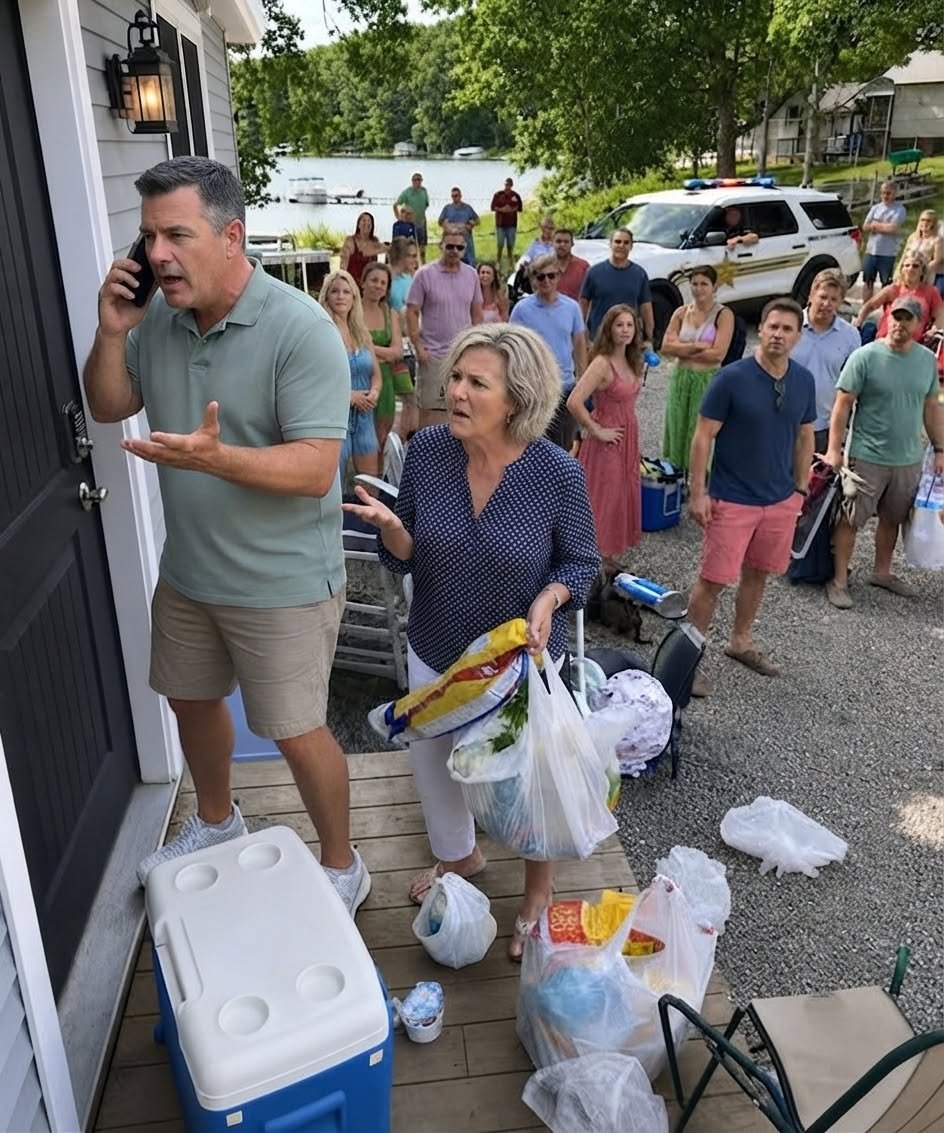
On the security feed, I could see twenty people crowded across my porch and driveway.
Some carried bags of groceries.
Others had coolers, folding chairs, and suitcases.
My mother stood beside the door, repeatedly entering the old access code.
Kyle kicked one of the porch posts in frustration.
My father paced near the driveway, shouting into his phone.
Then a sheriff’s cruiser slowly turned onto the property.
The conversation on the porch stopped.
For the first time, my family realized that I was serious.
PART 2: THE KEY THEY KEPT
My father walked toward the sheriff with an irritated expression.
“There has been a misunderstanding,” he said. “We were invited here for a family gathering.”
The sheriff looked toward the locked house.
“Invited by the owner?”
My father straightened his shoulders.
“She is my daughter.”
“That was not my question.”
I sent the officer everything he requested.
The deed.
The title.
The purchase records.
The property tax documents.
I also forwarded the email I had sent the sheriff’s office the previous day, clearly stating that no one had permission to enter.
Every document carried my name.
By late afternoon, the sheriff gave my family a simple choice.
They could leave voluntarily, or they could receive a formal trespass warning on the spot.
They left.
From the camera feed, I watched them carry the groceries, bags, and coolers back to their cars.
My mother kept turning toward the house, as though she still expected the door to open for her.
Kyle looked directly into one of the cameras and raised his middle finger.
My father said nothing.
But I knew him well.
He never accepted losing control.
The following morning, I drove to the lake house.
The road was quiet, and the lake looked calm beneath the early sunlight.
At first, nothing seemed unusual.
Then I noticed the front door.
It was slightly open.
I stopped several feet away.
My security application showed that every camera had gone offline at exactly 3:17 that morning.
Someone had disabled the system.
I called the sheriff’s office and reported a possible break-in before approaching the house.
Inside, the living room appeared untouched.
But the refrigerator had been completely emptied.
Every item I had purchased was gone.
On the kitchen counter sat a white envelope with my name written across the front in my mother’s handwriting.
Inside was a short note.
If you want your house to stay yours, stop acting like it belongs only to you.
Beneath the note was an old brass key.
My father had kept a copy.
The locks had been changed, but one entrance—the old side door near the garage—still had an older internal mechanism.
He must have discovered it years earlier and kept the key without telling me.
Then I heard a sound above me.
Footsteps.
Someone was upstairs.
I quietly called the sheriff again.
“There are people inside my house,” I whispered. “I can hear them on the second floor.”
The dispatcher told me to remain outside.
But before I could leave, my father called down from upstairs.
“We know you’re here.”
I looked toward the staircase.
My father appeared first.
My mother followed him.
Kyle stood behind them, carrying one of my bedroom drawers.
“Finally,” my father said, as though I had been the one keeping them waiting.
“You broke into my house.”
Kyle shrugged.
“We had a key.”
“You disabled my security system.”
“We came to fix this ridiculous situation,” my father replied.
My mother stepped forward.
“This house is wasted on you. You barely come here. Why should it sit empty when the family could enjoy it?”
There it was.
The truth they had refused to say directly.
Because I owned something they wanted, they believed they deserved access to it.
“You were told to stay away,” I said. “Leave now.”
My father crossed his arms.
“No.”
“This is my final warning.”
“You are not calling the police on your own parents.”
“They are already on their way.”
Kyle laughed.
“You always were dramatic.”
I pressed the emergency button on my phone.
A loud automated message echoed through every speaker on the property.
“Unauthorized occupants detected. Authorities have been notified. Audio and video recording is active.”
My mother’s face went pale.
My father looked toward the windows.
Then tires crunched across the gravel driveway.
The sheriff had arrived.
End Part Here: After a twelve-hour shift at St. Mercy Medical Center, I pulled into my apartment parking lot completely exhausted