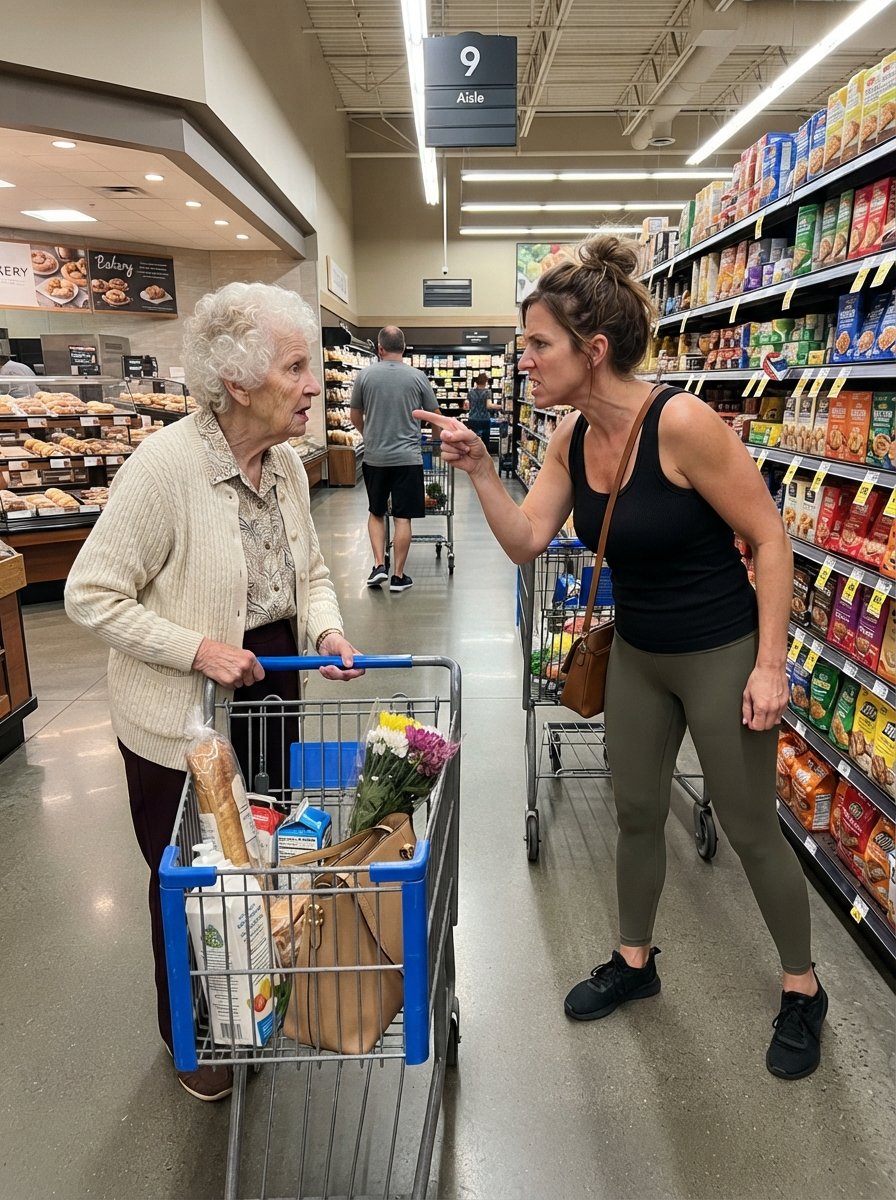
I thought the worst part of that grocery trip would be watching a stranger humiliate my 83-year-old mother for taking too long at the checkout. Then the cashier looked at Mom’s face, went pale, locked her register, and called for a box she’d been keeping in the back office for seven months.
My 83-year-old mother still insisted on doing her own grocery shopping.
That Saturday, the store was packed.
Mom had only six items, but when it was her turn to pay, she struggled to find her wallet.
The woman behind us sighed loudly.
“Oh, come on.”
Mom glanced back.
“I’m sorry.”
Her hands were trembling as she searched through her purse.
The woman pushed her overflowing cart forward.
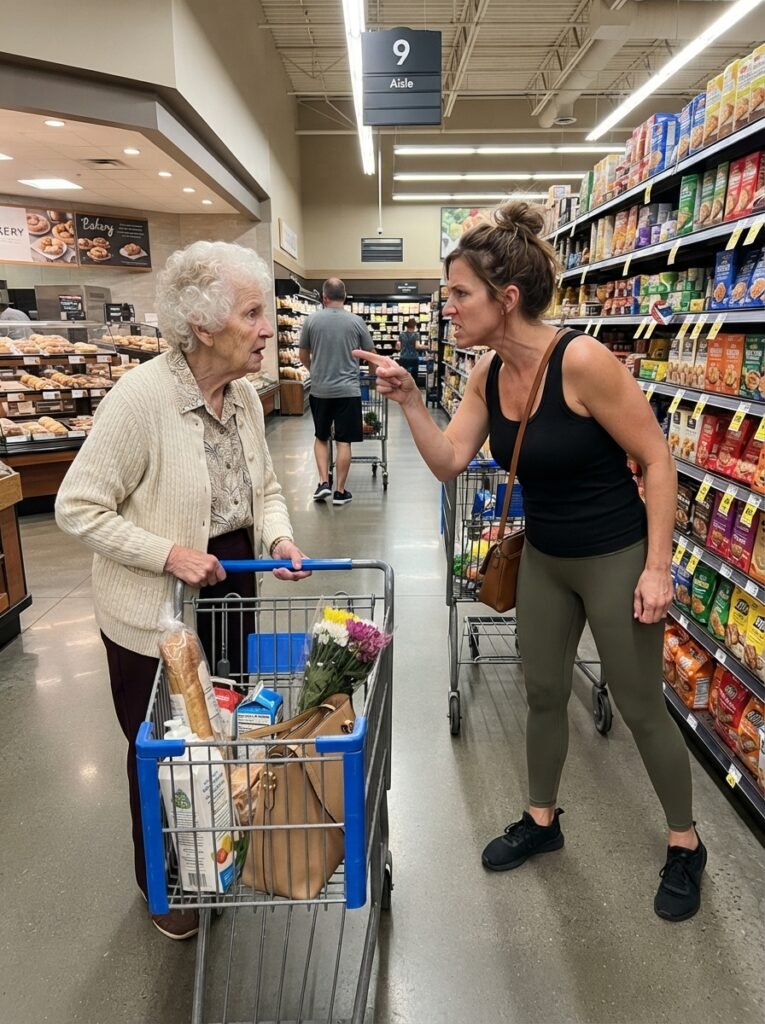
“If you’re too old to handle shopping, maybe stay home.”
People turned to look.
“Excuse me?” I said.
She rolled her eyes.
“I’m saying what everyone here is thinking.”
Mom touched my arm.
“Amani, don’t.”
She finally found her wallet and pulled out her card.
The woman laughed.
“Unbelievable. We’re all waiting for this?”
That’s when the cashier looked up.
Her eyes landed on Mom’s face and she froze. “What’s your name?”
Mom looked confused. “Margaret.”
The cashier didn’t move.
“Margaret what?”
Mom gave her last name.
The cashier went pale. Then she reached under the counter.
CLICK.
Her register locked.
She turned off the conveyor belt.
“Nobody leaves.”
The woman behind us scoffed.
“Are you serious?”
But the cashier wasn’t looking at her anymore.
She picked up the phone beside her register.
“Hi, Tom? I need you at register six.”
She listened.
“No. Now.”
Mom looked at me.
“Amani, what’s happening?”
“I have no idea.”
The cashier’s name tag said “HELEN.”
She kept staring at Mom like she was afraid she’d disappear.
“How old are you, if you don’t mind?” she asked.
“Eighty-three, what has this got to do with anything?”
Helen covered her mouth.
“Oh my God.”
“What?” I asked.
She lowered her hand.
“Please. Just wait.”
Two minutes later, the manager appeared.
Helen whispered something to him.
His expression changed. “The box?” he asked.
Helen nodded. Tom disappeared into the back office.
When he returned, he was carrying an old cardboard box.
It had been taped and retaped so many times that the corners were soft.
“I’ve kept it here since Mom died,” Helen said quietly. “I couldn’t bring myself to throw any of it away.”
Helen took it with both hands.
The woman behind us groaned. “This is ridiculous.”
Helen finally looked at her. “Register four is open.”
“You said nobody leaves.”
“I wasn’t talking to you.”
A few people laughed. The woman turned red and shoved her cart toward the next line.
Mom didn’t notice.
She was staring at the box.
Helen placed it beside our groceries.
“My mother died seven months ago,” she said.
Mom’s face softened. “I’m so sorry,” she whispered.
“Her name was Anna.”
Mom’s wallet slipped from her hand.
It hit the floor.
I bent to pick it up, but Mom didn’t move.
“What did you say?”
Helen’s eyes filled.
“Anna.”
Mom grabbed the edge of the counter.
I had never heard that name before.
Helen reached across the register.
“Margaret, my mother spent most of her life wondering what happened to you.”
“She found a photograph of you years ago. Older than the ones she had as a girl. She kept it beside this box.”
Helen shook her head. “I knew your face before I knew you.”
Mom made a sound I had never heard from her before.
Not quite a sob.
Not quite a word.
Then she whispered, “Anna had a daughter?”
Helen nodded.
“I’m her daughter.”
I stared at Mom.
“Who is Anna?”
Mom looked at me as though she’d forgotten I was standing there.
Her lips trembled.
“A little girl I loved.”
Helen opened the box.
The first thing she removed was a photograph.
The edges were curled.
A young woman stood outside a small white house holding the hand of a girl with dark braids.
The woman was my mother.
She couldn’t have been more than 25.
“She was my sister’s daughter,” Mom said, eyes glued to the photograph.
Her voice was barely audible.
“Her mother died when Anna was six. Her father was working away most of the time then, so Anna came to live with me.”
“At first I thought I was taking care of her because my sister couldn’t anymore. Somewhere along the way, she just became mine too.”
“For how long?”
“Almost six years.”
Six years.
I’d known my mother all my life, and somehow there had been an entire child in her life I’d never known about.
“Why didn’t you ever tell me?”
Mom seemed lost in thought and didn’t answer. Helen was watching her.
“Mom talked about you.”
Mom closed her eyes.
“Don’t.”
“She did.”
“Please.”
“I think you need to hear this.”
Helen reached into the box again.
This time she took out another photograph.
Mom holding a newborn baby. I recognized the yellow blanket immediately.
I’d seen that picture in our family album.
“That’s me,” I said.
Helen looked at me.
“I know.”
Something about the way she said it made my stomach tighten.
She turned the photograph over. There were two different kinds of handwriting on the back.
One was Mom’s.
“Amani. Six days old.”
Underneath it, in faded blue ink, someone else had written, “The baby Margaret needed more than me.”
Mom’s knees nearly gave out.
I caught her arm.
“No.”
Helen looked startled.
Mom took the photograph.
“No, no, no.”
“Mom?”
“That’s not what it meant.”
She pressed the picture against her chest. “That’s never what it meant.”
Helen pulled a chair from behind the service counter.
Mom sat.
People were still shopping around us. Carts rattled past. Registers beeped.
The manager quietly offered us his office.
Mom shook her head.
“No. Please. I need to hear this now.”
But register six had become its own little world.
Mom stared at the photograph.
“When I got pregnant with you, it was difficult,” she told me.
“I was sick all the time. Your father was working two jobs. We were behind on everything.”
She looked at Helen.
“Anna’s father, Robert, offered to take her for the summer. I said no.”
Then her face crumpled.
“Until one night.”
She had been exhausted.
Anna needed new shoes. The refrigerator had stopped working. Mom had spent the afternoon being sick.
After Anna went to bed, Mom cried in the kitchen.
“I told your father I was scared I couldn’t manage everything once the baby came.”
She looked at me.
“Then I said, ‘I don’t know how I’m going to manage both of them.'”
Helen inhaled sharply.
“Mom heard you.”
Margaret looked at her.
“What?”
“She told me that.”
Mom went still.
Helen sat beside her. “She thought you meant her and the baby.”
Mom covered her mouth.
The next morning, 12-year-old Anna announced that she wanted to live with her father.
Mom argued.
Anna insisted.
“I thought she wanted him,” Mom whispered. “I thought maybe she’d reached the age where an aunt wasn’t enough anymore.”
Helen shook her head.
“She thought she was helping you.”
Mom started crying. Not quietly, or politely.
The kind of crying that made me put both arms around her because suddenly she didn’t feel 83.
“She left because of me?”
“She left because she loved you.”
That sentence seemed to break something open.
Mom gripped my hand.
“I tried to get her back.”
“I know.”
“I called.”
“I know.”
“Robert said she wouldn’t come to the phone.”
Helen nodded.
“She wouldn’t.”
“Robert told me not to come,” Mom said. “He said Anna needed space and that I was making it harder for her to settle.”
Helen closed her eyes.
“Mom thought you’d come anyway.”
Mom looked crushed.
“So she really didn’t want to talk to me.”
“She was hurt,” Helen said. “But she didn’t want you to disappear.”
Helen opened the box again. “She was waiting to see if you’d come get her.”
Mom stared at her.
“She was 12,” Helen said. “She thought if you really wanted her, you’d refuse to let her go.”
Mom’s face folded.
“I thought letting her choose was the loving thing.”
“She thought fighting her choice was.”
Neither woman spoke.
Two people had spent more than 50 years on opposite sides of the same misunderstanding.
Then Helen picked up the photograph of me.
“After Amani was born, you sent my mother this.”
“With a letter,” Mom said immediately.
Helen looked at her.
“A letter?”
“Four pages.”
Helen’s face changed.
“There wasn’t a letter.”
Mom stared at her.
“I wrote that I wanted Anna to come home. I told her she had a little sister. I told her her room was still hers.”
Helen looked down at the photograph. “Mom only got this.”
“Robert had moved by then,” Helen said. “The letter had to be forwarded to their new address. Mom said when it finally arrived, the envelope was torn open and sealed inside a plastic postal bag.”
She touched the photograph.
“By the time Mom got it, this was the only thing still inside.”
Anna saw Margaret smiling with a newborn in her arms and thought she finally had proof.
Margaret had the daughter she really wanted.
“I sent her another card on her birthday,” Mom whispered.
Helen reached into the box.
“I know.”
She handed Mom an envelope. Mom recognized it before she touched it.
Her own handwriting covered the front.
Across the front, under Mom’s handwriting, someone had printed three words in blue ink.
“RETURN TO SENDER.”
Helen touched the writing.
“That’s Mom’s.”
Mom’s fingers shook.
“She sent this back.”
“Yes.”
Mom stared at the blue writing. “Then why was she waiting for another one?”
Helen swallowed.
“Mom told me she sent it back because she wanted to see if you’d try again. Then she checked the mailbox every day for weeks.”
Mom stared at her.
“Then Christmas came. She thought you’d write.”
“I didn’t.”
“I know.”
“I thought I was respecting what she wanted.”
Helen wiped her cheek. “She thought you’d stopped trying.”
Mom bowed her head. For decades, each of them had believed the other’s silence was an answer.
“Why didn’t she find me when she got older?” Mom asked.
There was no accusation in it.
Only pain.
Helen looked down.
“For the same reason you didn’t find her, I think.”
Mom said nothing.
“She was afraid the answer would hurt more than not knowing.”
Years passed.
Robert moved again. Then Mom and my father moved.
Anna married and changed her surname.
By adulthood, the misunderstanding had hardened into something worse than anger.
Fear.
Anna was afraid to discover Margaret truly hadn’t wanted her.
Margaret was afraid to force herself into the life of someone who had once sent her card back unopened.
“I thought about her every birthday,” Mom said.
Helen nodded.
“So did she.”
I was still staring at the photograph of myself.
“The baby Margaret needed more than me.”
For the first time, I understood why Mom had never told me.
“You thought I’d feel guilty.”
She looked at me.
“I thought you’d think I wished you’d been her.”
“Did you?”
“No.”
The answer came so quickly it almost hurt.
Mom grabbed my hand. “I loved Anna. Then I had you. One didn’t erase the other.”
Her eyes moved to the photograph.
“I spent years telling myself maybe it was better not to talk about her. I never wanted my daughter growing up thinking she was someone’s replacement. And once you’d grown up, the longer I’d kept quiet, the harder it became to explain why.”
I looked down at the photograph again, at Anna’s words beneath my name.
“So all those years, Anna thought I was the reason she lost you.”
“When she was 12,” Helen said.
I looked at her.
“What about later?”
Helen smiled through her tears. “Later was different.”
She reached into the bottom of the box. There was a small bundle tied with string.
Inside were photographs, old addresses, scraps of paper and notes.
Anna had started looking for Margaret again years later.
Not continuously.
In bursts.
An old address in one notebook.
A possible married surname in another.
A clipped photograph she’d found somewhere years later.
A letter returned from a house Mom had already left.
Then Helen pulled out a folded piece of paper.
“Mom wrote this after she got sick.”
Mom couldn’t take it.
So Helen read.
Only a few lines.
Anna wrote that she no longer blamed Margaret.
She wrote that when she became a mother herself, she finally understood how someone could love a child and still get something terribly wrong.
Then Helen stopped.
“There’s one part you should hear from me.”
Mom looked at Helen who then nodded toward me.
“Mom never forgot Amani. Not even after all those years.”
I blinked.
“From the photograph?”
“Yes.”
Helen smiled.
“She called you her little sister.”
I couldn’t speak. I’d gone my whole life not knowing someone out there had thought of me as her little sister.
The photograph in my hand changed again.
For Anna at 12, I had been the baby who replaced her.
For Anna as an adult, I had become the sister she never got to meet.
Mom reached for Helen.
“Did she hate me?”
Helen took her hand.
“No.”
“Was she angry?”
“For a long time.”
Mom nodded as though she deserved that. “But she never stopped loving you.”
Mom closed her eyes, as Helen squeezed her fingers.
“Before she died, she told me something. She said if I ever found you, I wasn’t supposed to ask why you didn’t come for her.”
Mom opened her eyes.
“She wanted me to ask you if you thought she didn’t want you.”
Mom broke down again.
“I did.”
Helen nodded.
“She thought so.”
“I would’ve gone anywhere for her. She needed to know how much I cared.”
Helen’s voice cracked. “She died hoping it was true.”
Mom closed her eyes.
That was the part no box could fix.
Anna had died with the question Margaret was only now answering.
Nothing could give them back the lifetime they’d lost.
Mom could never hold the 12-year-old who had waited at a mailbox.
Anna could never hear what had been inside that missing four-page letter.
But Margaret finally knew one thing for certain.
Anna had never stopped loving her.
Mom looked around the checkout lane. “I think I’d like to finish buying my groceries.”
Helen laughed through her tears. “Okay.”
She unlocked the register.
Mom stood slowly. Her six items were still waiting.
Bread.
Milk.
Tea.
Apples.
Soup.
A little chocolate cake she’d claimed was “for visitors,” although she was the one who always ate it.
Helen scanned each item.
When it was time to pay, Mom took out her card.
Her hands were trembling again.
She tried to insert it.
Missed.
Once.
Then again.
I saw her face change.
For half a second, I think she remembered the woman behind us.
The sigh.
The humiliation.
The suggestion that maybe she was too old to be there.
“I’m sorry,” Mom whispered automatically.
Helen reached toward the card reader.
But she didn’t take the card from her.
She steadied the machine.
Mom tried again.
This time, the card slid smoothly into place.
Helen looked at her.
“Take your time.”
Mom smiled weakly.
“I’ve made you wait long enough.”
Helen’s eyes filled again.
“You don’t have to apologize for making me wait.”
She reached across the counter and covered Mom’s trembling hand with hers.
Mom laughed. Then cried. Then somehow did both at once.
When we finally left the store, Helen came with us.
Outside, she stopped under the awning and turned the photograph over one more time.
“The baby Margaret needed more than me.”
Mom touched the faded words.
“She was wrong.”
“I know.”
“I wish I could tell her.”
Helen stood beside us.
“You just did.”
Mom looked at Helen, then reached out and touched her cheek.
For a second, neither of them moved.
That morning, a stranger had looked at Mom’s shaking hands and decided she was taking too long.
She had no idea Mom had already lost more than 50 years to waiting.
Years that weren’t coming back.
Before we left, Mom handed me the photograph.
“Keep this safe.”
I looked at the baby in her arms.
Then at Anna’s words on the back.
“I will.”
Mom took Helen’s hand.
And this time, when her fingers trembled, nobody told her to hurry.