
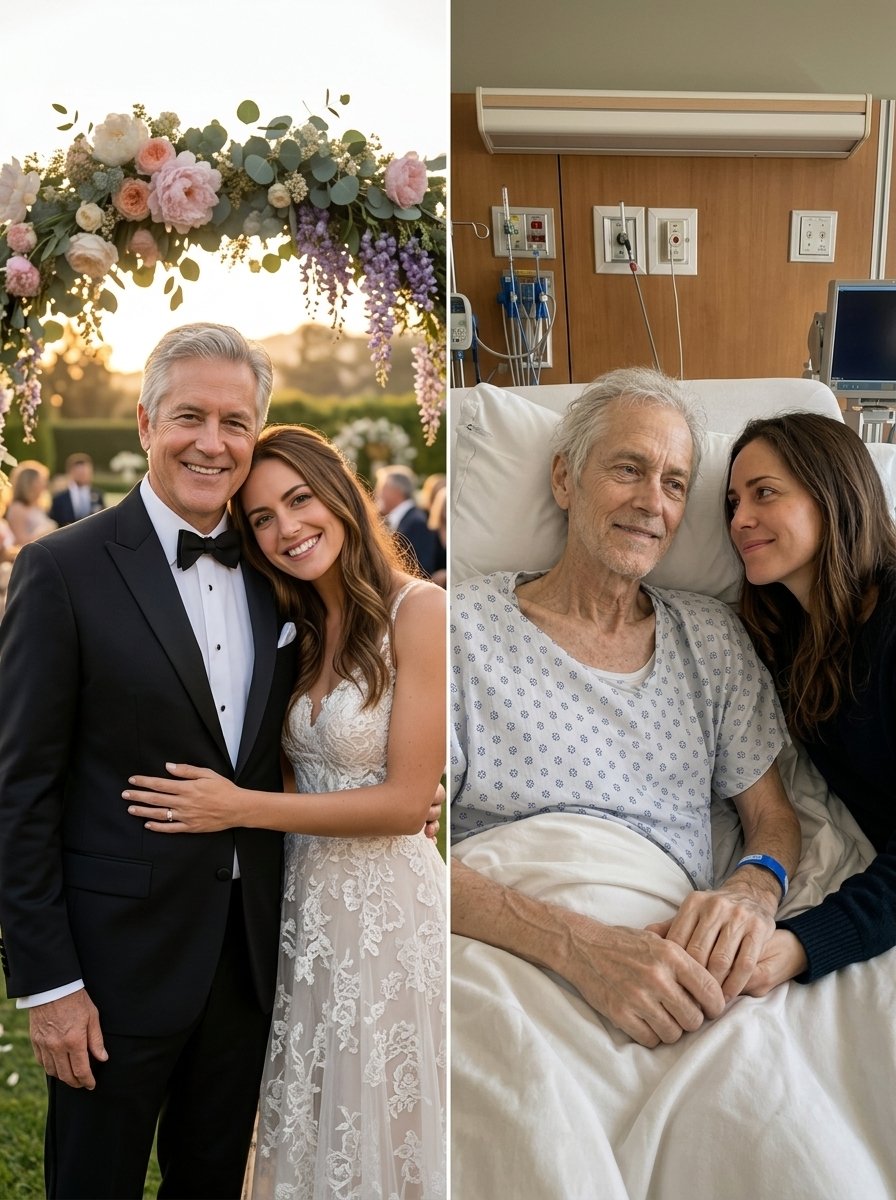
THE WEALTHY WIDOWER’S FINAL PROMISE
A struggling waitress believed she had finally found safety when a wealthy widower offered her a life far away from unpaid bills and aching feet.
But inside his grand house, not everyone believed she belonged there.
And one sentence from her new husband would stay with her long after their wedding.
PART 1 — THE WAITRESS
My apartment smelled of instant noodles and rain coming through a window that never closed properly.
I sat on the bed counting my tips into small piles across the comforter.
Rent.
Electricity.
Groceries.
The grocery pile was always too small.
My feet throbbed inside socks I had worn for twelve hours. I was thirty-two years old, still living from one paycheck to the next and still feeling as though I were holding my breath underwater.
The charity dinner had been a last-minute shift.
I wore black slacks and a white shirt while balancing a tray of champagne glasses against my forearm.
I had skipped both lunch and dinner so the uniform would fit, and the chandeliers above me seemed to swim whenever I looked up.
That was where Russell found me.
He had silver hair at his temples and wore a suit that probably cost more than my car.
He took a glass from my tray, paused, and asked my name.
When I told him, he did not look through me the way most wealthy guests looked through servers.
Instead, he asked whether my feet hurt.
I nearly dropped the tray.
Russell caught the attention of the catering captain across the ballroom. With a small gesture, he had a chair placed behind a column where I could sit without being noticed.
We talked about nothing important.
His late wife’s garden.
The book I read on the bus.
The fact that he had not eaten a homemade meal in three years, even though his kitchen was almost as large as my apartment.
He called me the following morning.
Then he called every morning after that, always gentle and punctual, as though kindness could become a habit.
Three months later, Russell took me to a small restaurant where the waiter knew him by name.
He slid a ring across the table.
“I’m not asking you to love me,” he said. “I’m only asking you to let me take care of you.”
I told myself I was being practical.
Anyone who was drowning would reach for an offered hand.
I said yes.
Some of my friends called me reckless.
Maybe they were right.
PART 2 — HIS CHILDREN
Russell’s children attended our engagement gathering.
His daughter, Marlene, did not shake my hand.
She looked at me as though I had tracked mud across an expensive antique rug.
“So you’re the new project,” she said.
I tried to smile.
“It’s nice to meet you too.”
Throughout the evening, she watched me from across the room, studying me as though trying to calculate how much damage I might cause.
After our wedding, Russell took my hand and led me through the front door of his house.
Marble floors.
High ceilings.
A staircase that curved like something from a movie.
“Welcome home,” he said softly.
From the landing above, Marlene watched us with a face so still that it looked carved from stone.
Later, after most of the wedding guests had left, I went downstairs to find some water.
Marlene stopped me near the staircase, one manicured hand resting on the banister.
Her smile never reached her eyes.
“You think you’re getting this house?” she whispered. “You’ll get nothing.”
Russell appeared behind her.
His bow tie was loose, and a forgotten glass of champagne hung from his hand.
He had heard everything.
His shoulders straightened, but his voice remained calm.
“She’ll get exactly what she deserves,” he said.
Marlene smiled as though he had just promised her victory.
I carried those words upstairs like a bruise.
PART 3 — LEARNING TO LOVE HIM
The months that followed were quieter than I expected.
Russell remembered that peppermint tea helped me after difficult nights.
He left the curtains slightly open because I could not sleep in complete darkness.
One morning, when I pushed away my toast, he watched me with a tenderness I did not understand.
“You don’t have to earn your coffee,” he said.
I gave a shaky laugh.
I had spent my whole life earning every small kindness.
Somewhere between the tea, the curtains, and a Tuesday in October when he reached for my hand at a traffic light, I stopped pretending.
Maybe I had accepted his proposal because I was tired of drowning.
But I stayed because I loved him.
Love came to us in ordinary ways.
Russell discovered which bus stop I used before I admitted that I still took the bus whenever his driver was unavailable.
Once, he slipped cash into my coat pocket.
I returned it to his desk with a note.
I want a partnership, not a rescue.
He never did it again.
Instead, he asked what groceries I liked, whether I missed my old neighborhood, and whether the silence inside his large house frightened me.
Sometimes it did.
Sometimes I missed the cracked window and noisy pipes of my old apartment because they had belonged to me.
Then, in November, the diagnosis came.
Six weeks.
That was all the time we were given.
PART 4 — THE HOSPITAL
The hospital corridor smelled of antiseptic and lilies.
Marlene stopped me three doors away from Russell’s room.
“He’s resting,” she said. “He doesn’t need a scene.”
I could have pushed past her.
I was his wife.
But her hand was trembling, nurses were watching us, and I imagined Russell hearing raised voices from inside the room.
So I sat in the hallway for three hours.
When Marlene finally left to get coffee, I slipped inside.
Russell was paler than the sheets.
He squeezed my hand weakly.
“Don’t fight them,” he whispered. “Just trust me.”
“I don’t care about the house,” I told him.
“I know,” he said. “That’s why.”
I believed there would be time to ask what he meant.
There was not.
The day before he died, Russell asked for the blue blanket from home.
I carried it into his room folded over my arm.
Marlene stood near the sink arranging flowers and throwing away the lilies before they could open.
For one brief second, she looked less cruel than exhausted.
Then she noticed me and hardened again.
Russell slept through most of that afternoon.
I sat beside him counting breaths instead of tips, wishing there were some bargain I could make to purchase one more month.
When he finally woke, he only touched my wrist, as though he needed to remind himself that I was real.
PART 5 — THE FUNERAL
At the funeral, Russell’s three children stood opposite me in matching black coats, forming a wall.
People offered their condolences and then drifted toward them.
I stood alone beside the casket.
I cried because I had loved him.
And because no one in that room believed me.
After the final guest left, Russell’s lawyer touched my elbow.
“Elena,” he said, “Russell left instructions.”
The instructions had to be delivered in person with all three children present.
“Tomorrow morning,” the lawyer said. “My office at nine.”
Then his voice softened.
“He asked me to repeat his final instruction.”
I looked at him.
“Trust him.”
PART 6 — THE WOODEN BOX
The chill of the funeral was still beneath my skin when I entered the lawyer’s office the following morning.
Marlene and her brothers were already seated there, lined up like a jury.
Marlene crossed her legs and tilted her head at me.
“How generous of you to come,” she said. “When do you plan to leave our father’s house?”
I folded my hands together so they would not shake.
A small wooden box sat on the lawyer’s desk.
There was no will in sight.
The lawyer placed his glasses on his nose and looked around the room.
“Russell asked that I follow his instructions in order.”
Marlene laughed softly.
“The serving girl gets a souvenir.”
The lawyer pushed the wooden box toward me.
“He wanted you to receive this first.”
Inside, there were no keys.
No cash.
No jewelry.
There was only a folded letter and a worn photograph.
Marlene gave a bitter laugh.
“There it is. Daddy’s final little joke.”
I lifted the photograph.
It showed me at the charity dinner holding a tray and laughing.
I did not remember anyone taking the picture, but the charity’s logo was stamped faintly in one corner.
The woman in the photograph had no idea someone across the ballroom had truly seen her.
The letter was written in Russell’s careful handwriting.
I unfolded it with both hands.
“What does it say?” Marlene demanded.
I continued reading.
My eyes filled with tears.
“What does it say?” she snapped again, reaching across the desk.
The lawyer stopped her gently.
“The letter is private. Your father was very clear.”
“Then read the real will,” Marlene said.
The lawyer opened a sealed envelope.
Her smile disappeared.
PART 7 — THE WILL
Russell’s children leaned forward.
The lawyer read in a steady voice, but I struggled to focus.
I kept staring at the photograph of the tired waitress who had no idea that a man across the room had noticed her.
“Skip ahead,” Marlene demanded. “Who gets the house?”
The lawyer turned one page.
Then another.
Marlene’s anger slowly changed into fear.
“This can’t be right.”
The lawyer looked up.
“It is exactly right. Your father reviewed every line, completed an independent competency evaluation before signing, and expected objections.”
Marlene’s brother touched her arm.
She shook him off.
The lawyer’s voice hardened.
“He knew what each of you was capable of.”
As he continued reading, I realized that Russell had planned for details he had hidden from everyone, including me.
His company shares came with professional advisors for one year.
His children’s trust allowances covered their housing, education, and medical expenses.
But the trusts would not fund lawsuits, threats, or public accusations.
The house could not be sold while my child was still a minor.
There was even a section naming guardians in case grief or pressure became too much for me.
It was not a punishment written in anger.
It was a map drawn carefully by a man who knew he would not be alive to hold the pen much longer.
The lawyer cleared his throat.
“The house, the estate, and the controlling interest in the company will go to Russell’s wife, Elena. His children will receive trust allowances under the conditions outlined in this document. Any attempt to contest the will results in the complete loss of that child’s share.”
Marlene jumped to her feet so quickly that her chair struck the wall.
“She manipulated him! He was sick and lonely, and she crawled into his life!”
For the first time, I did not lower my eyes.
“Maybe I accepted his proposal because I was tired of drowning,” I said. “But I would have stayed if he had lost everything.”
Marlene laughed sharply.
“You expect us to believe that?”
“The box was the real gift,” I replied.
I unfolded Russell’s letter and read one line aloud.
PART 8 — THE CHILD
“I watched you refuse my check the night before the doctor called. You told me you needed only me. You did not know you were carrying our child. I guessed after the toast, the tea, and the mornings you became pale. I arranged the appointment so you would be cared for.”
The room went completely still.
Marlene opened her mouth.
Then closed it.
Then opened it again.
“That proves it,” she said, but her voice had weakened. “She trapped him. A baby at his age.”
“He knew before I did,” I said. “He wrote this before he died. Look at the date.”
Her brothers stared down at the floor.
The lawyer pushed the letter toward Marlene, but she refused to touch it.
“You’re pregnant?” one of her brothers whispered.
“Yes.”
The lawyer set down the envelope and gave me a small nod.
It was the same kind of nod Russell used to give me across the breakfast table.
I picked up the wooden box, the letter, and my coat.
No one tried to stop me.
FINAL — EXACTLY WHAT SHE DESERVED
Outside, the air smelled of rain.
I held the box against my chest the way I had once held my final paycheck—as though it were something rare and easily broken.
I had expected victory to feel brighter.
It did not.
The first weeks were filled with paperwork, nausea, and rooms that echoed with Russell’s absence.
Marlene sent one letter through her lawyer and then sent nothing else.
Her brothers accepted the terms of their trusts and kept their distance.
I placed the charity photograph on my dresser.
Not because I looked beautiful in it.
Because I looked unguarded.
Some nights, I spoke to Russell as though he were downstairs making tea and about to ask whether I had eaten.
I told him I was trying.
I told him the baby kicked whenever rain touched the windows.
Months later, I stood inside the kitchen of the house Russell had built.
Sunlight crossed the floor in long, gentle squares.
One hand rested on my belly.
The other held his letter, now worn thin along the folds.
“Exactly what you deserve,” I whispered.
At last, I understood what he had meant.
He was not talking about money.
He was not talking about marble floors or ownership of the company.
He meant being seen completely and loved without conditions.
I placed the letter on the table and walked toward the window, ready for whatever came next.
That evening, I opened the kitchen windows as far as they would go.
They sealed perfectly, but I wanted the smell of rain inside.
I made peppermint tea and placed one cup across from mine.
It felt foolish.
It was also comforting.
Then, for the first time in years, I counted nothing.
Not bills.
Not debts.
Not who believed me.
The silence no longer felt like a threat.
It felt like space.
I pressed my palm against my belly and promised our child a different beginning.
A beginning filled with truth and warmth.
A home where love would never need to prove itself before being allowed through the door.
Outside, thunder rolled softly.
I imagined Russell smiling somewhere beyond the glass—patient as always, certain that I would finally understand him.