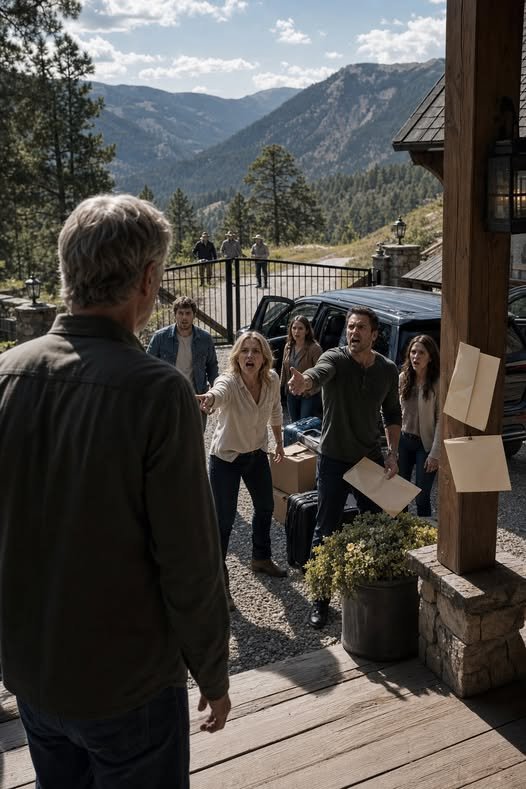
I walked to the front door, opened it, and stepped onto the porch. The cold air hit my face. Behind me, I heard chairs scrape, feet follow. Good. Let witnesses gather.
The man with the lockbox started up the steps. He was young, maybe thirty, with a trimmed beard and a vest bearing the company logo. He smiled like he had been taught to.
“Mr. Holloway?”
“That’s me.”
“I’m Spencer with Whitcomb Residential. We’re here for the preliminary property access evaluation.”
“No, you aren’t.”
His smile faltered. He glanced past me, probably at Harold. “We have authorization.”
“From whom?”
“Mr. Whitcomb.”
“Mr. Whitcomb doesn’t own the gravel under your shoes.”
The cameraman raised his phone higher.
I looked straight at him. “Record clearly.”
He lowered it a little.
I took my own phone from my pocket and started recording too.
Spencer’s confidence thinned. “Sir, we were told this was a family-approved evaluation.”
“It is not owner-approved. Leave.”
Harold stepped onto the porch behind me. “Grant, don’t embarrass yourself.”
There it was.
I turned slightly, making sure my phone caught him.
“Did you invite these men to inspect my property without my consent?”
Harold smiled coldly. “Daniel asked for help evaluating options.”
Daniel came through the doorway. His face had gone pale, but his voice was steady enough.
“I did not authorize a property inspection,” he said.
Claire grabbed his arm. “Daniel.”
He shook her off.
The emotional reversal came hard and visible. Harold had expected Daniel’s silence. Claire had expected obedience. Instead my son stood on my porch, small but present, and said no.
Not enough to repair anything.
But enough to change the room.
Spencer looked miserable. “Mr. Whitcomb, should we—”
“Proceed,” Harold snapped.
“No,” I said.
Then I did what Ruth told me. I called Deputy Crowder on speaker.
She answered with a tired, “Crowder.”
“Deputy, this is Grant Holloway. Harold Whitcomb has sent employees to inspect my property after being told no. I am asking them to leave. They are still here.”
Spencer took one step backward.
Harold said, “This is a civil matter.”
Lisa’s voice came through the speaker. “Mr. Whitcomb, are you on the property?”
Harold’s jaw tightened. “I’m a guest.”
“Then act like one. Any employees there for inspection need to leave unless Mr. Holloway permits them.”
The cameraman lowered his phone completely.
Spencer said, “We’ll head out.”
Harold turned on him. “Don’t move.”
Spencer froze.
I looked at him and saw something useful: fear. Not of me. Of Harold.
“You heard the deputy,” I said.
Spencer’s eyes flicked to Harold, then to me. “Yes, sir.”
He retreated down the steps, motioned to the others, and within a minute both trucks were backing out of my drive. Gravel cracked under their tires. Dust and exhaust hung in the cold air.
Harold watched them go with a face carved from stone.
Then Daniel said, “What were you going to do if Dad wasn’t here?”
That question changed everything.
Claire whispered, “Don’t.”
Daniel looked at her. “What were you going to do?”
Harold turned. “You wanted this handled.”
“I wanted to talk to him about maybe moving closer to us someday,” Daniel said. “You said we needed information.”
“We did.”
“You sent people with a lockbox.”
The word struck me.
Lockbox.
I looked down the drive where the trucks had vanished.
The young man had carried a real estate lockbox, the kind agents attach to doors when they expect showings.
Marlene saw it too late. Her hand went to her mouth.
I asked quietly, “Was my house being listed?”
No one answered.
The wind moved through the pines.
I turned to Harold. “Was my house being listed?”
His expression did not change, but Claire’s did. Her eyes filled with tears so fast they looked rehearsed.
“Grant,” she said, “it wasn’t like that.”
I looked at Daniel.
His face had collapsed inward.
“Claire,” he said. “Tell me.”
She began crying then. Not loudly. Not messily. The pretty kind, where tears slide straight down and make people want to forgive before they think.
“It was only a contingency,” she said.
A contingency.
Like my home was a spare tire.
Daniel backed away from her.
Harold stepped in. “Enough. This conversation has become emotional and counterproductive.”
“No,” Daniel said, voice rising. “It’s become honest.”
For one second, I saw the boy who once stood between a bully and a stray dog behind the school gym. Then I remembered he had also stood in the rain while Harold measured my land.
Both things were true.
That is what makes betrayal so hard to swallow. It does not erase the good memories. It poisons them.
I looked at Claire. “You used Daniel’s email for my mail.”
Her tears stopped.
Everyone saw it.
Harold said, “Don’t answer that.”
But Daniel was already staring at her.
“Claire,” he said. “Did you?”
She looked at him, then at her father, then back at him.
“I was trying to protect our future,” she said.
And with that, the last covered thing in the room tore open.
Part 11
People like Claire never say “money” when they mean money.
They say future. Security. Planning. Family. Stability. They wrap greed in clean white words and expect everyone to admire the packaging.
I stood on the porch while her sentence hung in the air.
I was trying to protect our future.
Not my present.
Not my rights.
Not even Daniel’s conscience.
Their future.
My goal now was no longer to uncover the plan. The plan was standing naked in front of me. My goal was to end it cleanly.
The conflict was Daniel, because part of me still watched his face for the child I raised, and that part was dangerous.
Marlene went inside first. She looked sick. Harold followed, not because he was done, but because he wanted the conversation away from open air and possible neighbors. Claire tried to touch Daniel’s arm again. He stepped around her and walked into the house without looking at her.
I came last and left the front door open.
Cold air followed us in.
Harold noticed. “Close the door.”
“No.”
“This is absurd.”
“The house needs air.”
He looked at me with open hatred then, and in a strange way I preferred it. Honest hate is easier to handle than fake concern.
Daniel stood by the kitchen table. “Start from the beginning.”
Claire wiped her face. “Daniel, please. We can talk privately.”
“No,” he said. “We talk here.”
Harold laughed. “You’re letting him manipulate you.”
Daniel turned on him. “You used me.”
“I helped you face reality.”
“You told me Dad’s place was too much for him.”
“It is.”
“You told me if he moved to the city, we could manage both properties better.”
“We could.”
“You told me the mountain house might cover debts if we structured it right.”
The word debts shifted the room.
I looked at Daniel. “What debts?”
He closed his eyes.
Claire’s crying resumed, but harder now, uglier.
Harold said, “That is private marital information.”
I stepped closer to the table. “My house was about to become public enough for a lockbox. What debts?”
Daniel opened his eyes. “Claire’s boutique failed.”
Marlene whispered, “Oh, honey.”
Claire snapped, “It didn’t fail. The market shifted.”
Daniel laughed once, hollow. “You hid vendor bills for eight months.”
My new information came in pieces then, jagged and ugly.
Claire had opened a high-end home décor shop in Raleigh with Harold’s backing and Daniel’s name on two credit lines. When the shop started losing money, Harold moved funds through one of his companies. Then he used Daniel’s worry about me to suggest “asset consolidation.” Sell the city apartment first, then pressure me into moving, then place the mountain house under family management “temporarily” while they evaluated care options.
Temporary again.
The favorite word of thieves who know permanent sounds too honest.
I listened without interrupting.
Daniel talked faster as he went, like a man vomiting poison. “I didn’t know about the listing. I didn’t know about the mail. I didn’t know they filed anything.”
“But you knew they were coming,” I said.
He looked at me. “Yes.”
“You knew I had said no.”
His face tightened. “Yes.”
“You told me to go back to the city.”
He swallowed. “Yes.”
Claire said, “Because you were being selfish.”
Daniel flinched, but I did not.
There was clarity in hearing it said plainly.
Selfish.
A man builds one place for peace after burying his wife, and when he does not hand it over fast enough, he is selfish.
I looked at Claire. “You will not sleep in this house tonight.”
She stared at me. “Excuse me?”
“You heard me.”
Harold stepped forward. “She is my daughter.”
“That’s your burden.”
Marlene made a small sound that might have been a laugh if it had more oxygen.
Harold ignored her. “You don’t get to throw family out.”
“You’re right,” I said. “Family already threw me out. I’m only returning the favor.”
Daniel’s face broke.
“Dad,” he whispered.
I held up one hand.
“No. Not yet.”
The emotional reversal came not from yelling, but from how quiet the room became. Everyone expected an explosion. They got a locked door instead.
I picked up the cream folder from the table. Claire lunged for it, but Daniel caught her wrist.
“Don’t,” he said.
That word, from him to her, changed her face more than any accusation had.
I opened the folder.
Inside were printed emails, draft agreements, a proposed “care transition timeline,” and a valuation estimate for my mountain house. At the back was a document labeled Preliminary Marketing Strategy.
My house had a name in it.
Ridgeview Retreat.
Not Holloway House. Not Grant’s place. Not home.
Ridgeview Retreat.
They had written copy for it.
Rustic luxury potential. Secluded but accessible. Ideal for high-net-worth buyers seeking privacy.
I thought of my muddy boots by the door. Marianne’s chipped blue mixing bowl locked away for safety. Daniel’s initials under the porch beam.
Luxury potential.
I set the pages down carefully.
“Everyone packs,” I said.
Harold scoffed. “You can’t remove lawful guests without notice.”
“You are not tenants,” I said. “You are temporary guests whose permission has been revoked because you attempted unauthorized property inspection and financial interference. Deputy Crowder is already aware.”
That sentence sounded like Ruth Hartwell, and I silently thanked her for every dollar I had ever paid.
Claire looked at Daniel. “Do something.”
He stared at her like she was a stranger wearing his life.
“I am,” he said.
He picked up her purse from the chair and handed it to her.
For one wild second, I thought maybe that would be the beginning of repair between us.
Then he turned to me with wet eyes and said, “I’ll stay and help you sort this out.”
The old father in me almost reached for him.
The man who owned the house did not.
“No,” I said.
His hand dropped.
“You leave too.”
The silence after that was the first peaceful sound I had heard all day.
Part 12
Daniel looked at me as if I had spoken a language he used to know but had forgotten.
“Dad,” he said. “You don’t mean that.”
“I do.”
“But I’m trying to fix it.”
“No,” I said. “You’re trying to arrive after the damage and call it repair.”
He took that like a hit.
Good.
Some truths should bruise.
My goal was to make the boundary plain enough that grief could not blur it later.
The conflict was my son standing six feet away with his mother’s mouth trembling on his face.
Claire’s anger returned fast. “This is insane. Daniel, don’t let him do this to you.”
“To me?” Daniel said.
She pointed at me. “He’s punishing you because he wants control.”
I almost smiled. Projection is a funny thing when you can afford to watch it from the porch of your own house.
Harold had gone very still. That worried me more than his anger. Still men are often counting exits.
Marlene, however, was moving. She went upstairs without another word. We heard drawers open. Suitcase wheels bump across floorboards. She was done before the rest of them accepted the sentence had been passed.
Daniel stepped closer. “I didn’t know everything.”
“But you knew enough.”
“I was worried about you.”
“No,” I said. “You were uncomfortable with me. That isn’t the same.”
His eyes filled. “I lost Mom too.”
There it was. The old door. The one he had never opened without slamming it.
“I know,” I said.
“You shut me out after she died.”
“I buried my wife.”
“I buried my mother.”
“I know.”
“No, you don’t!” His voice cracked through the room. “You stayed up here with your trees and your tools and your memories, and I had to go back to work like nothing happened. Claire’s family showed up. They helped. They made decisions. They acted like I wasn’t falling apart.”
That was new information of a different kind. Not useful legally. Useful painfully.
For a moment, the house softened. The woodstove ticked. Wind pressed against the open door. I saw Daniel at thirty-two, in a suit after the funeral, standing beside Harold while I sat alone by Marianne’s empty hospital bed. I remembered thinking he did not need me.
Maybe he had thought the same.
But pain explains betrayal. It does not excuse it.
“I failed you after your mother died,” I said.
The room went still.
Daniel stared.
I continued, “I disappeared into work because I did not know how to be a widower and a father to a grown man at the same time. That is true.”
His shoulders shook once.
“And you repaid that by helping people put a leash on my life.”
His face collapsed again.
Claire whispered, “That is cruel.”
I looked at her. “Cruel is accurate when kindness has been weaponized.”
Marlene came down with her suitcase. She had changed shoes. Practical flats now, not the polished boots she arrived in. She looked at Harold.
“I’m going to a hotel,” she said.
“We are not leaving like criminals,” Harold replied.
She laughed then, sharp and sad. “No, Harold. Criminals usually try to stay longer.”
His face flushed.
For the first time all day, I liked her.
Claire turned on her mother. “Mom.”
Marlene looked at her daughter with an exhaustion I recognized. The exhaustion of someone seeing family clearly too late.
“Claire,” she said, “how much of the debt did you hide from Daniel?”
Claire’s mouth hardened.
That was answer enough.
Daniel sat down slowly at the table.
The emotional reversal now belonged to him. He had arrived as an accomplice, became a victim in his own mind, and was now discovering he had been both.
Harold picked up his phone. “I’m calling our attorney.”
“Do that from the road,” I said.
He ignored me.
So I called Deputy Crowder again.
This time, I did not use speaker until she answered. Then I set the phone on the table.
“Deputy,” I said. “I have revoked permission for all guests to remain. Harold Whitcomb is refusing to leave.”
Harold lowered his phone.
Lisa’s voice came through. “Mr. Whitcomb, are you refusing to leave after the property owner revoked permission?”
He stared at the phone.
Marlene said, “Harold.”
Claire whispered, “Dad.”
Daniel did not speak.
Harold’s eyes stayed on mine. Then he smiled that thin, polished smile again.
“No,” he said. “We’re leaving.”
“Good,” Lisa said. “Grant, call back if that changes.”
I ended the call.
After that, movement replaced words.
Suitcases came down. The kitchen box went back out unopened. Harold shoved papers into the folder with enough force to bend the corners. Claire cried in bursts now, angry at being watched. Marlene carried her own bag. Daniel carried nothing at first, then picked up the cracked photograph from the table.
“Leave it,” I said.
He froze.
“I can fix the frame,” he said.
“I know.”
His hand tightened around it.
“Leave it,” I repeated.
Slowly, he set it back down.
That hurt him.
It was meant to.
Because some things cannot be fixed by the person who stood beside the one who broke them.
At the door, Daniel turned. The late light caught his face, making him look younger and older at once.
“What happens now?” he asked.
I looked at the folder under Harold’s arm, at Claire’s ruined mascara, at Marlene’s packed bag, at the empty hooks on my wall waiting for quiet to return.
“Now,” I said, “you all learn what no means when I say it out loud.”
They stepped onto the porch.
Then Harold stopped at the threshold and looked back, his voice soft enough for only me to hear.
“You think this ends because we drive away?”
I felt the final piece of the day settle into place.
“No,” I said. “I was hoping you’d admit it doesn’t.”
And for the first time, Harold realized I was still recording.
Part 13
They left in two vehicles, not three.
Marlene refused to ride with Harold.
That small rebellion caused more confusion in my driveway than the deputy had. Harold stood beside the silver SUV holding the driver’s door open, jaw clenched, while Marlene walked past him and got into Daniel’s sedan. Claire hesitated, torn between husband and father, then chose Harold.
Daniel saw that too.
I watched from the porch as the cars backed down the drive. No one waved. No one looked relieved. Gravel dust rose behind them, pale in the evening light, then settled over the ruts like nothing had happened.
But things had happened.
My goal after they left was to secure the house and the record.
The conflict was the silence Daniel left behind. It was bigger than the noise had been.
I closed the door and locked it. Then I leaned my forehead against the wood for a moment. The house smelled wrong: perfume, cold air, anger, oatmeal burned at the bottom of a pan. I opened windows even though the temperature was dropping. I wanted them out of the curtains, the rugs, the corners.
Then I got to work.
I photographed every room.
The cracked frame.
The folder pages I had managed to scan with my phone before Harold snatched them back.
The tire marks in the drive.
The envelope.
The guest room, barely used but already carrying Marlene’s powder scent.
Then I sent everything to Ruth.
She called an hour later.
By then it was dark. I had washed the saucepan twice and still smelled burned oats. The wind had picked up, scraping bare branches against the siding.
Ruth did not waste time. “You have enough for a protective letter. Maybe more.”
“More?”
“Attempted unauthorized property access. Possible identity misuse. Mail forwarding attempt. Elder exploitation concerns turned inside out.”
“That last one has a certain poetry.”
“It has teeth, Grant.”
I stood at the kitchen sink looking at my reflection in the black window. “Will teeth stop Harold?”
“No. But they make biting expensive.”
That was good enough for the night.
She told me she would draft letters to Harold, Claire, Daniel, Whitcomb Residential Holdings, and the attorney whose name appeared on one of the documents. She would also file fraud alerts, freeze the mail change, and put county recording monitors on both properties.
When she asked whether I wanted Daniel included in the no-contact notice, I did not answer right away.
Outside, an owl called once from the ridge.
“Yes,” I said.
The word came out like a door closing.
Ruth was quiet for half a breath. “You’re sure?”
“No,” I said. “But do it.”
“Temporary or permanent?”
I thought of Daniel at thirteen in the cracked photo. Daniel at thirty-eight telling me to go back to the city. Daniel in the rain with Harold. Daniel handing Claire her purse. Every version of him lined up in my mind, none canceling the others.
“Temporary legal no contact,” I said. “Personal no contact until I decide otherwise.”
“That is not the same thing.”
“I know.”
We hung up after that.
The emotional reversal came later, when I finally sat in my chair with a plate of reheated chili and felt not victory, but grief.
Real grief has texture. It is not one clean sadness. It is humiliation, loneliness, fury, love with nowhere safe to go, and a strange shame for not seeing sooner. I ate three bites and set the bowl down. My appetite had left with the cars.
At ten-thirty, my phone buzzed.
Daniel.
I did not answer.
A voicemail appeared.
I let it sit for twenty minutes before playing it.
His voice came through rough and close, like he was speaking from a parked car.
“Dad. I don’t know what to say. I’m at a motel. Mom—Marlene, I mean—she told me more. Claire’s asleep or pretending to be. Harold is calling people. I think he’s scared. I think I am too.”
He breathed shakily.
“I know I don’t deserve to ask anything. But please tell me you’re okay.”
I stopped the voicemail there.
That was the hardest moment of the day.
Not Harold’s threat. Not Claire’s lies. Not the lockbox. That sentence.
Please tell me you’re okay.
Because my first instinct was to comfort him.
Even then.
Even after everything.
I stood up so fast the chair scraped back. I walked outside onto the porch in my socks. The boards were cold. The sky had cleared, and stars crowded the dark like spilled salt. Down below, the trees moved as one body in the wind.
I replayed the voicemail from the beginning and listened all the way through this time.
At the end, Daniel said, “I’m sorry I made you feel disposable. I think I let them make me believe you were already gone.”
The message ended.
I stood in the cold holding the phone.
There is an apology that asks to be accepted, and there is an apology that simply admits the damage. His was the second kind.
That made it better.
That did not make it enough.
At 11:04, another message came in.
Not from Daniel.
From Harold.
You have made a serious mistake. Old men who insist on living alone often discover how alone they really are.
I read it once, then looked out at the black ridge.
The fear came, sharp and brief.
Then something better replaced it.
Because Harold had forgotten one simple thing about old men who live alone in houses they built themselves.
We know every sound the mountain makes.
And just after midnight, I heard one that did not belong.
Part 14
It was not a loud sound.
A careless man would have missed it. A city man would have blamed the wind. But I knew the rhythm of that house the way I knew my own pulse, and the sound under the north window was wrong.
Metal against wood.
Soft.
Testing.
My goal was to protect myself without becoming the version of me Harold wanted on paper.
The conflict was fear, plain and honest. I am not ashamed of that. Any man who says he feels nothing when someone comes creeping around his house after midnight is either lying or too foolish to survive long.
I turned off the lamp beside my chair.
Darkness filled the room.
The woodstove glowed faintly, red at the seams. I moved slowly, avoiding the board near the bookshelf that clicked in winter. In the kitchen, I picked up my phone and called 911. I whispered my name, address, and the fact that someone was attempting entry. The dispatcher told me to stay inside, stay on the line, and avoid confrontation.
Good advice.
I set the phone on speaker but low, then took the heavy flashlight from the drawer.
Not a weapon. A fact.
The sound came again.
This time at the mudroom door.
Whoever it was knew enough not to use the front.
That told me something.
I moved to the hallway where the angle gave me a view of the mudroom through the laundry shelf. The outside knob turned once. Stopped. Turned again. Then came the faint scratch of a tool near the lock.
My mouth went dry.
On the dispatcher’s line, a woman’s voice asked, “Mr. Holloway, are you in a safe location?”
“For now,” I whispered.
Then the mudroom door opened.
Not far. Two inches.
The security chain caught.
A man cursed under his breath.
I knew the voice.
Not Harold.
Spencer.
The young employee from the driveway.
That was the new information, and it turned the fear sideways into something complicated. Harold had sent someone else to risk the crime.
Of course he had.
The door pushed again. The chain held.
I lifted the flashlight and hit the switch.
White light blasted the mudroom.
Spencer froze in the gap, one gloved hand inside, a pry tool in the other. His eyes went wide.
“Grant?” he said, stupidly.
“Mr. Holloway,” I corrected.
He stumbled backward, but not fast enough to escape the porch camera above the mudroom light, which I had turned on after the bear incident. Red recording light steady. Beautiful.
“Deputies are on the way,” I said.
He looked toward the trees.
“Don’t run,” I added. “Running makes you look guiltier, and Harold won’t save you.”
That stopped him.
The emotional reversal came in his face. Panic shifted to calculation, then to resentment. Not at me.
At Harold.
“I was just supposed to get the folder,” he said.
I kept the flashlight on him. “What folder?”
“The one Claire left copies of. Mr. Whitcomb said you stole proprietary documents.”
I almost laughed. “He sent you to break into my house over paperwork?”
Spencer’s face crumpled around the edges. “He said it was family property. He said you were unstable and wouldn’t even know.”
There it was again.
The narrative.
The excuse that makes theft feel administrative.
Red and blue lights appeared faintly through the trees five minutes later. Spencer sat on the back steps by then, hands visible, pry tool on the ground. Deputy Crowder arrived with another deputy named Ames, and they did everything by the book. Photographs. Statements. Cuffs.
Spencer talked before they even put him in the cruiser.
By sunrise, Harold Whitcomb was no longer a threat in a vest and polished boots. He was a man named in a criminal complaint, an attempted unlawful entry, conspiracy to commit property interference, and whatever else the county attorney decided to stack on after Ruth finished feeding them documents.
Claire called me seventeen times that morning.
I answered none.
Daniel called twice.
I answered none.
At nine, Ruth came up the mountain herself with a thermos of coffee and a folder thicker than Claire’s had been. We sat at the kitchen table while the house warmed around us. Sunlight touched the cracked photograph, still lying face down.
Ruth laid out the steps.
Fraud alerts active.
Mail forwarding blocked.
Property record watch confirmed.
Cease-and-desist letters delivered electronically.
No-contact notice served.
Statement requested by sheriff’s office.
Harold’s company under review for prior complaints.
“You did well,” she said.
“I got lucky.”
“You got prepared.”
I looked at the locked storage room door. “Same family, different spelling.”
For the first time in days, Ruth smiled.
The months after that did not wrap themselves into a neat bow. Life rarely respects storytelling that much.
Harold tried to blame Spencer. Spencer produced text messages. Marlene separated from Harold before Thanksgiving and moved into an actual apartment with actual mold in the bathroom, which she later joked was the first honest thing she had lived with in years. Claire and Daniel split in January after the boutique debts became impossible to hide. I learned this through Ruth, not because I asked, but because legal matters leave footprints.
Daniel sent letters.
Real letters, on paper, mailed to Ruth’s office because he was not allowed to contact me directly.
The first one was six pages of apology and explanation. I read it once and put it away.
The second included a photo of him standing by Marianne’s grave. I did not like that. Grief should not be used as postage.
The third was shorter.
I am not asking to come back. I am asking to become someone you might someday choose to know again.
That one I kept on the table for a week.
But I did not call.
Forgiveness is not a refund counter where someone brings back regret and receives trust in exchange. Daniel had not made one mistake. He had made a road. Step by step. Silence by silence. He had walked with people who saw my life as inventory.
I could love him and still refuse to let him near the lock.
Spring came late that year.
The mountain thawed in stages: first the creek shaking loose under ice, then the smell of mud, then green tips pushing through dead leaves. I repaired the cracked photograph myself. Not perfectly. The glass was new, but the old split had left a pale mark on the print. Marianne’s face still carried a faint line through the smile.
I decided not to replace the picture.
Some damage should remain visible, not as punishment, but as warning.
In April, I changed my will.
Daniel would not inherit the mountain house.
That sentence looks cruel when written plainly. It was not written quickly. I spent nights walking from room to room, touching doorframes, listening to the house settle. I stood under the porch beam where his initials were carved and remembered the boy who made them. Then I remembered the man who pointed at my land in the rain.
The house went into a trust for the county land conservancy after my death, with lifetime access reserved for me and, if I ever chose, any person I named in writing. No automatic inheritance. No family assumption. No son arriving with grief in one hand and a lockbox in the other.
When Ruth filed the papers, she asked if I wanted to tell Daniel.
“No,” I said.
“He’ll find out eventually.”
“Yes.”
“And?”
I looked out her office window at Mason’s Fork, where dogwoods had begun to bloom along the sidewalk.
“And that will be the first thing he learns without being able to change it.”
That summer, I started hosting Saturday coffee on the porch for a few neighbors. Not many. Lisa Crowder came once out of uniform. Ruth came twice and complained that my chairs were built for men with no hips. A widow named Ellen Price from the next ridge began stopping by with blueberry scones and a laugh that arrived before she did.
I did not turn it into romance because lonely people in stories are always being shoved toward someone else like a chair against a door.
But I liked her.
I liked that she noticed the porch beam before the view. I liked that she brought her own mug. I liked that when she heard part of what happened, she did not say, “But he’s your son.”
She said, “Good fences are mercy when people have forgotten gates.”
By October, one year after Daniel’s call, the mountain looked almost exactly the same. Gold leaves. Cold mornings. Smoke from the chimney. Crows over the ridge.
I was on the porch splitting kindling when Daniel’s car came up the drive.
He parked at the bend, not near the house. That mattered. He got out alone. He had lost weight. His hair was longer. He stood beside the car with both hands visible, like a man approaching a wary animal.
I walked down only as far as the porch steps.
He did not come closer.
“Dad,” he said.
I nodded once.
He swallowed. “Ruth said I could leave something in the mailbox if I didn’t come past the sign.”
The sign said Private Property. No Entry Without Written Permission.
I had made it myself.
“You can,” I said.
He held up an envelope. “It’s not legal. It’s just… mine.”
I waited.
He walked to the mailbox, placed the envelope inside, and stepped back.
Then he looked toward the house.
“I know I don’t get to come in,” he said.
“No,” I replied. “You don’t.”
His face tightened, but he nodded. “I’m sober now. From debt, from Claire, from letting other people tell me what love is supposed to cost. I know that doesn’t fix anything.”
“It doesn’t.”
“I know.”
The wind moved between us. Leaves skittered across the gravel, dry as paper.
He looked older than thirty-nine. That hurt. I let it.
“I miss you,” he said.
“I miss who I thought you were.”
His eyes filled, but he did not argue. That was new.
“I deserved that,” he said.
“Yes.”
Another silence.
Then he said, “Will you ever forgive me?”
There it was. The question every betrayed person is expected to answer kindly so the room can breathe again.
I looked at my son. I loved him. That was the hardest part, and the truest. I loved him standing there in his worn jacket, humbled by consequences, carrying his regret like a stone he finally understood was his.
But love is not permission.
“No,” I said. “Not the way you mean.”
He closed his eyes.
I continued, “I may stop being angry every day. I may hope you become better. I may even speak to you someday if I choose. But forgiveness, the kind where you get to feel clean because I swallowed what you did? No. I’m not giving you that.”
A tear ran down his cheek.
He nodded.
“Okay,” he whispered.
Then he got in his car and drove away slowly, leaving no dust this time.
I waited until the sound of the engine disappeared before walking to the mailbox.
Inside was a single envelope with my name written by hand.
Grant Holloway.
Not Dad.
That told me he had learned at least one thing.
I carried it to the porch but did not open it. Not then. Maybe not ever. I set it on the table beside my coffee and looked out at the mountains.
The house was quiet.
Not empty.
Mine.
Wind moved through the trees, steady and clean, and the porch beam above me held Daniel’s childhood initials in the shade. I did not carve them out. I did not cover them.
I let them remain where they belonged.
In the past.
THE END!