
The Deed in My Name
They told me I ought to be thankful they still let me sleep there.
Not in a spare room. Not in some forgotten corner of somebody else’s house. They said it standing in my own kitchen, beneath a roof my husband and I had paid off one careful month at a time, in the house where I had raised three children, buried one good man, and learned how loud silence can become once love leaves the room.
My name is Rosalind Hartley. I was seventy years old when my daughter looked me square in the eye and forgot whose name was on the deed of the house she was standing in.
It happened on a soft Savannah morning in early April, the air already damp before the sun cleared the rooftops. Out front, the little flag my husband Walter had bolted to the porch post years ago tapped against the wood whenever a breeze slipped through the big water oak.
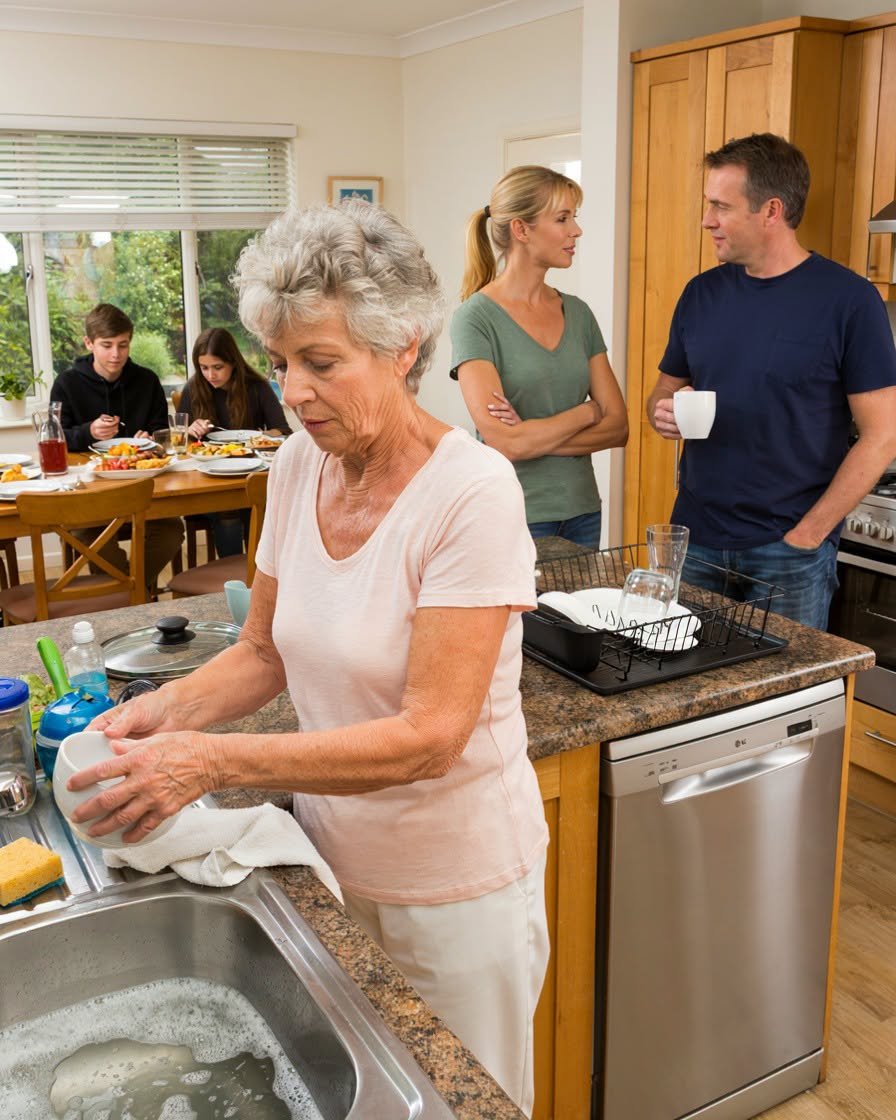
I had dish soap on my hands. That is the detail I keep, more than any other. Not my daughter’s face, not my son-in-law’s put-upon sigh, just the soap sliding slick between my fingers while Diane said, in a voice she must have thought reasonable, “Honestly, Mother, you should be grateful. You’re lucky we even let you sleep here.”
For one full second, the whole house went still. Craig stood by the counter, frowning at the breakfast I had made as though I had offended him with eggs and toast. My grandson Tyler had one earbud in and one dangling, doing that half-there thing teenagers do when adults are humiliating one another. My granddaughter Madison never looked up from her screen. Nobody corrected Diane. Nobody said, “Grandma owns this house.” Nobody said, “That was cruel.” Nobody said anything at all.
The bacon went cold. Down the block a lawn crew fired up a leaf blower, the drone that used to make Walter grumble, “Let a man finish his coffee before the racket starts.” He would have known what to say. But he had been gone nineteen months by then, and I had spent every one of them letting other people decide what my grief had turned me into.
At the start, Diane had called it help. She came by on a Sunday with Craig in tow, wearing that worried, tender expression grown children put on once they have already decided what is best for you and only need you to agree. “Mother, we need to talk.” Those five words have never once brought peace into anybody’s kitchen.
I was still living alone then, in the four-bedroom house on Chestnut Row that Walter and I had bought in 1979. Not a grand house, but solid, and ours. White clapboard, a deep front porch, a fig tree in the back that Walter had planted because his father had grown one, a hallway where the children’s heights were still penciled behind the pantry door.
Diane folded her hands like a woman about to chair a board meeting. “You can’t just keep rattling around in this big place all by yourself. There are too many stairs. Too much yard. What if you fall and nobody’s here? What if you leave a burner going?”
“I have never once left a burner going.”
“Mother.” That single word. Soft, disappointed, endlessly patient. The word grown children reach for when they have already stopped listening to you.
“We’re just trying to be practical here, Rosalind,” Craig said. He had started calling me Rosalind about a year before Walter got sick, and I never cared for it. There is a particular species of son-in-law who believes that using your first name makes the two of you equals, while still expecting you to behave like a mother the moment he wants something cooked or paid for.
Diane laid her hand over my wrist. “We could move in for a while. Just temporarily. Just until you’re steadier, and until Craig and I find a bigger place of our own. It helps everybody, really.” That was how she sold it to me. Temporary. A few months, no more. Family looking after family. Back then I was still raw enough from losing Walter that kindness could slip right past my judgment if it arrived in the right voice. I missed the noise of a full house, missed cooking dinner for more than one plate. So I said yes. I told myself Walter would have wanted the house full of life again. What I did not understand was that a house can fill right up with people and still grow lonelier than an empty one.
Diane and Craig arrived two weeks later with far more than any “temporary” arrangement should require. Two moving trucks pulled up before nine in the morning. Not a pickup, not a handful of suitcases, two full-sized moving trucks. Louise Tanner from next door came out in her gardening gloves and called across the hedge, “Big day, Rosalind?”
“Just helping Diane out for a little while,” I said.
Louise looked at the second truck, then back at me. “For a little while,” she repeated, and there was something in the way she said it that I should have heard as a warning.
Soon after, Diane decided the master bedroom made more sense for her and Craig. “Think of your knees,” she said.
“My knees are perfectly fine. And I’ve only been sleeping downstairs because Walter was sick and I didn’t want to leave him.”
Her face softened, but only for a breath. “I know. But wouldn’t it be easier? You wouldn’t have to climb all those stairs.” She made it sound like concern. She always made everything sound like concern. So I moved into the smallest bedroom on the ground floor, the room Walter and I had once used for sewing and wrapping Christmas presents. Diane called it cozy. Craig called it practical. I called it surrender, though never out loud.
The first month was loud but bearable. Then Diane announced that what this kitchen needed was systems. She moved my coffee mugs across the room because it “improved the flow.” She threw away Walter’s chipped mug from his old bowling league because it looked “sad.” She set a white canister labeled FLOUR right where Walter’s dented cookie tin had sat for thirty-six years. Tiny changes, not one worth a fight on its own. That is how a person vanishes. One drawer at a time. One chair. One room, until you look up and cannot find yourself anywhere in the house you built.
By the seventh month, Craig had taken over the mahogany dining table Walter and I had saved three years to buy, the one Walter used to carve the Thanksgiving turkey at with the grave concentration of a surgeon. Now it was buried under Craig’s client files, ringed with his coffee cups. When I mentioned coasters, he looked at me the way you look at something fragile and tiresome. “Rosalind, it’s just a table.” No. But how do you explain memory to a man who only ever sees the surface of things?
Then the money began quietly shifting. They stopped noticing what anything cost. The electric bill climbed, the water bill nearly doubled, and when I raised the subject of splitting utilities, Diane said they were “a little tight this month” because they were saving for a down payment. I believed that far longer than I should have, right up until a new SUV appeared in the driveway and Diane came home with bags from the pricey boutiques downtown.
What my family never bothered to learn is that I had spent nearly forty years as an office manager at a law firm, where men in good suits underestimated me right up until the moment they needed something located, dated, or remembered. I knew paperwork the way some women know Scripture, and all the ways people bury their intentions inside polite language. I was not helpless. I was not confused. I was simply quiet, and that difference sailed right over my family’s heads.
The night it turned, Diane hosted a dinner for two couples from Craig’s business circle and asked me, just before the guests arrived, to eat in my room so it would “feel professional.” So I ate soup off a tray while strangers laughed in my dining room and praised Diane’s “gorgeous home.” Through the wall I heard her say, “Thank you so much. We’ve done a lot with it.” We. I set my spoon down and did not pick it back up.
By that winter, the house no longer felt like mine anywhere except the places nobody else wanted, and Diane had begun speaking to the neighborhood association as if she ran the household. Louise called one afternoon to tell me. “Rosalind, your Diane told the association she’s handling the outdoor decisions now. She was asking about fence rules. Said the backyard needed a more modern look.”
The backyard held Walter’s fig tree and a brick path he had laid himself over three brutal July weekends, swearing cheerfully at every uneven brick. A modern look. I gripped the peeler so hard my knuckles ached. Louise was quiet a moment. “Honey, they’re not helping you. They’re settling in for good.”
I looked out the back window at Walter’s shed, where Craig had propped his golf clubs against the door. “I know,” I said. It was the first time I had said it out loud.
But knowing a thing and acting on it are two different animals, especially when the person hurting you is your own child. Diane was my firstborn. I could still see her at five with flour on her nose, helping me stir pancake batter, and on her wedding morning, whispering, “I hope Craig and I have what you and Daddy have.” Memory is dangerous that way. It carries the child back into the room even while the grown woman stands in front of you doing you harm.
So I gave her more chances. Far too many. I asked for respect; she called it my being oversensitive. I asked for help with the bills; she called it pressure. I asked, once, quietly, if I might have my old bedroom back, and she stared at me as though I had asked to sleep in the street. “Mother, Craig and I need our space. We’re a couple. You’re one person.” One person. As though widowhood had somehow made me mathematically smaller.
The final Tuesday began, of all things, with bacon. I had woken early and made a proper breakfast, because some old habits don’t vanish just because the people around you stop deserving them. Craig glanced at the spread and sighed. “Rosalind, we’re trying to eat cleaner. Can you stop pushing all this old-person food on us?” The words stung less than the look on his face, that bored irritation, that assumption that I existed mainly to inconvenience him. I turned off the burner.
Diane came in, cinching her robe. “Craig’s right. You’ve got to stop making these heavy breakfasts like it’s still 1975.”
“It’s my kitchen,” I said. It came out calm. Too calm, maybe.
“Mother, don’t start.” And then she said it. “You should be grateful. You’re lucky we even let you sleep here.”
There it was. The truth, at last, with its Sunday clothes stripped off. For one clear moment I saw it plainly. Not as a mother straining to understand her daughter, not as a widow desperate to keep the peace, but as a woman standing in a house she alone owned while four people treated her very presence as a burden they were generous to bear.
I dried my hands and hung the towel over the oven handle. I looked once at Diane, once at Craig, once at the two teenagers who had heard enough to understand exactly what was happening and had still said nothing. Then I walked out.
“Where are you going?” Diane called.
“To my room,” I said. My room. The smallest room. The surrendered room.
End Part Here: My Daughter Said I Was Lucky to Stay in My Own House, So I Showed Her the Deed