
I froze in the middle of the living room, barefoot and trembling, my phone clutched tightly in both hands.
On the screen, my eight-year-old daughter, Emily, was sleeping beneath her lavender blanket. One small arm was wrapped around her favorite white rabbit.
At first, everything in her bedroom looked normal.
The nightlight glowed softly in the corner. The curtains moved slightly with the air from the vent. Her bookshelf stood perfectly still against the wall.
Then the bedroom door slowly opened.
It did not swing wide enough for a dramatic entrance. It opened only a few inches—just enough for someone familiar with our home to slip quietly inside.
My throat tightened before I could make a sound.
A tall figure entered the room wearing dark clothes. He moved carefully through the soft yellow light.
For one terrifying second, I thought a stranger had broken into our house.
Then the figure turned slightly.
It was Daniel.
My husband.
Emily’s father.
He was still wearing his hospital scrubs beneath his coat. His hair was messy, and his shoulders were bent with exhaustion.
I stared at the screen, confused and frightened, as he stood beside Emily’s bed like a man afraid to touch something precious.
He did not wake her.
He did not speak.
He simply looked at her.
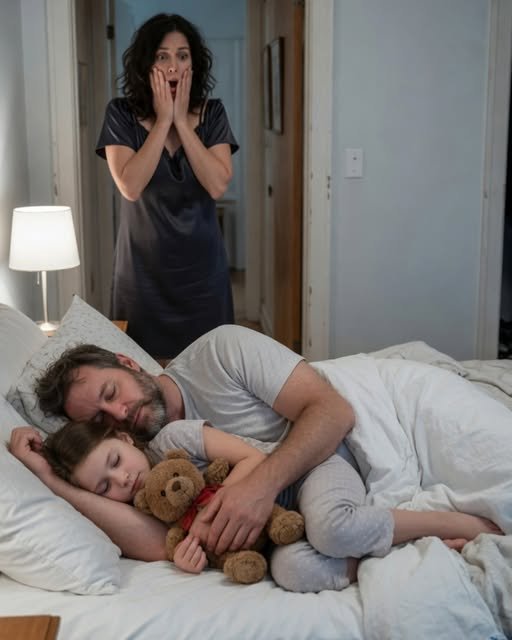
Then Daniel lowered himself onto the edge of her oversized bed, moving carefully so he would not disturb her pillow.
Emily stirred in her sleep and shifted closer to the wall.
Suddenly, everything made sense.
That was why she kept saying her bed felt too small.
Someone had been lying beside her.
I watched Daniel stretch out on top of the blanket. He did not climb underneath it. He curled his body as small as possible and turned toward our daughter.
Then he gently placed one hand near her little fingers.
He did not hold her hand fully.
He only allowed one finger to touch hers.
And then my husband—the brilliant surgeon everyone admired for his calmness and steady hands—began to cry.
Silently.
Completely.
His shoulders shook, but he covered his mouth so Emily would not wake.
I stood in the dark living room, unable to breathe, move, or understand what I was witnessing.
Daniel whispered something.
The camera had audio, but his voice was too low to hear.
With shaking fingers, I raised the volume.
At first, I could hear only the quiet hum of the nightlight and Emily’s slow breathing.
Then Daniel’s broken voice came through the speaker.
“I’m sorry, baby,” he whispered. “Daddy is trying. I promise I’m trying.”
My knees became weak.
I lowered myself onto the sofa without taking my eyes off the screen.
Daniel remained beside her for nearly ten minutes, crying into the sleeve of his coat.
Then he reached into his pocket and pulled out a small white envelope.
With the kind of care people use around sleeping angels, he slid it beneath Emily’s pillow.
Afterward, he leaned forward and kissed the blanket near her shoulder.
Not her cheek.
Not her forehead.
Only the blanket.
It was as though touching her directly might break him.
Then Daniel stood, wiped his face with both hands, and left the room as quietly as he had entered.
I did not go after him.
I could not.
I sat alone in the dark until the phone screen went black in my hands.
For the first time in our marriage, my husband had entered our daughter’s bedroom like a secret.
And whatever he had hidden beneath her pillow frightened me more than any stranger could have.
The Hidden Letter
At 5:30 the next morning, Daniel was gone again.
His side of our bed was cold.
On the kitchen counter, I found a short note beside the coffee machine.
Emergency surgery. Don’t wait for me. Love you.
The handwriting belonged to Daniel, but the final two words looked heavier than usual.
I stared at them for a long time.
Then I walked quietly into Emily’s bedroom.
She was still asleep, her cheek pressed against the white rabbit and her hair scattered across the pillow.
I slowly slid my hand beneath the pillow.
My fingers touched paper.
The envelope was still there.
On the front, Daniel had written in small, careful letters:
For Emily, when she turns sixteen.
My entire body went cold.
I sat on the edge of the bed and stared at the envelope until my vision blurred.
Why would a father write a letter eight years early?
Why would a healthy man leave messages for birthdays he expected to miss?
Emily slowly opened her eyes and blinked sleepily at me.
“Mommy?” she whispered. “Are you okay?”
I quickly hid the envelope behind my back and forced myself to smile.
“Yes, baby. I just came to check on you.”
She rubbed her eyes.
“My bed felt small again.”
My throat tightened.
“I know.”
Emily sat up and looked at me.
“Did you come into my room?”
“No,” I said, my voice breaking. “But I think Daddy did.”
Her expression changed.
She did not look frightened.
She looked relieved, as though something had finally been confirmed.
“So it was him,” she whispered.
I stared at her.
“You knew?”
Emily looked down at her blanket.
“I thought maybe it was Daddy,” she said. “He smells like hospital soap.”
That small sentence broke something inside me.
Hospital soap.
Not a ghost.
Not a stranger.
Not a nightmare.
Her father’s exhaustion had become a smell she recognized in the darkness.
“Did he scare you?” I asked.
Emily shook her head.
“No. He just cries.”
I tightened my grip on the envelope.
“How many times has he come in here?”
She shrugged, trying to appear casual in the heartbreaking way children sometimes do.
“I don’t know. A lot. Sometimes he says sorry.”
I pulled her into my arms.
She was warm, small, and confused by my sudden trembling.
“Mommy,” she asked, “did Daddy do something bad?”
I closed my eyes.
“No, sweetheart,” I whispered. “But I think he may be hiding something very sad.”
The Truth at the Kitchen Table
Daniel returned home at 10:48 that night.
He looked completely destroyed.
His face was pale, his eyes were shadowed, and his hands were hidden inside the pockets of his coat as though he were trying to protect them.
I was waiting for him in the kitchen.
The white envelope lay on the table between two untouched cups of coffee.
Daniel stopped the moment he saw it.
For a second, the confident surgeon disappeared.
A frightened man stood in my kitchen instead.
“Claire,” he said quietly.
My name sounded like an apology.
I folded my arms to stop myself from shaking.
“How long?”
Daniel looked at the envelope and then toward the hallway leading to Emily’s room.
“How much did you see?”
“Enough,” I answered. “Enough to know that you’ve been saying goodbye to our daughter while pretending to go to work.”
His jaw tightened.
He looked toward the window and then down at his hands.
“I didn’t want you to find out this way.”
A bitter laugh escaped me.
“You didn’t want me to find out at all.”
Daniel closed his eyes.
His silence answered for him.
I stepped closer.
“Tell me the truth. Right now. Not the husband’s version. Not the doctor’s version. Tell me everything.”
Slowly, Daniel removed his hands from his pockets.
For the first time, I noticed the tremor.
It was small and controlled, but it was real.
His right hand shook slightly before he clenched it into a fist.
My breath caught.
Daniel saw that I had noticed.
“Three months ago,” he began, “my hand slipped during a procedure.”
I gripped the back of a chair.
“At first, I thought it was exhaustion,” he continued. “Stress. Too many hours at the hospital.”
“Daniel,” I whispered.
“I arranged some tests privately. Then I had more tests done. Finally, I went to see a neurologist outside the hospital.”
The room seemed to tilt around me.
“What is it?”
Daniel swallowed.
“Early-onset Parkinson’s disease.”
The words were spoken quietly, but the damage they caused was enormous.
Every late night, strange absence, and unexplained change in his behavior suddenly rearranged itself into a new and terrifying picture.
“You’ve known for three months?” I asked.
He nodded.
“And you told no one?”
“I told one doctor,” he answered. “I didn’t tell the hospital board, my parents, or you.”
My anger rose so quickly that it burned through the grief.
“I am your wife.”
“I know.”
“No,” I said, my voice breaking. “You don’t get to know that quietly. You don’t get to turn me into a widow before you are even gone.”
“I’m not dying tomorrow,” he said.
“But you were writing letters as though you were.”
Daniel’s face crumpled.
He dropped heavily into a chair and covered his face with both hands.
“I’m a surgeon, Claire,” he said. “My hands are my life. My hands support our family. They built everything we have.”
I sat across from him, shaking.
“No,” I said. “Your hands are not your life. Emily and I are your life.”
Daniel began to cry openly.
This time, he did not hide from cameras or sleeping children.
“I was scared,” he admitted. “I was ashamed. I didn’t know how to tell Emily that her superhero father was breaking.”
My anger softened, but it did not disappear.
“She is eight years old,” I said. “She doesn’t need a superhero. She needs a father who doesn’t haunt her bedroom.”
Daniel flinched.
He needed to hear it.
“I thought that if I lay beside her for a few minutes,” he whispered, “I could survive the next day.”
I looked at the envelope.
“And the letters?”
His voice became smaller.
“They’re for her birthdays, graduation, wedding day, first heartbreak—things I may not be able to say properly someday.”
My eyes filled with tears.
I wanted to hate him for writing them.
Instead, I hated the disease.
I hated the secrecy.
I hated the way love could disguise itself as protection while still causing pain.
“You should have told me,” I said.
“I know.”
“No,” I replied. “You should have trusted me enough to fall apart in front of me.”
Daniel looked at me as though that sentence hurt more than the diagnosis.
Then a small voice came from the hallway.
“Daddy?”
We both turned.
Emily stood there in her pajamas, clutching her rabbit. Her eyes were wide and wet.
Daniel froze.
“Sweetheart,” he said carefully, “you should be sleeping.”
She walked slowly into the kitchen.
“Are you sick?”
Her question cut through every adult lie remaining in the room.
Daniel looked at me.
I nodded.
There would be no more hiding.
He knelt in front of her.
“I have an illness that sometimes makes my hand shake,” he explained. “The doctors are helping me.”
Emily looked down at his hands.
“Is that why you cry in my bed?”
End Part Here: Her Bed Was Too Small for Secrets