
My name is Jenna Whitaker. I’m thirty-four years old, and I secretly bought a million-dollar house without telling my family a single word. I thought moving day would be quiet. I thought I would unlock the front door, walk into my new life, and finally breathe in a place nobody could touch.
Instead, when I pulled into the driveway, a moving truck was already parked outside my house. My brother’s wife was on the porch, pointing like she owned the place. Boxes were stacked by the front door. Furniture was being carried through the hallway. Her family was laughing in the yard, choosing rooms, measuring walls, talking about where their holiday decorations would go. Nobody asked why I was there. Nobody looked guilty. One person even waved at me and said, “Perfect timing. We need extra hands.”
So I smiled. I helped them carry boxes into my million-dollar house. I let them celebrate. I let them get comfortable. And then someone opened the wrong folder on the kitchen island.
That was when the shouting started.
To understand why I smiled instead of screaming, you need to understand how my family worked. I was never the loud one. I was never the dramatic one. I was the useful one. I worked as a senior medical equipment supply chain analyst for a hospital vendor outside Baltimore, which meant my days were filled with contracts, delivery delays, emergency purchase orders, and quiet problems nobody noticed unless I failed to solve them.
I was good at my job because I was patient, organized, and calm under pressure. Those same qualities made my family think I had no needs of my own.
My older brother, Ryan Whitaker, was thirty-seven. Charming in the way people call charming when they mean unreliable, and married to Kelsey Whitaker, a woman who could turn any inconvenience into a family emergency. Kelsey was not subtle. She liked expensive things, emotional speeches, public gratitude, and private pressure. She believed wanting something badly was almost the same as deserving it.
My parents, Diane and Harold Whitaker, spent years feeding that belief. If Ryan’s job changed, they helped with rent. If Kelsey wanted a newer SUV, they called it practical. If they hosted a dinner and forgot to bring anything, my mother said they were overwhelmed. If I solved a problem quietly, everyone forgot there had ever been a problem at all.
I learned early that my achievements made the room uncomfortable. When I got my first major promotion, my father said, “Don’t let work consume your life.” When Ryan got a temporary sales award at his company, my mother framed the certificate and put it on the mantle. When I paid off my student loans, Kelsey asked if that meant I could contribute more to family vacations. When I said I was saving, she laughed and said, “Saving for what, Jenna? You live like you’re still renting your first apartment.”
She was right about one thing. I did live simply. I drove an older Honda. I packed lunch. I bought furniture from estate sales and wore the same winter coat for six years. What they did not know was that I had spent a decade building a life they could not measure. I had retirement accounts, emergency savings, and a small side business organizing supply systems for independent clinics. I had also bought and sold two modest condos carefully, never bragging, never asking for applause.
Then I found the house in Annapolis. It sat in Eastport, close enough to the water to smell salt in the air, but tucked on a quiet street where neighbors waved without needing your whole history. It had four bedrooms, a wide kitchen, a deep front porch, and a detached carriage house that I planned to renovate into a small rental studio. It was listed at a million dollars, exactly the kind of number my family would have laughed at if I had said it out loud.
But I did not need them to believe me. I needed a clean title, verified funds, and a good attorney. Miranda Scott handled the closing. She was sharp, precise, and not impressed by family emotion disguised as legal argument.
The mistake began because my parents had been talking about helping Ryan and Kelsey with a rental deposit somewhere nearby. Kelsey heard “house,” saw a moving confirmation on my mother’s phone, and created an entire fantasy before anyone corrected her. My parents should have stopped it. Ryan should have checked. Kelsey should have asked questions. Instead, they all let the story become more comfortable than the truth.
And because I had told nobody about my closing, I drove to Annapolis that Saturday morning expecting an empty house, a new key, and silence. By the time I stepped inside, half of Kelsey’s life was already in my foyer.
There were wardrobe boxes stacked against the staircase, plastic bins lined up in the dining room, framed wedding photos leaning against my freshly painted wall, and a giant sectional sofa wedged halfway through the living room entrance while two movers argued about angles. Kelsey stood in the center of it, wearing white jeans and a headset like she was directing a television renovation.
She looked at me, not with surprise, but with relief. “Jenna, finally. Can you take those boxes to the back room?”
I looked past her at Ryan, who was carrying a lamp under one arm and pretending not to notice my face. My parents were there too. My mother had tears in her eyes, happy tears, the kind she saved for Ryan’s milestones. My father stood near the kitchen, hands in his pockets, avoiding the folder on the island like paper could accuse him.
“Isn’t it beautiful?” my mother said, grabbing my arm. “They finally have room to start over.”
I asked, “Start over where?”
She blinked like the question annoyed her. “Here, Jenna. Obviously.”
I kept my voice soft. “You bought this exact house?”
Kelsey laughed from the hallway. “Technically, Harold and Diane helped us get it. Family blessing, right?”
My father cleared his throat. “We were helping with arrangements.”
“Arrangements?” I repeated. “Did anyone close on this house?”
Ryan set the lamp down too quickly. “Real estate has a million steps. Mom said it was handled.”
“Whose name is on the paperwork?” I asked.
Kelsey waved her hand. “Jenna, please do not do your little document interrogation thing today. We are exhausted.”
That was when I understood. They had not been tricked by a fake seller. They had not been scammed by a realtor. They had simply decided that if something looked like a blessing, it belonged to them.
I could have ended it right there. I could have pulled out my phone, called Miranda, and watched the color drain from every face in the room. But something inside me went very still. For years, my family had treated my silence like permission. They assumed I would absorb discomfort, smooth over conflict, and protect everyone from the consequences of their own behavior.
So I gave them exactly what they expected. I smiled and said, “Sure, show me where everything goes.”
Kelsey beamed. “That’s the spirit.”
For the next two hours, I helped carry boxes into my own house. I placed dishes in my kitchen cabinets while Kelsey told me the blue tile was not her favorite, but she could live with it for now. I carried folded blankets upstairs while her mother discussed turning one of my bedrooms into a meditation room. Ryan asked if the detached carriage house had separate utilities because it might be perfect for guests, or maybe a side hustle. My father watched me closely, and once, when nobody else was listening, he whispered, “Jenna, don’t make this ugly.”
I almost laughed. They were dragging furniture across my floors, claiming my rooms, and building a future on my deed, but I was the one who might make it ugly.
Kelsey kept talking. She said the neighborhood would finally help Ryan network with better people. She said the kitchen would be amazing for content. She said, “Maybe I would be inspired to stop hiding in small spaces and small goals.”
I smiled again. “Maybe.”
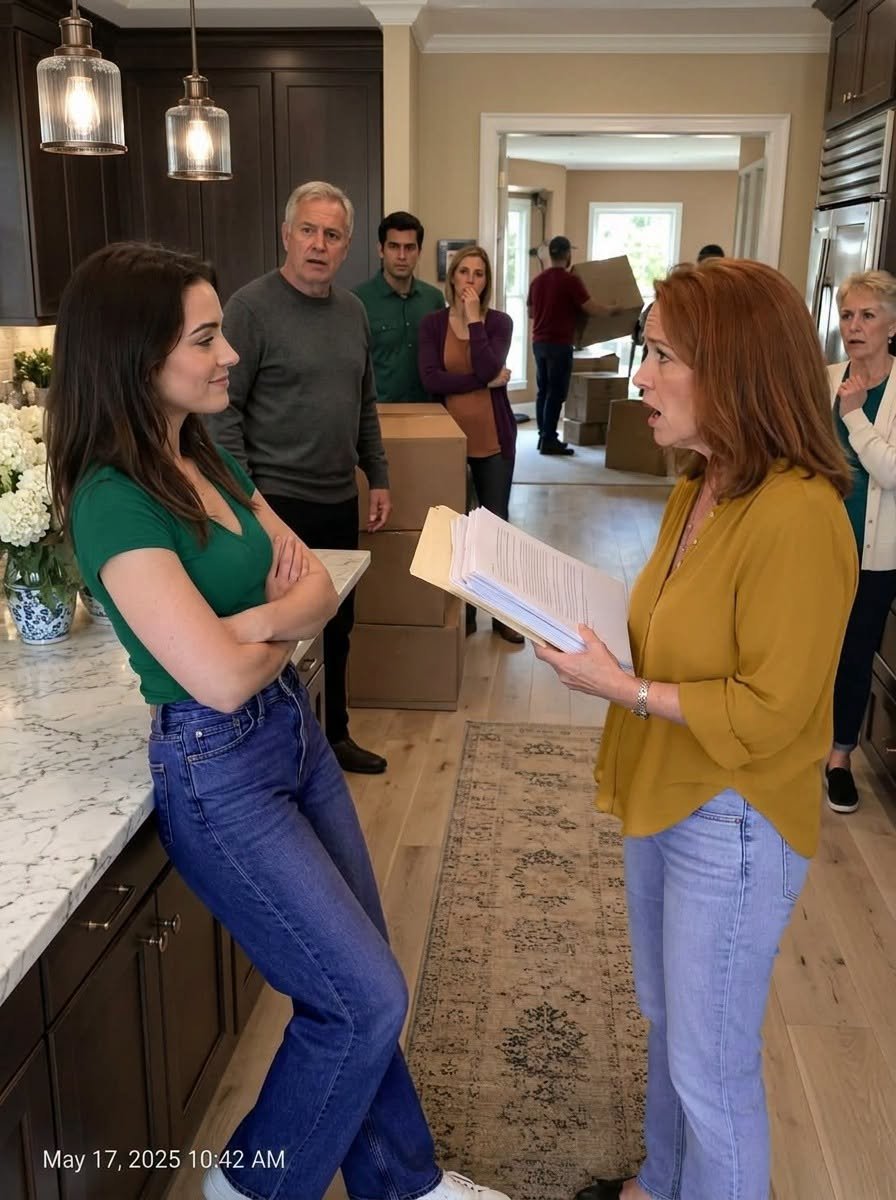
Then Ryan went looking for the Wi-Fi router. He opened the pantry, the laundry cabinet, and finally the drawer beside the kitchen island. That was where Miranda’s closing folder sat beneath a set of keys and the final walkthrough notes. I had left it there the night before after meeting the inspector.
Ryan pulled it out, frowned at the law office label, and flipped open the cover. I saw his shoulders tighten. I saw him read the first page twice. I did not stop him.
The house went quiet before anyone understood why. Ryan was standing beside the kitchen island with the folder open in both hands, his face emptied of that careless confidence he wore like a family inheritance.
Kelsey noticed first. “What is it?” she asked.
He did not answer. He turned another page, slower this time. She crossed the kitchen, snatched the folder from him, and looked down. Her expression shifted so quickly it almost looked theatrical. Confusion, irritation, fear, then rage.
“Wait a minute,” she said.
Nobody moved. My mother stopped unwrapping a vase. My father closed his eyes. Kelsey read out loud in pieces, like the words were insulting her personally.
“Buyer: Jenna Marie Whitaker. Purchase price: one million dollars. Closing date—”
She looked up at me. “Why is your name on our house?”
I leaned against the counter and folded my arms. “Because it is my house.”
The sentence landed harder than a shout.
Ryan whispered, “Jenna.”
Kelsey slammed the folder onto the island. “No, absolutely not. This is not funny.”
End Part Here: My Brother’s Family Tried Moving Into My $1 Million House Then They Found My Name on the Deed