My Husband Told Thousands My Cancer Was Getting Worse—But He Had Already Read the Good News
PART 1 — The Lie After the Livestream
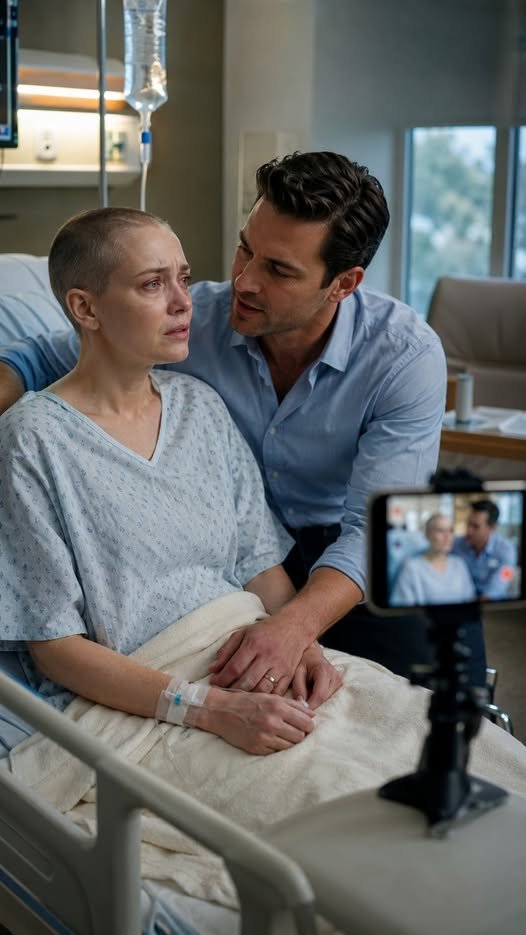
My husband kissed my bald head during a livestream and told eighty thousand strangers that my cancer treatment was failing.
His voice trembled as he held my hand beside the IV pole.
“We may have to take Nora out of state,” Grant said. “Insurance has denied the next phase of treatment, but I promised her I would do whatever it takes to bring her home.”
Comments raced across the screen.
You are an incredible husband.
Donating again.
Nora is lucky to have you.
Grant squeezed my fingers and looked at me with tears in his eyes.
Then he ended the livestream.
The red light disappeared.
So did the tenderness.
He released my hand, checked the donation total and said, “Almost four thousand dollars in twelve minutes.”
I stared at him.
That morning, my oncologist had given us the best news we had received since I was diagnosed with Hodgkin lymphoma five months earlier.
My latest scan showed an excellent response to treatment.
It was not a cure or a guarantee, but my tumors were shrinking.
“Why did you tell them the scan was bad?” I asked.
Grant picked up a sanitizing wipe and cleaned the fingers that had been stroking my wrist only seconds earlier.
“I said it wasn’t everything we hoped for.”
“That isn’t what the doctor said.”
“Nora, you’re exhausted.”
“The report said the response was excellent.”
His jaw tightened.
“Don’t mention the scan yet.”
“Why?”
Grant looked back at the rising donation total.
“We need one more week before people stop giving.”
For months, Grant had told everyone that he had closed his marketing agency to care for me full-time.
He managed my appointments, my patient portal and the online fundraiser created in my name.
I had signed a form allowing him to share medical updates that we approved together.
I had never given him permission to lie.
The following afternoon, I went alone to meet Priya Shah, the hospital’s financial navigator.
“I need to understand what insurance denied,” I told her.
Priya searched my file.
Then she frowned.
“Nothing was denied.”
I leaned toward her desk.
“What about my remaining chemotherapy?”
“Authorized six weeks ago.”
“The evaluation in Boston?”
“There is no out-of-state evaluation in your treatment plan.”
She turned the screen toward me.
Beside my name was one clear word:
AUTHORIZED.
The approval date was from six weeks earlier—the same week Grant posted a tearful video claiming that our insurance company had abandoned us.
Priya studied my face.
“Why does your fundraiser still say your treatment isn’t covered?”
I could not answer.
Instead, I asked her to print everything.
That night, I opened my patient portal from my hospital bed.
Grant had created the account after my first biopsy and told me it would be easier if he monitored the results while I rested.
Buried in the settings was an option I had never noticed before:
Proxy Access History.
I requested the report.
When it arrived, I found the scan Grant had called disappointing.
He had opened it at 9:12 that morning.
He downloaded it two minutes later.
At 7:03 that evening, he looked into a camera and told thousands of people that my treatment was failing.
Grant had not misunderstood my results.
He had read the truth ten hours before he lied.
PART 2 — Where the Donations Went
I changed the password to my patient portal, revoked Grant’s proxy access and removed him from my unrestricted hospital visitor list.
The following morning, he arrived carrying white roses.
His phone was already recording.
A nurse stopped him outside my room.
Grant looked through the glass and immediately softened his expression.
“Honey, I’m right here,” he called. “You don’t have to be afraid.”
“Please close the door,” I told the nurse.
An hour later, Grant posted a video from the parking garage.
He said chemotherapy had left me confused, emotionally unstable and unable to understand the sacrifices he was making for me.
The comments praised his patience.
I did not answer him publicly.
Instead, I requested the payout records from the fundraiser.
The campaign had raised $312,000.
Some of the money had paid legitimate medical expenses.
But seven transfers had gone to an account I did not recognize as part of my treatment.
Whitman Creative LLC.
Grant’s marketing agency.
The same company he had told everyone he closed so he could care for me had received more than $118,000 from donations made in my name.
Then I found one final scheduled transfer.
Amount: $50,000
Memo: Hospital donation
The transfer sat on my screen like a challenge.
Grant had announced that he was making a personal donation to the hospital’s patient assistance fund.
But the money was not coming from him.
It was coming from people who believed they were helping pay for my cancer treatment.
My friend Rachel read the memo twice.
“He’s donating your fundraiser money under his own name?”
“And receiving an award for it.”
The hospital telethon was less than forty-eight hours away.
Grant was scheduled to stand in the hospital atrium beside an oversized check and accept the Community Care Champion award.
I could already imagine him placing one hand on my shoulder, letting his voice shake and turning his face slightly toward the cameras.
For five months, he had used my illness as proof of his goodness.
Now he was about to turn stolen donations into a public halo.
I called Priya.
She gave me the name of Elena Brooks, the hospital foundation’s compliance director.
I sent Elena five documents:
The insurance authorization.
The patient-portal access history.
The fundraiser payout report.
Three invoices from Grant’s agency.
And the consent form I had signed when the campaign began.
That form mattered.
I had allowed Grant to share updates we approved together.
I had never allowed him to publish false medical information, pay his company with donations or use my face to build a new organization.
Twenty minutes later, Elena called me.
“Mrs. Whitman, do not contact your husband yet.”
My throat tightened.
“Are you still giving him the award?”
She paused before answering.
“We are verifying the source of the check.”
She asked whether I could come to the hospital the next morning.
When I ended the call, Rachel sat across from me in silence, watching my phone as though it might explode.
Then the screen lit up with a message from Grant.
He had sent me a photograph of himself standing beside the enormous ceremonial check, smiling beneath the hospital logo.
Underneath it, he had written:
Tomorrow, they’ll finally understand what I sacrificed for you.
PART 3 — Only the Lie
The hospital foundation met with me in a small conference room overlooking the atrium.
Elena sat across from me with Priya and a foundation attorney.
No one treated me like a confused patient.
No one asked Grant to explain what I meant.
They had already traced the $50,000.
It had come directly from the fundraiser.
The foundation would not accept it.
Grant’s award had been suspended, and the fundraising platform had been asked to freeze the remaining campaign balance while it investigated.
For a moment, I felt something close to relief.
Then Elena said, “We can cancel his appearance quietly and release a written statement later.”
Quietly.
Grant had lied about me to thousands of people.
He had told donors that I was getting worse after reading proof that I was improving.
Then he used my face, diagnosis and weakness to save his company.
If the hospital simply removed him from the program, Grant would post another video.
He would say I was confused, bitter or emotionally unstable from treatment.
He had already begun building that story.
“What would the public statement say?” I asked.
“That the foundation declined the donation and is reviewing concerns about the fundraiser,” Elena replied.
“That protects the hospital,” I said. “It doesn’t correct what he said about me.”
Elena folded her hands.
“What do you want people to know?”
I looked down at my scan report.
Most of it was private—measurements, medical language and details Grant had already treated like public content.
I took a black marker and covered everything except one line:
Excellent response to treatment.
I also left visible the timestamp showing when Grant had opened the report.
“I don’t want my whole body displayed on that screen,” I said. “Only the lie.”
Together, we created a short timeline.
What Grant knew.
What he told donors.
Where the money went.
There would be no dramatic accusations.
Only dates, documents and amounts.
As I left the conference room, I looked down into the atrium.
Workers were arranging chairs beneath a giant screen displaying the words:
THE WHITMAN HOPE INITIATIVE
My photograph covered half the wall.
I was asleep in the picture.
Grant had chosen an image in which I could not speak.
The following afternoon, I walked into that same atrium awake.
End Part Here: My Husband Told Thousands My Cancer Was Getting Worse—But He Had Already Read the Good News