
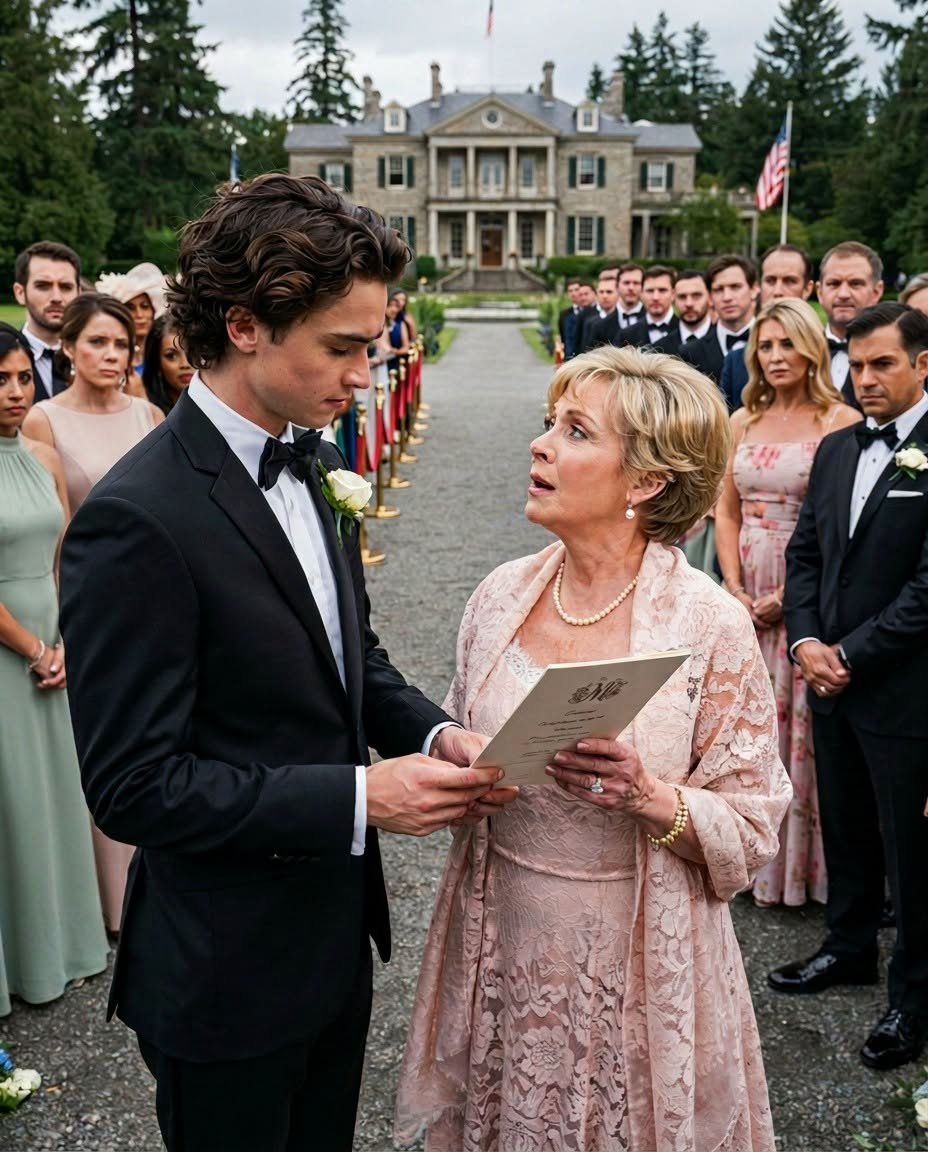
Your name’s not on the list, Mom.
My son Avery blocked me at the entrance of my granddaughter’s wedding in front of two hundred people, his hand firm against my shoulder as if I were an uninvited stranger trying to crash an exclusive event. His voice was apologetic, his expression pained, but his body language was unmistakable—I was not getting past him.
My name is Amelia Rivers. I’m seventy-two years old, a widow of seven years, and until that moment, I thought I knew my place in this family. But as I stood there in my carefully chosen pink silk dress and my mother’s pearls, watching two hundred wedding guests turn to stare at the elderly woman being turned away, I realized how wrong I’d been.
They forgot one small detail when they decided to humiliate me at the entrance of Green Valley Estate on that perfect September afternoon. I was the one who paid for the entire event—every single dollar of the $127,000 it cost. Every white rose in those towering centerpieces. Every piece of gold-rimmed china on those elegantly set tables. Every note the band would play. Every bite of the filet mignon and lobster tail that would be served at dinner. All of it came from my bank account, signed for with my name, secured with my credit cards.
But I’m getting ahead of myself. Let me take you back to where this nightmare really began.
It was a Tuesday afternoon in March when Avery and his wife Taylor first came to see me about Sophie’s wedding. I remember because Tuesdays were my volunteer days at the animal shelter, something I’d done every week since my husband David passed seven years ago. But that morning, Avery called with those words that make every mother’s heart jump to the worst conclusions: “Mom, can we come by this afternoon? We need to talk to you about something important.”
I canceled my shift at the shelter and spent the next three hours cleaning my penthouse apartment overlooking Central Park. Not that it needed it—I kept the place spotless, just like David had liked it. But cleaning gave my hands something to do while my mind raced through possibilities. Was someone sick? Were they having marriage trouble? In my seventy-two years, I’d learned that “we need to talk” rarely preceded good news.
At exactly two o’clock, my doorbell rang. Avery stood there in an expensive charcoal suit—the Tom Ford I’d bought him last Christmas. At forty-five, he’d kept his father’s strong jawline and dark hair, though gray was starting to thread through it. Behind him, Taylor wore a cream cashmere sweater that probably cost more than my monthly utilities, fresh from their third vacation of the year in Turks and Caicos.
“Mom.” Avery kissed my cheek, his familiar woody cologne enveloping me for a moment. Taylor’s smile was bright, perfectly white teeth against her tanned skin. “Your home looks beautiful as always, Mrs. Rivers.”
I ushered them into the living room—the space David and I had decorated together over forty years of marriage. The mahogany coffee table we’d found at an estate sale in Connecticut, the Persian rug from our anniversary trip to Istanbul, the Tiffany lamp that had been his mother’s. Taylor’s eyes lingered on each piece, and something flickered in her expression that I recognized but couldn’t quite name. Not appreciation. Something else. Calculation.
“Coffee’s ready,” I said. “And I made those lemon bars you like, Avery.”
“Mom, you didn’t have to do that.” But he took three, I noticed.
For a moment after we sat down, nobody spoke. Avery glanced at Taylor. She nodded almost imperceptibly, some silent communication I wasn’t privy to.
“So,” I said, unable to bear the silence any longer, “what did you want to talk about?”
Avery set down his coffee cup carefully, like a man about to deliver difficult news. “It’s about Sophie, Mom.”
My heart lightened. “Sophie? How is she? I haven’t seen her in—goodness—must be three weeks now.”
“She’s great,” Taylor cut in warmly. “Finishing her last semester at Columbia Business School. Top of her class, actually.”
Pride swelled in my chest. My granddaughter—twenty-five years old and brilliant. I still remembered teaching her to bake cookies in this very kitchen, her tiny hands covered in flour.
“Mom,” Avery continued, and I saw something cross his face. Hesitation. “Sophie’s getting married.”
The world seemed to tilt sideways for a moment. “Married? But she never told me she was seeing anyone seriously.”
“It happened fast,” Taylor explained, leaning forward with that practiced enthusiasm I’d seen her use in her Instagram videos. “She met Marcus at an internship last summer. He proposed at Christmas in Aspen. It was so romantic—right on the ski lift at sunset.”
“That’s wonderful news,” I managed, though my hands trembled slightly as I set down my cup. My granddaughter was getting married, and I was just finding out now, four months after the proposal. “When’s the wedding?”
“In September,” Avery said. “Saturday, September 14th.”
Six months away. “We wanted to tell you in person,” Taylor added quickly, clearly reading the hurt on my face. “Not over the phone. This is too important.”
“Of course,” I said, forcing myself to smile. “I understand. So how can I help? I assume you’re here because you need help with planning.”
Another glance passed between them, and this time I caught it clearly—that silent communication that spoke volumes about conversations they’d had without me. Conversations about me.
“Actually, Mom,” Avery said, his voice dropping to that soft tone he’d used since he was a little boy asking for something he knew was a stretch, “that’s exactly why we’re here. You know how times are these days. The economy. Inflation. Everything’s so expensive.” He paused, searching my face. “We just want Sophie to have her dream wedding. She’s worked so hard. She deserves a beautiful day.”
I looked at my son—truly looked at him. He worked at a small advertising agency in Midtown. Good job, but not great. Taylor didn’t work at all beyond her lifestyle influencer Instagram account with seventeen thousand followers, which as far as I could tell meant posting photos of brunch and giving advice about handbags.
“How much does Sophie’s dream wedding cost?” I heard myself ask.
Avery reached into his briefcase and pulled out a glossy brochure. The cover showed a sprawling estate with white columns and manicured gardens. “Green Valley Estate,” he said. “It’s in Westchester, about an hour north of the city.”
I took the brochure and studied the photos—a grand ballroom with crystal chandeliers, outdoor terraces overlooking a lake, gardens with stone pathways, tables set with fine china and gold-rimmed glasses, floral arrangements that looked like waterfalls of white roses and peonies. It was beautiful, undeniably so, the kind of venue you see in magazines.
“It’s gorgeous,” I admitted.
Taylor pulled out her phone, and I recognized the excited animation in her voice that I’d heard countless times before—the tone she used when she wanted something expensive. “There’s a full-service package. The venue includes the ceremony space, cocktail hour on the terrace, reception in the grand ballroom, tables and chairs, linens, and basic lighting. That’s thirty-five thousand.”
I tried not to react, though my heart sank. Thirty-five thousand dollars for one day.
“Then there’s catering,” Taylor continued, scrolling through her notes with practiced efficiency. “They have this amazing package with passed hors d’oeuvres, plated dinner—we’re thinking filet mignon and lobster tail—open bar, champagne toast, wedding cake for two hundred guests. That’s twenty-eight thousand.”
I did the math quickly in my head. Sixty-three thousand already, and she was still talking.
“Sophie found the most incredible dress,” Taylor went on, her voice taking on a dreamy quality. “Vera Wang. It’s like something a princess would wear. Twelve thousand, but you should see her in it, Mama Amelia. She looks like an angel.”
Mama Amelia. Taylor had started calling me that five years ago, shortly after Sophie graduated high school. It had felt forced then. It still did.
Twelve thousand dollars for a dress she’d wear once. I thought of my own wedding dress in 1973—forty-five dollars from a department store, and I’d felt like a queen in it.
“The flowers,” Taylor said, “we want white roses and peonies everywhere with elegant greenery. The florist quoted fifteen thousand for ceremony arrangements, reception centerpieces, bouquets, boutonnieres, everything.” She tapped her screen. “Photography and videography package is eight thousand. The band—Sophie wants live music, not a DJ—is seven thousand for five hours. There’s also invitations, programs, favors, transportation, hair and makeup for the bridal party.” She trailed off. “It adds up quickly.”
My head was spinning. I’d lost track of the total somewhere around the flowers. “How much?” I asked quietly. “Total.”
Avery cleared his throat, and I saw him brace himself. “With everything included, we’re looking at about one hundred twenty-seven thousand dollars.”
The number hung in the air between us like something tangible and heavy. $127,000. I thought of David, of our simple ceremony at city hall and dinner at his parents’ house. My forty-five-dollar dress. We’d been happy with that. We’d been happy, period. But times were different now, I reminded myself. And this was my granddaughter, my only granddaughter, the girl I’d helped raise when Avery and Taylor were “finding themselves” in their thirties, taking long vacations and pursuing their passions while I babysat and made meals and read bedtime stories.
I looked at the brochure again, at the fairy-tale venue, at the promise of a perfect day. “All right,” I heard myself say. “I’ll help.”
The relief that flooded both their faces was palpable and immediate. “Oh, Mom,” Avery said, standing up to hug me tightly. “Thank you. Thank you so much. Sophie’s going to be thrilled.”
“You’re the best, Mama Amelia,” Taylor said, and for a moment, her smile seemed almost genuine.
“I’ll need to see all the contracts before I sign anything,” I said, the business side of me kicking in despite the emotional weight of the moment. “And I want to meet with the vendors myself.”
“Of course,” Avery agreed quickly, eagerly. “We’ll send you everything. You can review it all.” He paused. “You’re really saving us, Mom. We couldn’t do this without you.”
Over the next six months, my life revolved around Sophie’s wedding, though I saw precious little of Sophie herself. She was always busy with finals, then her summer internship, then thesis preparation. But Avery and Taylor came by my apartment twice a week, regular as clockwork, bringing contracts and vendor information. They’d sit on my velvet couch, drink the coffee I made, eat the cookies I baked, and we’d go over the details.
I signed for the venue: $35,000 from my savings account. I signed for the catering: $28,000. I signed for Sophie’s dress: $12,000. When I asked if I could come with her to the fitting, Taylor explained that Sophie had already been and they’d wanted to keep it as a mother-daughter moment, just the two of them. The words stung, but I smiled and said I understood.
I signed for the flowers: $15,000. I signed for the photography: $8,000. I signed for the band: $7,000. Each time I wrote my name—Amelia Rivers—along with my bank account number and credit card information for deposits, I felt a small twinge of something I couldn’t quite identify. Unease, maybe. But I pushed it down.
“You’re so organized, Mom,” Avery would say appreciatively. “So good at handling all this paperwork.”
End Part Here: My Son Stopped Me at the Door and Said I Wasn’t Invited to My Granddaughter’s Wedding.