
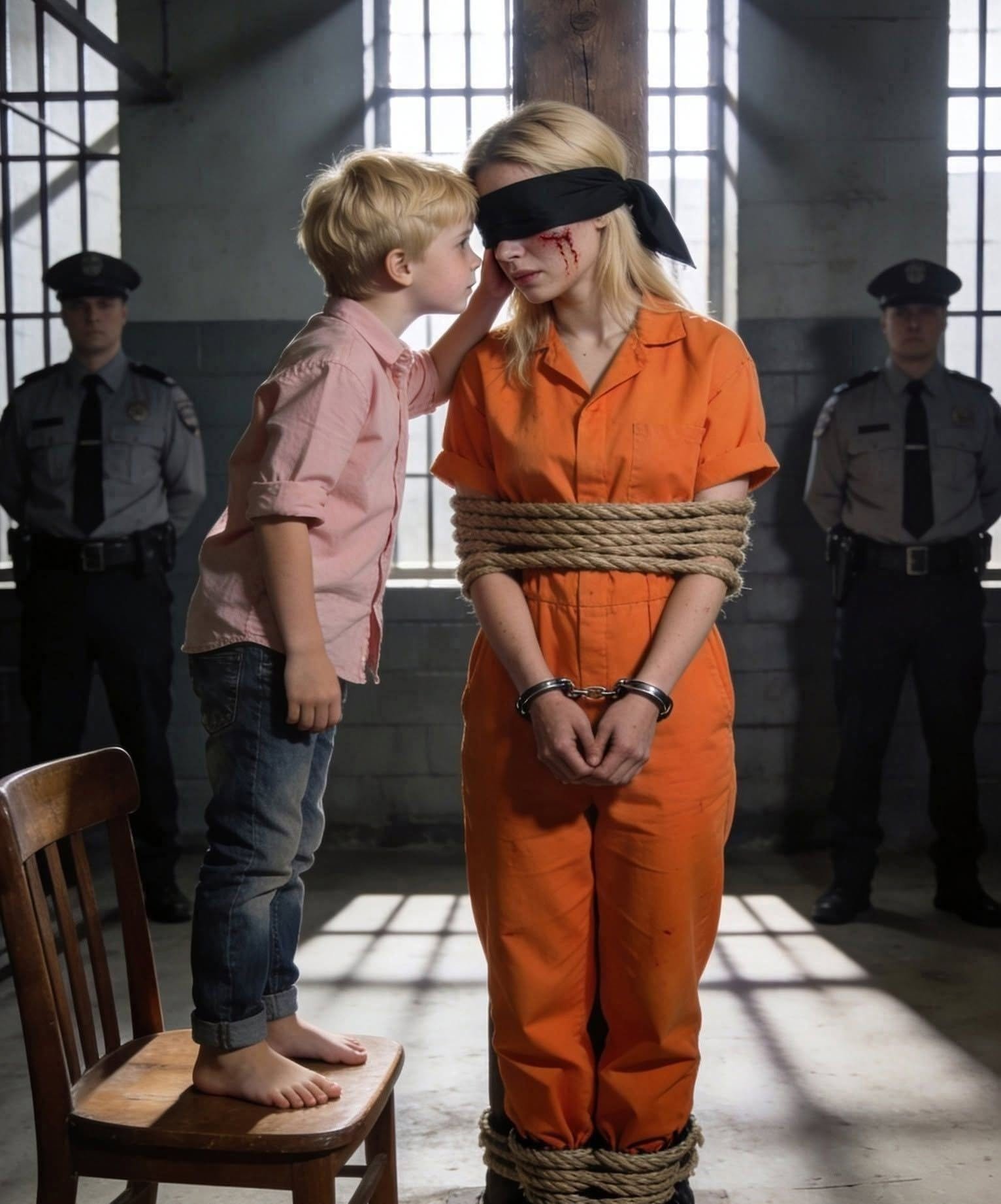
The Whispered Truth Beneath the Blade: Six Years of Silence, a Death Row Execution Halted by an Eight-Year-Old’s Revelation, and the Dark Legacy of the Hayes Family
Part I: The Shadow of the Verdict
Doubt does not arrive with the force of a hurricane. It does not crash through your doors or shatter your windows with thunderous applause. It seeps in through the floorboards, quiet and persistent, smelling of damp earth and old regrets, until you wake up one morning and realize you are standing knee-deep in a swamp of your own making.
For six years, I lived in that swamp.
I was seventeen when the world as I knew it ceased to exist. Seventeen is a strange, fragile age—old enough to understand the mechanics of tragedy, but too young to bear its crushing weight without fracturing at the seams. I thought I knew what my family was. I thought we were the picture of quiet suburban stability: a sturdy brick house on the edge of town, the smell of damp pine needles after a summer rain, the sound of my father’s heavy footsteps pacing the hallway as he balanced his ledger books, and my mother’s gentle hum echoing from the kitchen as she prepared dinner.
Then came that night.
The night was carved into my memory with a scalpel. There had been no warning signs—no screaming matches, no shattered plates, no violent buildup that families in novels always seem to experience before disaster strikes. Just a sudden, suffocating silence broken only by the piercing wail of police sirens cutting through the dark.
When I stumbled out of my bedroom in my pajamas, rubbing sleep from my eyes, the hallway felt different. It felt heavier, charged with a static electricity that made the hairs on my arms stand up. Downstairs, the kitchen was already cordoned off with yellow police tape. Flashing red and blue lights painted jagged patterns across the ceiling.
My father, Arthur Hayes, was lying on the cold linoleum floor.
One clean, brutal stab wound to the chest. The blade had pierced his heart with surgical precision, leaving almost no room for frantic struggle. There were no signs of a forced entry—no broken locks, no shattered glass, no footprint in the mud beneath the pantry window. Everything inside the house was orderly, untouched, almost pristine.
Except for the master bedroom upstairs.
Underneath my mother’s side of the bed, pushed far back into the shadowy recess where the dust bunnies gathered, the police found the murder weapon. A heavy chef’s knife from our own kitchen block, the stainless-steel blade slick with dark, oxidized blood.
My mother’s fingerprints were smeared across the handle. There were microscopic splatters of my father’s blood on the hem of her silk robe.
When the detectives questioned her that night, her face was completely blank—not with the cold calculation of a practiced criminal, but with the hollow, catatonic shock of someone who had been violently unmoored from reality. She didn’t scream. She didn’t curse. She just stared straight ahead, her lips slightly parted, murmuring over and over again, “I was asleep. God help me, I was asleep.”
The jury didn’t buy it. How could they? The evidence was a closed loop, tight and inescapable. Motive? The prosecution painted a grim picture of a quiet, suffocating marriage, hidden financial troubles, and a bitter domestic dispute that had festered beneath the surface for years. Means? The kitchen knife. Opportunity? She was in the house, asleep in the adjoining room, with no alibi that could be independently verified.
To everyone in the county, the conclusion was absolute, undeniable, and swift.
“She did it.”
Those three words became the ambient noise of my existence. They were whispered in the aisles of the local grocery store when I went to buy milk; they were muttered by my teachers when I walked into the classroom; they were exchanged with pitying, morbid glances by neighbors who used to bring us apple pie on Sunday afternoons.
And the most unforgivable sin of all—the secret, rotting guilt that I carried deep in my chest—was that I had let myself believe it, too.
I never said it out loud. Not to my aunt, not to the social workers, not to my younger brother Ethan, who was only two years old at the time and blissfully ignorant of the nightmare consuming our household. But in the quiet hours of the night, when the house creaked and the wind rattled the windowpanes, the seed of doubt took root in my mind.
The fingerprints were hers. The knife was hers. The blood was on her robe.
Logic whispered the verdict long before the judge banged his gavel. And because I didn’t fight it—because I allowed myself to harbor that insidious sliver of doubt—I felt like an accomplice to her destruction.
Yet, despite the silence of my belief, her letters kept coming.
For six years, without fail, a white envelope arrived every single month, bearing the bleak postmark of the state maximum-security penitentiary. Inside was the same handwriting, neat and deliberate, as if she were still sitting at the kitchen table writing out grocery lists:
“I didn’t do it, sweetheart.”
“I would never hurt your father. I loved him, and more than that, I loved the life we were building for you and Ethan.”
“Please believe me. No matter how dark it gets out there, hold onto the truth.”
I read every single one. I kept them all locked in a cedar box beneath my bed, right where the dust gathered, a shrine to a ghost who was still breathing. I read them until the paper grew soft and frayed at the edges. But I never wrote back.
How do you reply to a mother condemned to death when a part of your own soul has already convicted her? Every time I picked up a pen, the ink felt heavy, like lead. What could I say? “Mom, I’m trying, but the evidence is too loud”? “Mom, Ethan is growing up fast, but he doesn’t remember you”?
So I stayed silent. And silence, as it turns out, is the heaviest burden a human heart can carry.
Part II: The Final Hour and the Death Row Facility
The day of the execution came with a cruel, mocking brilliance.
It was an unseasonably warm autumn morning, the kind of day that should have been filled with the crisp scent of falling leaves and the laughter of kids walking home from school. Instead, the sky was a pale, washed-out blue, and the air felt thin and sharp, carrying the metallic tang of the impending tragedy.
Ethan was eight now.
He was small for his age, with oversized eyes that seemed to take up half his face and a fragile frame that made him look like he might snap if the wind blew too hard. He had insisted on wearing his favorite blue sweater—the one our mother had knitted for him three winters ago, the wool now worn and frayed at the cuffs. He clutched the sleeve of that sweater like it was the only lifeline tethering him to the earth.
We drove to the state penitentiary in absolute silence. Uncle Victor drove.
Victor Hayes, my father’s younger brother, had been our rock through the entire six-year nightmare. While the rest of the town turned their backs on us, Victor stayed. He helped sell our family home to pay for the endless, futile appeals; he managed the trust fund set aside for our education; he showed up every Thanksgiving with a turkey and a forced, comforting smile, telling us that we would get through this together.
“You’re doing remarkably well, Clara,” Victor said softly, his hands resting lightly on the steering wheel as the forbidding gray walls of the penitentiary loomed into view. His hair was streaked with distinguished gray at the temples, and his eyes always carried a heavy, sorrowful fatigue—the look of a man bearing the grief of an entire family on his shoulders. “I know today is… unbearable. But your mother made her choices. All we can do now is be strong for Ethan.”
“I know, Uncle Victor,” I murmured, staring out the window at the razor wire glinting in the cruel morning sun.
“We’ll give them a few private moments,” Victor added, parking the sedan in the designated visitor’s lot. “Just you, Ethan, and her. I’ll wait right here in the lobby.”
“Thank you for bringing us,” I said, my voice hollow.
“Family takes care of family, Clara. Always.”
The security checkpoint was a sterile, soul-crushing ritual of metal detectors, heavy steel doors that slammed with a sickening clunk, and guards whose faces had been scrubbed clean of any human empathy. They treated us not like grieving relatives, but like collateral damage in a state-sanctioned mechanical process.
They led us into the non-contact visiting room—a narrow, claustrophobic space divided down the middle by a thick sheet of reinforced ballistic glass. A pair of bolted-down metal chairs sat on either side.
And then, she appeared.
The heavy door at the far end of the room opened, and two guards escorted my mother in.
Caroline Hayes.
She wore the coarse, bright orange jumpsuit of the condemned. Her wrists were locked in steel cuffs, connected to a heavy chain around her waist; her ankles clanked softly with every measured step against the concrete floor. She looked impossibly small. The six years in a windowless cell had stripped away whatever flesh she had left, leaving her skin paper-thin and translucent against her high cheekbones. Her dark hair, once thick and glossy, was now streaked with silver and pulled back into a severe, hurried knot.
Yet, as she sat down in the bolted chair opposite the glass, her eyes caught mine, and time seemed to lurch backward.
Those eyes. They were the exact same shade of hazel as my own. They were not the eyes of a monster, nor were they the eyes of a broken woman begging for mercy. They held a profound, heartbreaking stillness—an oceanic depth of love that refused to be extinguished, even with the clock ticking down her final minutes on earth.
Because of Ethan’s age and the extraordinary circumstances of the final clemency denial, the warden had granted a rare, heartbreaking exception: a brief, five-minute physical contact visit before the final transfer to the death chamber.
The heavy side door opened, and a guard unlocked my mother’s wrist cuffs just enough for her to kneel.
“Caroline,” the guard warned gruffly, his hand resting on the butt of his sidearm. “Five minutes. No sudden movements.”
My mother didn’t answer him. She dropped to her knees on the cold linoleum floor, her movements stiff and aching, and reached out her arms.
Ethan didn’t hesitate. He broke away from my side, running across the room with a small, desperate sob, and threw himself directly into her embrace.
My mother caught him, burying her face into the crook of his small neck, her shoulders shaking with silent, wracking sobs that had no sound. She kissed his hair over and over again, her fingers trembling as they traced the knit fabric of his blue sweater.
“I’m so sorry,” she whispered, her voice cracking like dry wood. “I’m so sorry I won’t get to watch you grow up, my sweet boy. I’m so sorry I won’t be there when you lose your first tooth, when you learn to ride a bike, when you graduate…”
“Mom…” Ethan cried, clinging to her so tightly his knuckles turned white.
“You have to be brave,” she murmured, pulling back just enough to look into his tear-stained face, her thumbs gently wiping away his tears. “Take care of Clara. Look out for each other. Never forget how much I love you.”
The air in the room grew heavy, thick with the unbearable weight of finality. The guard shifted his weight, his boots squeaking on the floor, raising his wrist to check his watch.
“Three minutes,” the guard announced coldly.
My mother closed her eyes, pressing her forehead against Ethan’s in a final, agonizing farewell.
And then, in that fragile, fractured sliver of time—so softly, so innocently, that it sounded like a leaf falling against a windowpane—Ethan whispered something that changed the trajectory of the universe:
“Mom… I know who hid the knife under your bed.”
Part III: The Halt and the Exposure
Everything froze.
It was not a metaphor. It felt as though the atmospheric pressure in the room had dropped instantly to zero, freezing every molecule of sound, breath, and motion.
My mother went completely still. Her hands, which had been resting on Ethan’s shoulders, locked in place. The quiet, heartbreaking grief in her eyes vanished in a single microsecond, replaced by a terrifying, electric shock of pure comprehension.
Across the room, the guard’s head snapped up. “What did you say?”
Ethan started crying harder, his small frame trembling violently as he buried his face back into his mother’s orange jumpsuit. “I saw him… that night. It wasn’t Mom. I saw Uncle Victor.”
The air turned absolute ice.
Before my brain could process the syllables, before the shock could even translate into a scream, the heavy security door at the entrance of the visiting area banged open.
The warden strode in, flanked by two senior corrections officers, his face grim as he raised his hand sharply in the air.
“Stop the procedure!” the warden barked, his voice echoing off the concrete walls. “Hold all movement immediately!”
“Warden, we have clearance—” one of the junior guards started.
“I said hold!” the warden roared, his eyes darting directly toward our group. “We just received an emergency stay request from the state appellate clerk based on new verbal testimony under duress of execution. Bring the boy over here. Now.”
My mother didn’t let go of Ethan immediately. She held him for one long, fierce second longer, pressing him against her heart as if she were trying to graft him back into her own body, before gently setting him down. She looked up, her gaze cutting across the room like a drawn dagger, locking onto the open doorway behind us.
Because we weren’t alone in the building.
Uncle Victor Hayes had come along “to say goodbye.” He was waiting in the private administrative lobby just on the other side of the secure glass partition, sitting in one of the vinyl armchairs with a cup of prison-issue black coffee, playing the role of the devoted, grieving brother.
Or at least, he had been.
Through the wired glass window of the inner door, I saw him.
Victor’s face had completely drained of color. The warm, sorrowful paternal facade had vanished, stripped away in an instant like cheap wallpaper peeling off a damp wall. His jaw was slack, his eyes wide with a frantic, animalistic panic. In that single snapshot of time, he didn’t look like a loving uncle anymore. He looked cornered. He looked like a hunted beast.
Even as the guards moved toward the doorway to fetch him, Victor took a slow, deliberate step back. Then another. He angled his body toward the main exit doors that led out to the parking lot.
“Stop him!” my mother screamed—a sound so primal, so full of six years of buried rage, agony, and vindication that it rattled the bulletproof glass. “Don’t let him leave! He killed Arthur! He killed my husband!”
The chaos erupted like a powder keg.
Guards shouted commands, boots thudded against the linoleum, and the heavy steel alarms began to wail throughout the facility—a deafening, rhythmic klaxon signaling an internal security breach.
I stood paralyzed, my legs feeling like they were poured from wet cement. My mind spun into a chaotic vortex. Uncle Victor? No. That’s impossible. Victor was downstairs making coffee. Victor was the one who drove us here. Victor was the one who cried at my father’s funeral, who held my hand when I was drowning in grief…
“Clara!”
My mother’s voice cut through the alarm klaxons like a laser. She was standing now, tall and rigid despite the heavy chains around her waist, her eyes burning with a terrifying intensity.
“Clara, listen to me!” she shouted over the blaring sirens. “He framed me! Your uncle framed me! The night your father died… Victor was in the house. He had the key!”
The guards pushed past us, rushing toward the administrative lobby to intercept Victor Hayes. But it was already too late—or rather, the trap had already snapped shut.
Through the glass, we saw Victor bolt. He dropped his coffee cup, sending dark brown liquid splashing across the tiled floor, and sprinted toward the main exterior doors. But the facility’s lockdown protocol had already engaged. The heavy electromagnetic locks on all perimeter doors slammed shut with a thunderous bang.
Victor slammed his shoulder against the reinforced glass door, bouncing off it with a grunt of pain. He turned around, his chest heaving, his face contorted in a mask of wild, desperate fury, just as three armed guards tackled him to the ground.
As they pinned him face-down against the linoleum, forcing his arms behind his back in a brutal display of institutional force, Victor twisted his head sideways. His eyes didn’t meet the guards. They didn’t meet the warden.
They met mine.
Across the room, through the haze of dust and flashing red emergency lights, my uncle gave me a smile. It wasn’t a warm smile, nor was it a pleading one. It was a cold, jagged grin that chilled the marrow in my bones—a silent acknowledgment that the mask was gone, and the monster had finally stepped out into the light.
Part IV: Unraveling the Web – The Investigation Reopened
The days that followed were a surreal blur of flashing media vans, frantic legal maneuvers, closed-door grand jury hearings, and a city in complete ideological shock.
End Part Here: My mother was sentenced to d!e for k!lling my father, and for six years, no one believed she was innocent