
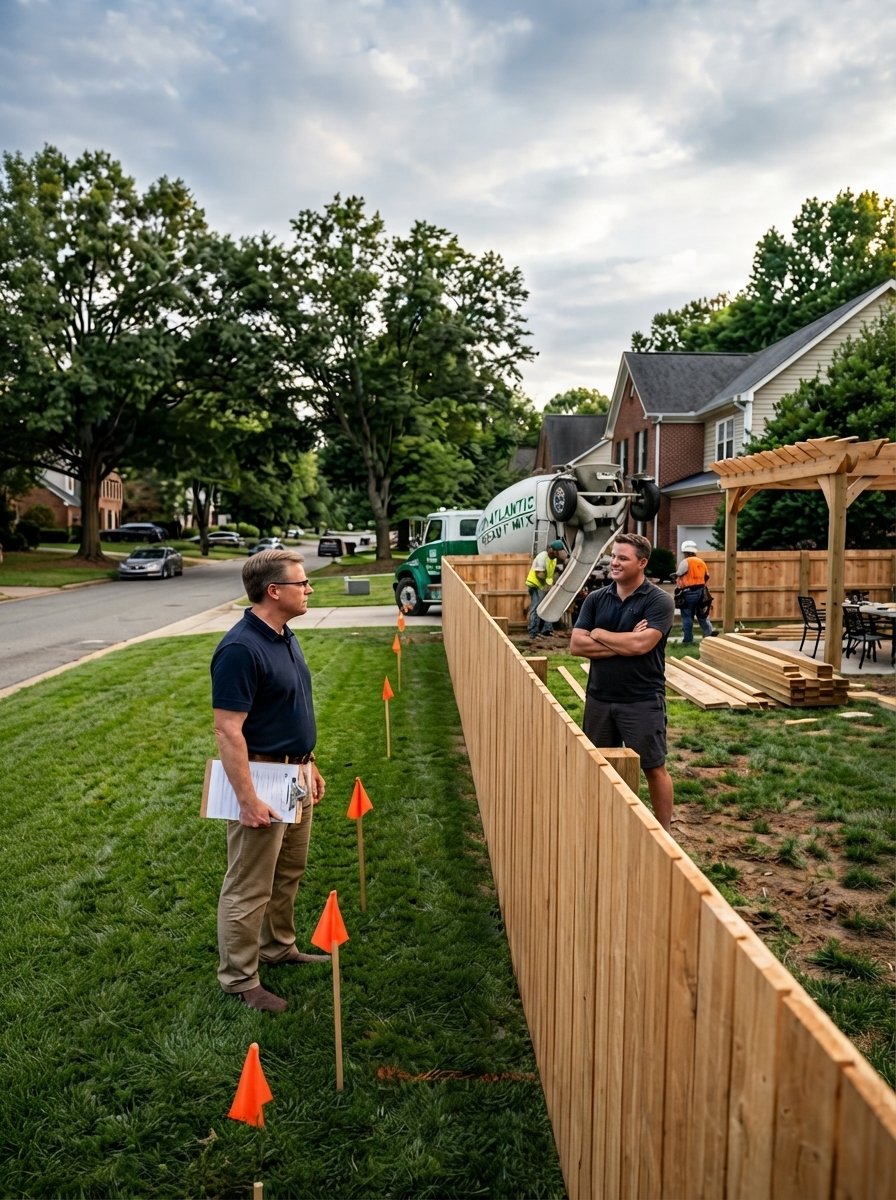
He Moved His Fence Eight Feet Onto My Property — And Thought I Would Let It Go
Part 1 — The Fence
Tyler built the fence on a Saturday, and at first, I barely noticed.
That is the part people never believe when I tell this story.
I did not storm outside the second the first post went into the ground. I was inside making coffee, half-watching the morning news, when I heard the sharp kick of an air compressor.
I glanced through the kitchen window.
Two workers in matching polo shirts were unloading cedar fence panels from a trailer parked crooked across Tyler’s driveway.
Tyler stood near the edge of what I still believed was my yard, arms crossed, nodding as one of the workers explained something to him. He looked like a man supervising the construction of his own private kingdom.
My first thought was simple.
That’s a big project for a Saturday.
My second thought was that it was none of my business.
If Tyler wanted a fence on his property, that was his choice.
That is the strange thing about boundaries. Most of the time, you never think about them.
Not until someone moves one.
By the time the workers left that evening, something about the fence looked wrong.
I stared at it from my kitchen window while the last sunlight stretched across the lawn.
The fence seemed too close.
I told myself I was imagining things.
New fences always looked strange. Maybe the angle was fooling me. Maybe the shadows made the yard appear smaller.
I decided to check again in the morning.
In daylight, it looked even worse.
I went into the garage, grabbed a tape measure, and walked the length of the new fence.
By the third measurement, I stopped pretending I was merely curious.
The fence was not off by a few inches.
It appeared to be nearly eight feet inside my property, running almost the entire depth of the yard.
That strip of grass had been mine for more than a decade.
I had mowed it.
Edged it.
Fertilized it.
Maintained it every summer since I bought the house.
A little after nine that morning, I found Tyler sitting on his new deck drinking coffee.
“Morning,” I said, keeping my voice calm. “Fence looks good. Your contractor works fast.”
“He’s efficient,” Tyler replied. “Wanted it finished before the pool guys start digging.”
That caught my attention.
“About that,” I said. “I think the fence might be farther onto my side than the old property line.”
Tyler did not look surprised.
That bothered me more than anything.
There was no confusion in his face. No concern. Nothing you would expect from someone who had accidentally built eight feet onto his neighbor’s property.
“I don’t think so,” he said.
Then he shrugged.
“But even if it is, moving it now would cost a fortune. The contractor already packed up the equipment.”
“I haven’t confirmed anything yet,” I said. “I just think we should check before you go any further with the pool.”
He smiled.
Over the next year, I would become very familiar with that smile.
It was the kind of smile someone gives you when they believe the conversation is already over.
“You’ve got plenty of yard, Jason,” he said. “I don’t think eight feet is going to change your life.”
For a moment, the conflict-avoidant part of me almost let him have it.
I hated arguments.
I was the man who would eat the wrong restaurant order rather than send it back unless it was completely inedible. I had paid parking tickets I believed were unfair because disputing them seemed like more trouble than the money was worth.
If Tyler had come to me beforehand and asked for some small accommodation, I might even have considered it.
But he had not asked.
He had simply taken.
Then he had explained to me that I had enough property already.
That changed something.
“I’m going to have the property surveyed,” I told him. “Just to make sure.”
For the first time, his smile flickered.
“Sure,” he said. “Do whatever you need to do.”
That afternoon, I called Carl Whitfield.
Carl was a licensed surveyor who had done work for a friend of mine. He had a reputation for being almost painfully meticulous.
It took him ten days to come out.
During those ten days, Tyler kept building.
His contractors dug footings for a pergola.
Pavers were delivered.
Landscapers planted ornamental grasses.
Then excavation equipment arrived for the pool.
Every day, more money and concrete went into land I was increasingly certain belonged to me.
When Carl finally arrived, he brought an assistant, a tripod, and a robotic total station.
He checked the recorded plat.
He cross-referenced county monument records.
He walked the boundary twice.
By early afternoon, he began driving orange survey flags into the ground.
The result was unmistakable.
Tyler’s fence was nearly eight feet over the legal boundary.
Carl pointed toward the line.
“You were right to call me,” he said. “This isn’t a few inches. He has structures and landscaping sitting almost entirely on your parcel.”
I stared at the orange flags.
I did not feel victorious.
Not yet.
I simply felt clear.
Until that moment, this had been a disagreement between neighbors.
Now it was documented fact.
A licensed professional had measured the land.
The survey was signed.
Stamped.
Recorded.
Tyler could smile all he wanted.
The boundary was not going to move with him.
Part 2 — He Knew
I called Tyler that evening.
“Can we talk?”
He came over with his hands in his pockets, looking as relaxed as ever.
I spread the survey across my kitchen table.
Tyler looked at it for perhaps three seconds.
“Surveys are wrong all the time,” he said.
I pointed to another document.
“This one also includes your permit application. The permit shows the fence six inches inside your legal property line.”
I tapped the survey.
“The fence standing outside right now is almost eight feet farther over.”
Something finally changed in his expression.
“The contractor probably made a mistake when he staked it out,” he said.
“Then you should have him fix it.”
I kept my voice calm.
“Before the pergola is finished. Before the pool goes in. It’s only going to become more expensive if you wait.”
Tyler studied the paper again.
“Let me think about it.”
Then he left.
He did not move the fence.
Instead, he accelerated construction.
Two days later, workers poured concrete footings for the pergola.
A week after that, excavation for the swimming pool began.
That was when I stopped treating this as an informal disagreement.
I sent Tyler a certified letter demanding that construction stop on the disputed strip until the boundary issue was resolved.
He signed for it.
He never responded.
So I hired Rachel Adler, a property attorney recommended by a coworker.
Within a month, we filed a formal complaint.
Tyler hired his own attorney, Martin Shaw.
The county also opened an inquiry after discovering that the fence standing on the property did not match the location shown in Tyler’s permit.
Eventually, the judge ordered mediation.
That was where everything changed.
Rachel had obtained Tyler’s contractor records during discovery.
We were sitting in her conference room when Ashley picked up one of the contractor estimates.
At the bottom was a handwritten note.
She read it.
Then she froze.
The sentence said:
OWNER REQUESTS FENCE SHIFTED WEST APPROX. 8 FT TO INCREASE USABLE YARD.
The room went silent.
Ashley slowly turned toward Tyler.
“You told me the contractor made a mistake.”
Tyler’s face hardened.
“Ashley, this isn’t the place.”
“It’s exactly the place.”
Even Tyler’s attorney looked uncomfortable.
Martin leaned forward.
“Did you instruct the contractor to move the fence away from the permitted location?”
Tyler rubbed his jaw.
“It wasn’t like that.”
Rachel leaned back.
“Then what was it like?”
Tyler looked toward me.
For a moment, that familiar half-smile tried to return.
It failed.
“The old mowing line looked arbitrary,” he said.
Carl, who was attending as a technical consultant, immediately responded.
“It wasn’t arbitrary.”
Tyler continued.
“The previous owners always treated that strip like part of their yard.”
I almost laughed.
“I bought my house from the previous owners.”
Eleven years earlier, Mr. Reynolds had personally walked the property with me before closing.
He had shown me the boundary markers.
I still had the original disclosure documents.
Rachel placed them on the table.
Then she produced county aerial photographs from multiple years.
They all showed the same thing.
The same straight maintenance line.
The same edging.
The same lawn.
My lawn.
The line had never moved.
Only Tyler’s fence had.
The mediator, retired Judge Ellen Price, folded her hands.
“Mr. Bennett, let me make sure I understand.”
She looked directly at Tyler.
“You obtained a permit showing one fence location. You instructed your contractor to shift that fence approximately eight feet. Your neighbor later provided a certified survey establishing that the fence crossed onto his parcel, and you still declined to relocate it.”
Tyler shifted in his chair.
“I believed the usable boundary was different from the legal boundary.”
Judge Price stared at him.
“That sentence is not helping you.”
Ashley closed her eyes.
It became obvious that she had not known much of what Tyler had done.
The permit.
The contractor’s note.
The exact boundary.
The timing of the construction.
He had apparently told her the county was harassing them because I had connections with inspectors.
The truth was much simpler.
The county had documents.
And documents did not care how confidently Tyler told his version of the story.
The mediator eventually asked me what I wanted.
Before I could answer, Tyler said, “He wants money.”
“No,” I replied.
Tyler looked surprised.
“I want my land back.”
Rachel listed the terms.
The fence had to be relocated entirely onto Tyler’s property.
The pergola footing had to be removed from my land.
The landscaping on the disputed strip had to be removed or abandoned at my choice.
Damaged sod had to be restored.
Survey costs, filing costs, and certain legal expenses had to be reimbursed.
And we wanted a recorded boundary acknowledgment so that no future owner could claim confusion.
Tyler laughed.
“You want me to tear up my whole backyard?”
“No,” I said. “I want you to move your backyard off mine.”
Judge Price almost smiled.
Tyler did not.
“This is insane.”
Judge Price shook her head.
“No, Mr. Bennett. This is property law.”
For the next three hours, Tyler tried to buy the strip.
“Five thousand dollars.”
“No.”
“Ten thousand.”
“No.”
“Eighteen thousand.”
I watched Ashley’s expression change as she apparently began wondering where that money would come from.
Still, I refused.
The land itself was not priceless.
But selling it could affect my privacy, drainage, resale value, and anything I might want to build in the future.
More importantly, I was not going to rearrange my property because Tyler had knowingly built on it and hoped I would surrender.
Finally, Tyler said, “Twenty-five thousand.”
Ashley stared at him.
“Where are we getting twenty-five thousand dollars?”
He ignored her.
I shook my head.
“No.”
Tyler slammed his hand onto the conference table.
“Then what do you want from me?”
“The same thing I asked you to do from the beginning.”
He glared at me.
“Move the fence?”
“Yes.”
“Do you have any idea what that costs now? The pool is half dug. The pergola is already in the ground.”
“More than it would have cost before you built the pergola.”
That ended the mediation.
Part 3 — The Court Decides
Two weeks later, we went before a superior court judge.
It was nothing like television.
There were no dramatic speeches or surprise witnesses.
There were documents.
Surveys.
Permits.
Emails.
Photographs.
And the contractor’s handwritten note.
Judge Harold Denny examined everything carefully.
Then he turned to Tyler.
“Why did you continue construction after receiving the certified survey?”
Tyler said he believed the survey was disputed.
The judge asked whether Tyler had hired his own surveyor.
“No.”
Had he filed a formal boundary challenge?
“No.”
Did he have a deed, easement, plat, or title document placing the boundary where his fence stood?
“No.”
Then Judge Denny asked the question that destroyed what remained of Tyler’s argument.
“Mr. Bennett, on what legal basis did you continue preventing Mr. Miller from accessing property identified by the recorded survey as belonging to him?”
Tyler looked at Martin.
His lawyer could not answer for him.
“There had been a fence there before,” Tyler finally said.
That was not true.
I had years of photographs showing open grass.
Judge Denny issued his ruling.
The surveyed boundary was confirmed.
Tyler was ordered to remove the encroaching fence and structures within forty-five days.
He was prohibited from interfering with my access to the land.
The ruling was simple.
The strip belonged to me.
It always had.
Tyler walked out of the courtroom without looking at me.
Ashley stayed behind.
She approached Rachel and me near the elevators.
“I’m sorry,” she said quietly.
She looked exhausted.
“I really didn’t know.”
“I believe you,” I told her.
Her eyes became wet.
“He told me the extra yard was part of our lot.”
Then she added something I did not expect.
“I told him to move the fence after the survey came.”
I looked at her.
“He said you’d back down.”
I nodded.
“He miscalculated.”
Ashley gave a short, humorless laugh.
“He does that.”
Over the next month, Tyler’s backyard was slowly dismantled.
The pool construction stopped.
Rainwater collected in the half-dug hole.
Workers removed the pergola board by board.
Three young Japanese maple trees Ashley had planted were carefully transplanted to another area.
Decorative stone edging was pulled up and stacked near the side gate.
Then the original fence contractor returned.
The cedar panels came down.
One of the workers even discovered one of Carl’s old orange survey flags buried beneath the mulch.
It was faded from months of sun.
Carl came back to verify the corrected fence location.
He picked up the flag and drove it back into the ground.
The same place it had always belonged.
The new fence was installed six inches inside Tyler’s property, exactly where his original permit had shown it should be.
When the final panel went up, my yard suddenly looked enormous.
Eight feet does not sound like much.
Not until someone takes it from you.
Part 4 — Making the Land Worth Defending
My daughter, Emma, came over that weekend.
She was seventeen then, old enough to find the entire dispute slightly ridiculous.
She stood near the restored boundary, hands on her hips.
“So this is the famous war zone?”
“No war.”
“Mom says you spent thousands of dollars fighting over grass.”
“Your mother enjoys simplifying things.”
Emma smiled.
“Was it worth it?”
I looked at the torn-up strip.
There were patches of dead sod.
Bare soil.
Marks from equipment.
“Ask me in a year,” I said.
She walked toward the far end.
“What are you going to do with it?”
That was a good question.
At first, I planned to restore the lawn and forget the whole thing.
Then I thought about my father.
He had grown blueberries behind the house where I grew up.
Six enormous bushes along a fence line.
Every July, Emma and I used to visit him.
She would carry a plastic bowl, supposedly to collect berries, but most of them ended up in her mouth.
By the time we drove home, her lips and fingers would be stained purple.
My father died five years earlier in his sleep.
I had always told myself I would plant blueberry bushes of my own someday.
I never did.
There was always work.
School schedules.
Responsibilities.
A hundred little reasons to delay something meaningful.
So Emma and I spent a Saturday turning the reclaimed strip into a garden.
We planted six blueberry bushes.
Hydrangeas went along the fence.
Near the corner, we planted a small red maple.
I deliberately chose not to build anything spiteful.
No giant wall.
No ugly shed.
Nothing designed to make Tyler miserable every time he looked outside.
I did not want revenge sitting outside my kitchen window for the next twenty years.
I wanted the property to become something worth defending.
End Part Here: My neighbor built a brand-new fence eight feet inside my property line, then smiled and told me moving it would cost too much