
The House I Sold Before Christmas
The words left my mouth before I had time to soften them.
“If they show up here again like this place is a hotel with a bottomless kitchen, I’m not opening the door. Not this Christmas. Not even if they stand on my porch and cry until the snow buries them.”
I said it into the steam rising off a mug I hadn’t touched. The dishwasher rattled through its cycle behind me, an old machine that shook the counter when it hit the rinse. On the stove, a pot of cinnamon coffee had gone from fragrant to scorched, and the smell that had felt like comfort an hour ago now sat sour at the back of my throat. December leaned against the kitchen windows, dark and hard, and the porch light outside blinked twice before steadying, the way it always did in the cold. Beyond it, the driveway stretched out empty and pale under a thin skin of frost.
But I could see the ghosts of it anyway. Every SUV that had ever pulled in without asking. Every suitcase dragged up the front steps. Every relative who had climbed out of a car and looked at my house the way a traveler looks at a lobby, already deciding which room they’d claim, already assuming I would smile and rearrange my life to fit theirs.
David didn’t laugh at what I’d said. That was the first sign that something had genuinely shifted, because David laughed at almost everything. It was one of the reasons I’d married him. He glanced down at my phone lying facedown on the counter, then back up at me, and when he spoke his voice was low and careful, the way you’d talk to someone standing near an edge.
“Claire,” he said. “They’ve already started.”
I turned the phone over.
The family group chat had come alive. Thirty-one unread messages, the number climbing even as I watched. I didn’t need to open it to know what it said. I’d read a version of it every December for the last eleven years, the same conversation with the same conclusion, arrived at without me, decided for me, presented to me as if it were weather.
Claire’s place is the easiest.
More room at Claire’s.
We’ll just do it at Claire’s again, it’s what we always do.
For a long time, I had worn that sentence like a badge. Claire’s is the easiest. There had been a version of me, younger and desperate to be needed, who heard those words and felt something warm unfold in her chest. I was the one who could hold it all together. I was the reliable one, the capable one, the one whose house had enough bedrooms and whose hands never seemed to tire. If being useful was the same thing as being loved, then I was the most beloved woman in the family, and I set about earning that love the only way I knew how.
I cooked. God, how I cooked. The turkey brined for two days in a cooler on the back porch because it wouldn’t fit in the fridge alongside everything else. The ham with its glaze that I basted through the night. Three kinds of pie because my mother liked pumpkin, my brother liked pecan, and someone always, at the last minute, mentioned that the children only ate apple. Breakfast casseroles assembled at midnight so they could bake while I made the coffee at dawn. And then the snacks nobody would confess to wanting until they appeared in my kitchen at half past twelve in bare feet, opening my cabinets, asking if there was anything to munch on.
I set out fresh towels folded the way hotels fold them. I made up the beds in the guest room and the office and the pull-out couch, and when we ran out of beds I made pallets on the floor with the good blankets. I stocked coffee and the flavored syrups certain people preferred. I labeled the leftovers in careful handwriting and scrubbed the bathrooms between one wave of guests waking and the next while everyone else settled into my living room to watch Christmas movies with their feet on my coffee table.
And for a while, there was gratitude. Genuine, if thin. Someone would catch my hand as I passed with a tray and say, Claire, you’ve outdone yourself. My mother would tell her sister on the phone, loud enough for me to hear, that her daughter kept a beautiful home. I collected those moments like coins and told myself they added up to something.
But gratitude, I learned, is a thing that erodes. It wears down a little more each year, worn smooth by repetition, until one December you realize nobody is thanking you anymore because nobody remembers that what you’re doing is a gift. Expectation had moved in where gratitude used to live. It had unpacked its bags. It wasn’t going anywhere.
My brother Ryan set the tone. He came days early, every year, with his wife Megan and their three children and a quantity of luggage that turned my front hallway into something resembling a bus depot. He liked to arrive before anyone else, he said, to help set up, though in eleven years I could not recall him setting up anything more demanding than his own phone charger. His children treated my house the way children treat a place with no consequences. They opened every cabinet. They left sticky handprints down the front of the refrigerator, ghost-maps of small fingers that I wiped away and that reappeared within the hour. One year the middle one knocked over a full glass of soda on my cream-colored couch, and I watched the dark stain spread while the adults kept talking, not one of them rising, because the couch was mine and therefore the stain was mine, a small private disaster that belonged to me alone.
My sister Bethany arrived with suitcases too large to lift and a smile she used the way some people use a doctor’s note. That tired, apologetic little smile that said you can’t possibly ask anything of me, look how depleted I am. She borrowed without asking. My shampoo, the expensive kind I bought myself as a single indulgence. My phone charger, which then vanished into the depths of her bag. My favorite mug, the one with the chip on the handle that I’d had since college, left in the sink with cold coffee scumming the bottom. When I asked her, once, gently, not to spread her makeup and jewelry across the top of my dresser as though my bedroom were a shared vanity, she laughed at me. Relax, Claire. I’m exhausted. It’s Christmas. As if her exhaustion were a currency and mine were counterfeit.
And my mother did not help. Let me be precise about this, because it matters. My mother did not fail to help by accident, or because she was frail, or because no one asked. My mother declined to help as a matter of principle, because she had decided long ago that her role was supervision. She stood in the doorway of my kitchen with a glass of wine and watched me work. She tasted the gravy off the stirring spoon and set it down and told me it wanted more salt, or less, or something she couldn’t name. “It needs more care,” she said one year, and I have never forgotten the phrasing. “Women in my day took pride in this. You rush it, Claire. You can taste the rushing.” That was as close to thanks as she came. A critique delivered with the confidence of a woman who had not lifted a pan in a decade.
I stayed quiet through all of it. Every year, I stayed quiet, because I had learned the particular arithmetic of the holidays: the moment a tired woman stops serving, she becomes the villain of the story. You can work until your hands crack and bleed in the December dry. You can sleep four hours a night for a week. You can spend money you shouldn’t on groceries to feed people who will not thank you, and you can do it smiling, and the instant you say the words I’m tired, I need help, I need rest, you become selfish. Ungrateful. Cold. The whole machinery of the family turns to face you, and you are astonished to find that all those years of labor bought you nothing, no credit, no cushion, no grace. The ledger resets to zero the moment you ask for anything back.
Last Christmas broke whatever was left.
Nineteen people came through my front door that year. I counted, later, going through the photos. Nineteen, including the children, in a three-bedroom house. Not one of them brought a dish. Not one of them handed me money for the groceries, though the receipt for that week alone would have made a grown man wince. Not one of them stripped a bed when they left, or wiped down a counter, or emptied a trash can without being asked twice and then sighing about it.
When I asked Ryan, on the second day, if he’d mind carrying the trash bags out to the bins by the garage, he chuckled. Actually chuckled, as though I’d asked him to sing.
“You’re the organized one, Claire,” he said, settling deeper into the couch. “You know where everything goes. I’d just put it in the wrong place.”
The next morning, I opened the refrigerator to get the cake I’d made for David’s parents, who were coming by that afternoon. It was a good cake, three layers, and I’d stayed up to finish the frosting so it would set overnight. The plate was still there. The cake was gone. Not a slice missing. Gone. A smear of frosting and a scatter of crumbs across the porcelain, a little white flag of surrender.
“Oh, the kids got into that,” Megan said from the kitchen table, not looking up from her phone. “You know how they are. What did you expect, leaving it right there?”
What did you expect. I have turned that phrase over so many times since. What did I expect. As if the cake had a right to be eaten simply because it existed within reach. As if my hours of work were a natural resource, free for the taking, and the only foolish thing in the whole arrangement was my expectation that it might be left alone.
That was the moment. Standing in front of the open refrigerator with the empty plate in my hands and the cold air spilling out around my legs, I understood something with a clarity that felt almost physical.
I was not family in this house. Not to them.
I was the service.
I was the kitchen and the hotel and the maid, and I was the villain the instant I asked to be treated like a person. That was my role. That was the whole of it. I had spent eleven years believing that if I gave enough, cooked enough, hosted enough, I would finally cross some threshold and be loved the way I loved. But there was no threshold. There was only the next December, and the next, and the ledger resetting to zero every time.
So this year, when the group chat lit up on a Friday night at 7:38 with the first messages about Christmas plans, I did something I had never done. I typed a message of my own. I sat with my thumbs over the screen for a long time, watching my own hands, waiting for them to stop trembling. They didn’t stop, so I typed it anyway.
This year I’m not hosting. I need rest. If everyone wants to get together, we can find somewhere else, or someone else can host. I love you all, but I can’t do this again.
I read it three times. I deleted the last sentence, then put it back, then deleted it again and left it out. I read it once more. And then, before I could talk myself out of it, I sent it.
The silence lasted less than a minute.
Don’t be selfish, my mother wrote. First. Of course first.
We already told everyone we’re coming to your place, Ryan added. Kids are so excited.
Then Bethany, who could always be counted on to say the cruelest thing in the gentlest font: Breaking tradition because you don’t feel like it? That’s not a great look, Claire. People are going to remember this.
I set the phone facedown on the counter and pressed both my palms flat against the cool granite until I could feel my own pulse in them. The dishwasher shuddered into its final cycle and I was absurdly grateful for the noise, for something to cover the sound of my breathing, which had gone shallow and quick.
Here is a thing I have learned about certain people. They do not want your boundary explained to them. They do not want to understand your reasons. They want the boundary softened and softened and softened again, apology by apology, concession by concession, until it has dissolved entirely and things go back to the way they were. An explained boundary is just a negotiation to them. The only boundary they respect is the one that costs them something.
At 8:11, Bethany posted on her public Facebook page.
Heartbreaking when someone chooses their own comfort over the people who raised them. Family is supposed to mean something. I guess not to everyone.
She didn’t tag me. She didn’t need to. Everyone knew.
My mother liked it within the minute.
By 8:26, the comments had begun, and they came from people who had never in their lives scrubbed a single pan in my kitchen, who had eaten my food and slept in my beds and driven home without so much as a wave. Family first, always. Some folks forget where they came from. Christmas isn’t about what’s convenient, it’s about love. One cousin I hadn’t spoken to in three years wrote a paragraph about the true meaning of the season. The screen glowed in my hand, brighter than the dim kitchen around me, and I felt the old pull, the one that had governed eleven years of my life. The pull to fix it. To explain. To make everyone comfortable again so that I could go back to being the good one.
The coffee had gone cold and skinned over on the counter. The sink smelled of dish soap and the ghost of cinnamon. David reached across the granite and covered my hand with his, warm over cold, and said the only thing that could have reached me.
“Don’t answer them, Claire. Not tonight. Nothing you say tonight will land the way you want it to.”
I wanted to answer them so badly it was like a physical hunger. I imagined, in vivid detail, opening my camera roll and posting the evidence. The photograph I’d taken last Christmas of the trash bags stacked four high by the garage door because no one would carry them out. The soda stain on the cream couch. The guest room floor I’d photographed to send David when he was traveling, the carpet invisible under wet towels and candy wrappers and someone’s discarded socks. I imagined the captions. I imagined the comments going quiet.
For one ugly, thrilling second, I picked up the phone.
And then I put it down.
Because I have learned that anger costs more when you are the one everyone has trained to stay calm. They expected the tired woman to break, eventually, in some loud and undignified way, and when she did they would have their proof. See? Unstable. Selfish. We always knew. The outburst they were half hoping for would become the whole story, and the eleven years behind it would evaporate. I would not give them that. I would not be the villain they had already cast me as.
So I did something better. Something quiet and cold and entirely mine.
I documented everything.
I screenshotted the group chat, every message, with the timestamps visible. I saved Bethany’s Facebook post and the growing thread of comments beneath it. I made a simple note in my phone, a plain record, because I understood even then that memory is a thing that gets revised and I wanted the truth preserved before anyone could tell me it had happened differently.
7:38 — I said no. 8:11 — Bethany’s public post. 8:26 — first comment.
I don’t know exactly what I thought I would do with it. I only knew that for eleven years my version of events had been overwritten by everyone else’s, and this year, at least, I would keep the original.
Then, standing in my quiet kitchen at nine o’clock on a Friday night in December, I made a decision that would have terrified the woman I’d been the year before.
Monday morning, I called a realtor.
Her name was Diane and she had sold the house two doors down in a single week, and when I told her I wanted to move fast, she asked no questions I didn’t want to answer. She came Tuesday, walked through every room with a practiced eye, and told me the market was hungry and the house would go quickly. She was right. By Wednesday we had three offers. I accepted the cleanest one, a young couple with a thirty-day escrow and no fussing over the inspection, and I signed and initialed every page that afternoon at Diane’s office with a steadiness in my hand that surprised me.
I did not announce it. That was the part that felt, I will admit, a little wicked, and I let myself enjoy it. While my family filled the group chat with plans I was no longer part of, coordinating who would bring the kids’ presents and whether we should do the gift exchange Christmas Eve or Christmas morning as though the location were a settled fact, David and I quietly began to pack up our life.
I sold the dining room table first. It felt right that it should go first. That table had hosted eleven years of Christmas dinners. It had been scratched by carving knives and stained by red wine and leaned upon by relatives too full to sit up straight, and prayed over by my mother, who insisted on saying grace and never once helped clear the plates after. A woman across town bought it for her first apartment and nearly cried when she saw it, and I helped her load it into her truck and felt lighter with every strap she cinched down.
Then the guest bed. Then the pull-out couch. Then the good dinnerware, the set they loved to use as though my cabinets were the supply closet of a banquet hall. Piece by piece, the house emptied. By the twentieth of December, the living room echoed when I walked through it. Bare walls, clean baseboards, sunlight falling in unobstructed rectangles across the floor. It should have felt sad. It didn’t. It felt like exhaling after holding your breath for a decade.
At ten in the morning on the twenty-second, my mother called. Her voice, when I answered, was coated in sugar.
“Claire, honey. We’re about two hours out. Traffic’s not bad. Will you make sure the guest room’s ready for the little ones? They’ll want to nap after the drive. And Ryan’s driving, so you know how he gets. We’re all just starving, so if you could have something ready when we get in, that would be wonderful.”
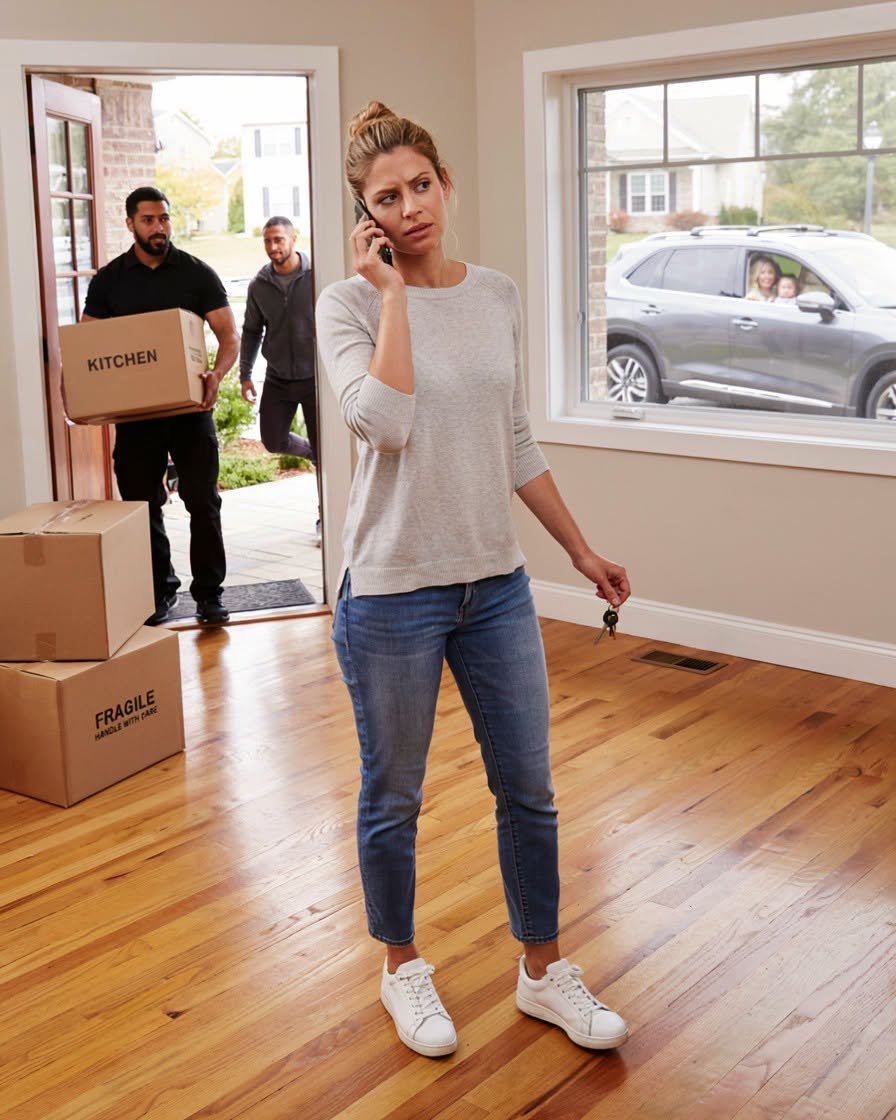
I stood in the exact center of my empty living room. My keys were in one hand. My phone was in the other. Through the front window I could see my own car idling in the driveway, packed and ready, exhaust curling white in the cold. And past it, just turning onto my street, a moving truck, and behind the truck, a small blue hatchback I recognized as belonging to the young woman who now owned my house.
For the first time all month, my hand did not shake.
“Mom,” I said, watching the hatchback slow in front of the mailbox. “You’re going to have to turn around.”
The words came out so evenly that I startled myself. My own voice, calm as still water.
There was a small confused sound on the other end, a sort of hm?, the sound my mother made when she wanted me to rush in and smooth over whatever discomfort she’d decided was mine to fix. Behind her I could hear the ambient noise of a full car. A child asking how much longer. The crinkle of a fast-food bag. Ryan saying something about a rest stop.
“What do you mean, turn around?” she said, and the sugar was gone now, replaced by an edge I knew well. “Claire, don’t start. Don’t do this today. We’re almost there.”
I looked around the empty room. No tree in the corner where the tree always went. No couch. No stockings on the mantel, no folded blankets stacked at the end of the hall for guests who never asked before they came. Just clean baseboards and bare walls and the wide echoing quiet of a house that had finally stopped apologizing for belonging to me.
A second call flashed across my screen. Bethany. And underneath her name, a preview of a message she’d just fired into the family group chat, timestamped 10:04, four minutes after my mother had called.
Almost there. Everyone have your cameras ready in case Claire tries to make a scene and embarrass Mom.
David read it over my shoulder and went very still.
My mother must have heard the silence stretch, because when she spoke again her voice had changed. The edge was gone. In its place was something almost like fear.
“Claire,” she said slowly. “What did you do?”
Outside, the young woman stepped out of the blue hatchback holding a folder from the closing office. She looked toward the porch, then toward me standing framed in the window, and lifted a hand in a small uncertain wave, waiting, I understood, for me to come out and hand her the last key.
Ryan’s voice came onto the line then, loud and close, as though he’d grabbed the phone.
“Claire? Why is there a moving truck in front of your house? And some car in the driveway?”
I looked at the key in my palm. I looked at the empty hallway where nineteen people had once dumped their bags without a thought. And I said it.
“I sold the house.”
Silence. But not the ordinary kind. Not the pause after bad news. This was the specific sound of an entire family trying, all at once, to force reality into a shape they liked better, and failing.
Ryan laughed first. A short, hard bark of it.
“Okay. Very funny, Claire. Real funny.”
“I’m not joking.”
“You can’t sell a house without telling us.”
“I can, actually. And I did.”
Bethany’s voice cut in from another phone, tinny and shrill on speaker. “Oh, please. She’s bluffing. She’s just trying to scare Mom into feeling bad. It’s a guilt trip.”
Through the window, the young woman smiled at me pleasantly, entirely unaware that eleven years of family history was collapsing through my phone speaker three feet away from her.
I walked to the front door. The brass key felt strangely weightless in my hand, the way things do when you’ve already let go of them somewhere deeper than your fingers.
“I signed the papers three weeks ago,” I said. “We closed this morning. The truck you see is the last of my furniture leaving. The woman in the driveway is the new owner.”
“No,” my mother whispered.
“Yes.”
“Claire, you wouldn’t.”
“I already have.”
I could hear, behind her, the sound of car doors. They’d arrived. The two vehicles rolled slowly down my street and I watched them through the glass, watched them slow, and then, in a moment I will remember for the rest of my life, watched them stop not in front of my house but in front of the neighbor’s, because they no longer recognized their own destination without me standing in the doorway to receive them.
The children spilled out first, clutching backpacks and pillows, blinking in the cold. Then Bethany, in her good coat. Then my mother, moving fast toward the porch with her chin lifted. Then Ryan, phone still in his hand, staring at the moving truck as though it might explain itself.
They gathered on the sidewalk and looked at the young woman standing in what they still believed was my yard.
My mother marched up the walk. “Excuse me,” she called, in the voice she used on customer service representatives.
The young woman turned. “Oh. Hi.”
“We’re here for Christmas. This is my daughter’s house.”
The young woman’s smile faltered. She looked at me through the window, then back at my mother, and said, with real gentleness, “I think there might be a mix-up. I just bought this house. We closed today.”
“That’s not possible,” my mother said. “My daughter lives here. Claire. Claire lives here.”
The young woman glanced at me again. “She used to,” she said softly. “I’m so sorry.”
I opened the front door then, for the last time. Not to invite anyone in. Only to step out onto my porch, into the cold, with the final key in my hand. Every face on the sidewalk turned toward me.
My mother’s expression flooded with relief. “Oh, thank goodness. Claire. Tell this woman there’s been a misunderstanding. Tell her.”
“There hasn’t been,” I said.
Ryan frowned, looking from the truck to the empty windows behind me. “Em. Claire. What is actually going on right now?”
I came down the steps and onto the walkway, into the middle of them, and I gestured toward the young woman.
“This is Rebecca,” I said. “She owns the house now.”
Rebecca blinked. “I… yes. That’s me.”
I held out the key to her. The last one. “Yours,” I said.
She took it carefully, and the small metallic click of it settling into her palm was, I swear, louder than any church bell I have ever heard.
Bethany’s mouth had fallen open. “You’re serious. You actually did this.”
“I’ve never been more serious about anything in my life.”
Ryan looked again at the moving truck, at the bare front windows, at the bareness of the whole situation, and something in his face finally gave way to belief. “But where are we supposed to stay?”
And there it was. I almost laughed, because the question arrived so purely, so instinctively, unfiltered by anything else. Not are you all right, Claire. Not why would you feel like you had to do something this drastic. Not were you really that unhappy. Not even a moment’s pause to wonder what eleven years of this had done to me. Just, immediately, the only question that had ever really mattered to any of them.
Where are we supposed to stay.