
Sarah had learned to measure David’s mood before he ever entered a room. The sound of his car in the drive, the pace of his steps, the way his key turned in the lock all told her what kind of night waited inside.
For three years, she lived inside those measurements. She adjusted dinner, adjusted her voice, adjusted how long she looked at her own phone. David called it sensitivity. Margaret, his mother, called it maturity.
Before David, Sarah had been the kind of woman who organized everything. She saved receipts, backed up documents, labeled folders, and arrived early to appointments. Her father joked that she could make a hurricane feel scheduled.
That competence was what David admired first. Later, it became what he resented. He liked the appearance of a capable wife, but not the reality of one who questioned a ledger.
Sarah’s inheritance had come from her mother’s side, but her father had protected it carefully before Sarah ever met David. It sat apart, documented through trust letters, monthly statements, and signed account instructions.
At first, David praised that caution. He said it proved Sarah came from good stock. Then he began asking why married people needed separate protections. Then he started calling the money family security.
Control rarely announces itself as control. It arrives as concern, then patience, then a suggestion made twice too kindly. By the time Sarah felt the trap close, David had taught everyone to call the cage a home.
The first time he locked Sarah’s phone in his desk drawer, Emma was three. David said Sarah needed a break from her father’s influence. Margaret said young wives sometimes cling too hard to their old families.
Sarah did not shout that day. She waited until David slept, found the spare key, and called her father from the laundry room with the dryer running to cover her voice.
Her father did not tell her to leave immediately. He knew panic could make dangerous men louder. Instead, he asked practical questions. Were there cameras? Where were the exits? Could Emma reach a phone without help?
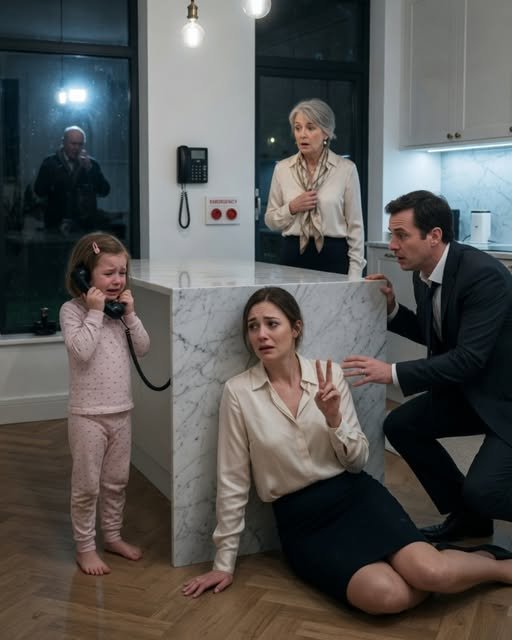
A week later, he brought a child-safe emergency handset and installed it near the hall. It had one large red button and one instruction for Emma: if Mommy showed two fingers, press it.
They practiced it as a game. Emma would giggle, run to the phone, and say, “Grandpa, Mommy needs help.” Sarah hated that her daughter needed such a game, but she hated helplessness more.
David never noticed the handset. He noticed expensive things, polished things, things that reflected his importance. A plain emergency phone near a hallway table did not interest him.
Margaret noticed everything, but only when noticing protected her son. She could spot a wrinkle in Sarah’s blouse from across a room, yet somehow missed fear when it sat beside her at dinner.
The Tuesday night everything changed began with lemon cleaner. Sarah had wiped the kitchen island twice because the smell steadied her. Clean counters, bright lights, and folded towels made the mansion feel almost manageable.
At 8:17 p.m., the First Meridian Bank alert flashed on Sarah’s phone. A transfer confirmation appeared first. Then the joint-account ledger loaded, and the source line underneath made the room narrow around her.
The money had come from her inheritance.
Sarah opened the saved PDF trust letter, then the monthly statement, then the transfer confirmation again. She checked the numbers until her eyes burned. This was not a mistake. This was a decision.
David came in smelling of expensive cologne and bourbon. His tie was loosened, but not carelessly. David always arranged disorder when he wanted people to believe he had been working hard.
“You transferred the money,” Sarah said.
“Our money, Sarah,” he replied, almost bored.
“My inheritance.”
His mouth curved. “Your father’s charity.”
That sentence told Sarah more than the transfer did. David had not merely taken money. He had rehearsed contempt for it, shaped it into something he could say aloud.
Margaret entered behind him with a wineglass and pearls at her throat. She looked from Sarah’s phone to David’s face and chose her side before asking a single question.
“Don’t make this ugly, Sarah,” Margaret sighed. “You know you’ve never been good under financial pressure.”
Emma watched from the stairs in pink pajamas, one hand pressed over her mouth. Four years old, small enough to believe monsters lived under beds, old enough to know one was standing in the kitchen.
Sarah looked at her daughter and kept her voice even. When a dangerous man is waiting for panic, calm becomes the only weapon small enough to hide.
“Put it back,” Sarah said.
David laughed. Then the laugh vanished.
He crossed the marble in three steps. His hand closed on the front of Sarah’s silk blouse, hard enough to pull the collar against her throat, and he threw her backward into the kitchen island.
The edge hit her hip first. Pain burst white behind her eyes. She fell wrong, and her right leg twisted underneath her with a sound that did not belong in a home.
Emma screamed.
Margaret did not.
The wineglass in Margaret’s hand stayed halfway lifted. One red drop slid down the crystal stem. The refrigerator hummed. The chandelier shivered in its own light. Margaret looked at the wood floor instead of at Sarah’s face.
Nobody moved.
Then Margaret took one careful sip and said, “Look what you made him do.”
Those words became part of the injury. Later, Sarah would remember the leg, the sound, the heat of pain, and Margaret’s sentence sitting neatly inside the room like a verdict.
David crouched over Sarah. “Tell your father you slipped,” he said. “Tell everyone the floor was wet.”
Sarah’s hands trembled against the floorboards. For one second, rage arrived like fire. She imagined grabbing his tie, dragging him down, making him feel even one inch of what he had done.
Instead, rage went cold.
She lifted her right hand.
Two fingers.
Emma stopped screaming.
Sarah saw the change in her child’s face. Fear stayed there, but obedience rose through it, bright and terrible. Emma turned from the stairs and ran toward the hallway phone.
David’s head snapped toward the sound. “Where is she going?”
The keypad beeped once. Twice. Three times. Each sound landed in the kitchen like a match striking. Sarah heard Emma breathing too fast into the receiver.
“Grandpa,” Emma whispered. “Mommy looks like she’s going to die! There was a very bad accident!”
For the first time in three years of marriage, David looked truly afraid.
The speaker crackled. Then Sarah’s father’s voice came through it, calm enough to scare everyone in the room.
“Sarah. Listen to me.”
End Part Here: When my husband violently shoved me to the floor and broke my leg, I gave my 4-year-old daughter the secret signal