“GET OUT And DON’T Come Back!” My Parents Shouted, Slamming The Door As I Stood Bleeding At 2AM. At The Hospital, The Nurse Looked at Me And Said, “These Aren’t From Broken Glass…” When The Police Arrived… EVERYTHING Changed
Part 1
I dropped a glass.
That was the sentence I kept repeating in my head while the ambulance lights washed the inside of the rig red, then white, then red again. I had said it to the paramedic when he asked what happened. I had said it to Mrs. Aldridge when she found me shivering outside her mailbox with blood running down my wrists. I planned to say it to the doctor, the nurse, the police, God, anybody who looked too closely.
I dropped a glass.
The truth was sitting beside me in that ambulance like a second patient. It took up room. It breathed louder than I did. It smelled like cold pavement, coppery blood, and the burnt edges of a dinner I never got to eat.
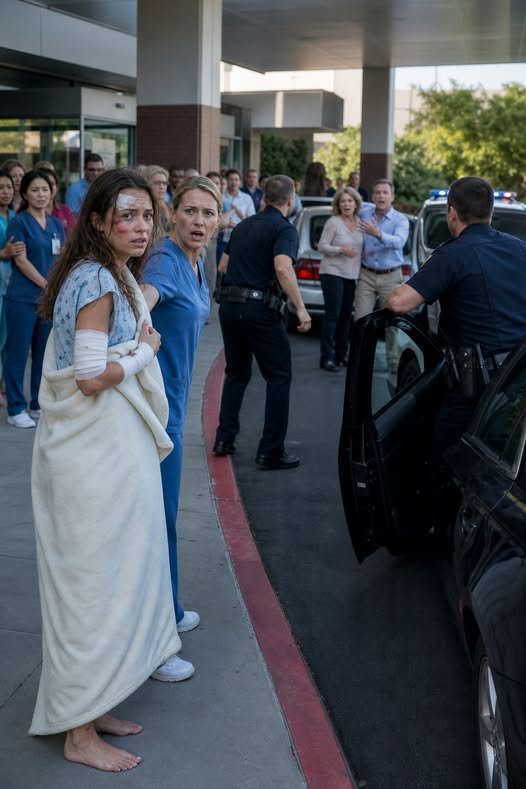
My name is Isla Calloway. I was nineteen years old, barefoot in October, and I had both palms wrapped in gauze so thick they looked like oven mitts. The worst cut ran from the base of my right thumb across my palm, then another one climbed along my forearm in a thin, ugly line. Every bump in the road sent a hot, bright pain up my arm and into my teeth.
“Almost there,” the paramedic said.
He was young, with tired eyes and a wedding ring that flashed whenever he adjusted the IV tape. He kept his voice soft, like I was a stray dog that might bolt.
I nodded even though he wasn’t asking me anything.
My feet were the part I couldn’t stop noticing. They were gray from the sidewalk, scratched at the heels, the nails half painted from three weeks ago when I had still had a private hour on a Sunday afternoon. My mother hated nail polish in “loud colors,” so I had used the palest pink I could find. Now there were drops of blood dried across my toes like tiny rust-colored freckles.
At the ER, they rolled me past the front desk and into a curtained bay. It was quieter than I expected. Hospitals on TV were all shouting doctors and crashing carts, but this place hummed. Fluorescent lights buzzed overhead. A vending machine clunked somewhere down the hall. A toddler coughed in the waiting room with that wet, miserable sound that made his mother rock him harder.
I stared at the curtain hooks above me.
One. Two. Three. Four.
Counting was something I had learned young. Count tiles. Count fence boards. Count breaths between footsteps in the hallway. If you counted, you did not have to feel everything at once.
A nurse stepped inside my bay with a clipboard tucked under one arm. Her badge said Carmen Reyes, RN. She had dark hair pinned at the back of her head and a face that looked calm without looking empty.
“Hi, Isla,” she said. “I’m Carmen. I’m going to take a look at your hands, okay?”
I nodded.
She pulled up a rolling stool instead of standing over me. That small choice made my throat tighten for no reason I could explain.
“I’m going to unwrap what the paramedics put on. It may sting.”
“It’s fine,” I said.
It wasn’t fine. The gauze stuck in places, and when she loosened it with saline, my whole body went rigid. I bit the inside of my cheek until I tasted blood there too.
Carmen noticed. Of course she did.
“You don’t have to pretend it doesn’t hurt,” she said.
That almost made me laugh. Pretending it didn’t hurt was basically my family’s religion.
She cleaned slowly, carefully. Her face didn’t change much, but I saw the first pause. It lasted less than a second. Her eyes moved from my right palm to the cut along my forearm. Then to the yellowing bruise near my elbow. Then to the older pale marks that crossed the side of my wrist like faded threads.
My stomach dropped.
“So,” she said, voice light, “tell me what happened tonight.”
I swallowed. “I dropped a glass baking dish. In the kitchen. I tried to pick up the pieces too fast.”
“What kind of dish?”
“One of those heavy ones. Clear glass.”
“Pyrex?”
“I guess.”
She nodded, but the nod did not mean she believed me. It meant she had put that answer somewhere in her mind and was waiting to see what else would line up beside it.
“The cuts on your palms could come from broken glass,” she said. “Some of them, anyway.”
I stared harder at the curtain.
Five. Six. Seven.
“But this one on your forearm,” she continued, “runs the wrong direction for someone reaching down to clean a floor. And these older marks here…” Her gloved fingers hovered, not touching until I gave the smallest nod. “These aren’t from tonight.”
My mouth went dry.
“I fall a lot,” I said.
Carmen looked at me for a long second. Not angry. Not impatient. Just present. That was worse, somehow. Anger I understood. Presence was dangerous.
She set the soaked gauze aside.
“Isla,” she said quietly, “these aren’t from broken glass.”
The room seemed to tilt under me. For one wild second, I thought I could still save the story, still smooth it flat before anyone saw what was underneath. Then Carmen lowered her voice and asked the question I had spent my whole life learning how not to answer.
“Who hurt you?”
Part 2
Before the ER, before the ambulance, before Mrs. Aldridge wrapped me in an old blue cardigan that smelled like lavender dryer sheets, there had been dinner.
Dinner was supposed to be ready by ten-thirty on Thursday nights.
That was not written down anywhere, but every rule in our house was carved into the air. You learned it by what happened when you broke it. My father had poker night every Thursday in a finished basement two towns over with men who laughed too loudly and came home smelling like beer, cigar smoke, and the sharp chemical lemon of someone else’s cleaning products.
If he won, he came home loose and generous. He might toss his keys on the counter and call me “kiddo” like he had seen fathers do in commercials. If he lost, he entered quietly, and quiet was worse.
That night, I knew before he even walked in.
The kitchen clock said 1:37 a.m. when I took the casserole dish from the oven. The house was dark except for the stove light, which made everything look yellow and oily. My mother had gone to bed, or pretended to. She slept lightly when she wanted to hear trouble coming.
The dish was too hot through the thin towel. My hands were sweaty inside the fabric. I had been studying at the kitchen table while dinner baked, my biology notes spread beside a stack of coupons my mother expected me to clip before morning. On the counter, my father’s plate waited under foil.
Chicken. Potatoes. Green beans, not overcooked. No garlic because he said garlic made people smell poor. No black pepper because my mother said it was “aggressive.”
I lifted the dish, turned toward the stove, and my left foot slipped on a tiny patch of water near the sink.
The dish fell.
It hit the tile with a sound so huge it seemed impossible our little kitchen could hold it. Glass exploded outward. Chicken slid across the floor in a pale, steaming heap. Sauce splattered the cabinet doors. My heart slammed once, hard.
I should have stayed still.
Instead, I crouched.
The biggest piece of glass was nearly invisible against the light tile. My right palm came down on it. For half a second, I felt pressure instead of pain, like I had pressed my hand against the edge of a table. Then the skin opened, and blood poured so fast I made a sound without meaning to.
Not a scream. More like a broken breath.
The hallway light snapped on.
My father stood in the kitchen doorway wearing his gray jacket, the one with the torn pocket lining. He had not taken off his shoes. That meant he had just come in. That meant he had heard the glass before he had seen me.
Behind him, my mother appeared in her robe, arms folded tight across her chest.
I pressed a dish towel against my hand. “I’m sorry,” I said immediately. “I slipped. I’ll clean it up.”
My father’s eyes moved over the floor, the ruined food, the broken dish, the blood. His face went still in the way lake water goes still right before something rises under it.
“One thing,” he said.
“I know. I’m sorry.”
“One simple thing.”
“I’ll fix it.”
My mother made a small sound with her tongue. “Look at the floor.”
“I know,” I whispered.
“No, you don’t know,” my father said. His voice was low, almost gentle. “You never know. You move through this house like consequences are for other people.”
I pressed harder on the towel. It was already soaking through. Pain pulsed in my palm with every heartbeat.
“I think I need stitches,” I said.
My mother laughed.
It wasn’t loud. It didn’t need to be. The sound slid under my skin.
“You need stitches because you can’t hold a dish?”
“I’m bleeding through the towel.”
“Then don’t bleed on the grout,” she said.
I looked at her to see if she heard herself. That was the stupid part. Even then, I was still checking for the moment she would become a mother.
My father stepped into the kitchen. A shard cracked under his shoe.
“You want a hospital bill now?” he asked. “After the tuition forms? After the car insurance? After everything we pay for?”
I did not have a car. I had never been allowed to drive alone.
“I can pay,” I said, because fear makes you offer things you don’t have. “I have money saved.”
Something moved across my mother’s face so quickly I almost missed it.
My father looked at her. She looked away.
At the time, I thought I had said the wrong thing because my money was selfish. Later, I would understand that I had said the wrong thing because my money was gone.
“Get out,” my father said.
I blinked. “What?”
He pointed toward the front of the house.
My mother did not protest. She did not even pretend to.
“Dad, I’m not wearing shoes.”
“Then maybe you’ll remember what carelessness costs.”
“I’m bleeding.”
“You heard me.”
The hallway felt a mile long. I waited for my mother to say enough, stop, she’s hurt. Instead she went to the counter, tore a single paper towel from the roll, and held it out between two fingers like she didn’t want my blood on her.
“Wrap it,” she said. “And don’t make a scene on the porch.”
That was when I realized they weren’t trying to scare me.
They were really going to open the door.
And when my father’s hand closed around the front doorknob, I finally understood that the cold waiting outside was not the worst thing they were willing to do.
Part 3
The porch light had burned out three weeks earlier, and my father had said replacing it would teach me to be more aware of my surroundings.
So the first thing I saw after he pushed me outside was darkness.
The second thing I heard was the lock.
A small click. Clean. Final.
I stood there holding a paper towel around my right hand while blood warmed my fingers and the October air moved under my thin T-shirt. I had on pajama pants with tiny blue moons printed on them because I had expected to clean the kitchen, finish my notes, and sleep for four hours before class.
I knocked once.
Not hard. Just enough.
“Please,” I said through the door. “At least give me my shoes.”
No answer.
The living room curtains shifted. Then the hall light went out.
I waited another minute because some part of me still believed humiliation had a limit. When nothing happened, I stepped off the porch.
The concrete bit into my feet.
Our neighborhood always looked safe from the outside. Split-level houses. American flags. Basketball hoops at the ends of driveways. Pumpkins on porches, some already soft and collapsing at the mouths. At 2 a.m., safety looked different. Garage doors became blank faces. Tree branches scraped gutters like fingernails. Every dog bark felt like an accusation.
I had no phone.
My parents had taken it two weeks earlier after they found texts between me and Maya Fields, a girl from my English class who wore denim jackets covered in embroidered flowers and had once asked why I flinched when the classroom door slammed.
My mother called Maya “unstable.” My father called her “a distraction.”
I called her the only person who had noticed I was disappearing.
I walked toward the main road because that was where streetlights were. My right hand throbbed. My left palm had two smaller cuts from trying to catch myself, and blood kept slicking the paper towel until it fell apart. I tried wrapping it tighter, but my fingers wouldn’t work right.
Halfway down the block, I heard a door open.
A porch light snapped on behind me.
“Isla?”
I froze.
Mrs. Aldridge lived four houses down in a pale yellow ranch with wind chimes shaped like birds. She was in her seventies, maybe, though I had never known exactly. She had a small white dog named Biscuit who hated squirrels and everyone under five feet tall.
Biscuit barked once, then stopped.
Mrs. Aldridge came down her steps in slippers and a quilted coat pulled over her nightgown. “Honey?”
“I’m okay,” I said automatically.
She stopped two feet away.
There are looks people give you when they don’t believe you but don’t want to frighten you by saying so. Her face did that. Her eyes went to my hands, then my bare feet, then back toward my house.
“What happened?”
“I dropped a glass.”
The lie came out so fast it sounded practiced because it was.
“At two in the morning?”
“I was cleaning.”
“Where are your shoes?”
I had no answer for that one. I looked down at my feet like maybe they had betrayed me by being visible.
Mrs. Aldridge didn’t ask again. She put one arm around my shoulders and guided me toward her house. “Inside. Right now.”
“I’ll get blood on your floor.”
“Then I’ll mop.”
Her kitchen was warm. Too warm at first. The shift from cold air to heated room made my skin sting. A brass lamp glowed on the counter. There was a mug in the sink with a tea bag string hanging over the rim. Everything smelled like toast, dog food, and the lavender detergent she used on the cardigan she put around my shoulders.
She wrapped my hand in a clean dish towel and pressed down.
I gasped.
“Sorry,” she said. “I know. I’m sorry.”
Sorry meant something different in her mouth. It was not a weapon. It did not mean fix my mood. It meant I see that you hurt.
She picked up the phone mounted on the wall.
“No,” I said.
She paused.
“My parents will be mad.”
Mrs. Aldridge looked at me then. Really looked.
“Isla,” she said, “you are sitting at my kitchen table barefoot and bleeding through a towel. Let them be mad.”
She called 911.
While we waited, she asked if I wanted water. I said yes because I did not know how to say I wanted someone to sit between me and the door in case my father came. She sat between me and the door anyway.
The paramedics arrived seven minutes later. Red light flashed across Mrs. Aldridge’s cabinets. One of them asked where my parents were. I said at home. He asked if they knew I was hurt. I said yes before I could stop myself.
He and his partner exchanged a glance.
At the ER, that glance followed me. It was in Carmen’s careful hands. It was in the way Officer Reyes stood just outside the curtain like he wanted to give me privacy but not distance. It was in the silence after Carmen said the cuts were wrong.
“Who hurt you?” she asked.
My mouth opened around the old answer.
Nobody.
Me.
It was my fault.
But my body had finally gotten tired of carrying my parents’ version of the world. A sob came out instead, ugly and sudden, and Carmen reached for my uninjured wrist like she was asking permission to keep me from falling.
I looked at the curtain hooks through tears.
Eight. Nine. Ten.
And for the first time in my life, I wondered what would happen if I stopped protecting the people who had locked me outside.
Part 4
The first truth came out like a splinter.
Small. Sharp. Impossible to put back.
“My dad made me leave,” I whispered.
Carmen did not gasp. She did not say, “Are you sure?” or “Why would he do that?” She just nodded once, slowly, as if I had handed her something fragile and she knew exactly how to hold it.
“Okay,” she said. “You’re doing really well.”
That made me cry harder.
People think praise feels good when you’ve gone without it. Sometimes it does. Sometimes it hits the part of you that learned to survive on crumbs, and the hunger of it hurts worse than the injury.
Officer Reyes stepped in after Carmen asked if I was ready. He was in his forties, broad shouldered, with silver at his temples and a notebook already open. He introduced himself by first and last name. He asked where I wanted him to stand. No one had ever asked me that in my own house.
“Near the curtain is fine,” I said.
He stood there, not too close.
Carmen kept cleaning my hands while I talked. That helped. The sting gave me something to focus on. I told them about dinner. About the glass dish. About my father pointing to the door. About the paper towel. About the lock.
I did not tell them everything at first.
I left out the belt hanging behind the laundry room door. I left out my mother checking my arms before family events, choosing cardigans that hid bruises better. I left out how my father once made me stand in the garage for three hours because I had gotten a 92 on a chemistry test and “smart girls don’t get lazy.”
Some lies are spoken. Others are made of what you leave out.
Carmen noticed those too.
When she finished with my palms, she asked if she could examine the rest of my arms. Her voice stayed gentle. I said yes. She pushed my sleeves up slowly.
The air changed.
Officer Reyes stopped writing for half a beat.
I looked away.
There were bruises on my upper arms where fingers had pressed too hard. One yellow near my shoulder. One purple-black closer to my elbow. A faint line near my wrist from when my mother had grabbed me with her ring turned inward.
Carmen described everything out loud for the chart. Clinical words. Measured words.
“Bruising in different stages of healing. Linear scarring along right forearm. Older healed lacerations.”
My life sounded different when translated into evidence.
It sounded less like a failure of personality and more like a crime.
A doctor came in and injected anesthetic around the deepest cuts. The needle hurt almost as badly as the glass had. Then stitches. Black thread moving through my skin. Carmen kept one hand near my elbow, not restraining me, just reminding me there was something solid in the room.
Officer Reyes asked careful questions.
“Has this happened before?”
“Yes.”
“How often?”
“I don’t know.”
“More than once a month?”
I laughed then, a small broken sound. “Yes.”
“More than once a week?”
I stared at the tiled floor.
He wrote something down.
The new information came after sunrise, when the ER windows went pale and the vending machine guy with the ankle brace was replaced by a woman in scrubs drinking coffee from a paper cup. Detective Marisol Rivera arrived with reading glasses on top of her head and a leather folder under one arm.
She looked like someone who did not waste words.
“Isla,” she said, “I’m sorry to ask more questions when you’ve already been through a long night.”
“I’m okay,” I said.
Her eyes flicked to my bandaged hands. She did not correct me. “There is something we need to clarify. You mentioned having savings.”
“Yes.”
“For college?”
I nodded. My stomach tightened.
“Do you have access to the account?”
“My parents keep the card. They said it was safer.”
Detective Rivera opened the folder.
Inside were printed bank records. My name sat at the top of the page, official and black and undeniable. Deposits from my garden center job. A scholarship award from the school district. Birthday checks from relatives I had barely been allowed to call.
Then withdrawals.
Three hundred here. Five hundred there. ATM transactions. Transfers. A steady bleeding I had never felt because I had never been allowed to touch the wound.
I leaned forward.
“That’s wrong,” I said. “That can’t be right.”
Detective Rivera’s voice softened. “We believe your parents have been taking money from this account for at least eighteen months.”
The room went too quiet.
My hands hurt. My feet hurt. My face felt swollen from crying. But the pain that opened then was different. I had been saving for a future like a girl filling a jar with coins during a house fire, and all along, someone had been emptying it from the other side.
“My aunt sent money once,” I said slowly. “When I turned sixteen. My mom said it bounced.”
Detective Rivera looked at a note in her folder.
“Your aunt Ruth?”
I had not heard that name spoken by anyone outside my own memory in years.
“She tried to contact you,” the detective said. “Several times.”
A strange pressure built behind my ribs.
“My parents said she didn’t want anything to do with us.”
Detective Rivera closed the folder, and the click of it sounded louder than it should have.
“That’s not what she says,” she told me. “In fact, she’s been looking for you.”
Part 5
Aunt Ruth existed in my memory like a bright object at the bottom of dark water.
You could see the shape, but not reach it.
She was my father’s older sister, though they never looked related to me. My father was all straight lines and locked doors. Ruth was color and motion. She wore silver rings on nearly every finger. She laughed with her whole chest. The last time I saw her, I was eleven, and she brought me a book about deep-sea creatures because I had once mentioned wanting to see the ocean at night.
Two days after that visit, my parents stopped saying her name.
When I asked why, my mother said, “Some people enjoy causing trouble.”
My father said, “Your aunt doesn’t respect boundaries.”
In our house, boundaries meant whatever protected them from being questioned.
Now Detective Rivera was telling me Ruth had been trying to find me.
I wanted to believe it so badly that I didn’t trust the feeling.
“Why didn’t she come?” I asked.
The detective did not rush. “From what we know so far, your parents blocked her number, returned mail, and told extended relatives you didn’t want contact. She says she contacted your school once, but your mother convinced them it was a custody dispute.”
“A custody dispute?”
“You were a minor then.”
I looked at my bandaged hands. “She gave up.”
Carmen, who had been quietly replacing the blanket over my legs, stopped.
Detective Rivera said, “I don’t think so.”
She asked if I would speak to Ruth by phone. I said yes, then immediately wanted to throw up.
The hospital phone felt heavy against my ear. It rang twice.
“Isla?”
Her voice was older than I remembered. Rougher. But there was something in it that reached straight through the years and found the girl with the ocean book.
“Hi,” I said, and the word came out tiny.
“Oh, sweetheart.”
That was all. Two words. She started crying, then tried to stop because she did not want to scare me, and somehow that restraint made me trust her more.
“I tried,” she said. “I need you to hear that first. I tried lawyers. Letters. Calls. I drove down once and your father threatened to call the police. I should have done more. I have lived with that every day.”
My throat closed.
My parents had told me she was selfish. Dramatic. Dangerous. They had built a whole ghost story around her absence.
“Are you safe?” she asked.
I looked around the hospital bay. Carmen. Detective Rivera. Officer Reyes near the nurses’ station with a paper cup of coffee. My stitched hands. My bare feet now tucked inside hospital socks with rubber grips.
“I think so,” I said.
“I’m coming,” Ruth said.
The emotional reversal did not feel like relief at first. It felt like suspicion. Relief had been used against me too many times. A good mood could turn. A kind voice could sharpen. A promise could become a debt.
While Ruth drove from Portland, the police went to my parents’ house.
Detective Rivera told me later what happened, though she softened parts I eventually read in the report. My mother opened the door in makeup and a cream sweater, as if police visits before breakfast were normal social calls. My father stood behind her with his arms folded.
They said I had left voluntarily.
They said I was troubled.
They said I had been seeing “inappropriate people.”
They said I had always been dramatic.
They said there had been no blood.
That was the part that made Detective Rivera pause.
No blood.
By then, officers had already photographed the kitchen trash. Inside were pink-stained paper towels, broken glass wrapped in newspaper, and the corner of the dish towel Mrs. Aldridge had not used because mine had apparently been thrown away. Someone had mopped the floor, badly. Thin reddish streaks remained in the grout by the stove.
The first search also turned up my phone in my mother’s dresser drawer, sealed in a zip-top bag like contraband.
When Detective Rivera told me that, I felt embarrassed before I felt angry. Embarrassed that my private messages might be read. Embarrassed that Maya’s name might appear. Embarrassed, somehow, that my loneliness had evidence.
Then the detective added one more thing.
“There were voicemails on it,” she said. “Deleted, but recoverable.”
“From who?”
She hesitated just long enough for my heart to start pounding.
“Your aunt,” she said. “And someone named Maya Fields.”
I had spent years believing people left because they chose to. Now, lying in a hospital bed with stitches in my hands and my parents’ lies collapsing one by one, I had to face a different possibility.
Maybe I had not been abandoned.
Maybe I had been hidden.
Part 6
Aunt Ruth arrived at 6:14 p.m.
I remember the exact minute because I was watching the digital clock on the wall, trying not to expect anything. Expectation had always felt like standing under a shelf full of glass.
She appeared in the doorway wearing a green raincoat, damp hair curling around her face, and boots speckled with mud. For a second, she did not move. Her eyes traveled over the IV, the bandages, the hospital socks, the bruise near my elbow that the blanket didn’t cover.
Then her face changed.
Not into pity. I had been afraid of pity.
It changed into grief with a backbone.
She crossed the room and sat beside my bed. “Can I hug you?”
No one in my family asked before touching me. I nodded because I couldn’t speak.
She hugged me carefully, arms around my shoulders, avoiding my hands. She smelled like rain, coffee, and peppermint gum. I held still at first, waiting for the catch. There was always a catch. Then she whispered, “You never did anything to deserve this,” and my body folded toward her before I could stop it.
I cried into her raincoat.
Ruth did not tell me not to cry. She did not tell me I was making her feel bad. She did not say she had driven three hours so I should appreciate it. She just held on.
Later, when I could breathe, she took a stack of envelopes from her bag. Some were copies. Some were originals returned to sender. My name was written across them in her looping handwriting.
For Isla.
Happy thirteenth birthday.
Just checking in.
Please call me if you get this.
I’m worried about you.
One envelope had a coffee stain. One had been opened and taped shut again. My mother’s neat handwriting appeared on a sticky note attached to a returned package: Refused. Do not contact minor child.
Ruth watched me read the outside of each one.
“I sent books,” she said. “Gift cards. Money orders. Letters. At first your father wrote back saying you were busy. Then your mother said contact upset you. Then everything started coming back.”
I held an envelope dated three years earlier. “They told me you forgot my birthday.”
Her mouth tightened. “I never forgot.”
The room filled with every birthday I had spent pretending not to care.
The next two days moved in a blur of social workers, discharge instructions, police follow-ups, and Ruth signing temporary paperwork because even at nineteen, with no home and no access to my own documents, adulthood felt more theoretical than real.
My parents did not call.
Not once.
No message came through the hospital. No apology. No demand. No fake concern in front of officials. Their silence hurt in a way I hated admitting. I had told the truth, and some childlike part of me still waited for my mother to burst through the doors, pale and sorry, saying she had lost her mind for a moment but loved me underneath it all.
She didn’t.
When officers asked why they had not reported me missing, my father said he thought I was staying with a friend. My mother said I was “prone to attention-seeking.”
I had been in an emergency room getting stitches while they practiced their story.
On the third morning, Carmen came in before her shift ended. Her eyes were tired, and she carried a paper bag from the cafeteria.
“I brought you a muffin,” she said. “Blueberry was the least suspicious-looking option.”
I laughed. It startled both of us.
She helped review the wound care instructions. Keep dry. Watch for infection. Come back if there was fever, swelling, red streaks. I listened like my life depended on remembering every word because in some ways it did. My body was mine now. I had to learn how to care for it.
Before she left, Carmen wrote her number on the back of a hospital card.
“You don’t owe me updates,” she said. “But if you ever want to send one, I’d like to know you’re okay.”
I took the card between two clumsy bandaged fingers.
“Why?” I asked.
She looked surprised. “Because you matter.”
That answer was so simple I had no defense against it.
Ruth drove me to Portland under a sky the color of wet cement. Rain tapped the windshield. Every mile between me and my parents’ house felt unreal, like distance was a trick that might collapse if I looked back too long.
At a gas station outside Vancouver, Ruth went in to buy coffee. I stayed in the car with the heater blowing against my socked feet. Her phone buzzed in the cup holder. The screen lit up with a number I recognized.
Home.
My parents were calling my aunt, not me.
And when Ruth came back, saw the missed call, and played the voicemail on speaker, my father’s voice filled the car with a calm so polished it made my blood run cold.
“Ruth,” he said, “before you make this worse, you should know Isla has always been very good at lying.”
Part 7
Ruth turned the voicemail off before it finished.
For one breath, the car was silent except for rain ticking against the roof. I stared at the phone in her hand as if my father might crawl out of it.
“Do you believe him?” I asked.
The question came out before I could dress it up.
Ruth’s head snapped toward me. “No.”
“You didn’t listen to all of it.”
“I don’t need to.”
The certainty in her voice made something inside me loosen and ache. In my parents’ house, every truth had gone to trial. If I said I was sick, my mother checked my temperature like she hoped to prove fraud. If I said I was tired, my father called it laziness. If I cried, they asked what I was trying to get.
Ruth believed me without making me perform pain for her.
Her house sat on a quiet Portland street lined with wet maple trees and parked Subarus. It was small, painted blue-gray, with a porch swing and pots of rosemary by the steps. Inside, it smelled like coffee grounds, old books, and wood smoke from the little stove in the living room.
“This is your room,” she said.
The room had white walls, a quilt folded at the end of the bed, and a window facing the garden. There was a desk with a lamp shaped like a brass mushroom. On the nightstand sat a glass of water, a box of tissues, and three kinds of granola bars because Ruth said she didn’t know what I liked yet.
Then she showed me the door.
“It locks from the inside,” she said. “No one comes in unless you say so.”
I nodded like a normal person.
That night, after she went downstairs, I locked and unlocked the door twenty-three times.
Click. Open.
Click. Open.
Proof. Repeated proof.
I started community college two weeks later because stopping felt more dangerous than moving. Ruth found a therapist named Dr. Okafor whose office had plants on every windowsill and a rug with blue diamonds woven through it. The first session, I sat on the edge of the couch, ready to be told I had misunderstood my own life.
Dr. Okafor said, “Your brain learned danger as a household language. We are not going to shame it for being fluent.”
I wrote that sentence down when I got home.
Healing was not beautiful at first. It was paperwork and nightmares. It was flinching when Ruth dropped a pan. It was crying in the cereal aisle because there were too many choices and no one was telling me which one would keep the peace. It was waking at 2 a.m. convinced I had heard my father’s shoes in the hallway, then remembering I was three hours away and my door locked.
It was also strange little freedoms.
Buying shampoo that smelled like oranges.
Eating toast at midnight because I was hungry.
Texting Maya from a new phone Ruth helped me set up.
I stared at Maya’s name for ten minutes before typing.
This is Isla. I’m safe. I’m sorry I disappeared.
Her reply came less than a minute later.
Oh my God. I knew something was wrong.
Then another.
Where are you?
Then another.
You don’t have to explain tonight. Just tell me you’re okay.
I cried so hard I dropped the phone on the bed.
The new information arrived in pieces. Detective Rivera called every few days. The bank had camera footage of withdrawals. My father at an ATM in his poker-night jacket. My mother depositing one of Ruth’s money orders into a separate account two towns over. My school grant, gone within forty-eight hours of deposit.
My parents hired a lawyer.
Their story changed.
First, I had left voluntarily. Then I was mentally unstable. Then the money had been used for “household expenses benefiting Isla.” Then my father claimed the injuries happened because I threw the dish at him and cut myself in the chaos.
“That’s not true,” I said into the phone, suddenly breathless.
“I know,” Detective Rivera said. “The evidence does not support that.”
Evidence does not support that.
I repeated it after we hung up.
My parents had always owned the story. Now the story had other witnesses.
Carmen’s notes. Mrs. Aldridge’s 911 call. Photographs of blood in the grout. Bank records. Deleted voicemails. My body.
Three months after I moved to Portland, a thick envelope arrived from the prosecutor’s office. Inside was a subpoena and a list of charges: aggravated assault, reckless endangerment, coercive control under state statute, and financial exploitation.
Ruth found me sitting at the kitchen table with the papers spread in front of me.
“You don’t have to read it all tonight,” she said.
But I was already staring at one sentence in the witness summary.
The State intends to prove a long-term pattern of abuse, isolation, and financial control.
Pattern.
Not accident. Not drama. Not my fault.
Then I turned the page and saw my mother’s name on a new line, attached to words I had not expected.
Recorded jail call.
Part 8
The recorded call was between my mother and my father’s cousin, Paul.
I had met Paul twice. He smelled like motor oil and cinnamon gum and always gave my father the kind of laughing approval that made both men worse. According to the transcript, my mother called him three days after my parents were arrested and told him she needed people to “remember Isla correctly.”
At first, I did not understand what that meant.
Then I read on.
She wanted Paul to tell the police I had stolen things as a teenager. She wanted another cousin to say I had threatened to hurt myself for attention. She wanted someone from church to mention that I was “obsessed with victim stories online.” She said the words calmly, like she was organizing a potluck.
Remember Isla correctly.
My hands shook so badly Ruth took the paper from me.
“That’s enough for now.”
“No,” I said. “I want to know.”
Want was not the right word. Need was closer. My parents had done so much damage in private that I needed to see what they looked like when the lights came on.
The call got worse.
Paul asked if I would “come around” if the family pressured me.
My mother said, “She’ll break. She always does.”
That sentence stayed in my body for days.
I heard it while brushing my teeth. While sitting in biology lab labeling parts of a fetal pig. While crossing campus under rain that misted instead of fell. She’ll break. She always does.
For a while, I was terrified she was right.
The prosecutor, Ms. Han, met with me in a conference room that smelled like printer toner and burnt coffee. She had a blunt bob, square glasses, and a way of speaking that made every sentence feel placed exactly where it belonged.
“The defense is going to suggest you exaggerated,” she said. “They may ask why you didn’t leave earlier. They may ask why you lied at first about the glass. They may bring up Maya.”
My face went hot. “Why?”
“To imply rebellion. Secretiveness. Motive.”
“Maya didn’t do anything.”
“I know.”
“No, I mean she really didn’t. We weren’t even—” I stopped.
Ms. Han’s voice stayed steady. “You don’t have to justify caring about someone.”
I looked at the table.
There were scratches in the laminate. Tiny half-moons where nervous people had dug pens into the surface. I pressed my thumb into one of them and wondered how many survivors had sat there before me, learning that the truth could still be attacked even when it was documented in photographs.
Preparing for trial meant learning my own story in a language the court could understand.
Dates. Times. Injuries. Transactions. Witnesses.
It also meant hearing red herrings dressed up as reasonable doubt.
Maybe I had slipped on glass in a panic. True.
Maybe my parents were strict but not abusive. False.
Maybe the older scars came from gardening work. One did. Most didn’t.
Maybe the bank withdrawals were family budgeting. Then why hide the statements?
Maybe Aunt Ruth had poisoned me against them. Then why had the abuse been documented before she arrived?
Each question felt like someone turning my life over in their hands, looking for a crack to blame me for.
Carmen helped without meaning to. She sent a text once a week. Sometimes it was practical.
How are the stitches healing?
Sometimes it was ordinary.
Saw a dog in a sweater today and thought you should know it looked judgmental.
And sometimes it was exactly what I needed.
You told the truth before you believed anyone would protect you. That is courage.
The stitches came out after ten days. The scars were pink and raised. I hated looking at them until Dr. Okafor asked what I saw.
“Proof that I was stupid,” I said.
She tilted her head. “Try again.”
“Proof that I panicked.”
“Try again.”
I stared at my palm.
“Proof that they left me bleeding.”
“And?”
My throat tightened. “Proof that I survived it.”
The emotional reversal did not arrive like a movie scene. No swelling music. No sudden confidence. Just a small shift. A half-inch of ground reclaimed.
By the time trial approached, my father had stopped calling Ruth. My mother had not stopped.
She sent one letter.
It came in a white envelope with my name written in her perfect school-secretary handwriting. Ruth asked if I wanted her to throw it away. I said no.
Inside was a single sheet of paper.
Isla,
This has gone too far. Families handle problems inside the family. Your father is not well. You know how he gets, and you know how to calm him down. If you had not involved strangers, none of this would be happening. I hope you understand the damage you are doing.
Mom
Not “I love you.”
Not “I’m sorry.”
You know how to calm him down.
I folded the letter carefully and brought it to Ms. Han.
She read it once.
Then she smiled without warmth.
“Your mother just helped us,” she said.
Part 9
The courthouse smelled like floor polish and old paper.
I had imagined it would feel grand, but it felt mostly tired. Beige walls. Metal detectors. A vending machine with one stuck bag of pretzels hanging by a corner. People in suits walked quickly past people in work boots, all of them carrying separate disasters.
Ruth sat beside me on a bench outside the courtroom. She wore a navy dress and the silver rings I remembered from childhood. Carmen had come too, though she warned me she might be called as a witness and couldn’t sit through everything. Maya rode the train down from Seattle, where she had started college, and stood awkwardly near the window holding two coffees she had bought because she “didn’t know what else to do with her hands.”
Seeing her felt like opening a door to a version of myself I thought had been erased.
She had cut her hair shorter. She still wore embroidered flowers on her jacket.
“Hi,” she said.
“Hi.”
We hugged carefully, my hands still sensitive.
“I’m sorry,” I said.
“For what?”
“For disappearing.”
Her eyebrows pulled together. “Isla, you were being controlled.”
The word landed between us. Controlled. Not flaky. Not rude. Not careless.
The courtroom doors opened before I could answer.
My parents were already inside.
My father sat at the defense table in a dark suit that didn’t fit the shoulders right. He looked smaller than he had in our kitchen. That should have made me feel powerful. Instead, it made me feel nauseated. My mother sat beside him in pearls, hair smooth, hands folded. She looked like she was waiting for a parent-teacher conference to begin.
When she saw me, her expression hardened.
Not sadness.
Not shame.
Correction.
As if even there, with a judge above us and a prosecutor holding evidence, she still believed I could be brought back into line by the right look.
The trial lasted six days.
Mrs. Aldridge testified first. She described finding me barefoot, bleeding, shaking too hard to hold a glass of water. Her voice trembled only once, when the defense attorney asked if she was certain I had not simply wandered from my house after an accident.
“I know what fear looks like,” Mrs. Aldridge said. “That girl was afraid of being sent back.”
Officer Reyes testified about my first statement. Detective Rivera testified about the house, the bank records, the deleted voicemails, the inconsistencies in my parents’ accounts.
Then Carmen took the stand.
She wore navy scrubs under a blazer, which made Maya whisper, “That is the most nurse thing I have ever seen,” and I almost laughed in court.
Carmen explained the injuries with calm precision. The direction of the forearm laceration. The depth of the palm wounds. The older scars. The bruising patterns.
“These injuries were not consistent with the explanation initially provided,” she said.
The defense attorney stood.
He was tall and silver-haired, with a voice like butter spread over a knife.
“Ms. Reyes, isn’t it true that emergency rooms are chaotic environments?”
“Yes.”
“And patients in distress may give incomplete or inaccurate accounts?”
“Yes.”
“So it is possible Isla herself did not understand how she was injured?”
Carmen folded her hands. “It is possible for a patient to be confused. It is not possible for a cut to run in a direction it did not run.”
Something moved through the courtroom. Not noise exactly. Attention.
The defense attorney tried again. “But you cannot say who caused those older bruises.”
“No,” Carmen said. “I can say they were consistent with repeated gripping force. I can say they were in various stages of healing. I can say that, combined with the patient’s disclosure and the circumstances under which she arrived, they raised serious concern for ongoing abuse.”
Patient.
Disclosure.
Ongoing abuse.
End Part Here: My Parents Left Me On The Street Bleeding At 2AM—The ER Nurse Said “These Aren’t From Broken Glass