
My Husband Gave My Car to His Mother — Then One Question From My Dad Exposed Everything
Part 1: “Where Is the Car I Gave You?”
The taxi had barely pulled away from my parents’ driveway when I stepped inside their house for our monthly family dinner.
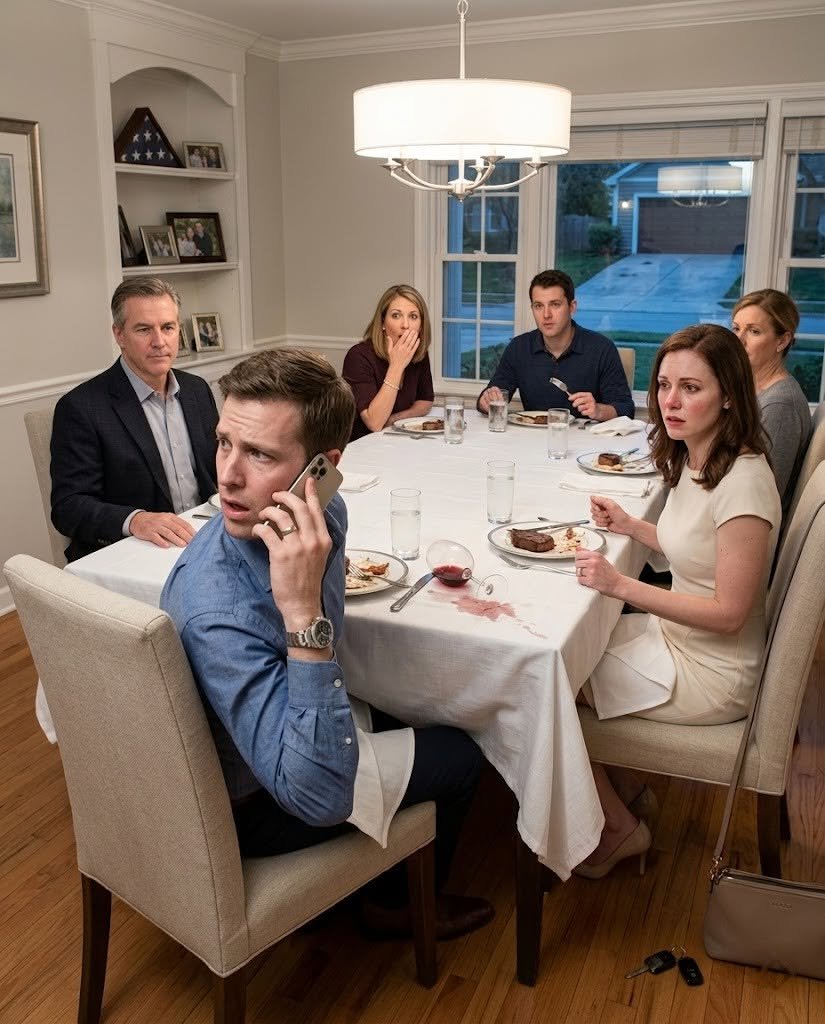
Warm chandelier light filled the dining room. The smell of roast beef, lemon polish, and expensive candles hung in the air.
Everyone was already seated.
My father, Dr. Richard, sat at the head of the table. Aunt Lauren and Uncle Mark were discussing a vacation. My cousin Jason was laughing at something Patrick had said.
And there was my husband of three years, sitting calmly in the blue shirt I had bought him and wearing the watch I had paid for.
He barely looked at me.
Then Dad noticed I had arrived in a taxi.
“Why did you take a taxi, Jenna?”
The room quieted slightly.
Then he asked the question that would change my entire life.
“Where is the Honda Civic I gave you?”
My stomach tightened.
I immediately began creating excuses in my head.
The car was being repaired.
I had not wanted to drive.
I was running late.
Anything would have worked.
Anything that kept the dinner peaceful.
Anything that stopped my family from seeing what my marriage had slowly become.
For years, I had learned how to translate Patrick’s behavior into softer words.
Control became stress.
Selfishness became family responsibility.
Humiliation became a misunderstanding.
I was preparing to do it again.
But Patrick answered before I could.
He calmly wiped his mouth with his napkin.
“I gave it to my mother,” he said.
Then he smiled.
“She needed it more.”
The entire table went still.
Not quiet.
Still.
Aunt Lauren stared at him.
Jason stopped smiling.
Even Uncle Mark lowered his wineglass.
Patrick continued as if he had just explained where he moved a piece of furniture.
His mother’s old car embarrassed her.
She needed reliable transportation for church activities and charity events.
I worked close enough to take taxis or use ride-share services.
According to Patrick, giving her my car had simply been the practical thing to do.
But the Honda Civic was not Patrick’s car.
My father had bought it for me six months earlier.
It was registered entirely in my name.
The title was mine.
Patrick had no right to give it to anyone.
I felt my face grow hot.
But the car itself was not what hurt most.
Patrick had just announced in front of my entire family that anything belonging to me could be reassigned whenever he decided someone else deserved it more.
And the worst part was that this behavior was not new.
It was simply new to my family.
For years, Patrick had used my money to support his mother.
Birthday gifts came from my credit card.
Expensive dinners he called “his treat” appeared in our joint account later.
I had paid his mother’s rent.
I had covered medical and dental expenses.
I had helped replace appliances.
I had even paid for a vacation Patrick described as an “emergency family retreat.”
Every request arrived wrapped in guilt.
His mother needed help.
His business was struggling.
A relative had an emergency.
Unexpected taxes appeared.
Something always happened.
And somehow, my money always became the solution.
I had saved bank alerts, receipts, canceled transfers, and messages.
One message from Patrick still bothered me more than the others.
Mom comes first. You know that.
I kept the evidence because, after enough manipulation, proof becomes the only thing that reminds you your memory is not wrong.
I wanted to throw everything across my parents’ beautiful white table.
Instead, I folded my hands in my lap.
Dad did not yell.
He did not argue.
He simply looked at Patrick.
Then he gave a faint, polite smile.
“I understand.”
Patrick visibly relaxed.
He thought Dad had accepted his explanation.
But I knew my father.
Dr. Richard had spent his career delivering difficult diagnoses without panic.
That expression did not mean he was letting anything go.
It meant he had already decided something was wrong.
A few moments later, I noticed the blue glow of Dad’s phone beneath the tablecloth.
His thumb moved across the screen.
Once.
Twice.
Then he put the phone away and continued eating.
No announcement.
No confrontation.
Nothing.
At 7:42 p.m., my father had sent one quiet message.
And somehow, for the first time in months, I felt hope.
Dinner continued awkwardly.
Patrick kept talking about business opportunities and future plans.
He ate dessert as though nothing had happened.
Then his phone rang.
He looked at the screen.
“It’s my mother.”
He sounded almost proud.
But three seconds after answering, all the color disappeared from his face.
“Mom…”
He lowered his voice.
“What did you do with Jenna’s car?”
Everyone stopped eating.
Patrick stood so quickly that his chair scraped across the floor.
His mother was speaking loudly enough that we could hear panic coming through the phone.
“No,” Patrick whispered.
“No. Don’t tell me that.”
Dad calmly set down his glass.
“Put her on speaker.”
Patrick looked at him.
“Why?”
“Because you were comfortable discussing Jenna’s car in front of everyone. We can hear the rest in front of everyone too.”
Then Dad’s phone buzzed.
He turned the screen toward me.
There was a photograph.
My silver Civic.
But it was not sitting in Patrick’s mother’s driveway.
It was parked beneath fluorescent lights at a dealership.
A paper tag hung from the rearview mirror.
Jason stared at Patrick.
“Tell me you didn’t sell her car.”
Patrick’s hand started shaking.
Then I heard him whisper into the phone:
“What do you mean you sold it?”
My stomach dropped.
Until that moment, I thought Patrick had simply given his mother the keys.
I had been wrong.
His mother had traded my six-month-old Civic toward a luxury SUV.
And the dealership believed I had authorized everything.
“Jenna,” Dad asked, “did you give Patrick or his mother permission to sell your car?”
“No.”
It was the first time that evening I answered without trying to protect Patrick.
Patrick immediately started explaining.
Marriage meant shared property, he argued.
He intended to replace my Honda eventually.
A business deal was about to close.
Everything would have worked out.
Dad listened.
Then he asked:
“Does that business deal involve sixty-eight thousand four hundred dollars?”
Patrick froze.
I turned toward my father.
“What are you talking about?”
Dad explained that the moment Patrick admitted giving away my Civic, he had texted his longtime estate attorney, Rebecca Collins.
Rebecca had helped Dad purchase the car for me.
She still had copies of the title and purchase documents.
Within minutes, she checked the records.
My Civic had been transferred three days earlier using documents carrying my electronic signature.
A signature I had never provided.
Even worse, the vehicle appeared inside a financing package connected to a company called:
Donnelly Strategic Ventures.
Donnelly was Patrick’s last name.
His mother was listed as company manager.
And I was listed as financial guarantor.
I had never even heard of the company.
Dad looked at Patrick.
“The financing is for $68,400.”
Patrick’s face changed.
Privacy, he said.
Marriage.
Temporary financing.
Family business.
He threw every explanation he could find at us.
But none answered the only question that mattered.
Why was my name on a commercial loan I had never authorized?
Patrick insisted my excellent credit had simply strengthened the application.
That sentence told me everything.
He had not viewed me as his partner.
He had viewed me as financial access.
My name opened doors his could not.
Dad asked whether I wanted Rebecca to continue investigating.
Patrick interrupted.
“This is between my wife and me.”
Dad turned toward him.
“No. It stopped being only about your marriage when someone used my daughter’s identity to obtain money.”
Then Dad looked at me.
“Jenna?”
For years, I had softened every answer.
Not this time.
“Yes.”
I took a breath.
“Keep investigating.”
Patrick immediately stood.
“We’re leaving.”
I stayed seated.
He looked at me as if I had failed to follow an order.
“Jenna. Get your coat.”
“No.”
His expression hardened.
“You’re my wife.”
I looked directly at him.
“And that was my car.”
The entire room fell silent.
“You sold it.”
Patrick wanted to discuss everything privately at home.
But I remembered too many private conversations where Patrick somehow turned his actions into my mistakes.
So I refused.
“I’m staying here until every account, loan, and document connected to my identity has been checked.”
He laughed bitterly.
“You’re destroying our marriage because my mother needed a better car?”
Before I could respond, Dad asked me one more question.
“Jenna, when did you last check your credit report?”
I stared at him.
Months.
I had not checked it in months.
Patrick suddenly reached for his jacket.
And that was when I understood.
The Honda Civic was only the first visible crack.
Something much larger was underneath.
Part 2: My Car Was Only the Beginning
Dad called Rebecca from the dining room.
With my permission, she joined us on speakerphone.
What she told me made my stomach turn.
A preliminary credit review showed several hard inquiries under my Social Security number during the previous year.
Two personal loans.
A business credit line.
Luxury appliance financing.
I had applied for none of them.
Patrick immediately argued that married couples shared financial information.
Rebecca’s answer was simple.
“Sharing information is not permission to impersonate your spouse.”
Then she mentioned a home-equity application.
I frowned.
Patrick and I rented a townhouse.
We did not own a home together.
“What property?” I asked.
Rebecca hesitated.
Then I knew.
My grandmother’s lake cabin.
Grandma had left it to me two years earlier.
It was separate inherited property.
Patrick hated that cabin.
He called it outdated.
Expensive.
Useless.
He repeatedly told me to sell it.
I always refused.
Grandma had taught me how to swim there.
Her handwritten recipes were still inside the kitchen drawers.
The cabin was more than property.
It was part of my childhood.
Rebecca explained that someone had attempted to open a credit line against it three months earlier.
The application failed only because the lender required my signature in person.
Patrick stood again.
This time, his face was red.
He accused my family of never respecting him.
According to him, everyone admired my stable career as a hospital administrator while treating his entrepreneurial ambitions like a joke.
Then he used his mother again.
She had raised him alone.
She deserved a good life.
I had resources.
Why was I so unwilling to share them?
That was when Aunt Lauren quietly asked me:
“Jenna, how much money have you given Patrick and his mother?”
I opened my mouth.
Nothing came out.
“I don’t know.”
That answer frightened me.
I had stopped counting.
Patrick said couples were not supposed to keep score.
So I asked:
“Why have you been keeping my financial passwords?”
He went silent.
Rebecca immediately focused on that question.
Patrick should never have known the master password to my password manager.
Then I remembered.
Six months earlier, I had undergone emergency surgery.
While heavily medicated, I asked Patrick to pay a hospital bill using my phone.
I gave him the master password.
Later, I changed my banking password.
But I never changed the password manager itself.
Patrick had access.
Rebecca told me to freeze my credit immediately.
Within twenty minutes, my parents’ elegant family dinner had transformed into emergency financial triage.
Dad opened his laptop.
Jason helped contact the credit bureaus.
Aunt Lauren wrote account numbers on a legal pad.
Rebecca walked us through fraud alerts.
Patrick remained at the end of the table, alternating between anger and desperate explanations.
Then my phone rang from an unfamiliar number.
A man introduced himself as the finance manager at the dealership where my Honda had been traded.
“There is a problem with the title documentation,” he said. “Did you personally authorize this transaction?”
“No.”
Patrick moved toward me.
Dad stood.
Patrick stopped.
The dealership still physically had my Civic because the title had not completely cleared.
But Patrick’s mother had already driven away in the luxury SUV under provisional financing.
The dealership now suspected the signature on the transaction was fraudulent.
They were contacting law enforcement.
Patrick realized his plan was not irreversible.
That was when he finally lost control.
He shouted that I was humiliating his mother over paperwork.
He demanded that I tell the dealer I had given verbal authorization.
I looked at him.
“Did you forge my signature?”
Patrick said nothing.
“Did you sign my name?”
He stared at the floor.
Then he answered:
“I handled it.”
Those three words ended my marriage.
Not the Honda.
Not his mother.
Not even the debt.
I handled it.