
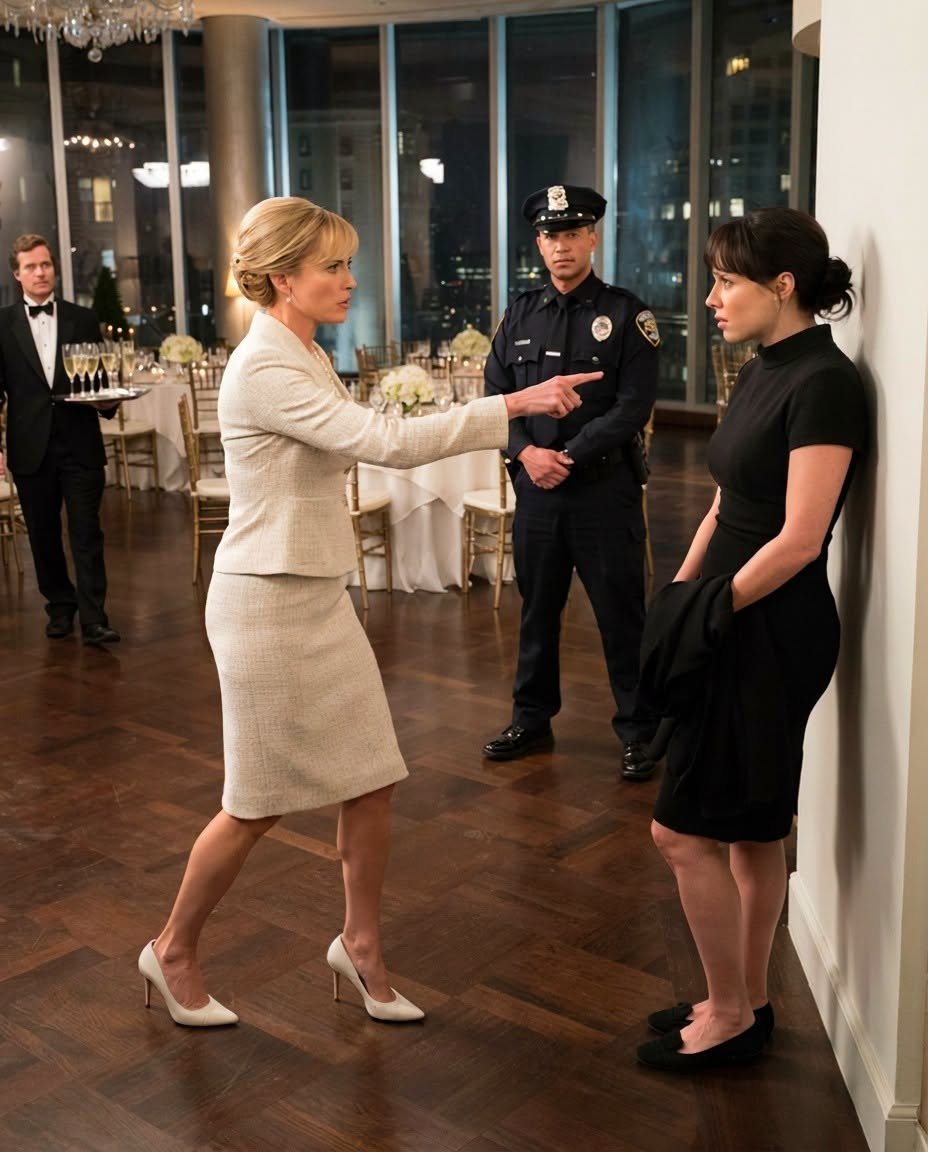
Vivian stopped. Something in the register of Gabrielle’s voice, flat and unhurried, produced a small silence.
“I did not transfer anything,” Gabrielle said. “My mother transferred it. Twenty-two years ago. Through a properly established discretionary trust with an independent trustee. Everything that moved tonight was operating exactly as she intended it to operate. I simply made the phone call she asked me to make.”
Her father’s face changed. The flushed, panicked expression from the ballroom had settled into something older and more complicated. He looked at her with the eyes of a man who has just understood that something he thought he controlled was never, in any meaningful sense, his.
“She never told me,” he said.
“She told you the trust existed,” Gabrielle said. “Marian Webb was very clear about that. Whether you chose to understand what that meant is a different matter.”
“The hotel has been running for sixteen years. The staff. The accounts. Everything I have built on top of what your mother started.”
“What she started and saved and rebuilt when it was failing,” Gabrielle said. “Yes.”
Daniel closed his eyes briefly. “Gabby.”
“Don’t,” she said, and there was no anger in it, just a clean, clear line. “Don’t use the name right now. You stood in that ballroom tonight while your wife told security to remove me. You looked at me across the room and you said nothing. You did nothing. I have watched you say nothing and do nothing for sixteen years, and I have swallowed it every time because you were grieving and then because you needed stability and then because I did not want to cause trouble and then because the habit of swallowing it had become so ingrained that I had almost forgotten it was a choice.”
Vivian opened her mouth.
Gabrielle looked at her.
Vivian closed it again.
“Tonight you made me the trespasser in my mother’s hotel,” Gabrielle continued. “In front of her donors and her guests and the people who have been eating dinner in a room my mother saved. You let that happen. So I went and found the thing my mother left me and I used it, because that is what she built it for.”
Her father sat down in the hallway chair without being invited to, which was not rudeness but the collapse of a man whose legs have stopped cooperating. He sat with his elbows on his knees and his hands clasped and he looked at the floor.
“What happens now?” he asked.
“Now I own the hotel,” Gabrielle said. “And the land. And the assets your firm has been characterizing as general business holdings for the past sixteen years.”
“You’re going to sell it,” Vivian said. The fury in her voice had taken on a new quality, something colder, more calculating. “You are going to strip everything down out of spite and sell it.”
“No,” Gabrielle said.
Vivian looked at her.
“I am not selling it. It was my mother’s. She built it and it nearly killed her and she loved it and I am not selling it.” She looked at Vivian with a steadiness that came not from rehearsal but from sixteen years of practice staying upright in rooms that did not want her. “But it will be run correctly. With her name restored to the history she wrote. With her contribution documented accurately in every piece of public-facing material the hotel produces. And with management that understands whose work they are standing on.”
Vivian’s jaw tightened.
Daniel looked up from the floor.
“I was wrong tonight,” he said.
Gabrielle waited.
“I should have said something. I should have—” He stopped. Started again. “I have been wrong about a great many things for a long time and I convinced myself that keeping the peace was the same as keeping the family, and those are not the same thing at all.”
“No,” Gabrielle said. “They are not.”
“Will you give me the chance to be different?”
She looked at him for a long time.
He was her father. He was a weak man who had made choices that protected his comfort at the expense of his daughter, who had allowed a second wife to slowly overwrite the memory of a first wife because the overwriting required less courage than the preservation, who had stood in a ballroom and let a security guard follow his daughter to the door rather than step forward and say her name.
He was also the man who had sat beside her mother’s hospital bed for eleven days without leaving. Who had taught her to drive in an empty car park on a Sunday morning. Who used to call her on the first day of school every year until she told him in her twenties that she was probably old enough to manage it without a call, and who had laughed and said he knew, he just liked doing it.
People were not one thing.
That had never made the harm easier to absorb. But it was still true.
“I don’t know yet,” she said. “I think that’s the honest answer. I don’t know what different looks like from you because I have not seen it. If you want the chance to show me, that is a choice you make over time and in small moments, not in this hallway tonight.”
Daniel nodded slowly.
Vivian said nothing. She stood with her arms folded, her gaze directed somewhere toward the middle distance, and Gabrielle understood that Vivian was not going to apologize tonight, possibly not ever, because women like Vivian experienced accountability as assault and could not easily distinguish between the two. That was Vivian’s limitation to carry. It was not Gabrielle’s problem to solve.
“I think you should both go,” Gabrielle said. “It’s late and there is nothing more that needs to be decided tonight.”
Her father stood from the chair. He looked at her with an expression she had not seen on him in years, something unguarded and a little lost, the face he had worn at her mother’s funeral when he had forgotten for a moment that he was supposed to be managing how everyone else was feeling.
“Your mother,” he said, and stopped.
Gabrielle waited.
“She was the smartest person I have ever known,” he said. “And I am not sure I ever told her that while she was here.”
“She knew,” Gabrielle said, and was surprised to find that she believed it. “She built the trust because she understood how things worked and she wanted to make sure her work reached the right place. That requires a very clear understanding of your own intelligence and its value. She knew.”
Daniel nodded once. He moved toward the door and Vivian followed him, and he stopped on the threshold and looked back once as though he wanted to say something else and then thought better of it.
“Goodnight, Gabby,” he said.
“Goodnight, Dad.”
She closed the door.
She stood in her hallway for a long moment in the quiet of her apartment, listening to the rain against the windows and the distant sound of the city. She was very tired. The tiredness was not unpleasant. It had the quality of tiredness that follows effort rather than the grinding tiredness of indefinite endurance, and there was a difference between those two things that she had not felt in years.
In the weeks that followed, Marian’s firm completed the registration and the transfer of control with the efficiency of a process that had been prepared and waiting for a long time. There were solicitors’ letters and accountants’ meetings and one particularly uncomfortable session with the hotel’s existing management team in which Gabrielle sat at the head of a conference table and explained, clearly and without malice, how the organizational structure and the public historical record of the hotel would be changing.
Nobody at that table argued with her. She had come prepared and she was a property attorney and the documents were in order, and people who work within institutional structures understand when the structure has shifted underneath them.
She had her mother’s name restored to the lobby wall within the first month, a new brass plaque beside the original framed photograph that had been removed years earlier and which Gabrielle had found, after some searching, in a storage room on the third floor behind a broken luggage rack. She had it reframed and rehung in its original position, and she stood in the lobby for a moment after the maintenance team finished and looked at her mother’s face and felt something move through her that she did not have a word for and did not particularly need one.
Her father called her, the first time, three weeks after the night in her hallway. He called to say that he had been speaking with a therapist and that he was trying to understand, to use that therapist’s word, the pattern of choices he had made. He did not ask for forgiveness. He asked whether they could have coffee sometime.
She said yes.
The coffee was uncomfortable and brief and they talked mostly about the hotel and about the weather and about a documentary they had both watched separately that they agreed was overlong. It was not a reconciliation. It was a first step in the direction of something that might eventually become more than managed distance, and she was willing to see where it led.
Vivian did not call.
That was its own kind of answer, and Gabrielle found that she was at peace with it.
The thing she thought about most, in the evenings on the weeks that followed, sitting with tea that was actually warm this time and looking out over the city, was not the legal process or the sixty-eight missed calls or the look on Vivian’s face in the hallway. It was her mother at the kitchen table. Cold coffee. Red ink circling the numbers that needed attention. Invoices stacked beside a notepad covered in calculations. The particular focused expression of someone who understood that the work mattered and that nobody was going to do it for her.
Her mother had not built only a hotel. She had understood, with the clarity of someone who had watched her own contribution being gradually minimized, that institutions require documentation and documentation requires deliberateness and deliberateness requires knowing which drawer to put the business card in and which three words to write on the back.
Call her first.
Not call your father. Not trust the family solicitors. Not wait and see whether the people who benefit from the current arrangement choose to be honest about it.
Call her first.
Gabrielle had spent sixteen years moving carefully around the edges of her own inheritance, waiting for permission that was never going to arrive, smoothing herself down to fit inside the space that had been assigned to her rather than claiming the one her mother had actually built.
The cedar chest had been waiting the whole time.
The business card had been sitting under a blue cardigan for sixteen years with a message that was also, she understood now, a kind of love letter. Not sentimental. Not soft. The practical, unsentimental love of a woman who had watched the world carefully and understood that what you build needs to be protected not just while you are alive to protect it but long after.
I know how this works, the business card said without saying it. I know what happens to things that are left unprotected. I know what happens to women whose contributions are convenient for others to absorb. I know what happens to daughters who wait for the room to invite them in.
So I built you a door of your own.
On a Thursday evening in November, Gabrielle walked through the hotel’s lobby on her way to a meeting with the accounts team. She walked past the restored photograph, past the new plaque with her mother’s name, past the front desk where a receptionist looked up and said good evening and she said good evening back.
She walked through the room her mother had saved, in the building her mother had rebuilt, on the land her mother had thought clearly enough about to protect for the daughter she knew would eventually find her way to it.
She thought about that ballroom on a rainy Friday night, and the security guard two steps behind her, and the sound of forks going still on salad plates.
And then she let it go.
Not because it had not hurt. It had hurt with the particular depth of things that confirm what you have been trying not to believe. But she had learned, slowly and at some cost, that the things that happen to you in rooms full of witnesses become very small compared to the things you build in rooms of your own.
Her mother had known that.
She had left the proof of it in a cedar chest under a blue cardigan, waiting with the patience of someone who trusted her daughter to find it eventually.
Gabrielle took the lift to the fourth floor and walked into the meeting room and sat down at the head of the table and opened her files, and outside the windows the city spread itself in every direction, lit and moving and entirely ordinary, entirely unaware that anything significant had happened.
Which was exactly how she preferred it.