
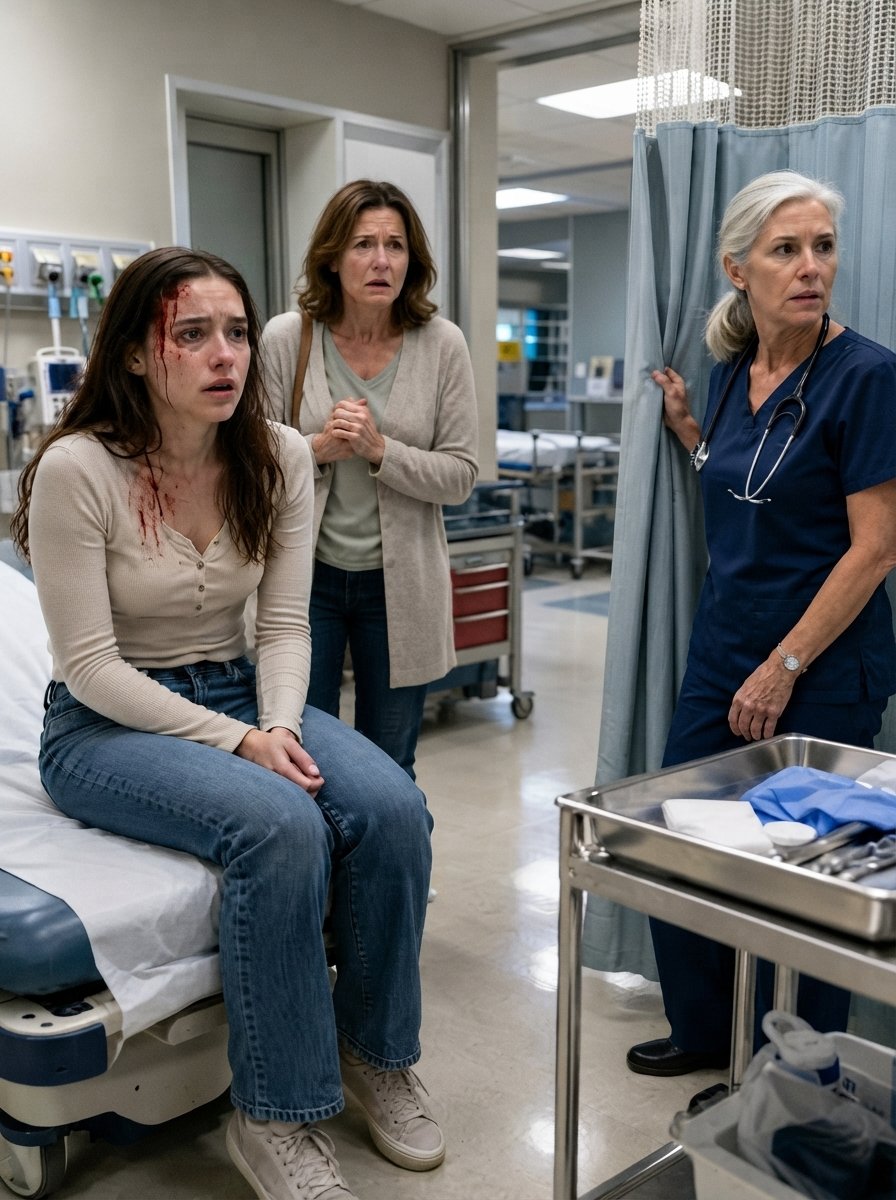
The sound of my skull hitting the hallway wall was louder than my mother’s scream.
One second, my brother Logan was shouting in my face. The next, his fist was twisted into the back of my hoodie and he was driving me sideways into the wall hard enough to make every framed family photograph jump.
There was a crack.
Then warmth.
Blood slid through my hair, crawled behind my ear, and soaked into the collar of my shirt.
I dropped to my knees.
And the first thing my mother said wasn’t, Emily, are you okay?
It was:
“Logan didn’t mean to.”
That sentence had protected my brother for most of his life.
That night, it almost protected him again.
By the time the triage nurse called my name at the emergency room in Dayton, Ohio, the blood on my shirt had dried stiff and brown.
“Emily Carter?”
I stood too quickly.
The waiting room tilted.
Mom reached for my elbow, suddenly playing the concerned parent after spending the entire drive gripping the steering wheel and repeating:
“Logan didn’t mean to.”
“He loses his temper.”
“You know how he is.”
And finally:
“We are not reporting this.”
Inside the exam room, a physician’s assistant carefully pulled apart my blood-matted hair.
She stopped.
“That’s deep.”
Mom jumped in instantly.
“She tripped.”
The PA looked at her.
“They were arguing,” Mom continued. “Emily fell into the wall.”
I stared at my trembling hands.
I remembered exactly how I had “fallen.”
Logan’s face had been bright red.
A framed picture of the four of us—Mom, Dad, Logan, and me—had already been smashed on the floor.
I had done something dangerous that night.
I had said no.
No, I wouldn’t lend Logan money again.
No, I wouldn’t tell Mom he had paid back the cash he’d taken from her purse.
No, I wouldn’t call his boss and lie about why he hadn’t shown up.
For once, I refused to clean up after him.
He grabbed me.
Then came the wall.
The physician’s assistant left to get the doctor.
Mom leaned close.
“Emily.”
I kept my eyes down.
“You understand what could happen if you tell this the wrong way.”
The wrong way.
As if there were multiple versions of blood.
The doctor arrived a minute later.
Silver hair. Navy scrubs. Calm eyes.
Her badge read DR. HANNAH REEVES.
She cleaned my wound and examined it carefully.
“You’re going to need staples.”
Mom began again.
“Doctor, this was an accident. My son would never intentionally—”
Dr. Reeves stopped.
She looked directly at me.
Not at Mom.
At me.
There was something steady in her expression.
Something that made my throat tighten.
Mom leaned forward.
“He didn’t mean to. Please don’t make this bigger than it is.”
Dr. Reeves wiped blood from my temple.
Then she said quietly:
“We’re not covering for him this time.”
My breath caught.
This time?
Before I could ask what she meant, Dr. Reeves pulled the privacy curtain partly closed and spoke toward the nurses’ station.
“Call hospital security and notify the police. Possible domestic assault.”
Mom went white.
The room fell into a silence so complete I could hear the fluorescent lights buzzing overhead.
Then Mom looked at me.
For the first time that evening, she wasn’t worried about Logan.
She was afraid.
Two hospital security officers arrived first.
Then a police officer stepped into the room.
“Emily Carter?”
“Yes.”
“I’m Officer Daniel Price. I need to ask you some questions.”
Mom stood immediately.
“She has a head injury. She’s confused.”
Dr. Reeves moved between us.
“I want to speak with Emily privately.”
Mom’s face hardened.
“That’s my daughter.”
“And she’s twenty-six,” Dr. Reeves replied.
Officer Price asked Mom to wait outside.
As security guided her toward the hall, she turned back.
“Emily.”
Her voice was low now.
Dangerously calm.
“Whatever you tell them can destroy your brother’s life.”
The door shut.
Officer Price opened a notebook.
“Has Logan ever hurt you before?”
I froze.
Because there was no simple answer.
He had shoved me.
Cornered me.
Punched holes in doors.
Thrown a coffee mug close enough to my face that a piece of ceramic cut my cheek.
Once, when I was nineteen, he had wrapped both hands around my neck during an argument.
Mom had pulled him away.
The next morning she told me:
“He was drunk. Don’t ruin his future over one bad night.”
So I said nothing.
I kept saying nothing.
Officer Price waited.
Finally, I whispered:
“Yes.”
His expression changed.
“How many times?”
“I don’t know.”
The words came faster after that.
I told him about the holes in the walls.
The broken phone.
The bruised wrist.
The mug.
The choking.
Mom’s excuses.
Every secret I had swallowed for years.
When I finished, my entire body was shaking.
Officer Price closed the notebook for a moment.
Then he asked:
“Emily… where is your brother right now?”
My stomach dropped.
“At home, I think.”
“Was anyone else there?”
“No.”
He nodded toward his radio.
“I’m going to have officers check the residence.”
That was when Dr. Reeves suddenly spoke.
“You should send them quickly.”
Officer Price looked at her.
Something passed between them.
A look.
Too fast for me to understand.
And that strange sentence came back into my mind.
We’re not covering for him this time.
I turned toward her.
“What did you mean earlier?”
Dr. Reeves became still.
“When you said this time.”
Mom’s voice suddenly erupted from outside the room.
“Emily!”
Security stopped her from entering.
Dr. Reeves looked toward the door.
Then back at me.
“I think you should hear this from your mother.”
“Hear what?”
No one answered.
Twenty minutes later, Officer Price returned.
His face was different.
Serious.
Controlled.
“Logan wasn’t at the house.”
Mom, now allowed back inside, pressed both hands together.
“See? He probably went to cool off.”
Officer Price ignored her.
“There was blood in the hallway.”
Mom swallowed.
“Emily’s.”
“Some of it.”
The room went silent.
I stared at him.
“What does that mean?”
“We found blood near the back door too.”
Mom’s face drained.
Officer Price continued.
“And a phone.”
He looked directly at her.
“A second phone.”
Mom whispered, “I don’t know anything about that.”
The lie sounded terrible.
Even to me.
Officer Price placed a clear evidence bag on the counter.
Inside was an old black smartphone.
I recognized it immediately.
It had belonged to my father.
My father, Robert Carter, had died seven years earlier.
Car accident.
Rainy highway.
He had supposedly lost control and hit a concrete barrier.
I stared at the phone.
“That was Dad’s.”
Mom grabbed the armrest of her chair.
“No.”
Officer Price watched her.
“It was hidden beneath a loose floorboard in Logan’s room.”
My pulse began hammering.
“Why would Logan have Dad’s phone?”
Mom stood.
“I want a lawyer.”
I turned toward her.
“What?”
“Mom?”
“I said I want a lawyer.”
Officer Price’s eyes narrowed.
Dr. Reeves closed the door.
And suddenly I understood something terrifying.
This wasn’t only about what Logan had done to me.
Police found Logan two hours later at a gas station outside Dayton.
He didn’t resist.
He didn’t run.
According to Officer Price, the first thing he asked was:
“Is Emily alive?”
The second was:
“Did she find the phone?”
That question changed everything.
I was kept overnight for observation.
Four staples.
Mild concussion.
No skull fracture.
Mom left with an attorney before midnight.
She never came back to my room.
Dr. Reeves stayed long after her shift should have ended.
Around 1:30 a.m., I finally asked her:
“You knew my family before tonight, didn’t you?”
She sat beside the bed.
“Yes.”
The answer hit harder than I expected.
“How?”
She hesitated.
Then said:
“I treated your father.”
My mouth went dry.
“After the accident?”
“No.”
She looked down at her hands.
“Three days before he died.”
I stopped breathing.
Dad had never mentioned being in a hospital.
“He came to the emergency department with bruising around his ribs and a cut over his eyebrow.”
“From what?”
“He said he fell.”
I almost laughed.
Of course he did.
In my family, apparently everyone fell.
Dr. Reeves continued.
“Your father waited until your mother left the room. Then he told me the truth.”
“What truth?”
She met my eyes.
“He said Logan attacked him.”
I felt something inside me collapse.
“No.”
“Emily—”
“Logan was seventeen.”
“I know.”
“Dad would’ve told me.”
“Maybe he was trying to protect you.”
I stared at the ceiling.
Suddenly, memories changed shape.
Dad and Logan fighting behind closed doors.
Mom turning the television louder.
Dad sleeping in the guest room.
Logan disappearing for days.
Three days later, Dad died.
I whispered:
“Did you report it?”
Dr. Reeves looked ashamed.
“Your father begged me not to.”
And there it was.
The disease our family had carried for years.
Silence disguised as love.
The next morning, detectives arrived.
They had unlocked Dad’s phone.
There were deleted messages.
Voice recordings.
Photographs.
And one video.
Detective Morales sat beside my hospital bed.
“Before I show you anything, you should know that what we found may change your understanding of your father’s death.”
I nodded.
My hands had gone numb.
He played the first recording.
Dad’s voice filled the room.
Tired.
Angry.
Scared.
“If anything happens to me, it wasn’t an accident.”
My heart stopped.
Then came another voice.
Mom’s.
“You’re being dramatic.”
Dad answered:
“You keep protecting him.”
Mom said:
“He’s our son.”
“And Emily is our daughter.”
The recording ended.
I covered my mouth.
Detective Morales played another.
This one was only thirty seconds.
Dad again:
End Part Here: The sound of my skull hitting the hallway wall was louder than I expected. One second, I was arguing with my brother