
Part 3: You Don’t Own My Story Anymore
Daniel remained until visiting hours ended.
He sat in the hard plastic chair beside my bed, holding the custody folder on his knees and the battered envelope in his hands.
For a while, neither of us spoke.
Then he opened the envelope.
Inside were birthday cards.
Not copies.
The originals.
There was one for my eighth birthday.
One for my ninth.
One for my tenth.
Every envelope had been stamped, returned, or marked undeliverable.
Daniel placed them carefully on my blanket, making sure not to disturb the IV line.
“I didn’t know whether you wanted to see these yet,” he said. “But I didn’t want your mother to be the only person keeping things from you.”
The card for my twelfth birthday still contained a twenty-dollar bill taped inside.
The tape had turned yellow with age.
I stared until the writing blurred.
Daniel looked away, giving me the dignity of crying without being watched.
Later that evening, Ms. Reed returned with a temporary safety plan.
When the surgeon approved my discharge, I could leave the hospital with Daniel.
The hospital would document the delay in medical care.
A formal report would be filed.
Because I was eighteen, I had the legal right to choose my emergency contact.
I changed it before dinner.
My mother called eleven times.
Greg called twice.
Samantha sent one message.
Are you seriously making Mom cry over this?
I looked at the message for a long time.
Then I turned my phone facedown.
At 7:38 that evening, Daniel helped me drink water through a straw.
His hand trembled so badly that several drops fell onto the blanket.
“Sorry,” he said.
I shook my head.
Rain began tapping against the hospital window.
On the rolling table were two stacks of evidence.
The custody papers that exposed an eighteen-year lie.
And the Best Buy receipt that documented the twenty-eight minutes that finally ended it.
The following morning, my mother returned alone.
Hospital security stopped her at the intensive care doors.
Through the glass, I could see her carrying a tote bag filled with my clothing.
She had dressed carefully.
Cream sweater.
Pearl earrings.
Soft makeup.
She looked like the perfect worried mother from a hospital advertisement.
Tyler and Ms. Reed met her at the doors.
My mother raised the bag slightly, displaying it as though it were proof of love.
Daniel stood beside my bed with one hand resting on the rail.
My phone buzzed.
A message from my mother appeared.
You’re making a mistake.
Before I could respond, another message arrived.
He will leave again.
I looked through the glass at her carefully arranged face.
Then I looked at the old birthday cards lined across the table.
For eighteen years, she had taught me that silence kept me safe.
That morning, with fresh stitches under my hospital gown and my father standing beside me, I finally understood that my silence had protected only her.
My thumb hovered above the screen.
Then I typed six words:
You don’t get my story anymore.
I pressed send.
Beyond the ICU doors, my mother read the message.
The tote bag slipped from her hand and landed on the polished floor.
Inside my hospital room, the monitor continued beeping.
Steady.
Strong.
Alive.
For eighteen years, my mother had decided who loved me, who abandoned me, and which version of my life I was allowed to believe.
But the folder beside my bed had exposed the truth.
My father had not disappeared.
His letters had been hidden.
His visits had been blocked.
His payments had been accepted while his name was used as a warning.
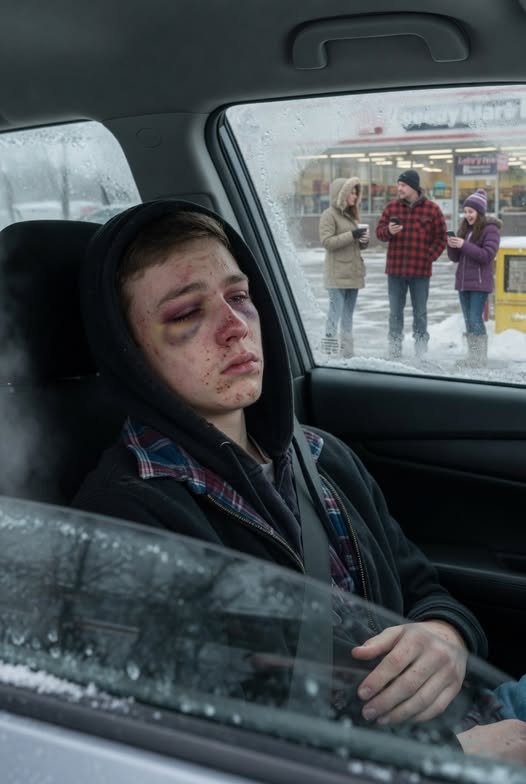
And when I became dangerously ill, the same woman who claimed she had always protected me locked me inside a vehicle because buying a phone charger mattered more than my pain.
Nothing could restore the childhood I had lost.
No document could return the missed birthdays, the unanswered questions, or the years I spent believing I had been unwanted.
But the truth gave me something else.
A choice.
For the first time in my life, I could decide where I went.
I could choose who stood beside my hospital bed.
I could decide who was allowed to speak for me.
My father did not arrive like a hero from a perfect story.
He arrived wearing a mechanic’s jacket, carrying a damaged envelope and eighteen years of evidence.
He could not save the childhood that had already passed.
But he gave me the truth.
And sometimes, the truth is where saving yourself begins.
THE END