Part 5: The Truth Behind Their Decision
December brought heavy snow to Vermont.
The orchard turned white, and my farmhouse looked like the winter home I had always imagined.
Communication with my parents nearly disappeared.
After years of daily calls, the silence felt unnatural. Whenever my phone lit up, part of me hoped to see my mother’s name.
The old guilt remained.
Maybe I should call.
Maybe I should apologize.
Maybe I should be the bigger person.
Then I remembered their message.
Skip Thanksgiving. We need space.
I also remembered that their concern had appeared only after their friends began asking uncomfortable questions.
By the middle of December, I began seeing a therapist named Dr. Janine Moore.
I told her about my childhood, my role as the dependable daughter, the constant comparisons with David, and the way affection disappeared whenever I failed to meet expectations.
“You were given a specific role in your family,” she explained. “You were expected to be reliable, pleasant, and easy to control. Moving away disrupted that system.”
“So Thanksgiving wasn’t really about having fewer guests?”
“It sounds more like punishment,” she said gently. “They hoped exclusion would push you back into your old role.”
Her words clarified everything.
I loved my parents, but I no longer wanted to pay for their love with my peace.
Two weeks before Christmas, a handwritten letter arrived from my father.
He admitted that he and my mother might have hurt me, although he stopped short of offering a complete apology. He said he missed our conversations and asked whether we could meet for coffee.
For my father, it was a meaningful first step.
We met at a café halfway between Connecticut and Vermont.
At first, we discussed safe subjects—the weather, his business, and my work.
Then he turned his coffee cup slowly in his hands.
“You were always dependable,” he said. “I suppose your mother and I came to expect that you would accommodate whatever we wanted.”
He looked down.
“That doesn’t make it right.”
“No,” I said. “It doesn’t.”
Progress with my mother was more difficult.
When she finally called, she attempted to behave as though nothing had happened. She discussed neighborhood gossip and David’s children until I brought up Thanksgiving.
“I don’t understand why we are still discussing one holiday,” she said defensively.
“It isn’t only about the holiday. It is about whether I feel valued and whether I belong.”
For a long moment, she said nothing.
“I’m not good at conversations like this,” she finally admitted. “Your father says I need to listen.”
“That would be a beginning.”
During the following weeks, pieces of the truth slowly emerged.
“You built an entire life without us,” my mother said one evening. “Your career, your farmhouse, your friends—sometimes I compare it with the life your father and I have, and ours seems small.”
I finally understood.
She was jealous.
More than that, she was afraid.
My independence made her feel unnecessary.
“I suppose I was jealous,” she whispered.
“Mom, I have always admired you,” I said. “You gave me the foundation that helped me build this life.”
“Even your cooking?” she asked cautiously.
I laughed.
“Especially my cooking.”
That small moment did not repair everything, but it opened a door.
We eventually agreed on a Christmas plan.
I would attend Christmas Eve at my parents’ home with David’s family. On Christmas Day, my parents would visit my farmhouse for the first time.
It was not perfect.
But it was the first holiday arrangement we negotiated as adults with equal voices.
Part 6: New Traditions
Christmas Eve at my parents’ home felt like entering a carefully preserved museum of my childhood.
The same wreath hung on the door. The furniture remained perfectly arranged, and every family photograph faced the correct direction.
David and Pamela were already there with Thomas. My mother hovered near Pamela’s pregnant belly as though protecting something precious.
When I entered, my mother’s smile appeared automatically.
Then it softened.
“Abby,” she said.
“Hi, Mom.”
Her hug was stiff at first, but after a moment, her arms tightened.
My father greeted me with a hand on my shoulder.
“It’s good to see you.”
Old habits still appeared.
My mother praised David’s stable working hours in a way that made my career sound like an irresponsible hobby. David remained silent, as usual.
But the comments did not hurt as much as they once had.
I was no longer there to earn approval.
I was there because I had chosen to attend, and I knew I could leave at any time.
Christmas Day changed everything.
My parents drove to Vermont through the snow. When they stepped from their car, they stared at the farmhouse, the orchard, and the open land around it.
My mother stopped on the porch.
“This is beautiful,” she said quietly.
Inside, she walked slowly through the kitchen, touching the edge of the counter as though she needed proof that it was real.
“You created all of this.”
“I did.”
My father stood near the window and asked questions about the apple trees. It was his way of trying to understand something important to me.
During dinner, my mother raised her glass.
“To new traditions,” she said. “And to a daughter who had the courage to create her own path.”
My throat tightened.
My father cleared his throat.
“And to not taking one another for granted.”
After dinner, we sat near the fireplace.
For the first time, the silence between us did not feel like punishment. It felt peaceful.
The conflict had not destroyed our family.
It had exposed the truth.
For years, I had carried the relationship on my back. When I stopped, the imbalance became impossible to ignore.
During the following months, I continued setting boundaries.
When my mother used guilt, I calmly told her that the comment was unacceptable.
When conversations became disrespectful, I ended them.
There were setbacks, but my parents slowly began showing up differently.
My father called to ask about the orchard and my garden plans. My mother requested recipes and complained about the amount of butter in them, but now her complaints sounded almost affectionate.
We were not completely healed.
However, a healthier relationship was beginning to form—one in which I was not responsible for holding everyone together at the cost of my own happiness.
As another November approached, I realized that Thanksgiving had become a turning point rather than a tragedy.
The holiday my parents tried to take away had taught me that I could create joy without their permission.
Part 7: My Permanent Seat at the Table
The following November, I refused to wait for my parents to decide whether I would be included.
I called my mother early.
“I want to discuss Thanksgiving before anyone becomes uncomfortable,” I said.
She laughed softly.
“That would probably be wise.”
I proposed that we alternate hosting. One year would be at their home, and the next would be at mine. Everyone would always be invited.
“I think that sounds lovely,” she replied. “And I promise not to criticize your garlic.”
I laughed.
“And I promise not to accidentally embarrass you online.”
That year, Thanksgiving was held at my parents’ home.
I brought Sarah and Aunt Catherine.
My mother hesitated briefly when I mentioned the guests, but then she caught herself.
“Of course they should come.”
David seemed uncomfortable with the new arrangement. He preferred the old family system, where he remained close to our parents and benefited from their approval.
But this time, he did not control the decision.
The meal was not perfect.
My father still defended oyster stuffing as though it were sacred. Pamela made a comment about how she could never live as far away from family as I did.
Old patterns appeared like weeds.
But something new happened too.
When my mother began making a critical comment about me, my father interrupted.
“Abby’s turkey is excellent,” he said. “Let’s enjoy the meal.”
It was a small moment, but it meant everything.
After dinner, Thomas asked whether he could visit my farmhouse and climb the apple trees.
“Only if you promise not to climb them like a raccoon,” I told him.
He laughed and ran away.
Later, I watched Aunt Catherine talking with my mother while Sarah somehow convinced my father to admit that he preferred my cranberry tart to my mother’s pumpkin pie.
My two worlds were finally meeting.
My chosen family and my biological family were no longer competing.
When I left, my mother hugged me near the door.
“I’m glad you came.”
“I’m glad too.”
The following year, Thanksgiving was held at my farmhouse.
My parents arrived as participants rather than visitors. David and Pamela brought the children. Sarah, Aunt Catherine, Miguel, and Luis also joined us.
My mother entered the kitchen, looked around, and asked a question I never expected to hear.
“What can I do?”
It was not a performance.
It was an offering.
I handed her a bowl of potatoes.
“Start peeling.”
She laughed, rolled up her sleeves, and began working beside me.
We had not entered perfection.
We had entered possibility.
Part 8: Learning to Love Without Control
My life continued expanding.
My cooking channel reached a major milestone, and I was offered a small streaming series filmed inside my Vermont kitchen.
The farmhouse my parents once considered too isolated became something they proudly discussed with their friends.
In the past, that would have irritated me.
Now I understood that my parents loved feeling proud. Their mistake was believing that pride gave them the right to control me.
The difference was that I no longer paid for their approval with my self-respect.
One afternoon, my father called.
He and my mother were considering retirement and planning to sell the insurance agency.
For the first time, I saw them not only as my parents but as aging people whose identities had been built around being admired and needed.
My independence had frightened them.
“We were wrong,” my father finally admitted. “We thought withholding affection might push you back toward us. That isn’t love.”
“No,” I said quietly. “It isn’t.”
“We’re learning,” he replied.
My parents eventually sold their large home and moved into a smaller one closer to David. It made sense for their daily lives, but they also began visiting Vermont more often.
My mother learned to enter my home without rearranging anything.
She still made mistakes.
I corrected her.
She adjusted.
The greatest change occurred during a disagreement in October.
“You always choose work over family,” she said.
The old anger rose inside me. I wanted to list every sacrifice I had ever made.
Instead, I took a breath.
“When you say that, it makes me feel as though nothing I do will ever be enough.”
My mother opened her mouth to argue.
Then she stopped.
“I don’t want you to feel that way,” she said quietly. “I think I’m afraid you won’t need us anymore.”
It was the first time she admitted fear instead of using guilt.
“I will always want a relationship with you,” I said. “But I will not shrink my life to maintain it.”
She nodded.
“Okay.”
That Thanksgiving, my parents hosted again.
They invited Aunt Catherine and Sarah without argument. My mother even told Pamela that there would be no comparisons between family members.
During dinner, my father raised his glass.
“To family,” he said. “The ones nearby, the ones in Vermont, and the ones who make us drive farther than we would prefer.”
Everyone laughed.
Then his expression became serious.
“And to not taking people for granted.”
My mother reached across the table and squeezed my hand.
Later, while we cleaned the kitchen, she finally said the words I had waited to hear.
“I regret sending that message.”
I remained silent.
“I was angry that you moved,” she continued. “I was jealous that you were happy. I thought excluding you might bring you back.”
“It did the opposite.”
“I know,” she whispered. “It almost cost me my daughter.”
For the first time, I saw my mother not as the gatekeeper of family approval but as a woman learning how to love without control.
Part 9: The Table I Built
Three years after the message that began everything, I hosted Thanksgiving again at my farmhouse.
It was not perfect.
It was honest.
My parents arrived on Wednesday evening carrying groceries. My father brought firewood inside without being asked. My mother walked directly into the kitchen.
“Which station do you want me on, Chef?”
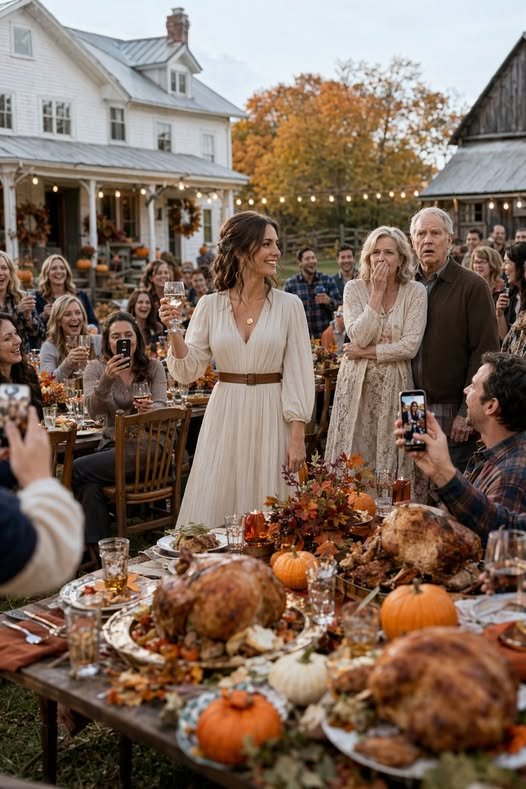
Sarah arrived with pies and her usual dramatic energy. Miguel and Luis brought wine. Aunt Catherine began rearranging flowers, but I allowed it because she did it with affection rather than control.
David and Pamela came with two children now—Thomas and his little sister, who called my orchard “Aunt Abby’s apple jungle.”
Pamela still made small judgmental comments occasionally.
But my mother no longer joined her.
When Pamela remarked that she did not understand how I had time to accomplish so much, my mother replied firmly:
“Because Abigail is capable.”
By noon, the farmhouse smelled of cider, turkey, herbs, and warm bread.
The dining table was crowded with people who were not there because tradition required it.
They were there because they wanted to be.
Before dinner, my father stood and raised his glass.
“Three years ago, your mother and I made a terrible decision,” he began. “We asked Abigail for space without understanding the price.”
The room became quiet.
“Telling someone to stay away doesn’t only create space,” he continued. “It creates distance. And distance can become permanent.”
My mother’s eyes filled with tears.
“Abby created something extraordinary after we rejected her,” my father said. “We regretted our decision quickly, but regret does not erase harm. Only change can do that.”
He looked at me.
“To Abigail—for teaching us something we should have understood long ago. Love is not control. Love is showing up.”
Everyone raised their glasses.
My mother stood beside him.
“To our daughter, to chosen family, and to garlic—which I now admit is not the enemy.”
The room filled with laughter.
Later, I stepped onto the porch alone.
The night air was cold and clear. Through the windows, my farmhouse glowed with warmth, conversation, and life.
I remembered the morning three years earlier when I had sat crying on my kitchen floor because my parents told me I did not belong at Thanksgiving.
Their regret had arrived quickly.
It came when their friends asked why I was absent.
It came when Aunt Catherine chose my table instead of theirs.
It came when they realized that the space they created did not hurt only me.
But the most important lesson was never about their regret.
It was about what I learned.
I did not need to earn my place at the table.
When people truly loved me, I belonged.
And when they refused to make space for me, I was capable of building a table of my own.
Inside, I heard Sarah’s bright laughter, Miguel telling a story, and my father chuckling in response. My mother gently scolded Thomas for trying to steal another roll.
They were ordinary sounds.
Warm sounds.
The sounds of a real family—not perfect or carefully performed, but honest.
When I returned inside, my mother met my eyes from across the room.
She gave me a small look that said she finally saw me.
Not as the obedient daughter.
Not as a role she needed me to play.
As a person.
The next morning, before my parents left, my mother touched my arm.
“I’m glad you didn’t beg us to invite you,” she said.
I stared at her.
“If you had begged, we might never have learned.”
“Neither would I,” I admitted.
She hugged me tightly.
“Thank you for not allowing us to keep you small.”
After their car disappeared down the snowy road, I stood outside with the farmhouse behind me, still smelling of coffee, cinnamon, and turkey stock.
My parents had told me to skip Thanksgiving because they wanted space.
They got it.
And inside that space, I finally found myself.
Everything we rebuilt afterward was a gift.
THE END