
Chapter 5: Hazel Tells the Truth
A week after I moved into the retirement community, Hazel came to visit.
She carried an expensive basket of fruit and wore the same gentle, strained smile.
“I’m sorry I did not come sooner,” she said. “Things have been busy at home.”
Makeup covered most of her exhaustion.
But in the daylight, I noticed a fading blue-yellow bruise near her hairline.
Nicholas had hurt her again.
I led her to the garden bench where Sigrid had spoken to me.
For several minutes, Hazel talked about ordinary things.
When she finally became quiet, I looked into her eyes.
“The bruise on your forehead—did you bump into something again?”
Hazel flinched and touched the mark.
“No, I—”
“Please do not lie to me anymore. I know everything.”
Her face went white.
“What do you mean?”
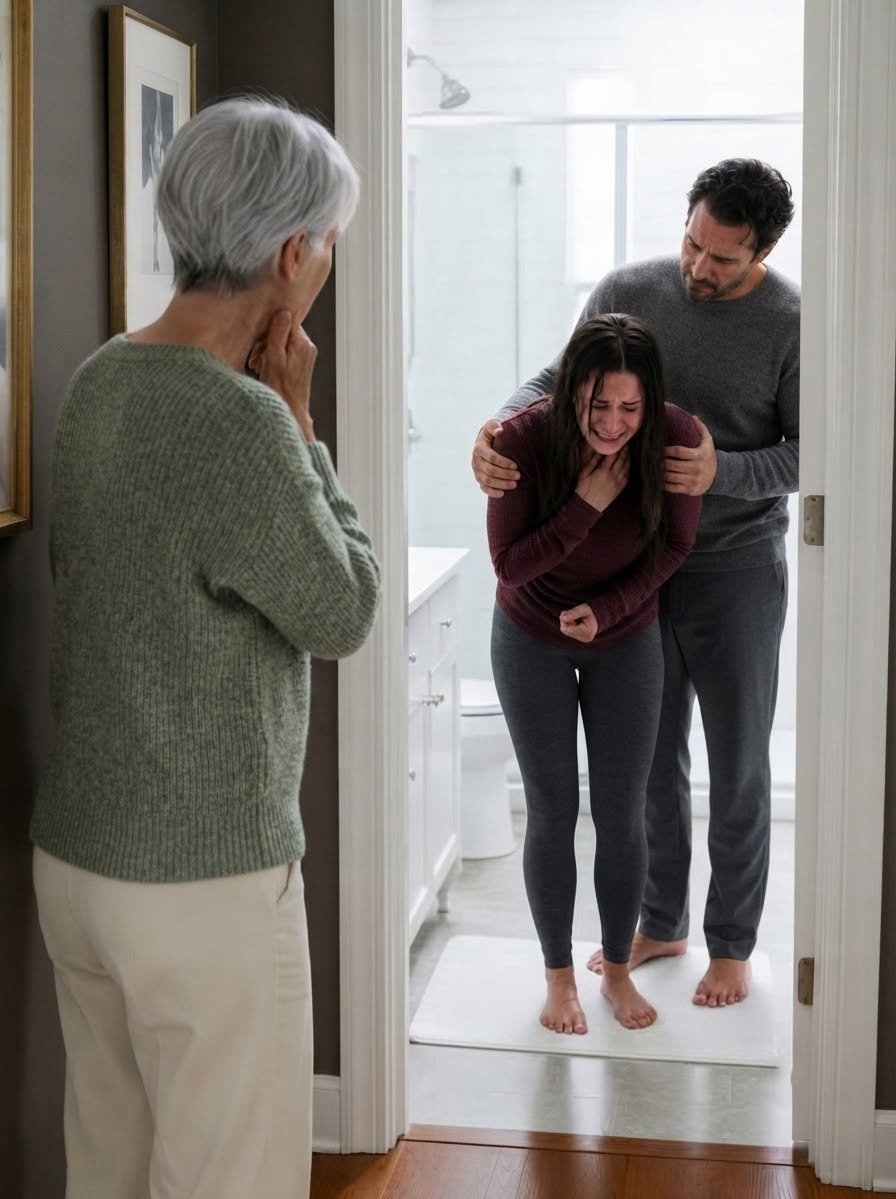
“The night before I left, I saw what happened in the bathroom.”
Hazel began shaking.
Then she did what frightened victims often do.
She defended the person hurting her.
“You misunderstood. Nicholas has a short temper because of work. He loves me. He is under pressure. He is suffering too.”
I listened until her excuses faded.
Then I pulled her into my arms.
“The same words you just used—I said them for nearly twenty years.”
Her body became still.
“I told people Samuel was tired. I said he loved me. I said I caused his anger. I lied about every bruise.”
My voice broke.
“You and I both know the truth.”
Hazel’s final defense collapsed.
She buried her face against my shoulder and sobbed.
It was not the quiet crying I had heard in the bathroom. It was raw and uncontrollable, releasing years of fear, humiliation, and pain.
I held her until she was ready to speak.
“He hits me often,” she whispered. “Sometimes because the soup is too salty. Sometimes because he loses a contract. Sometimes for no reason at all.”
She wiped her eyes.
“He calls me useless. He says I am a burden and a waste of space.”
Before marrying Nicholas, Hazel had been a respected teacher at a private school.
She had loved her work.
But Nicholas convinced her to resign.
“He told me I would never have to work again,” she explained. “He said he would take care of me.”
She gave a broken laugh.
“I believed him. I gave up my career and became completely dependent on him.”
Whenever Hazel tried to return to work, Nicholas became violent.
He destroyed her phone, locked her inside the condo, and threatened her family.
“Why did you not ask for a divorce?” I asked gently.
“I thought about it many times. But he said I would leave with nothing. I have no job, no income, and no savings. He said he would prove I was mentally unstable and destroy me in court.”
Nicholas had not only used physical violence.
He had taken away her independence and made her believe survival without him was impossible.
I held both her hands.
“You are not alone anymore. I will not leave you inside that house.”
Hazel looked at me uncertainly.
“You will not leave with nothing,” I continued. “I have already spoken to a lawyer.”
For the first time, a small light appeared in her eyes.
His name was Mr. Rodriguez, an old classmate of mine and a highly respected divorce attorney.
He had explained how we could build a case.
“We need evidence,” I told Hazel. “Without it, Nicholas will deny everything.”
I explained the plan carefully.
Whenever Nicholas threatened or insulted her, Hazel would secretly record him.
After every physical attack, she would photograph her injuries and send the images to a private email account.
She would keep a detailed diary of dates, words, threats, and violence.
She would also photograph financial documents, bank statements, property records, and employment contracts.
“What if he discovers what I am doing?” Hazel asked.
“I know it is dangerous. But we will be careful. Mr. Rodriguez and I will preserve everything you send.”
The final step frightened her most.
After collecting enough evidence, Hazel would formally ask for a divorce and leave the condo immediately.
“He will become violent,” she whispered.
“That is why you must not remain there after telling him. Leave immediately. Take a taxi, go to a friend, or come directly here.”
When Hazel left that afternoon, she was still afraid.
But she was no longer without hope.
She returned to the condo not as a helpless victim, but as a woman secretly preparing for freedom.
Over the next two weeks, evidence arrived in the private email account.
A photograph of a bruised arm.
An audio recording of Nicholas screaming insults.
A diary entry:
He struck me today because I accidentally broke a bowl.
Each file broke my heart.
But each one also strengthened her case.
Mr. Rodriguez believed we had enough evidence.
Only the final step remained.
One morning, Hazel sent me a message.
Mom, I am telling him tonight.
I spent the day praying.
Around ten that evening, my phone rang.
“Hazel?”
“Mom,” she whispered. “I told him.”
Before she could say more, I heard Nicholas roar in the background.
“Who are you calling? Give me that phone!”
Hazel screamed.
Something shattered.
The call ended.
I dialed repeatedly.
No one answered.
Half an hour later, Nicholas called me.
His voice was cold.
“What have you been telling my wife?”
“What did you do to Hazel?”
“I taught her a lesson she will never forget.”
My blood froze.
“She will never mention divorce again. From now on, she will not leave this condo, and she will never see you.”
He disconnected the call.
Our plan had failed at the most dangerous moment.
Hazel had not escaped.
She had been beaten and locked inside the condo.
This was no longer only a divorce case.
It had become a rescue.
Chapter 6: The Rescue
I immediately called Mr. Rodriguez.
“My son found out,” I said. “He has beaten Hazel and locked her inside the condo.”
Mr. Rodriguez contacted the police.
We reported domestic violence and unlawful imprisonment.
Officers went to the building and forced Nicholas to open the door.
They found Hazel frightened, injured, and covered in fresh bruises.
She was taken to the hospital, where every injury was photographed and documented.
Mr. Rodriguez arranged a secure temporary residence where Nicholas could not find her.
The battle had moved from secrecy into the open.
Two days later, Nicholas came to the retirement community.
He still wore an expensive suit, but his face was haggard and his eyes were bloodshot.
He found me reading in the garden.
“What have you done?” he demanded. “You have destroyed my family.”
I calmly closed my book.
“You call what you created a family?”
“I gave Hazel everything. A luxury home, expensive clothes, and a comfortable life.”
“You also gave her fear, bruises, and imprisonment.”
“That is private business between a husband and wife,” he shouted. “A woman must know her place.”
Several people nearby turned to look at us.
His words confirmed what I had already accepted.
The boy I raised was gone.
His father’s cruelty had taken root inside him.
“Violence is not discipline,” I said. “It is a crime. Controlling someone is not love. It is weakness.”
I gave him one final chance.
“Admit what you did. Ask Hazel for forgiveness. Seek professional help before it is too late.”
Nicholas laughed bitterly.
“What mistake did I make? I work. I earn money. All she had to do was stay home and obey.”
“The only person who destroyed your marriage was you.”
His face twisted with rage.
“If you continue helping her, then you are no longer my mother.”
The words hurt.
But I had already lost my son the night I saw him beneath that bathroom light.
The man standing before me was a stranger.
“If that is what you choose,” I said, “then so be it.”
He pointed at me.
“I will hire the best lawyers. I will prove Hazel is mentally unstable. She will leave with nothing.”
Then he walked away.
The legal battle began exactly as he promised.
Nicholas hired aggressive attorneys who questioned every piece of evidence.
They claimed the audio recordings had been edited.
They said the photographs were staged.
They argued that Hazel’s injuries came from accidents or were self-inflicted.
They even produced a false medical record claiming she suffered from psychological problems and imagined the abuse.
The case began to stall.
Hazel was exhausted and frightened.
She started doubting herself.
“What if he wins?” she asked me. “What if everyone believes him?”
I held her hand.
“You survived him. Now we will survive his lies.”
Still, I was afraid.
Then an unexpected witness appeared.
A resident from the building across the hallway contacted Hazel.
The building had recently installed a high-resolution security system. One camera pointed directly toward the eighteenth-floor corridor outside Nicholas and Hazel’s condo.
The night Nicholas imprisoned her, he had dragged Hazel into the hallway.
The camera recorded everything.
It showed Nicholas pulling her by the hair.
It showed him striking her.
It captured his threats clearly.
Because the attack occurred in a shared corridor, the footage came from an independent source and could not be dismissed as staged.
Mr. Rodriguez immediately submitted it to the court.
The video destroyed Nicholas’s defense.
His attorneys could no longer claim that Hazel invented the abuse.
Nicholas now faced the possibility of criminal charges in addition to the divorce proceedings.
To reduce the legal consequences, his lawyers advised him to accept a settlement.
The marriage was officially dissolved.
Hazel received half of the marital assets and substantial compensation for the physical and psychological harm she suffered.
When the judge issued the final divorce decree, Hazel cried.
But these were not tears of fear.
They were tears of freedom.
Chapter 7: A New Life
With her settlement, Hazel purchased a small, elegant condo in another part of the city.
She decorated it herself.
Sunlight filled the rooms.
There were no locked doors, no hidden fear, and no shower running at three in the morning.
On the day she moved in, the first person she came to collect was me.
When I saw her smile, I knew every sleepless night had been worth it.
“Thank you,” she said, wrapping her arms around me. “Without you, I might never have escaped.”
“You escaped because you found the courage to fight,” I told her. “You saved yourself.”
We sat together drinking tea in her new living room.
After a while, Hazel placed one hand against her stomach.
“There is something else I need to tell you.”
“What is it?”
“I have not been feeling well. I went to the doctor.”
Her cheeks reddened slightly.
“I am more than two months pregnant.”
For several seconds, I could not speak.
Then joy overwhelmed me.
Nicholas had insulted Hazel for years, blaming her because they had no child.
Now, after escaping him, she discovered that a new life had already begun inside her.
News of the pregnancy eventually reached Nicholas.
He began calling.
At first, he contacted Hazel. When she blocked him, he called me.
“Mom, please give me another chance,” he begged. “I know I was wrong. I will change. Talk to Hazel. Let me take care of her and my child.”
Before blocking his number, I answered him once.
“The night you beat and imprisoned a woman who was carrying your child, you lost every chance you had.”
Hazel refused to return to him.
The damage was too deep.
She could not trust promises from a man who had used love as a weapon.
Over the following months, I visited her often.
We cooked together, walked through parks, and shopped for the baby.
One afternoon, Hazel took my hand.
“My mother died years ago,” she said. “You helped give me another life.”
Her eyes filled with tears.
“Would you allow me to call you my mother—not only my mother-in-law?”
I could not stop myself from crying.
I had lost my biological son.
But life had given me a daughter and a grandchild.
“Yes,” I whispered. “I would be honored.”
I did not move out of the retirement community.
I had made friends there, and I enjoyed my independence.
But Hazel’s condo became my second home.
It was not a home created by expensive furniture or social status.
It was created by love, courage, and understanding.
My life had passed through many storms.
For years, I believed peace meant remaining quiet, avoiding anger, and staying safely out of a violent man’s path.
But silence had protected neither me nor Hazel.
True peace required truth.
It required courage.
It required someone willing to stand beside the frightened person and say:
“You are not alone.”
I could not save my son from becoming his father.
But I helped save the woman he tried to destroy.
And in helping Hazel escape, I finally freed the frightened woman who had lived inside me for most of my life.
At sixty-five, I did not find peace by hiding from the past.
I found it by refusing to let the past happen again.
THE END