
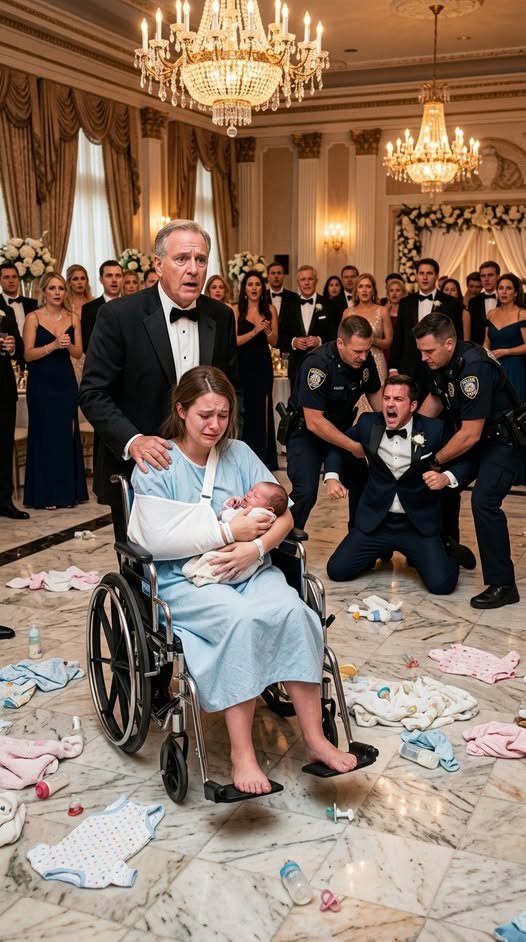
The grand ballroom of the Waldorf Astoria glittered beneath twelve enormous crystal chandeliers.
It was the fiftieth anniversary of Vanguard Holdings, one of the most powerful real-estate and private-equity empires in the country. Hundreds of senators, billionaires, foreign investors, journalists, and old-money families moved across the polished marble floor.
Champagne flowed freely. White truffles covered silver platters. Quiet deals worth millions were being made in every corner.
At the center of it all stood my husband, Preston Vanguard.
He wore a midnight-blue designer tuxedo and the confident smile of a man who had never been told no. Beside him stood his mother, Beatrice, wrapped in diamonds and dressed like royalty.
Her sister, Eleanor, and her niece, Chloe, remained close to her, drinking expensive champagne and laughing as photographers surrounded them.
And then there was me.
I stood ten feet away, hidden in the shadow of a massive swan-shaped ice sculpture.
I was twenty-eight years old, but the woman reflected in the mirrored pillars looked much older.
My cheekbones had become painfully sharp. My skin was pale from exhaustion and hunger. The plain black dress I wore had cost fifteen dollars from a clearance rack three years earlier.
Under a thin shawl, I held my six-week-old son, Leo, against my chest.
He whimpered softly.
I rocked him gently, shifting my weight from one aching foot to the other. My stomach twisted with hunger. I had not eaten a proper meal in two days.
Inside my faded canvas bag was the only bottle I owned.
It was made of cloudy, scratched plastic and had warped slightly after being washed in hot water. The formula inside was thin because I had been forced to dilute it so the small container would last until the end of the week.
I lifted the bottle toward Leo’s mouth.
From the raised platform at the front of the ballroom, Harrison Vanguard was watching.
At seventy-eight, Preston’s grandfather remained the unquestioned ruler of the Vanguard empire. His signature could move markets, close companies, or destroy careers.
He sat in a high-backed chair, observing the room with cold, sharp eyes.
His gaze passed over the politicians, executives, and members of his family.
Then it stopped on me.
More precisely, it stopped on the cloudy plastic bottle in my hand.
Harrison looked from the bottle to the crystal champagne glasses held by his daughters.
His jaw tightened.
He leaned toward the event director and whispered something.
A moment later, the string quartet stopped playing.
A painful burst of microphone feedback echoed through the ballroom. Conversations died instantly. Every face turned toward the stage.
Harrison rose slowly and approached the podium.
“Preston,” he said into the microphone.
His deep voice filled the enormous room.
“Why is my great-grandson being fed from a scratched, dollar-store bottle at the Vanguard anniversary celebration?”
The silence that followed felt like the world had stopped.
Champagne glasses froze halfway to people’s mouths.
Photographers lowered their cameras for only a second before raising them again.
Every person in the ballroom turned toward us.
Preston’s polished smile disappeared.
He crossed the distance between us in two quick steps and moved in front of me, trying to block the cameras.
Then he grabbed my upper arm.
His fingers dug painfully into my skin.
He took a wireless microphone from a nearby waiter and immediately replaced his panic with an expression of deep concern.
“Grandfather, please excuse us,” Preston said. “Harper has been struggling since the baby was born.”
His voice shook at exactly the right moments.
“The postpartum psychosis has become frightening. She is confused and refuses to accept help. She rejected the nannies, the doctors, and the money we arranged for her. She even insisted on bringing that bottle after finding it in the trash.”
He looked toward the crowd as if he were a loving husband carrying an unbearable burden.
“We are trying to find an appropriate treatment facility for her tonight. Please give my wife some privacy.”
Beatrice immediately joined him.
She touched a silk handkerchief to her perfectly dry eyes.
“It’s tragically true,” she announced. “Poor Harper has become paranoid and delusional. We have tried everything to help her, but she simply isn’t in her right mind.”
Sympathetic whispers spread through the ballroom.
Reporters began typing quickly on their phones.
Within minutes, they would publish stories describing me as the unstable wife of a billionaire heir.
That was exactly what Preston and Beatrice wanted.
They planned to remove me through the back entrance, put me inside a black SUV, and send me to a private psychiatric facility.
Once I was medicated and locked away, they would call me unfit and take Leo.
They would erase everything they had done.
I did not pull away from Preston’s grip.
I did not scream.
I did not cry.
Instead, I took a slow breath and looked directly at Harrison.
“Six weeks ago,” I said calmly, “I gave birth to your great-grandson in an underfunded public clinic because the payment for the private hospital was rejected for insufficient funds.”
A nearby audio technician heard me and pushed my voice through the ballroom speakers.
Every word became clear and impossible to ignore.
“Last week, I received a forty-eight-hour eviction notice for the freezing studio apartment Preston placed us in,” I continued.
“And tonight, I am feeding Leo diluted formula because I have not eaten a solid meal in two days. My body has become so malnourished that I can no longer produce enough milk for him.”
The ballroom erupted.
Guests gasped. Journalists rushed closer. Camera shutters began clicking without pause.
Preston’s fingers tightened around my arm.
“Shut your mouth,” he hissed into my ear.
His handsome mask was gone.
“I will take that baby from you. I’ll have you declared psychotic and locked away before midnight. You will never see him again.”
I adjusted Leo carefully against my shoulder.
Then I reached into my canvas bag.
I did not pull out a pacifier or a tissue.
I pulled out a black encrypted external hard drive.
“You called me a charity case, Preston,” I said, tearing my arm free from his grip.
“You and your mother believed that because I wore cheap clothes and came from a poor neighborhood, I was uneducated and powerless.”
I raised the drive so the cameras could see it.
“You forgot one important detail about my life before this marriage.”
Preston stared at the drive.
His face slowly lost all color.
“Before I became your wife, I spent five years working as a senior financial-crimes auditor for the Securities and Exchange Commission.”
The room went silent again.
“I specialized in offshore embezzlement, shell companies, forged authorizations, and complex wire fraud.”
Beatrice released a small scream.
Eleanor’s champagne glass slipped from her hand and shattered against the marble floor.
“I didn’t merely survive what you did to me,” I said.
“I audited it.”
Before Preston could move, I walked toward the audio-visual control station.
The technicians stepped aside.
I connected the hard drive to the main presentation computer and entered the encryption code.
The Vanguard anniversary logo disappeared from the sixty-foot screens behind the stage.
In its place appeared bank records, routing ledgers, wire-transfer receipts, digital signatures, and internet protocol logs.
The elegant anniversary celebration had just become a public financial investigation.
“When I became pregnant,” I explained, “Harrison Vanguard authorized the creation of a dedicated care trust for Leo and me.”
I pointed toward a highlighted line on the screen.
“The trust provided five hundred and eighty-two thousand dollars every month. But the money never reached my account.”
Murmurs spread through the crowd.
“The payments were intercepted through an offshore routing system before they entered the United States.”
I changed the image.
Two digital signatures appeared side by side.
One was mine.
The other was a forgery.
“Beatrice Vanguard forged my written signature and copied my biometric authorization forty-eight hours after the trust was created.”
Beatrice shook her head violently.
“No,” she whispered. “That isn’t true.”
“The authorization was sent through a proxy connection,” I continued. “But the person responsible failed to use a secure virtual network. The internet address leads directly to the private router inside Beatrice’s penthouse.”
The cameras turned toward her.
“That constitutes identity theft and wire fraud.”
Beatrice covered her face as photographers captured every second of her collapse.
I displayed another series of transactions.
“Three hundred thousand dollars per month was transferred into a hidden company registered in Delaware. From there, the money was sent to private casinos in Macau.”
Eleanor dropped into a chair.
“The transfers were used to pay Eleanor Vanguard’s unpaid gambling debts.”
Eleanor buried her face against Chloe’s shoulder.
“The remaining funds paid for Preston’s yacht rentals, secret accounts, and settlement agreements with three long-term mistresses.”
Preston began shaking his head.
“No. She altered those records.”
I brought up the final account.
“Some of the stolen money also funded Chloe’s failing fashion boutique.”
Chloe’s mouth fell open.
“They spent money intended to feed and protect a newborn child on gambling, luxury holidays, secret relationships, and personal businesses,” I said.
“While they lived like royalty, they left Leo and me in an apartment without reliable heat. They gave me a dirty plastic bottle and expected my child to survive on diluted formula.”
Preston finally exploded.
“She’s lying!” he screamed.
He rushed toward the control station.
“Turn it off! She manipulated everything!”
Four security guards stepped between us before he could reach the computer.
Their hands moved toward their holsters.
Preston stopped.
The guards were not looking at him for instructions.
They were looking at Harrison.
Harrison lifted the microphone.
“Let her finish.”
His voice froze the entire room.
He walked slowly down from the platform, using his silver-handled cane.
The crowd parted before him.
He stopped between me and his family, looking up at the evidence covering the screens.
Then he turned toward Preston.
“I knew there was a leak,” Harrison said calmly. “I knew money was disappearing from the lower-level family trusts.”
Preston’s face became pale.
“You knew?” he asked. “Why didn’t you stop it?”
“I built this company from nothing,” Harrison replied. “Did you truly believe millions could disappear from my financial system without triggering an alert?”
He glanced toward Beatrice and Eleanor with open disgust.
“I knew for six months.”
Beatrice stared at him.
“Then why did you allow it?”
“Because I needed to learn something more important than where the money was going.”
Harrison turned toward me.
“My late wife came from poverty, Harper. She had courage and discipline. She refused to be broken.”
His eyes moved toward the enormous screens.
“When you married Preston, you were quiet. You tolerated insults. You never asked me for anything. I thought my grandson had chosen someone weak.”
My arms tightened protectively around Leo.
“When the theft began,” Harrison continued, “I watched. I wanted to know whether you would surrender, run to me for help, or find a way to fight.”
A faint smile touched his face.
“You did not simply fight back.”
He looked around the ballroom filled with politicians, billionaires, journalists, and television cameras.
End Part Here: The Thirty-Two-Dollar Heir