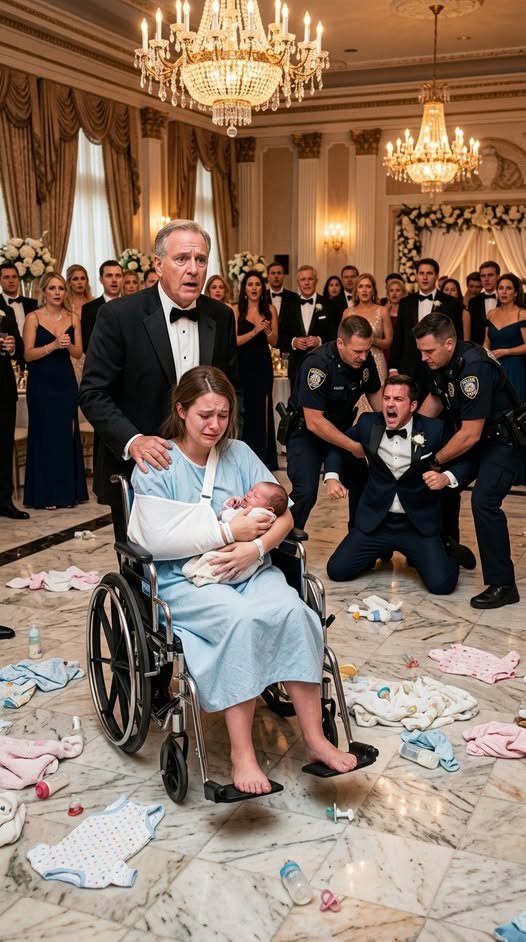
“You exposed every one of them live before the world.”
Then Harrison faced his family.
“Beatrice.”
His daughter looked up at him, trembling.
“You are finished.”
She stared at him in disbelief.
“Every corporate credit card, property, allowance, and trust payment connected to your name is revoked immediately. You will leave the penthouse before tomorrow morning.”
Beatrice fell to her knees.
“Father, please.”
Harrison did not look at her again.
“Eleanor, your remaining trust will be liquidated to recover part of the stolen money. Any debt that remains belongs to you.”
Eleanor began sobbing.
“Dad, you can’t abandon us!”
Harrison walked directly toward Preston.
“As for you, you will sign full legal and physical custody of Leo over to Harper tonight.”
Preston’s eyes widened.
“You cannot take my son.”
“You were willing to let him starve,” Harrison replied. “Do not pretend to care about him now.”
Preston opened his mouth, but Harrison raised one hand.
“You will ask for no custody, no financial support, and no access to the child. If you challenge even one sentence of the agreement, I will personally hand this evidence to the federal agents seated at table four.”
Several people near the back of the ballroom quietly stood.
Preston looked toward them and realized Harrison was not bluffing.
“I will fund the prosecution myself,” Harrison continued. “I will make certain every transaction, every forged signature, and every hidden account is investigated.”
Preston began breathing rapidly.
“If you cut me off, I’ll have nothing,” he said. “How am I supposed to live?”
I stepped away from the computer station with Leo sleeping peacefully in my arms.
“That is not entirely true,” I said.
I pressed one final key.
A secure banking terminal appeared on the giant screen.
“Five minutes ago, I used the original trust agreement and the authority created through your mother’s forged documents to begin a federal clawback.”
I displayed the list of frozen assets.
“Your offshore accounts are frozen. Your domestic accounts are frozen. Your shell companies and cryptocurrency wallets have also been secured while the stolen funds are recovered.”
The final balance appeared on the screen.
Preston stared at it.
“You do not have nothing,” I told him.
“You have exactly thirty-two dollars.”
At that moment, his phone began buzzing repeatedly inside his pocket.
One notification followed another.
Frozen account.
Declined card.
Suspended transfer.
Zero available balance.
Harrison gestured toward the security guards.
“Remove them.”
The guards took hold of Beatrice, Eleanor, Chloe, and Preston.
Beatrice screamed. Eleanor begged. Chloe tried to hide her face from the cameras.
Preston struggled against the guards.
“Grandfather, please! Harper, stop this!”
No one answered him.
They were escorted through the gilded lobby and pushed outside into the freezing New York night.
For the first time that evening, I stepped out of the shadows.
I stood beneath the warm chandeliers with my son safe in my arms.
The cheap plastic bottle remained inside my canvas bag.
But I knew Leo would never need to drink from it again.
Three Years Later
The federal investigation began before the anniversary celebration had even ended.
The evidence shown on the ballroom screens was too extensive and too public to disappear. The Securities and Exchange Commission, the Federal Bureau of Investigation, and federal prosecutors opened multiple cases.
Harrison refused to pay for Preston’s defense.
Without the family’s money or influence protecting him, Preston was convicted and sentenced to eight years in federal prison.
The former billionaire heir lost his luxury apartment, yachts, private drivers, and custom-made suits.
Inside the prison, he wore a rough gray uniform and worked on the sanitation team.
For eight hours each day, he scrubbed toilets, cleaned cafeteria floors, and carried heavy garbage bags.
He earned nineteen cents an hour.
The man who had mocked workers his entire life was now performing the labor he had once considered beneath him.
Beatrice’s fall was just as public.
She lost her penthouse, credit lines, social memberships, and invitations to every major charity gala.
None of her wealthy friends offered her a home.
She moved into a small fourth-floor apartment in an aging building far from the center of Manhattan. The elevator rarely worked, the pipes rattled, and dampness covered part of the kitchen wall.
The woman who once wore designer gowns began shopping in the same discount stores she had once called disgusting.
Every morning, she took the subway to a low-paying receptionist job.
On the way to work, she passed newsstands displaying business magazines.
My face appeared on many of their covers.
While Preston and Beatrice watched their old lives disappear, Leo and I were finally safe.
I now sat behind a wide glass desk on the highest floor of Vanguard Corporate Tower.
The fifteen-dollar dress was gone.
I wore a perfectly tailored midnight-blue suit. My face no longer looked hollow. My health had returned, and the exhaustion in my eyes had been replaced with peace.
Beside my office was a bright playroom surrounded by soundproof glass.
Leo, now a happy and energetic toddler, spent his afternoons there with a carefully chosen tutor. His laughter often reached me through the intercom while I worked.
Harrison had not only returned the stolen money.
After reviewing my investigation, he appointed me Chief Financial Officer of the Vanguard Family Office.
I was placed in charge of the same fortune that Preston and his family had tried to steal.
Harrison said I had the discipline, intelligence, and courage that his descendants lacked.
Under my management, the company became more secure and more profitable. Every trust was audited. Every payment was traced. No member of the family could move money without accountability.
One afternoon, my assistant, Sarah, entered my office holding a wrinkled envelope.
“Ms. Vanguard,” she said, “another letter arrived from the prison.”
I looked at the Department of Corrections seal.
“It’s from Preston,” she continued. “He marked it urgent.”
It was the fifth letter that month.
I already knew what it contained.
He was no longer asking for money. He knew he would never receive any.
Instead, he begged for a photograph of Leo.
He wanted to see the child he had once allowed to live in a freezing apartment without enough food.
I placed the envelope aside without opening it.
That evening, the first heavy snow of winter fell across Manhattan.
Thick white flakes covered the rooftops and softened the noise of the streets below.
I stood on the private balcony of my penthouse, protected by a warm cashmere coat. The Vanguard skyline stretched before me.
In one gloved hand, I held Preston’s unopened letter.
For a moment, I remembered the smell of diluted formula.
I remembered wrapping Leo in thin blankets because the apartment was so cold.
I remembered lying awake at night, afraid he would stop breathing.
I remembered the pain of hunger and the terror of knowing that people with more money than they could spend had deliberately left us with nothing.
But I did not feel anger anymore.
I did not wonder whether Preston had changed.
I felt nothing.
He was no longer my husband.
He was simply a stranger who had once tried to destroy me.
I walked back into the warmth of the penthouse and approached the steel paper shredder beside my home-office desk.
I did not open the envelope.
I placed it inside the machine.
The metal blades came to life, cutting Preston’s desperate words into thin strips of meaningless paper.
I watched them fall into the bin like artificial snow.
Then I turned my back and walked into the living room.
Leo sat on the soft rug beside the fireplace, playing with a wooden train. A warm blanket covered his legs, and his cheeks were pink from the heat.
When he saw me, he lifted both arms.
“Mommy!”
I picked him up and kissed his forehead.
He laughed and wrapped his small hands around my neck.
Together, we looked through the floor-to-ceiling windows at the snow falling across the city.
Preston and his family had believed my cheap clothes meant I was weak.
They thought my silence meant I was foolish.
They imagined that if they threw me into the cold, I would lie down and disappear while they stole my money, my dignity, and my son.
But they had misunderstood something important.
A woman forged in the fires of survival does not simply learn how to endure the winter.
Eventually, she learns how to own it.
And once she does, the people who tried to freeze her out will never feel its warmth again.