Daniels felt the room grow heavier.
Andrew wiped his eyes.
“I know I don’t deserve to walk into her life and call myself her father. I know Rachel and Thomas have done what I failed to do. But I want the chance to prove I can be someone safe.”
The officers arranged for the information to be passed to the appropriate social worker and family court. Andrew was told not to contact Mia directly until his identity and circumstances were verified.
He agreed.
Before leaving, he placed a small wooden music box on Daniels’s desk.
“Mia’s mother gave this to me when we found out she was pregnant,” he explained. “It plays the song she used to hum to the baby.”
Daniels turned the tiny key.
A soft melody filled the room.
It was simple and gentle.
Yet Daniels immediately recognized it.
Mia had hummed the same tune while hugging her bear.
A week later, DNA results confirmed that Andrew was Mia’s biological father.
But that was not the only discovery.
The social worker found a sealed letter among Mia’s mother’s belongings. It had been addressed to Andrew but never mailed.
Inside were seven handwritten pages.
On the final page, Mia’s mother had written:
If something happens to me, please find our daughter. But do not take her away from people who make her feel safe. Love her enough to earn a place in her life.
The next afternoon, Mia was brought to a supervised meeting room.
Rachel and Thomas sat beside her.
Daniels waited near the door.
Andrew stood across the room, holding the wooden music box with shaking hands.
Mia stared at him.
“Who are you?” she asked.
Andrew swallowed hard.
Then he knelt and placed the music box on the floor between them.
“I’m someone who knew your mommy,” he said. “And I think I may have another hug that belongs to you.”
Mia’s face changed when the melody began.
She stood completely still.
Then she whispered the words that made every adult in the room stop breathing.
“My mommy used to sing that when she was scared.”
Part 3 — Final: The Hug That Brought Them Home
Andrew did not move toward Mia.
He remained kneeling on the opposite side of the room, his hands resting on his knees, allowing the music box to speak for him.
Mia listened until the melody ended.
Then she looked at Rachel.
“Why does he know Mommy’s song?”
Rachel sat beside her.
“Because he knew your mommy a long time ago.”
Mia looked back at Andrew.
“Were you her friend?”
Andrew’s eyes filled with tears.
“For a while, I was her best friend,” he answered. “Then I made choices that hurt her. I’m very sorry for that.”
The social worker had advised everyone to keep the first meeting simple. Mia was only three years old. Words like biological father, custody, rehabilitation, and abandonment were far too complicated for her.
She needed truth, but she needed it in pieces small enough for her heart to carry.
Andrew did not tell her that he was her father that afternoon.
Instead, he showed her photographs.
There was a picture of Mia’s mother laughing beside a lake.
Another showed her wearing a yellow raincoat and holding a broken umbrella.
In one photograph, she and Andrew had painted a nursery wall pale green.
Mia touched the picture with one finger.
“Was that my room?”
“It was supposed to be,” Andrew said.
“Why didn’t I sleep there?”
Andrew looked toward the social worker.
Then he answered with careful honesty.
“Because I wasn’t ready to take care of a little girl. Your mommy needed to keep you safe.”
Mia thought about that.
“Are you ready now?”
The question nearly broke him.
“I’m trying very hard to be,” he said.
Mia did not hug him.
Not that day.
But she pushed the music box across the carpet and asked him to play the song again.
That was enough.
Over the next several months, Andrew attended supervised visits. He never missed one.
He arrived early.
He brought simple things: crayons, picture books, bubbles, and once, a badly shaped sandwich cut into what he claimed was a rabbit.
“It looks like a potato,” Mia informed him.
Andrew laughed.
“Then it’s a potato rabbit.”
For the first time, Mia smiled at him.
Rachel and Thomas remained cautious, but they never spoke badly about Andrew in front of her. They understood that Mia did not need to choose which adults she was allowed to love.
She needed more safe people, not another painful goodbye.
Andrew also understood that biology did not erase absence.
He attended parenting classes, continued counseling, submitted to regular sobriety testing, and followed every court requirement. He never demanded that Mia call him Dad.
When people praised him for “fighting for his daughter,” he corrected them.
“I’m not fighting anyone,” he said. “Rachel and Thomas saved her when I wasn’t there. I’m trying to build trust, not take credit.”
Officer Daniels watched the arrangement carefully.
He had seen many adults make emotional promises and disappear when patience became difficult.
Andrew did not disappear.
When Mia became frightened during one visit and asked to go home with Rachel, Andrew did not become angry.
He carried her coat to the door.
“I’ll see you next week,” he said.
Mia looked back at him.
“You’re not sad?”
“I’m sad,” he admitted. “But you are allowed to go where you feel safe.”
The following week, she brought him a picture.
It showed a small girl standing between three adults. Above them, she had drawn a large red heart.
“Who is everyone?” Andrew asked.
“That’s Rachel. That’s Thomas. That’s me.”
“And who is that?”
Mia pointed to the fourth figure.
“That’s you. You have big ears because you listen now.”
Andrew laughed so hard he cried.
The custody case did not end with one dramatic decision.
Instead, the court created a gradual plan.
Mia remained with Rachel and Thomas while Andrew continued rebuilding his relationship with her. Overnight visits would happen only when professionals believed she was emotionally ready.
Months passed.
Then a year.
During that time, Rachel and Thomas applied to become Mia’s permanent guardians. Andrew supported the application under one condition: that he would remain involved as long as his presence was healthy for Mia.
Some people found the arrangement unusual.
But families are not always formed by simple lines.
Sometimes family is the person who gives birth to you.
Sometimes it is the person who searches for you.
Sometimes it is the couple who sits beside your bed while you cry through the night.
Sometimes it is a police officer who kneels in front of you and explains that love is not a crime.
Mia needed all of them.
On the second anniversary of her mother’s death, Rachel worried Mia might return to the unbearable guilt that had once consumed her.
Instead, Mia asked to visit the cemetery.
She brought the hug bear.
Andrew carried flowers.
Rachel and Thomas held her hands as they walked between the rows of stones.
Officer Daniels and Lopez waited a respectful distance away. Mia had invited them herself.
At her mother’s grave, Mia placed the bear on the grass.
For a while, she said nothing.
Then she leaned close to the stone.
“Mommy, I know I didn’t steal your hug,” she whispered. “Officer Daniels checked the rules.”
A quiet laugh passed through the adults, though several were crying.
Mia continued.
“I kept your hug safe. And I shared it with people.”
She pointed toward Rachel and Thomas.
“They helped me when I was scared.”
Then she pointed toward Andrew.
“He knew your song. He made bad choices before, but now he listens with his big ears.”
Andrew covered his face.
Finally, Mia opened her arms.
“I’m giving you another hug now. You don’t have to give it back.”
She wrapped her small arms around the headstone.
No one interrupted her.
When she stepped away, she took the wooden music box from Andrew and wound the key.
Her mother’s melody floated through the cemetery.
It no longer sounded like a song of loss.
It sounded like a bridge connecting every part of Mia’s life.
Later that afternoon, they all returned to the police station.
The lobby had changed since Mia’s first visit. On one wall hung a framed photograph of her hug bear wearing a tiny police badge. Beneath it was a sign:
THE HUG PROJECT — NO CHILD SHOULD CARRY GRIEF ALONE
Inspired by Mia, the department had partnered with counselors, foster-care organizations, and local volunteers. Officers received additional training on how to respond to grieving children. Families could request comfort kits containing stuffed animals, books, and information about child counseling.
Every kit included a card with Mia’s message:
Hugs are gifts. Love does not disappear.
The project spread to nearby towns.
Then to other states.
Letters continued arriving from people who said Mia’s story helped them speak about grief they had hidden for years.
Yet Mia remained mostly unaware of how far her message had traveled.
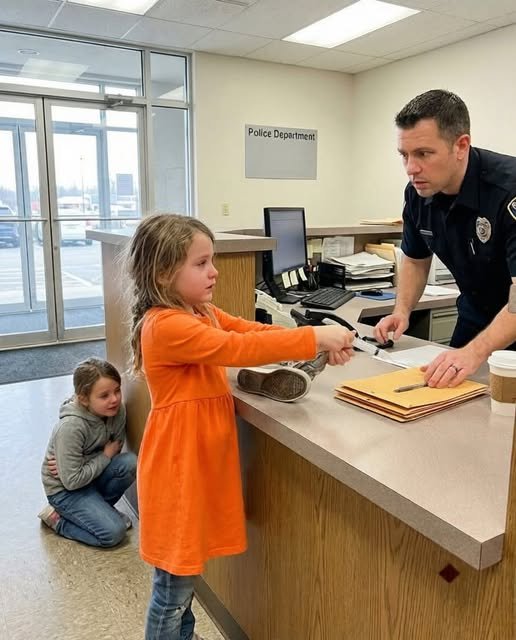
To her, the police station was simply the place where Daniels kept juice boxes in his bottom drawer and Lopez allowed her to stamp old paperwork.
On her fifth birthday, the officers held a small celebration for her.
Andrew brought the potato-shaped sandwiches.
Rachel brought a cake.
Thomas helped Mia place five candles on top.
Before blowing them out, she announced that she had another confession.
Officer Daniels smiled.
“We’re listening.”
Mia climbed onto a chair and looked around the room.
“I used to think people left because I did something wrong,” she said. “But Mommy didn’t leave because of my hug. She died, and that was sad. Rachel and Thomas stayed. Andrew came back. And the police helped my heart stop hurting.”
The room became silent.
Mia smiled.
“So my confession is that I have too many hugs now.”
Daniels wiped his eyes.
“That sounds serious.”
“It is,” Mia said. “I need help giving them away.”
The officers lined up, just as they had on the first day.
But this time, Mia was not crying.
She moved from person to person, wrapping her arms around each of them and laughing whenever someone squeezed her gently.
When she reached Andrew, she paused.
He did not open his arms until she nodded.
“Can I hug you?” she asked.
“Always,” he whispered. “But only when you want to.”
Mia stepped forward.
As he held her, she rested her head against his shoulder.
Then, quietly enough that only the people nearest them could hear, she said, “I think I can call you Daddy now.”
Andrew closed his eyes.
He did not hold her tighter.
He did not turn the moment into a performance.
He simply whispered, “Thank you.”
Rachel and Thomas stood beside them, crying and smiling.
There was no jealousy in their faces.
Only relief.
Mia had not been taken from one family and handed to another.
Her family had grown around her.
Years later, Daniels would retire with countless stories from his career. He had arrested dangerous people, helped find missing children, and responded to emergencies that stayed with him long after his shifts ended.
But whenever someone asked him which case mattered most, he spoke about the afternoon a three-year-old girl walked into the station to confess that she had stolen a hug.
“She thought she needed punishment,” he would say. “What she really needed was permission to keep loving someone who was gone.”
Mia grew older, but she never forgot.
She kept the hug bear on a shelf beside the wooden music box. She volunteered with the Hug Project and sat with children who carried the same impossible questions she once carried.
Whenever a child whispered, “Was it my fault?” Mia gave them the answer that had once saved her.
“No. Love did not cause them to leave. And the love they gave you is still yours.”
The little girl who entered the station burdened by guilt did not become famous because she confessed to a crime.
She became unforgettable because she reminded an entire community of something adults often forget:
Grief can make children believe terrible things about themselves.
Compassion can help them believe the truth again.
A hug cannot bring someone back.
But when it is given with patience, safety, and love, it can bring a broken heart home.