Part 1
My 10-year-old daughter almost died during a severe allergic reaction after my family abandoned her and refused to call an ambulance. Instead, they took the other kids on a luxury day trip like nothing was happening. I never raised my voice, but three hours later, their lives began falling apart.
At 11:07 that morning, my phone buzzed against my desk. My sister Rebecca was calling from my mother’s house, where they had agreed to watch my daughter, Emma, while I worked.
Rebecca sounded annoyed, not frightened.
“Emma has a rash again,” she said. “She’s making herself panic because she knows we’re leaving.”
Behind her voice, I heard my daughter trying to breathe. Each inhale ended in a thin, strained whistle.
“Call 911 now,” I said. “Then get the red emergency pouch from her backpack.”
My mother answered from somewhere near the phone. “An ambulance will turn this into a whole production. We already paid for the day package, and the other kids shouldn’t lose their trip because Emma is upset.”
I asked them to put Emma on the phone. There was movement, a car door opening, and Rebecca telling someone to load the cooler into the SUV.
Emma never came to the phone.
I called emergency services myself, gave them the address, grabbed my keys, and drove with the dispatcher on speaker. I stayed calm because panic would not get me to my daughter faster.
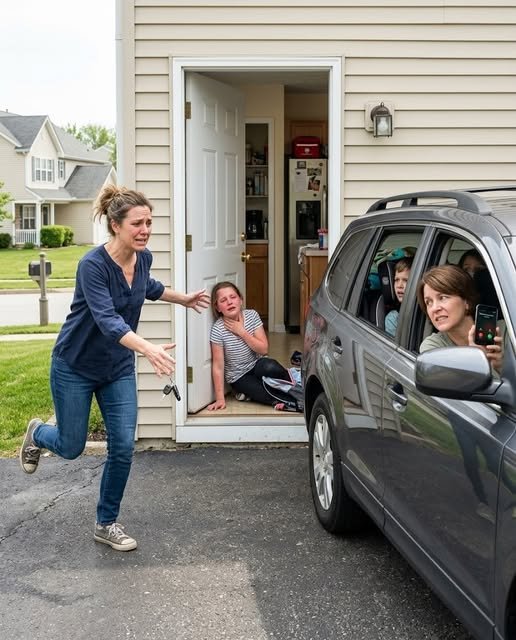
When I turned into the driveway at 11:18, my family’s SUV was already rolling backward. Rebecca was driving. My mother sat beside her, and Emma’s cousins were buckled into the back seat with their day-trip bags.
The front door of the house stood open.
Emma was on the kitchen floor just inside it.
Her face was blotchy, her eyelids were swelling, and one hand was pressed against her throat. Her backpack lay open beside her, but the red pouch that held her prescribed emergency medication was gone.
Rebecca looked directly at me through the open window. My mother looked back once, then faced forward.
They left anyway.
I ran past the SUV and dropped beside Emma. A strip of red fabric caught my eye above the refrigerator. Someone had placed the emergency pouch where a 10-year-old could never reach it.
I gave Emma her prescribed medication while the dispatcher talked me through the seconds until help arrived. Her breathing did not immediately return to normal, but she was still conscious when the paramedics carried her out.
At the hospital, a clinician told me that a longer delay could have killed her. Emma needed continued treatment and observation because her symptoms had been severe.
I sat beside her bed with her small hand wrapped around two of my fingers. I did not scream at anyone. I did not post accusations online or call every relative we had.
I waited until my daughter was stable.
Three hours after Rebecca’s first call, I sent one message to the family group.
My mother had been living rent-free in the apartment above my garage. Rebecca had been using my spare SUV for work, and I had been paying for her children’s after-school care while she got back on her feet.
I told my mother she would receive proper written notice to move. I told Rebecca to return my SUV and spare key that evening. I would make sure the children still had groceries and transportation for the next week, but the open-ended money, vehicle access, and free housing were over.
Most importantly, neither of them would ever be alone with Emma again.
Their replies arrived immediately. They called me cruel, dramatic, ungrateful, and vindictive. Rebecca said I was destroying several lives over “one scary afternoon.”
Then the nurse asked Emma a routine question about where her emergency medication had been when the reaction began.
Emma stared at the hospital blanket before answering.
“Grandma took it out of my backpack,” she whispered. “She put it on top of the refrigerator and said if I could reach it, I’d make everybody stay home again.”
That changed everything. They had not simply frozen during an emergency. Someone had deliberately moved the one thing Emma had been taught to use while she could still help herself.
Before I could respond, another message appeared in the family group.
It was from Rebecca.
“Leave Mom out of this,” she wrote. “Hiding the pouch was my idea.”
Part 2
I read Rebecca’s message three times.
“Hiding the pouch was my idea.”
For several seconds, I could hear nothing except the steady beeping of the monitor beside Emma’s hospital bed. My daughter’s fingers remained wrapped around mine, but her eyes were closed now. Medication had made her sleepy, and the swelling around her face was beginning to ease.
I took a screenshot of Rebecca’s confession before anyone could delete it.
Then I placed my phone face down.
I did not answer her.
A few minutes later, the hospital social worker entered the room with a police officer. Because Emma was a child and her emergency medication had apparently been deliberately taken away from her, the medical staff were required to report what had happened.
The officer introduced herself as Officer Daniels. Her voice was calm, but her expression changed when I showed her Rebecca’s message.
“Did your sister know what the pouch contained?” she asked.
“Yes,” I said. “Everyone who watches Emma receives written instructions. They know where the medication is kept, when it should be used, and that they must call emergency services immediately.”
I opened the family group chat and showed her older messages.
Only two weeks earlier, I had reminded my mother and Rebecca about Emma’s allergy plan. My mother had replied with a thumbs-up emoji. Rebecca had written, “We know. Stop worrying.”
Officer Daniels photographed the messages.
Then she asked the question I had been trying not to think about.
“Why would your sister hide the medication?”
I looked toward Emma.
She was still asleep, but her grip tightened around my fingers.
“Because they thought she was pretending,” I said quietly. “They believed she was using her allergy to ruin their trip.”
The officer’s jaw tightened.
The luxury day trip had been planned for weeks. My mother had purchased a private poolside package at an expensive resort nearly two hours away. Rebecca’s children had been talking about it constantly, and Emma had been excited to go too.
But that morning, after breakfast at my mother’s house, Emma began developing a rash.
Instead of considering that she might be having a reaction, Rebecca decided Emma was trying to stop everyone from leaving.
What I did not understand was why.
Emma had never faked an allergic reaction before. She hated hospitals. She hated needles. She became embarrassed when people stared at her emergency pouch.
There had to be more to the story.
When Emma woke, the social worker gently asked whether she felt ready to explain what happened before the phone call.
Emma looked at me first.
“You’re not in trouble,” I told her. “Nothing that happened was your fault.”
Her eyes filled with tears.
“Grandma gave me a cookie,” she whispered.
My stomach dropped.
“What kind of cookie?”
“One from the blue box.”
I knew exactly which box she meant.
A client had given my mother a box of imported cookies containing several varieties. The label clearly warned that some were made with ingredients dangerous to Emma.
I had seen the box on my mother’s kitchen counter the previous evening.
I had placed it inside a high cabinet and reminded my mother that Emma could not eat anything from it.
“What did Grandma say when she gave it to you?” the social worker asked.
Emma pulled the blanket toward her chin.
“She said it was safe because she scraped the nuts off the top.”
Officer Daniels stopped writing.
I felt something inside me go cold.
Emma continued in a trembling voice.
“I told her that wasn’t safe. Aunt Rebecca said I was being rude. Grandma said children in her time weren’t allowed to control the whole family with made-up rules.”
“Did they know you had eaten it when the rash started?” I asked.
Emma nodded.
“I told them my throat felt funny. I tried to get my pouch, but Aunt Rebecca took it.”
“Why?”
“She said if I used the medicine, everyone would have to stay home.”
The room went silent.
This was no longer about people failing to recognize an emergency.
They had knowingly given Emma unsafe food, dismissed her symptoms, removed her medication, and prepared to leave her alone on the floor.
Officer Daniels stepped into the hallway to make a call.
My phone began ringing again.
Rebecca.
I rejected it.
She called six more times.
Then my mother called.
I rejected that one too.
Finally, another message appeared.
Rebecca: “I only said it was my idea because Mom is old and can’t handle this stress. Stop showing our private messages to strangers.”
A second message followed.
Mother: “Emma misunderstood. The cookie was fine. Children exaggerate.”
I took screenshots of both.
Thirty seconds later, Rebecca deleted her confession from the group chat.
But it was already too late.
At 4:42 that afternoon, Officer Daniels returned and told me another officer had gone to my mother’s house.
The kitchen had not yet been cleaned.
The open cookie box was still on the counter.
Emma’s red emergency pouch was still sitting above the refrigerator.
And the home security camera mounted over my mother’s back door had recorded everything.
My mother had installed the camera herself after several packages went missing. She had forgotten that its wide-angle lens captured most of the kitchen.
The footage showed my mother handing Emma the cookie.
It showed Emma reading the wrapper and refusing it.
It showed Rebecca taking the wrapper away and telling her to stop being difficult.
It showed my mother breaking off the visible topping and placing the cookie into Emma’s hand.
Most damning of all, it showed Rebecca taking the emergency pouch from Emma’s backpack after the rash appeared.
The video had sound.
Officer Daniels did not tell me every word that had been recorded, but she repeated one sentence.
Rebecca had looked at my struggling daughter and said, “You can breathe well enough to complain, so you can wait until we leave.”
I had believed I could not feel any more betrayed.
I was wrong.
At 5:10, my mother and Rebecca returned from their trip.
They had apparently turned around only after another relative warned them that police were at the house.
The resort wristbands were still on their arms when they arrived.
Rebecca’s children were crying in the SUV.
My mother began shouting before she reached the front door.
According to Officer Daniels, Rebecca tried to take the emergency pouch from the kitchen before an officer stopped her.
She claimed she wanted to bring it to the hospital.
The security footage showed otherwise.
That evening, Rebecca was taken to the police station for questioning. My mother was also interviewed, and child protection services began reviewing whether Rebecca’s children were safe in her care.
I did not celebrate.
I did not feel victorious.
I sat beside Emma while she slept and wondered how many times she had been made to feel like a burden when I was not there.
At 8:30, a doctor told me Emma needed to remain overnight.
I went downstairs to buy coffee.
When I returned, I found a woman standing outside Emma’s room.
It was Rebecca’s 13-year-old daughter, Lily.
She had arrived with her father, Rebecca’s ex-husband.
Lily’s face was pale, and she held her phone against her chest.
“I need to show you something,” she said.
Her father looked furious.
Lily unlocked her phone and opened a video recorded that morning from the back seat of the SUV.
The first few seconds showed my mother laughing as they drove away.
Then Rebecca’s voice came through the speakers.
“By the time her mother gets there,” she said, “Emma will have learned not to ruin another family day.”
Lily looked at me with tears streaming down her face.
“That isn’t the worst part,” she whispered. “They talked about doing this before.”
Part 3 — Final
Lily’s words remained in the air between us.
“They talked about doing this before.”
Her father, Daniel, placed a protective hand on her shoulder.
“You don’t have to explain everything tonight,” he told her.
But Lily shook her head.
“Yes, I do.”
We moved into a small family consultation room near Emma’s hospital room. Officer Daniels returned, along with the hospital social worker. Lily sat beside her father and placed her phone on the table.
She opened a group chat involving Rebecca, my mother, and several relatives.
Most of the messages were ordinary complaints about schedules, money, and family events. Then Lily scrolled back to a conversation from the previous week.
My mother had written that Emma’s “constant allergy drama” was making family activities impossible.
Rebecca replied, “Next time, don’t give her the pouch so quickly. She needs to learn that every itch isn’t an emergency.”
Another relative responded with a laughing emoji.
Then my mother wrote, “Maybe if she realizes the world won’t stop for her, she’ll grow out of it.”
I felt sick.
Emma’s allergy was not new. She had been diagnosed years earlier after a reaction that required emergency treatment. Every adult in the family knew it was real.
Yet somewhere along the way, they had decided that protecting her was inconvenient.
Lily explained that she had overheard her mother and grandmother talking the night before the trip. They said Emma had become “too powerful” because everyone changed plans whenever she felt unwell.
“They said they were going to teach her a lesson,” Lily whispered. “I thought they meant they wouldn’t let her complain about the pool or the food. I didn’t know they were going to give her something dangerous.”
Her father looked devastated.
“Why didn’t you tell me?” he asked gently.
Lily began crying.
“Mom said you were trying to take us away from her. She said if I repeated family conversations, I’d be the reason she lost custody.”
Daniel closed his eyes.
That single sentence revealed another kind of harm.
Rebecca had not only endangered Emma. She had been using fear to keep her own children silent.
The investigation moved quickly after that.
The security-camera footage, Rebecca’s deleted confession, Lily’s recording, and the family messages created a clear timeline.
My mother had given Emma food she had been warned was unsafe.
When Emma began showing symptoms, Rebecca removed the emergency pouch.
They delayed calling for help.
Then they left her on the kitchen floor while they drove away with the other children.
Rebecca tried to insist she believed Emma was pretending. But the video captured Emma wheezing, begging for her medication, and saying she could not breathe properly.
My mother claimed she thought scraping the topping off the cookie made it safe.
But investigators found my text message from the previous evening telling her not to give Emma anything from that box.
She had replied, “I understand.”
There was no misunderstanding.
There was only arrogance.
For the next several weeks, my life became a mixture of hospital follow-ups, interviews, legal meetings, and helping Emma sleep through nightmares.
She began asking me the same question every night.
“Did they leave because they wanted me to die?”
Every time, I answered carefully.
“No. They left because they were selfish, cruel, and refused to understand how serious the danger was. But none of that happened because of anything you did.”
She did not believe me immediately.
Children often blame themselves for the harm adults choose to cause.
So I repeated it until the words began to settle inside her.
None of this was her fault.
My mother received formal notice to leave the apartment above my garage. She tried to claim I was making an elderly woman homeless, but she had savings, retirement income, and two other adult children who had defended her in the family chat.
Strangely, none of them offered her a room.
They had supported her when support required only angry messages.
End Part Here: My 10-year-old daughter almost died during a severe allergic reaction after my family abandoned her and refused to call an ambulance