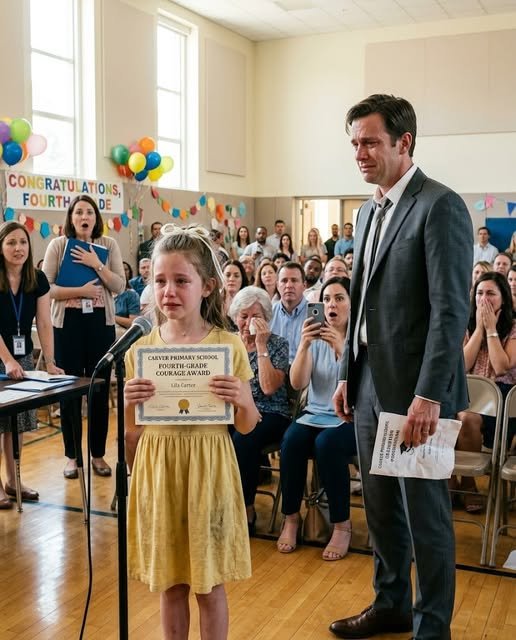
Lila gripped the certificate tightly.
Elliot did not rush his next words.
He seemed to understand that a careless sentence could hurt a child more deeply than silence.
“I don’t know the whole truth yet,” he said. “And I will not stand here and pretend that I do. But when I saw your name, I knew I had to come.”
Mrs. Hanley lowered the old paper.
“Your mother listed him as an emergency contact once,” she explained softly. “Later, his name was crossed out.”
Elliot nodded slowly.
“I sent letters, but they were returned. I called numbers that eventually stopped working.”
He looked at Lila.
“I was told your mother had moved on and did not want me to contact her.”
Under the bright stage lights, Lila suddenly appeared even smaller.
Then she asked the question nobody in that auditorium would ever forget.
“Are you my father?”
Elliot’s face crumpled.
But he did not reach for her without permission.
“I might be,” he answered honestly. “And if I am, I am so sorry that I wasn’t here sooner.”
His answer did not fix everything.
It did something more important.
It refused to lie to her.
Mrs. Hanley gently brought the ceremony to an end, although no one in the room truly returned to normal.
Parents wiped tears from their faces.
Children whispered to one another.
Elliot waited at the bottom of the stage until Lila came down.
She held out her certificate, as though she needed something ordinary to happen before they could face something impossible.
He read it carefully.
“Courage Award,” he said. “That sounds right.”
“My grandmother keeps old papers,” Lila whispered. “Maybe she knows something.”
Elliot nodded.
“Then we will ask her together.”
They did not leave alone.
Mrs. Hanley followed them after informing the school office.
The school counselor accompanied them as well.
There were rules for situations like this.
And for once, the adults moved gently around Lila instead of making decisions over her head.
Lila’s grandmother was sitting beside the apartment window with a blanket across her knees when they arrived.
The moment she saw Elliot in the doorway, her hand rose to cover her mouth.
“Oh,” she whispered. “So you finally came.”
It was not an accusation.
It was grief recognizing itself.
The shoebox beneath her bed contained far more than school papers.
Inside were returned envelopes, two old photographs, a hospital bracelet, and a folded note written in Lila’s mother’s handwriting.
The note did not explain everything.
But it explained enough.
Lila’s mother had been young and frightened.
Relatives had pressured her into believing that Elliot’s wealthy family would take her baby away.
During a moment of panic, she crossed his name off the emergency contact form.
She later regretted it.
But then illness entered her life quickly.
As her health deteriorated, apologies became more difficult to send.
Inside the box was also a photograph of Elliot and Lila’s mother standing outside a diner.
They were laughing in the sunlight.
Lila gently touched the edge of the photograph.
“She looks happy,” she said.
“She was,” Elliot whispered. “She was very happy that day.”
The legal answers took longer.
They always do.
There were forms to complete, old records to examine, and careful conversations involving lawyers, counselors, and family members.
Elliot did not demand to become Lila’s father immediately.
He did not try to buy his way into her life.
Instead, he showed up.
At first, he visited on Saturdays carrying bags of groceries that Lila’s grandmother pretended she did not need.
Then he attended school meetings.
He drove them to doctor appointments.
He learned which cereal Lila liked and how much she hated being rushed in the morning.
He discovered that she smiled whenever someone remembered the exact page where she had stopped reading a book.
He began learning the small details that make someone part of a child’s life.
When the DNA test finally confirmed what everyone had already begun to understand, Lila did not cry immediately.
She sat very still at the kitchen table, staring at the paper.
Then she looked at Elliot.
“So you don’t have to pretend anymore?”
Elliot covered his mouth with one hand.
His eyes filled with tears.
“No,” he said. “I don’t.”
Months later, Mrs. Hanley kept a copy of Lila’s Courage Award photograph inside her desk drawer.
Not because the story had become a perfect happy ending.
It had not.
There were still years of absence to understand, trust to build, and grief that would never completely disappear.
But the photograph reminded Mrs. Hanley that children sometimes ask for so little.
You only have to clap.
That sentence remained with everyone who had heard it.
Loneliness is often most painful when it becomes visible.
That morning, an entire auditorium watched one empty chair become a doorway.
On the day of her fourth-grade ceremony, a lonely little girl approached a stranger and quietly asked him to pretend to be her father.
And because he chose to stand beside her, the truth finally stood up too.