PART 2: FIFTY-TWO THOUSAND DOLLARS IN RENT
Ashley came into our lives the previous winter.
She was thirty, with shoulder-length blonde hair, warm brown eyes, and a quiet manner that made people comfortable around her.
She worked as a receptionist at a dental office across town.
Nick met her through a coworker.
The first time he mentioned her, he seemed embarrassed.
“There’s someone I’ve been seeing.”
I looked up from folding Gracie’s pajamas.
“Someone special?”
He nodded.
“Maybe.”
I smiled.
“Then I’d like to meet her.”
And I meant it.
People sometimes assume that a mother-in-law will resent the woman who comes after her daughter.
But I didn’t want Nick to spend the rest of his life grieving.
Kelsey had loved him.
She would have wanted him to find happiness again.
And those children deserved a happy father.
Ashley first came to dinner on a Sunday.
She brought a homemade apple pie.
Gracie hid behind my legs for ten minutes before finally asking if Ashley knew how to braid hair.
Ashley laughed.
“I can try.”
Within an hour, the two of them were sitting on the living room rug, surrounded by colorful hair ribbons.
Owen showed her his baseball cards.
Lily watched more cautiously.
She was old enough to understand what a new woman in the house might mean.
Later that evening, Lily came into my bedroom.
“Grandma, if Daddy marries Ashley, will she replace Mommy?”
I pulled her onto my lap.
“No, sweetheart. Nobody can replace your mother.”
“Then what would Ashley be?”
“Someone else who cares about you.”
Lily considered that.
“Can people have more than one person who loves them like a mom?”
“Of course.”
She leaned against my shoulder.
“Good. Because I don’t want to lose anybody else.”
I held her a little tighter.
Neither of us knew how important those words would become.
Nick and Ashley grew closer.
She began joining us for Sunday dinners.
Then birthday parties.
Then holidays.
She never seemed bothered by my presence.
Sometimes she even asked about Kelsey.
“What was she like?” Ashley asked one afternoon while we washed dishes.
I glanced at the yellow kitchen walls.
“She was the kind of girl who could make you laugh when you were determined to be miserable.”
Ashley smiled.
“Nick says Lily has her laugh.”
“She does.”
I showed Ashley photographs.
Kelsey at graduation.
Kelsey holding newborn Lily.
Kelsey standing in the backyard with dirt on her nose after planting lavender.
Ashley listened carefully.
I thought we were becoming friends.
In June, she and Nick married in a small ceremony at a local church.
I sat with the children in the second pew.
When Nick exchanged vows with Ashley, I cried.
Not because I resented her.
Because I remembered watching Kelsey marry him in that same church years earlier.
After the ceremony, Ashley approached me.
“Thank you for being so welcoming, Roxanne.”
I hugged her.
“Just love those children.”
“I will.”
Two weeks later, Nick asked me to sit with him at the kitchen table.
The children were watching television in the living room.
Ashley had gone grocery shopping.
Nick looked uncomfortable.
He kept turning his wedding ring around his finger.
“Roxanne, there’s something we need to discuss.”
I put down my cup of tea.
“All right.”
“Ashley and I have been talking about the future.”
“Of course.”
“We think it’s time for us to establish our own household.”
I waited.
He cleared his throat.
“I think you should start looking for somewhere else to live.”
For a moment, I couldn’t understand the words.
“Somewhere else?”
He nodded.
“We need our privacy. The children need to adjust to Ashley being here.”
I stared at him.
“Nick, I’ve lived here for nearly three years.”
“I know.”
“I sold my house to help you.”
His jaw tightened.
“Nobody forced you to do that.”
The words struck harder than I expected.
I looked toward the pantry door, where Kelsey’s handwriting still marked the children’s heights.
“And the money I put into the mortgage?”
Nick folded his arms.
“What about it?”
“That was fifty-two thousand dollars.”
“I remember.”
“Will you be able to repay any of it?”
His expression changed.
“Roxanne, you lived here almost three years.”
I nodded slowly.
“And?”
“That money covered your rent.”
I thought I’d misheard him.
“My rent?”
“Yes.”
“Nick, I raised your children.”
“You helped with the children.”
“I bought groceries. Paid bills. Took them to school. Stayed awake when they were sick.”
“I never asked you to pay for everything.”
“Because you knew I would.”
He pushed his chair back.
“Look, I’m not trying to fight with you.”
“Then why are you calling the money I gave you rent?”
He rubbed his forehead.
“Because you lived here, Roxanne. You had a roof over your head. You can’t expect to live somewhere for free forever.”
I looked around the kitchen I’d cleaned thousands of times.
The table where I’d helped Lily learn multiplication.
The stove where I’d made birthday cakes.
The window where I’d stood watching for Nick to come home after another late shift.
For the first time, the house felt unfamiliar.
“I wasn’t a tenant,” I whispered.
Nick looked away.
“That’s how I see it.”
Something inside me went very still.
I could have shouted.
I could have reminded him of every sacrifice.
But the children were only a few feet away.
And I could already imagine the consequences of a terrible argument.
I had lost Kelsey.
I couldn’t bear losing her children, too.
So I stood.
“All right.”
Nick looked surprised.
“All right?”
“I’ll find somewhere else.”
He exhaled.
“Thank you for understanding.”
Understanding.
That was what he called it.
I walked to my bedroom, closed the door, and sat on the edge of the bed.
Then I cried into a pillow so the grandchildren wouldn’t hear.
For three years, I’d believed I was helping preserve my daughter’s family.
Now the man I’d trusted was telling me that my sacrifice had been nothing more than the price of a room.
The following morning, Lily noticed my swollen eyes.
“Grandma, are you sick?”
“No, honey.”
“Then why do you look sad?”
I brushed her hair away from her forehead.
“Sometimes grown-ups have difficult days.”
She hugged me.
“Mommy used to say hugs make difficult days smaller.”
I closed my eyes.
“Yes,” I whispered. “She did.”
Over the next two weeks, I searched for an apartment.
Most were too expensive.
Others were too far from the children.
Then I found a tiny rental on Third Street.
Six hundred and fifty dollars a month.
One bedroom.
A small kitchen.
A bathroom with cracked tiles.
And a narrow porch facing the sidewalk.
The landlord apologized for its condition.
“It’s not much.”
I asked one question.
“Does the elementary school bus stop nearby?”
He pointed toward the corner.
“Right there. Every afternoon.”
I signed the lease that day.
When I told Nick I’d found a place, he looked relieved.
“When are you moving?”
“Saturday.”
“Good. That gives us time to rearrange things.”
I wanted to ask whether rearranging things included removing the photographs of Kelsey.
But I kept quiet.
On moving day, Owen carried my smallest suitcase.
Gracie followed me from room to room, asking why I couldn’t stay.
And Lily stood in my doorway holding the framed photograph of her mother and me.
“Grandma, are you leaving because Daddy doesn’t love you anymore?”
My heart nearly stopped.
“No, sweetheart.”
“Then why?”
I knelt in front of her.
“Sometimes grown-ups need to live in different places.”
“Like when Mommy went away?”
“No.”
I took her hands.
“Not like that at all.”
“Promise?”
“I promise.”
She looked into my eyes.
“Will we still see you?”
“Every chance we get.”
That night, I slept alone in the little apartment on Third Street.
I had one mattress, two chairs, a kitchen table, and a photograph of Kelsey beside my bed.
I lay awake listening to traffic pass outside.
For the first time in years, there were no small footsteps in the hallway.
No whispers asking for water.
No children’s laughter floating through the walls.
Only silence.
I pressed Kelsey’s photograph against my chest.
“I tried, baby,” I whispered.
“I really tried.”
Then, a week later, Nick called.
He and Ashley both worked until after five.
The children’s school bus arrived at 3:40.
Would I mind watching them until he finished work?
I stared at the telephone.
After everything that had happened, he was asking me to continue caring for his children.
But I didn’t need to think about my answer.
“Of course,” I said.
Because whatever Nick thought of me, those children were still my grandchildren.
And I would never make them pay for the choices their father had made.
PART 3: THE ENVELOPE IN LILY’S BACKPACK
By October, our little routine had become the happiest part of my life.
Every morning, I swept the porch.
Every afternoon, I checked the clock.
At 3:30, I washed apples and set out peanut butter.
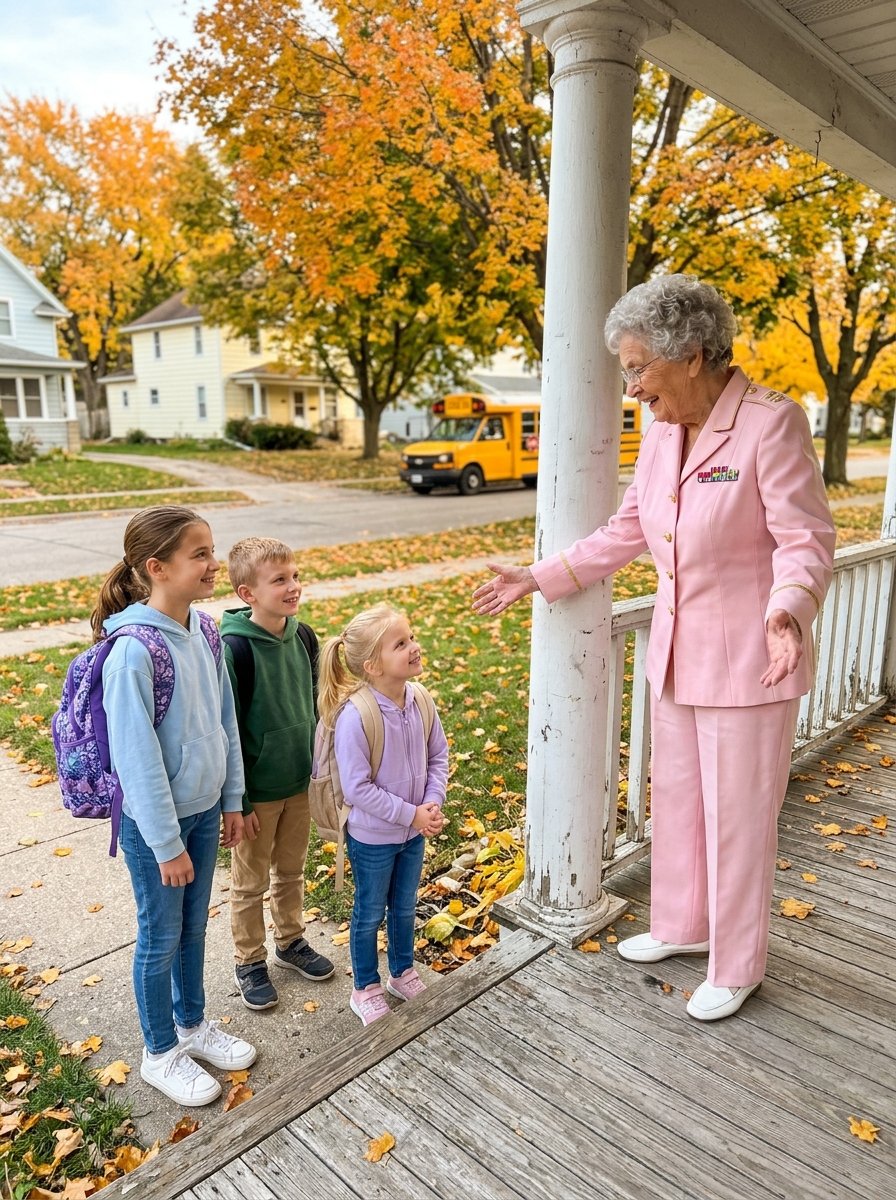
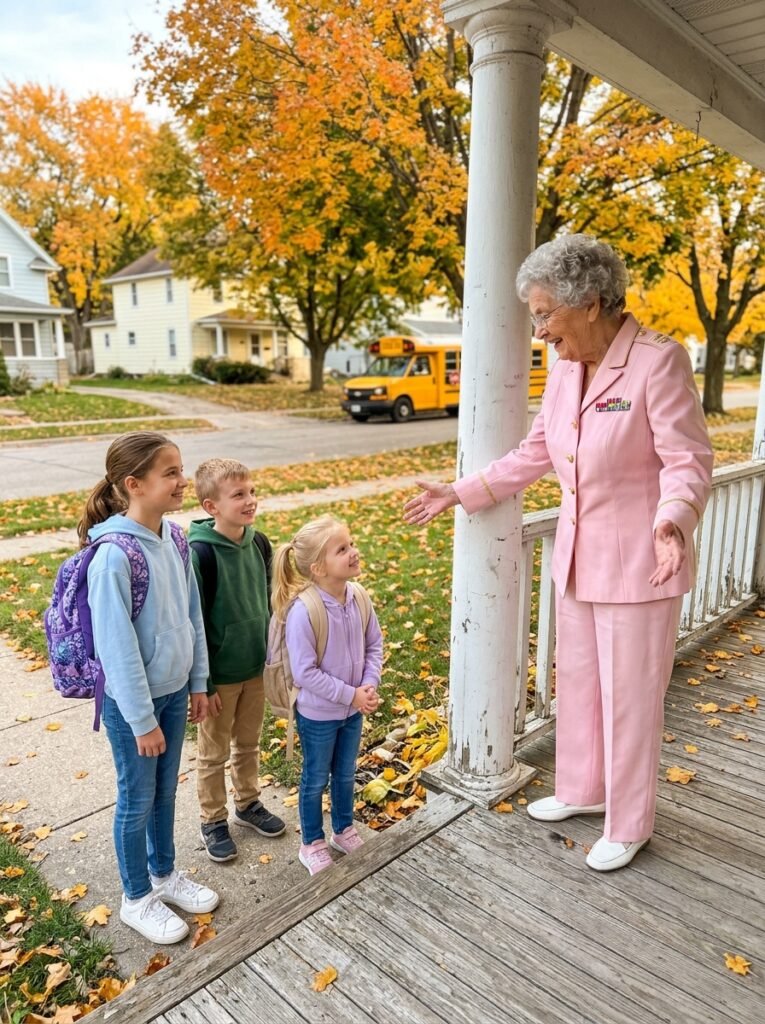
At 3:35, I opened the front door.
And at 3:40, the school bus arrived.
Lily always stepped off first.
Owen usually had something exciting to tell me about baseball.
Gracie talked so quickly that half her words ran together.
They filled my tiny apartment with noise, shoes, backpacks, school papers, and life.
I loved every minute.
We had no fancy furniture.
The kitchen table wobbled.
One of my chairs had a torn cushion.
But the children never complained.
“Your apartment is cozy, Grandma,” Gracie told me one afternoon.
Owen nodded.
“And you have better snacks.”
Lily smiled.
“And it smells like Mommy’s old house.”
That comment nearly brought me to tears.
Because I still used Kelsey’s favorite cinnamon-scented cleaner.
Sometimes, I wondered whether the children noticed more than the adults realized.
Lily certainly did.
She was becoming observant in ways that reminded me of her mother.
She noticed when I skipped lunch.
She noticed when I turned off the kitchen light early to save electricity.
And she noticed when I told her I wasn’t hungry, even though my stomach growled.
One afternoon, she opened my refrigerator while looking for milk.
There were two eggs, half a carton of orange juice, some carrots, and a small container of leftover soup.
She stood looking inside for several seconds.
“Grandma?”
“Yes, honey?”
“Why don’t you have much food?”
I tried to smile.
“I go shopping when I need something.”
She frowned.
“But we always eat all your snacks.”
“That’s what they’re for.”
She closed the refrigerator.
“Does Daddy give you money for watching us?”
I turned away from the sink.
“Why do you ask?”
“Because Mrs. Henderson watches our neighbor’s little boy, and his mommy pays her.”
“Well, grandparents are different.”
“How?”
I looked at her.
“Because spending time with you is something I love doing.”
She studied me for a moment.
Then she came over and hugged my waist.
“You’re the best grandma in the world.”
That evening, after the children left, I sat at the kitchen table with my bills.
Rent.
Electricity.
Medicine.
Groceries.
My early retirement income covered the basics, but the money I’d once expected to last comfortably had become a constant worry.
I had begun putting off replacing my worn winter shoes.
I cut my own hair.
I stopped buying the expensive coffee I’d enjoyed every Sunday.
None of those sacrifices seemed important compared with the children.
But sometimes, alone at night, I felt frightened.
Not of being poor.
I’d lived modestly all my life.
I was frightened of becoming a burden.
And I was frightened that one day Nick might decide the children no longer needed to visit.
He never came inside when he collected them.
At 5:45, his truck would pull up outside.
The children gathered their things.
I’d kiss their foreheads.
And he’d wait behind the steering wheel.
Sometimes he waved.
Sometimes he didn’t.
Ashley never came.
I assumed she disliked me.
Perhaps Nick had told her I was interfering.
Perhaps she believed I refused to let go of Kelsey’s place in the family.
Whatever the reason, I didn’t ask.
I had learned that peace could be fragile.
Then came the Thursday afternoon that changed everything.
The maple trees along Third Street had turned bright orange.
A cool wind scattered dry leaves across the sidewalk.
I’d baked oatmeal cookies that morning.
Not because I had extra money, but because Gracie had received a gold star for learning to write her full name.
I wanted to celebrate.
At 3:40, the bus stopped at the corner.
I stood on the porch in my red cardigan.
Lily climbed down first.
But something was different.
She didn’t wave.
Owen followed, unusually quiet.
Then Gracie stepped off, clutching her pink backpack straps.
None of them ran toward me.
My stomach tightened.
I walked down one step.
“Sweethearts? Is everything all right?”
Lily looked at her brother.
Then at Gracie.
Finally, she approached me.
“Grandma, Ashley gave me something for you.”
I blinked.
“Ashley?”
Lily nodded.
“She said it was important.”
She slipped her backpack from her shoulders.
Owen stared at his shoes.
Gracie looked worried.
“Lily, honey, did something happen?”
“Not bad,” Lily said quickly.
“At least, I don’t think it’s bad.”
She opened the small front pocket of her backpack.
Inside was a cream-colored envelope.
My name was written across the front.
ROXANNE.
The handwriting was neat and unfamiliar.
Lily held it out.
“Ashley said you would understand what it means.”
I took the envelope.
It felt thicker than an ordinary letter.
My first thought was that Nick wanted to change our arrangement.
Perhaps he thought the children were spending too much time with me.
Perhaps Ashley wanted them to start going somewhere else after school.
My fingers trembled.
“Did Ashley say anything else?”
Lily nodded.
“She said she was sorry she didn’t know sooner.”
I looked up sharply.
“Didn’t know what?”
Lily hesitated.
“She said you should read it first.”
I opened the envelope carefully.
Inside were three things.
A folded letter.
Several pages of printed bank records.
And a photograph.
The photograph was old.
Kelsey stood in the backyard, holding baby Gracie.
I stood beside her, laughing, with one hand resting on her shoulder.
Nick had taken that picture during a summer cookout.
I hadn’t seen it since my daughter died.
My throat tightened.
I turned it over.
On the back, in Ashley’s handwriting, were six words.
“She was lucky to have you.”
I sat down in my porch chair.
Then I unfolded the letter.
Dear Roxanne,
I hope you can forgive me for sending this through Lily.
I know I should have come to you myself, but I was afraid that if I waited any longer, I would lose the courage to tell you what I discovered.
Until three days ago, I believed you had chosen to move out because you wanted your independence.
That’s what Nick told me.
He said you had lived with the family for almost three years and were ready for a quieter life.
He also told me that you had helped with household expenses, but that you had never contributed anything significant toward the house.
I believed him.
I was wrong.
Last Monday, while we were reviewing our finances, I discovered the records showing your $52,000 payment toward the mortgage.
I asked Nick about it.
And he told me he considered that money your rent.
Roxanne, I want you to know something.
I did not know he had said that to you.
I did not ask him to make you leave.
And I would never have agreed to it if I’d known the truth.
But there’s something else you need to see.
Please look at the last page.
My hands had started shaking so badly that I could barely hold the paper.
I turned to the final page.
There was a copy of a mortgage statement.
A large payment was highlighted.
Fifty-two thousand dollars.
Below it was a handwritten note from Ashley.
Nick told me this payment helped make it possible for us to stay in the house.
He also told me that without your help after Kelsey’s death, he doesn’t know how he would have managed.
I asked him why someone who had saved his family should be treated like a tenant.
He had no answer.
I read those sentences twice.
Then I noticed another sheet folded behind the statement.
It contained a short message.
This one was written in Nick’s handwriting.
Roxanne,
Ashley and I have talked.
I know what I said to you.
I know I hurt you.
I need to speak with you in person.
There are things I should have said months ago.
I’m sorry.
Nick.
I stared at the paper.
I had waited four months to hear those words.
Four months of wondering whether the man I’d once considered another son understood what he’d done.
And now they were sitting in my lap.
But what troubled me most was the fact that Ashley had sent them.
I looked at Lily.
“Sweetheart, did Ashley tell you what happened?”
Lily nodded slowly.
“She was crying last night.”
My chest tightened.
“Why?”
“She and Daddy were talking in the kitchen. I heard her say something about you giving him money.”
I closed my eyes.
“Lily, you shouldn’t have had to hear that.”
“I know.”
She moved closer.
“But Grandma?”
“Yes?”
She looked directly at me.
“Did Daddy really make you leave?”
The question I’d been avoiding for months was finally standing in front of me.
And this time, I couldn’t hide behind a comforting lie.
PART 4: WHAT ASHLEY REALLY KNEW
I looked at my granddaughter.
Eleven years old.
Too young to carry grown-up problems.
Old enough to recognize when someone was hiding the truth.
I reached for her hand.
“Lily, your father and I disagreed about some things.”
She frowned.
“About money?”
“Yes.”
“Did you give him money so we could stay in our house?”
I hesitated.
Then nodded.
“I helped with the mortgage after your mommy died.”
“Why?”
“Because I wanted you children to keep living somewhere that felt safe.”
Lily looked down at the photograph in my lap.
“That’s why you sold your old house?”
“Partly, sweetheart.”
She became very quiet.
Then she whispered, “Mommy would be mad at Daddy.”
My heart ached.
I pulled her close.
“I don’t want you worrying about who should be angry with whom.”
“But it wasn’t fair.”
“No,” I admitted softly.
“It wasn’t.”
Owen stepped forward.
“Grandma, are you going to stop watching us?”
I shook my head immediately.
“No, sweetheart.”
Gracie started crying.
“I don’t want another grandma.”
That nearly broke me.
I wrapped my arms around all three children.
“Nobody is replacing anybody.”
We stayed like that for a long moment.
Then I brought them inside.
I put the letter away.
We ate oatmeal cookies.
Lily did her math homework.
Owen told me about a classmate who’d fallen during recess.
And Gracie proudly wrote her name across an entire sheet of paper.
I praised every letter.
But my thoughts kept returning to Ashley’s note.
I did not ask him to make you leave.
All summer, I’d assumed she’d wanted me gone.
I’d imagined her standing in Kelsey’s yellow kitchen, telling Nick that his mother-in-law was in the way.
Now I wondered whether I’d been unfair to a woman who might have been just as confused as I was.
At 5:45, Nick’s truck arrived.
I watched through the window as the children gathered their things.
Then, for the first time in four months, I walked outside before they reached the truck.
“Nick?”
He looked up.
His face changed when he saw the envelope in my hand.
“Roxanne.”
“I received Ashley’s letter.”
He glanced toward the children.
“Can we talk about this later?”
“Yes.”
He seemed relieved.
Then I added, “But we are going to talk.”
He nodded.
“I know.”
I watched him drive away.
That evening, I sat alone at my kitchen table.
The photograph of Kelsey lay beside Ashley’s letter.
I studied my daughter’s smiling face.
For years, I’d told myself that loving her children meant swallowing every hurt.
But something about Ashley’s words made me reconsider.
I had given up my house voluntarily.
I had chosen to help.
Those choices were mine.
But I hadn’t agreed to be dismissed as a renter once my work was no longer convenient.
I could forgive Nick.
I could even understand why he wanted a new beginning.
But forgiveness didn’t mean pretending what happened was acceptable.
At seven-thirty, someone knocked.
When I opened the door, Ashley stood on the porch.
She wore a navy coat over her work clothes.
Her hair was pulled back.
And her eyes were red.
“Roxanne,” she said quietly, “may I come in?”
I stepped aside.
She looked around my apartment.
At the narrow kitchen.
The worn furniture.
The small shelf holding photographs of the children.
Her expression changed.
“Nick told me you liked having a place of your own.”
“I do like being close to the children.”
She looked at the cracked tile beneath her shoes.
“But you didn’t want to leave their house.”
I folded my arms.
“No.”
Ashley swallowed.
“I’m so sorry.”
I motioned toward the kitchen table.
“Sit down, honey.”
She sat.
For a moment, neither of us spoke.
Then Ashley opened her handbag.
“I want to explain what happened.”
I nodded.
“When Nick and I got engaged, I worried about moving into a house where his late wife’s mother lived.”
She looked embarrassed.
“Not because I disliked you. I was afraid I’d always feel like an outsider.”
“I understand.”
“But you never treated me that way. You welcomed me. You showed me pictures of Kelsey. You told me what foods the children liked.”
I smiled faintly.
“They can be particular.”
Ashley laughed through her tears.
“Especially Owen.”
Then her face grew serious.
“When I asked Nick whether you would always live with us, he said you’d probably want your independence soon. He made it sound like it was already your plan.”
I said nothing.
“After the wedding, he told me you had found an apartment. I thought you’d decided it yourself.”
“He asked me to leave two weeks after your wedding.”
Ashley pressed a hand over her mouth.
“He never told me that.”
“I thought you wanted me gone.”
She shook her head.
“I was nervous about sharing the house with you. But I never asked him to put you out.”
I looked toward the window.
The streetlight had just flickered on.
“Then why did he do it?”
Ashley took a breath.
“I asked him the same question.”
“And?”
“He said he wanted us to feel like a married couple. He thought that as long as you were there, I would always feel like a visitor.”
I nodded slowly.
“Perhaps he should have asked you.”
“That’s what I told him.”
Her voice trembled.
“Then I found the mortgage statement.”
She explained that she and Nick had been reviewing their household budget.
They were considering replacing their aging car.
While going through old financial records, Ashley noticed a large payment made nearly three years earlier.
She asked Nick where the money had come from.
He told her I’d sold my house.
She assumed he’d borrowed the money and intended to repay me.
When he explained that he’d considered it rent, she couldn’t believe what she was hearing.
“I asked him whether you knew that was the arrangement.”
Ashley looked at me.
“He said there hadn’t been an arrangement.”
My hands tightened around my teacup.
She continued.
“I asked him what you’d done for those three years.”
“He told me you helped with the children.”
I gave a humorless little laugh.
“Helped.”
“That’s when I reminded him that you were still watching them every single afternoon.”
She leaned forward.
“Roxanne, I work at a dental office. I know what childcare costs. I know what it means to have someone available every afternoon, every school holiday, every sick day.”
Her eyes filled again.
“And I realized he was pretending your contribution was smaller than it really was because admitting the truth would mean facing what he’d done.”
I sat silently.
It was painful hearing someone put my private hurt into words.
But it was also a relief.
For months, I’d begun wondering whether I’d been unreasonable.
Whether expecting gratitude was selfish.
Whether I’d simply misunderstood my place in the family.
Ashley reached across the table.
“You were not a tenant.”
I looked at her.
“You were helping raise your grandchildren.”
A tear slipped down my cheek.
She squeezed my hand.
“And you deserved to be treated with respect.”
I covered my face.
For three years, I’d been strong for everyone.
For four months, I’d told myself that I didn’t need anyone to understand.
But those simple words finally broke through the silence I’d been carrying.
Ashley waited while I cried.
She didn’t interrupt.
Didn’t offer excuses.
Didn’t tell me to forget what happened.
When I finally lowered my hands, she asked a question I wasn’t expecting.
“Why didn’t you tell me?”
I thought about it.
“Because I didn’t want to make you choose between me and your husband.”
She shook her head.
“Telling me the truth wouldn’t have made me choose sides.”
Then she added quietly, “Nick’s choices created this problem. Not yours.”
I looked at her with new respect.
“Does he know you’re here?”
“Yes.”
“What did he say?”
Ashley took a long breath.
“He said he was afraid you wouldn’t forgive him.”
I looked at the photograph of Kelsey.
“Maybe he should have thought about that before he asked me to leave.”
Ashley nodded.
“He knows.”
She opened her handbag again.
This time, she removed a folded sheet of paper.
“I brought something else.”
I glanced at it.
“What is it?”
“It’s a repayment proposal.”
My heart began pounding.
Ashley placed the paper on the table.
“We can’t give you fifty-two thousand dollars tomorrow. We don’t have that kind of savings.”
“I know.”
“But we have been discussing ways to make this right.”
I looked down.
The document outlined a monthly repayment schedule.
There was a place for Nick’s signature.
And a note stating that the original $52,000 mortgage contribution had not been rent.
I stared at the words.
Ashley continued.
“I told Nick that I wouldn’t pretend this was a normal family disagreement. If he wanted to make things right, there had to be something more than an apology.”
I looked up.
“And he agreed?”
“He did.”
“Why isn’t it signed?”
Ashley answered without hesitation.
“Because I told him he needed to discuss it with you first. You deserve a say in what happens next.”
Something about that answer moved me more than if she’d arrived with a check.
She wasn’t trying to buy forgiveness.
She was trying to give me back a voice.
I folded the paper.
“Thank you, Ashley.”
She wiped her eyes.
“There’s one more thing.”
I waited.
She glanced at the children’s photographs.
“Lily has been asking questions.”
My stomach tightened.
“I know.”
“She told me she thought you might be struggling to buy groceries.”
I looked away.
Ashley spoke gently.
“Roxanne, those children love you. But I don’t want them worrying about whether their grandmother can afford to feed them.”
I swallowed.
“Neither do I.”
“Then please let us start paying you for their afternoon care.”
I shook my head immediately.
“I don’t want to charge for loving my grandchildren.”
“That’s not what I’m asking.”
She leaned closer.
“I’m asking you to stop paying for everyone else’s comfort with money you no longer have.”
I looked at her.
For once, I couldn’t find an answer.
Ashley stood to leave shortly afterward.
At the door, she turned.
“Nick wants to come tomorrow evening.”
I nodded.
“Tell him to come.”
She hesitated.
“Are you angry with me?”
I studied her face.
“No, honey.”
Her shoulders relaxed.
“Good.”
I touched her arm.
“But I wish you’d come to me sooner.”
She nodded.
“So do I.”
After she left, I sat on my little porch beneath the October stars.
I thought about Kelsey.
About the house I’d sold.
About every afternoon I’d spent waiting for the school bus.
And I realized that tomorrow, for the first time since my daughter’s funeral, I would have to stop protecting Nick from the consequences of his own decisions.
PART 5: THE PLACE I FINALLY FOUND MYSELF
Nick arrived the following evening at six-thirty.
He came alone.
I had already made tea.
Two cups waited on the kitchen table.
He stood in the doorway, looking around the little apartment.
I’d seen him there dozens of times when he collected the children.
But he’d never stepped inside.
His eyes moved over the worn sofa, the small kitchen, and the secondhand bookshelf.
Finally, he looked at me.
“Roxanne.”
“Come in, Nick.”
He removed his jacket and sat.
For several seconds, he stared at his hands.
Then he said something I hadn’t expected.
“I didn’t realize how small this place was.”
I sat opposite him.
“You never came inside.”
He lowered his head.
“No.”
The silence stretched between us.
I didn’t try to rescue him from it.
At last, he looked up.
“Ashley told me everything you talked about.”
I nodded.
“She was very kind.”
“She’s furious with me.”
“She has a right to be.”
He winced.
Then he looked toward the photograph of Kelsey on the shelf.
For a moment, his face crumpled.
“I’ve made a terrible mess of things.”
I took a breath.
“Yes, you have.”
He nodded slowly.
“I know.”
I waited.
“After Kelsey died, I couldn’t function,” he began.
“I remember.”
“You handled everything. The kids. The house. The bills. All the things I didn’t know how to do.”
I kept my hands folded in my lap.
“Then when Ashley came along, I thought I finally had a chance to start over.”
“You did.”
“But every time I walked into the kitchen and saw you standing there, I remembered Kelsey.”
My chest tightened.
He wiped his eyes.
“I know that’s a terrible thing to say.”
“It’s an honest thing.”
He looked at me.
“I didn’t hate having you there. I hated how guilty I felt.”
I studied him.
“Guilty about what?”
“About moving on.”
His voice cracked.
“You’d lost your only child. And there I was, getting married again.”
I sighed.
“Nick, I never wanted you to spend the rest of your life alone.”
“I know that now.”
“I told you I was happy for you.”
“But I didn’t believe I deserved it.”
He stared at his wedding ring.
“And instead of dealing with that, I convinced myself you needed to leave.”
I shook my head.
“You could have talked to me.”
“I should have.”
“You could have told me you wanted more privacy. We could have discussed it.”
“I know.”
“But you told me the money I’d given you was rent.”
His eyes filled.
“That was the worst thing I’ve ever said to you.”
I looked down.
“I hope it was.”
He covered his face.
For a moment, the only sound was the ticking of the little kitchen clock.
Then I spoke.
“Do you know what hurt most?”
He lowered his hands.
“Not losing the money.”
He looked confused.
“Not even leaving the house.”
I swallowed.
“It was realizing that somewhere along the way, you’d stopped seeing me as family.”
Nick shook his head.
“That’s not true.”
“It was how you treated me.”
He stared at the table.
I continued.
“When I gave you that money, I didn’t think I was buying a share of your home. I thought I was helping save my grandchildren’s home.”
My voice trembled.
“And when you said it was rent, you made three years of love sound like a business arrangement.”
He began crying.
I didn’t reach across the table to comfort him.
That surprised me.
I’d spent years comforting Nick.
Through grief.
Through exhaustion.
Through every moment he felt overwhelmed.
But this time, I let him sit with what he’d done.
Finally, he whispered, “I’m sorry.”
I nodded.
“I believe you.”
He looked up hopefully.
“But sorry doesn’t make it disappear.”
His shoulders dropped.
“I know.”
I reached for the paper Ashley had brought.
“She showed me this.”
Nick nodded.
“I want to repay you.”
I studied the proposal.
It offered a fixed monthly amount, with the possibility of additional payments when finances allowed.
I could see that repayment would take years.
But it was a beginning.
“Have you spoken with someone who can help us put this into a proper agreement?” I asked.
“Not yet.”
“Then we should.”
He looked surprised.
I gave him a sad smile.
“I trusted you once without putting anything in writing, Nick. I’m not doing that again.”
He nodded immediately.
“That’s fair.”
“And there will be no more pretending that the money was rent.”
“Never again.”
I set the document down.
“There’s something else.”
“Anything.”
I looked directly at him.
“The children will always be welcome here.”
He nodded.
“But I cannot continue paying for every meal, every snack, and every school-day expense by myself.”
“I know.”
“Ashley offered to help with their afternoon care.”
“Yes.”
“I don’t need a salary for loving my grandchildren. But their everyday expenses are your responsibility.”
Nick looked ashamed.
“You’re right.”
“And if you need me to watch them outside our usual hours, ask me. Don’t assume I’ll always be available.”
He nodded again.
“I understand.”
I leaned back.
For the first time in years, I felt like an adult making decisions about my own life instead of someone desperately trying to keep everyone else comfortable.
Nick looked around the apartment once more.
“Would you consider moving back?”
The question took me by surprise.
He continued.
“Ashley and I could rearrange things. You could have your old room.”
I stared at him.
Four months earlier, that invitation might have been everything I wanted.
I’d spent so many nights missing the sound of the children sleeping down the hall.
I’d cried over the memory of Kelsey’s yellow kitchen.
And I’d wondered whether I would ever feel at home again.
But sitting there, I realized something.
I didn’t want to go back.
Not because I’d stopped loving them.
Because somewhere between moving into this tiny apartment and learning to stand up for myself, I’d begun building a life that belonged to me.
“No, Nick.”
He blinked.
“No?”
I shook my head.
“I appreciate the offer. But I like my little place.”
He looked around.
“Here?”
I smiled.
“Yes. Here.”
“Are you sure?”
“I am.”
I glanced toward the porch.
“I have my own kitchen. My own schedule. My own front door.”
He smiled faintly.
“And the bus stop.”
“Especially the bus stop.”
We both laughed softly.
For a moment, it felt like the old days.
Then Nick grew serious.
“Can you forgive me?”
I looked at the man who had once promised to take care of my daughter.
The man who had held three frightened children after her funeral.
The man who had hurt me deeply because he didn’t know how to face his own guilt.
I thought about the years we’d shared.
The tears.
The sacrifices.
The love we’d both had for Kelsey.
And I knew my answer.
“Yes, Nick.”
He closed his eyes.
“But forgiveness is something we’ll have to rebuild trust around.”
“I understand.”
I reached across the table.
He took my hand.
And for the first time in four months, I felt that something broken between us had begun to heal.
Not completely.
Not magically.
But honestly.
Over the following weeks, things changed.
Nick and I met with a local attorney to put our repayment agreement in writing.
The arrangement was realistic and included a schedule we both understood.
There were no dramatic promises.
No sudden windfall.
Just a clear acknowledgment of the money I’d contributed and a practical plan to return it.
Ashley insisted on making sure the children’s daily expenses were covered when they visited.
Every Monday, she dropped off groceries.
Apple slices.
Peanut butter.
Crackers.
Juice boxes.
Whatever the children liked that week.
At first, I protested.
“Ashley, this is too much.”
She smiled.
“Roxanne, you spent three years taking care of everybody. Let somebody carry a grocery bag for once.”
I laughed.
And I let her.
Sometimes she joined us for dinner.
She never tried to take Kelsey’s place.
In fact, one evening, she asked Lily if she’d like to help make her mother’s favorite chicken casserole.
Lily immediately looked at me.
“Grandma knows how.”
Ashley smiled.
“Then perhaps Grandma can teach both of us.”
We spent that Saturday afternoon in my little kitchen.
Lily chopped vegetables.
Ashley stirred the sauce.
Gracie sprinkled cheese over everything, including the countertop.
Owen complained about being hungry.
And for a little while, I could almost hear Kelsey laughing with us.
Later, when the children were playing outside, Ashley stood beside me at the sink.
“I hope you don’t think I’m trying to replace her.”
I looked at her.
“Kelsey?”
She nodded.
I took a dish towel from her hands.
“No, honey.”
Her eyes filled.
“I love these children.”
“I know.”
“But sometimes I worry that loving them will make people think I’ve forgotten their mother.”
I shook my head.
“Love doesn’t work that way.”
She looked at me.
“Kelsey will always be their mother. Nothing changes that.”
I smiled.
“And there is room in their lives for you, too.”
Ashley began crying.
I hugged her.
For the first time, I understood that she hadn’t come into our family to take something away.
She’d been trying to find a place in a family that had already suffered a terrible loss.
We both had.
And perhaps that was why we finally understood each other.
By November, Nick had made his first repayment.
It wasn’t a large amount.
But when I saw it deposited into my account, I cried.
Not because the money changed my life overnight.
It didn’t.
I still lived carefully.
Still compared grocery prices.
Still planned every expense.
But the payment meant something.
It meant my sacrifice had finally been acknowledged.
It meant Nick was keeping a promise.
And it meant I could begin thinking about my own future without feeling guilty.
One afternoon, I found an old gardening catalog tucked inside a kitchen drawer.
I’d kept it for years.
Before Kelsey died, I’d dreamed of planting roses when I retired.
Then I sold my house.
And somewhere along the way, I’d decided there wasn’t room in my life for such unnecessary things.
I sat at the table turning the pages.
Pink roses.
Yellow roses.
Climbing roses.
Then I looked at the two empty flowerpots on my porch.
And smiled.
The next weekend, I bought a small rosebush.
It cost more than I usually spent on myself.
But I bought it anyway.
Lily helped me plant it.
Owen carried the potting soil.
Gracie insisted on pouring the water.
“What’s its name?” she asked.
I laughed.
“Roses don’t usually have names.”
“Well, this one should.”
Lily looked at the little plant.
Then at me.
“Can we call it Kelsey?”
My throat tightened.
I nodded.
“Yes, sweetheart.”
Gracie patted the soil.
“Then Mommy has a flower.”
I wrapped an arm around her.
“Yes, baby. She does.”
A few weeks later, on a cold Friday afternoon, Nick surprised me.
He arrived at 5:45 as usual.
But this time, instead of waiting in his truck, he climbed the porch steps.
He knocked.
When I opened the door, he smiled.
“May I come in?”
I laughed.
“Of course.”
He entered carrying a small wooden picture frame.
“I found this while cleaning out the garage.”
Inside was a photograph of Kelsey and me.
We were standing in front of my old house.
She had her arm around my shoulders.
I remembered that day.
She’d brought the children over for Sunday lunch.
The sun had been shining.
We’d spent the afternoon eating watermelon on the porch.
It was one of those ordinary days nobody realizes they’ll miss until it’s gone.
Nick handed me the frame.
“I thought you should have it.”
I brushed my fingers across Kelsey’s smiling face.
“Thank you.”
He hesitated.
“Roxanne?”
“Yes?”
“I know I’ll never be able to give you back those three years.”
I looked up.
“And I know money won’t fix what I said.”
He swallowed.
“But I want you to know that I remember what you did for us.”
My eyes filled.
He continued.
“I remember coming home and finding dinner on the table when I couldn’t even remember to eat.”
“I remember you sitting with Owen when he was sick.”
“I remember Lily sleeping peacefully because she knew you were nearby.”
His voice broke.
“And I remember that after I lost my wife, you lost your daughter.”
He wiped his eyes.
“But somehow, you still found the strength to take care of all of us.”
I pressed the photograph against my chest.
Nick stepped closer.
“I’m sorry I forgot to take care of you.”
For a long moment, I couldn’t speak.
Then I reached out.
And I hugged him.
Not because the past had been erased.
But because he’d finally found the courage to face it.
The following Monday, the school bus arrived at exactly 3:40.
I was waiting on my porch in my red cardigan.
The little rosebush stood beside my rocking chair.
Its first leaves were beginning to grow.
Lily stepped off the bus.
Owen followed.
Then Gracie, her blonde pigtails bouncing above her bright pink backpack.
They ran toward me.
“Grandma!”
I opened my arms.
All three children crashed into me.
I laughed so hard I nearly lost my balance.
“Careful, babies!”
Gracie looked at the rosebush.
“Is Mommy’s flower growing?”
“It certainly is.”
Owen inspected the tiny leaves.
“Looks pretty strong.”
Lily slipped her hand into mine.
“Just like you, Grandma.”
I looked at her.
And something inside my chest softened.
We went indoors.
I poured juice.
Cut apples.
Spread peanut butter.
The children settled around the kitchen table.
Lily opened her homework.
Owen began explaining his latest baseball practice.
Gracie colored a picture of a little yellow house with a red roof.
I watched them.
And I thought about everything that had happened.
The hospital corridor.
Kelsey’s funeral.
The house I’d sold.
The $52,000.
The kitchen table where Nick had called my sacrifice rent.
The lonely night I moved into this apartment.
And the October afternoon when Lily brought me an envelope from a woman I’d mistakenly believed wanted me gone.
I had thought that envelope would contain another goodbye.
Instead, it had brought the beginning of an apology.
A chance for honesty.
And the unexpected kindness of a woman who understood that joining a family did not mean erasing the people who had kept it together.
I looked around my tiny apartment.
The furniture was still old.
The kitchen was still small.
The front door still stuck when it rained.
But there were children’s drawings on the refrigerator.
Three backpacks beside the table.
A photograph of Kelsey on the shelf.
And a rosebush growing on the porch.
For the first time since my daughter died, I wasn’t living only to preserve what we’d lost.
I was learning to make room for what remained.
That evening, after the children went home, I sat outside with a cup of tea.
The street was quiet.
The sky had turned soft pink.
I looked at Kelsey’s photograph through the window.
“I think we’re going to be all right, sweetheart,” I whispered.
And this time, I believed it.
Because I had finally learned something I’d spent nearly sixty years forgetting.
Loving your family does not mean giving them everything until there’s nothing left of you.
Sacrifice can be beautiful.
But it should never become an excuse for someone else to stop being grateful.
Forgiveness can heal.
But it doesn’t require silence.
And sometimes, the smallest home can hold more love than the biggest house you’ve ever owned.
Every afternoon at 3:40, three familiar faces still appear on my porch.
They come for cookies.
For homework help.
For stories about their mother.
For hugs that last just a little longer than necessary.
But now I understand something I couldn’t see before.
They don’t come because I own a beautiful house.
They don’t come because I have money.
And they certainly don’t come because someone pays me to watch them.
They come because I’m their grandmother.
Because I was there when their world fell apart.
Because love, when it’s real, doesn’t disappear when the address changes.
And because the most important thing I gave those children was never the money I spent keeping a roof over their heads.
It was the certainty that no matter what happened, they would always have somewhere to go.
Someone waiting.
Someone who remembered their mother.
Someone who would open the door.
And welcome them home.
THE END.