PART 1
“Tomás, forgive me for interfering, but every afternoon, I hear a young girl screaming inside your house.”
I stood frozen in front of my gate, the keys still clenched in my hand. Doña Estela’s words felt like a bucket of ice water thrown directly into my face.
It was almost eight o’clock at night. I had just returned from a construction site in Tlalnepantla, my boots covered in dust and my back aching from another exhausting day.
The last thing I needed was a neighbor spreading strange rumors about my family.
“You must be mistaken, Doña Estela,” I said, trying not to sound disrespectful. “There shouldn’t be anyone inside the house at that hour.”
She stared directly at me.
“Then you don’t know what is happening inside your own home.”
Her words hurt more than any insult could have.
My name is Tomás Medina. I am forty-three years old, and for most of my life, I believed being a good father meant paying the rent, keeping food in the refrigerator, and bringing home money every two weeks.
My wife, Verónica, worked at a dental clinic. I usually left home before sunrise and returned after dinner had already been reheated.
Our daughter, Lucía, was fifteen years old. Lately, she seemed to spend most of her life behind a closed bedroom door.
Whenever Verónica mentioned that Lucía had changed, I always gave the same excuse.
“She’s a teenager. It’s probably just her age.”
Lucía barely ate. She answered our questions with short sentences and locked herself in her room without music, phone calls, or laughter.
But I always found an excuse not to look too closely.
That night, I told Verónica what Doña Estela had said.
She placed her handbag on the sofa and sighed.
“People who live alone sometimes imagine things,” she said. “Don’t pay attention to her, Tomás.”
I wanted to believe Verónica.
Believing her was easier than asking questions.
But two days later, Doña Estela was waiting for me at the gate again.
“The girl screamed even louder today,” she said, her face pale with concern. “She kept saying, ‘Please, just leave me alone.’ You need to find out what is happening.”
That night, I went upstairs and knocked on Lucía’s bedroom door.
She was sitting on the edge of her bed, wearing headphones and staring at her phone.
“Is everything all right, sweetheart?” I asked.
“Yes, Dad. Everything is normal.”
Normal.
For the first time, that word sounded like a lie.
The following morning, I pretended to leave for work.
I drank my coffee, put on my jacket, and said goodbye as usual. Lucía left wearing her school uniform and carrying her backpack. Verónica left shortly afterward.
I drove several blocks away, parked where no one could see my truck, and walked back home.
Using the back door, I entered the house without making a sound.
Everything was quiet.
I removed my boots and searched the hallway, the living room, and every bedroom.
There was no one there.
For a moment, I felt ridiculous.
Maybe Doña Estela really had imagined everything.
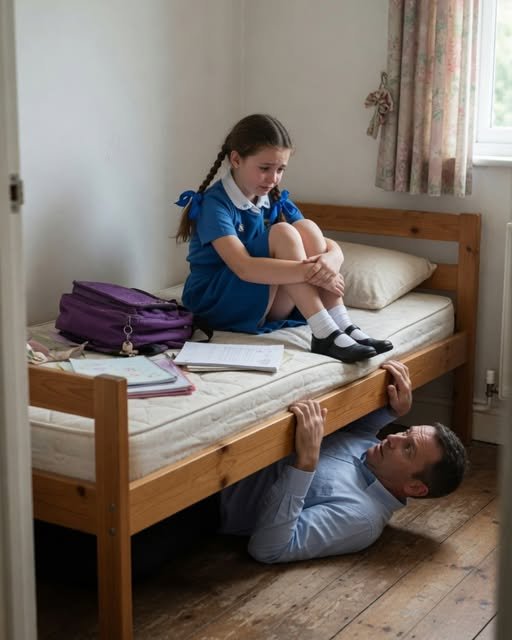
Then I decided to hide beneath the bed in my bedroom.
Twenty minutes passed.
Suddenly, I heard the front door open.
Light footsteps moved through the house and slowly climbed the stairs.
Someone entered my bedroom.
The mattress sank beneath their weight.
At first, I heard a quiet sob.
Then another.
Finally, a broken voice whispered, “Please… that’s enough.”
It was Lucía.
My daughter, who should have been sitting in a classroom, was curled up on my bed, crying as though the entire world were crushing her.
From underneath the bed, I could see only her white sneakers and the socks from her school uniform.
Between painful sobs, she repeated the same words.
“I’m not going to lose. I’m not going to let them destroy me.”
Then she completely broke down.
As I lay hidden beneath the bed, listening to my daughter cry, I finally understood.
This was not a teenage tantrum.
It was a nightmare that had been unfolding directly in front of me—and I had been too busy to see it.
I had no idea that what my daughter was about to reveal would change our family forever.
PART 2
When Lucía eventually went downstairs, I quietly followed her.
She sat on the living room sofa, wrapped her arms around her knees, and stared blankly ahead. Her eyes were swollen, and her face had lost all its color.
For several seconds, she looked at her reflection in the hallway mirror, almost as though she were searching for the happy little girl she used to be.
“I can’t do this anymore,” she whispered.
That was when I stepped into the room.
“Lucía.”
She jumped and turned toward me, terrified.
“Dad…”
I did not shout.
I could not.
My throat felt completely closed.
“Why aren’t you at school?” I asked.
Her lips began trembling.
“I went this morning, but I left.”
“How long have you been doing this?”
She lowered her eyes and remained silent.
I sat across from her, leaving enough space so she would not feel trapped.
“Doña Estela heard you screaming,” I said gently. “Today, I heard you too. Please don’t tell me everything is normal anymore.”
Lucía squeezed her hands together until her knuckles turned white.
“They’ve been bothering me at school.”
The word “bothering” was far too small for what she began to describe.
At first, they hid her backpack.
Then they wrote cruel messages inside her notebooks.
Soon, notes began appearing on her desk.
“You’re disgusting.”
“Nobody wants you here.”
“You should leave.”
One day, someone placed sharp tacks inside her shoes.
Another time, they edited a photograph of her and shared it throughout the school’s WhatsApp groups.
Nobody defended her.
Some students laughed.
Others simply looked away and pretended nothing was happening.
“Who is doing this?” I asked.
Lucía swallowed nervously.
“Nayeli Ríos.”
The surname struck me like a stone.
But I still refused to understand what it might mean.
Verónica arrived home thirty minutes later. The moment she saw us sitting together, she knew something serious had happened.
The three of us sat in the living room while Lucía continued telling her story.
Nayeli was not acting alone. Several students followed her and did whatever she ordered because Nayeli’s mother, Professor Alma Ríos, worked at the school.
“I went to speak with her,” Lucía explained. “I told her everything her daughter had done.”
“What did she say?” Verónica asked.
Lucía gave a bitter laugh.
“She told me that her daughter would never behave that way. She said I was probably making everything up because I wanted attention.”
Verónica covered her mouth in horror.
I felt a deep anger rising inside my chest.
“Then Nayeli discovered that I had reported her,” Lucía continued. “After that, everything became worse.”
Nayeli and her friends invented a story claiming that Lucía had been harassing another student.
They created a fake social media account using Lucía’s name.
In the hallways, they called her crazy, obsessive, and dishonest.
The school nurse already knew Lucía well because she had repeatedly arrived at the office suffering from stomach pain, dizziness, panic attacks, and uncontrollable crying.
Meanwhile, I had been carrying bags of cement, convinced that everything in my home was perfectly fine.
“Why didn’t you tell us?” Verónica asked through her tears.
Lucía looked at both of us with an expression so filled with sadness that it broke something inside me.
“Because you always say that people need to be strong and endure difficult things,” she told her mother.
Then she looked at me.
“And you, Dad… you were never here.”
There was nothing I could say to defend myself.
After a long silence, I finally asked the question that had been burning inside me.
“Why is Nayeli doing this to you?”
Lucía lowered her gaze.
“She said you ruined her mother’s life.”
Verónica immediately turned toward me.
“Do you know that woman?”
I froze.
Yes.
I had known Alma Ríos many years before I married Verónica.
We had shared a brief relationship that ended badly. Instead of explaining myself or ending things properly, I had walked away without looking back.
I buried the memory and convinced myself that time would erase the pain my cowardice had caused.
I never imagined that the past would return years later and become poison in my daughter’s life.
“Nayeli told me that her mother cried because of you,” Lucía said. “She said it was finally my turn to pay.”
Verónica stood up, trembling with anger.
“An adult allowed this to happen because she wanted revenge?”
Guilt tightened around my chest until I could barely breathe.
The following morning, the three of us went to the school.
The principal welcomed us with a polite but obviously false smile. Professor Alma Ríos was already sitting inside the office, perfectly dressed and completely calm, as though her position at the school gave her authority over the truth.
“We should handle this situation calmly,” the principal said.
“The time for calm has passed,” I replied.
I placed everything we had gathered on the table: screenshots, messages, dates, medical reports from the nurse, and records of Lucía’s absences.
Alma barely glanced at the evidence.
“Teenagers exaggerate,” she said dismissively.
“Say that again while looking directly into my daughter’s eyes,” I replied, pointing toward Lucía.
Alma could not do it.
I leaned closer and stared directly at her.
“Your daughter is not attacking mine because of an argument between teenagers. She is using Lucía to collect a debt that belongs to adults.”
The principal slowly turned toward Alma.
For the first time, the teacher lost her calm expression.
“There are men who destroy people’s lives and then pretend to be saints,” she spat.
At that moment, everyone in the room understood the truth.
To Alma, Lucía had never been an innocent student who needed protection.
She had been the perfect target.
We believed the truth was finally about to come out.
But then Alma smiled coldly and said something that took our breath away.
End Part Here: The Screams Inside My House