I returned from a two-week trip to find 15 strangers sleeping in my living room. My daughter had given her in-laws my house keys without asking. But when I showed her mother-in-law something I’d brought home, she went pale and demanded to know who else had seen it. What was she hiding?
At 62, I never imagined I’d have to ask strangers to get out of my own house.
I had just returned from two weeks in Florida, visiting my sister.
It was Sunday morning, and I was looking forward to a shower, fresh coffee, and sleeping in my own bed.
Instead, I opened my front door and nearly tripped over a pair of men’s shoes.
Suitcases lined the staircase, and a child’s jacket hung from my grandfather’s coat rack.
Then I looked into the living room.
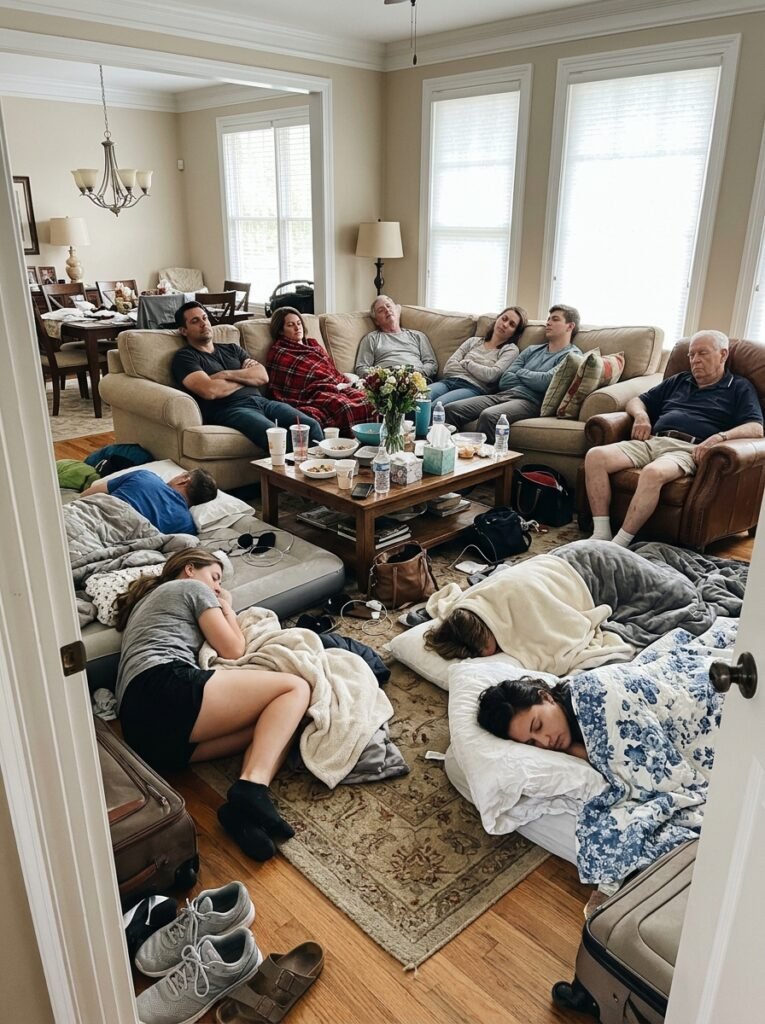
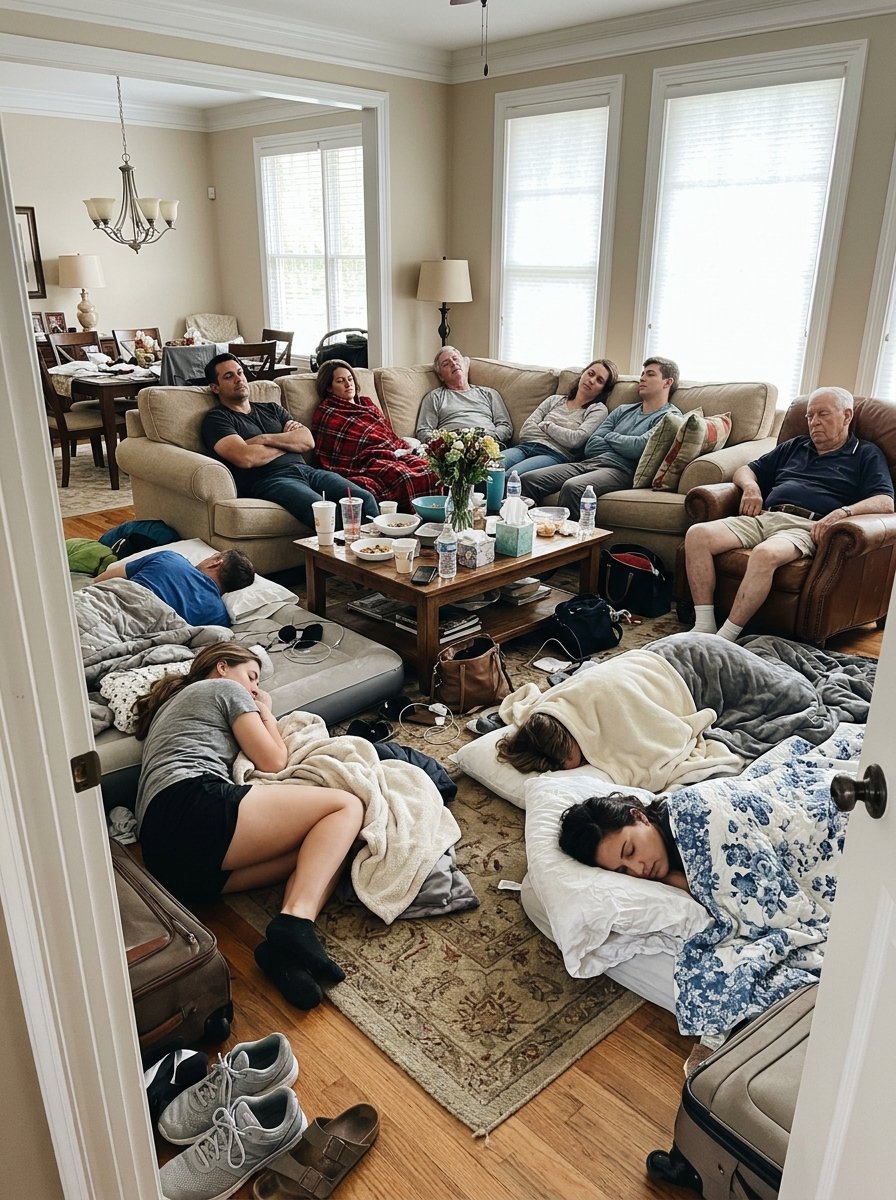
Fifteen strangers were sleeping on air mattresses across my floor.
One woman had wrapped herself in the blue blanket my late husband had given me for our anniversary.
For several seconds, I couldn’t move.
Then I called my daughter.
“Emily, why are there people sleeping in my house?”
“Oh, Mom, relax! They’re David’s relatives. His parents needed somewhere to host a family reunion.”
“Fifteen people?”
“They’re leaving tomorrow. Don’t make a scene.”
“Emily, I gave you that key to water my plants!”
“I know. But you weren’t using the house.”
Before I could respond, she hung up.
I stood in the hallway, staring at the phone.
My refrigerator was nearly empty. Dirty dishes filled the kitchen sink, and someone had moved the photographs of my late husband, Robert, from the mantel.
I found them stacked in a drawer beneath the television.
That’s when David’s mother, Linda, entered the kitchen.
“Oh, you’re back early!” she said brightly.
“I’m back when I said I’d be back.”
Linda glanced toward the living room.
“Well, everyone is still sleeping. Could you keep your voice down?”
I looked at her.
“This is my house, Linda.”
“Of course, dear. But we’re practically family.”
She said it as though that settled everything.
I wanted to demand that everyone leave immediately. Instead, I remembered something my sister had given me before I left Florida.
“Actually,” I said, “I brought something back. I think everyone should see it.”
Linda smiled.
“How thoughtful!”
I went upstairs, carrying my suitcase around the luggage blocking the steps.
Inside my bag was a small wooden urn containing some of Robert’s ashes.
My sister had kept it after our private memorial by the ocean. She’d also given me an old photograph she’d found among our mother’s belongings.
I had slipped the photograph beneath the urn’s removable inner lid to keep it safe.
When I returned downstairs, several guests were awake and gathered around the kitchen table.
I placed the urn in front of Linda.
“Go ahead. Open it.”
She laughed nervously.
“Is this some kind of joke?”
“Just look.”
Linda lifted the lid.
Her smile disappeared.
She stared at the photograph lying above the sealed container of ashes.
“Whose ashes are these?” she whispered.
“Robert’s. My husband.”
Her hands began shaking.
Then she turned the photograph over and read the words written on its back.
She slammed the lid shut.
“Who else has seen this?” she demanded.
Before I could answer, David appeared in the doorway.
“Mom? What’s going on?”
Linda immediately pulled the urn toward herself.
“Nothing. We’re just talking.”
I reached across the table and took it back.
“No,” I said. “I think we’re finally going to talk about something you’ve been hiding.”
David looked from his mother to me.
“What are you talking about?”
I opened the urn and removed the photograph.
It showed Robert as a young man, perhaps 20, standing beside a teenage girl with dark hair and a crooked smile.
On the back, Robert had written, “My little sister, Linda. I hope someday she’ll come home.”
David stared at it.
“Mom, that’s you.”
Linda said nothing.
I looked at her.
“Why is my husband calling you his sister?”
She pushed back her chair.
“I don’t want to discuss this in front of everyone.”
“Then let’s go into the dining room.”
David followed us.
Linda tried to stop him.
“David, please.”
He shook his head.
“If this involves our family, I want to hear it.”
I closed the dining room door.
For years, Robert had occasionally mentioned a girl he’d grown up with.
Her name was Linda.
His parents had taken her in when she was nine, after her own family fell apart. She lived with them for several years, and Robert always considered her his younger sister.
But she’d left their home as a teenager.
Whenever I asked what happened, Robert would say, “We lost touch. I wish we hadn’t.”
He never showed me a photograph.
Or perhaps he had, and I’d forgotten the face of a girl who’d grown into someone entirely different.
Linda stared at the floor.
“Robert was my foster brother,” she finally admitted.
David looked stunned.
“You told me you grew up with distant relatives.”
“I did.”
“You never said you had a brother.”
“He wasn’t my real brother.”
The words stung, even though they weren’t directed at me.
I remembered Robert talking about her with such affection.
“He thought you were his sister,” I said.
Linda folded her arms.
“That was a long time ago.”
“How long have you known who I am?”
She hesitated.
“Since Emily and David got engaged.”
I looked at her, eyes wide.
“That was six years ago.”
“I recognized Robert in a photograph Emily showed us.”
“And you never said anything?”
“I didn’t see the point.”
I thought about every holiday dinner we’d shared. Every birthday party. Every conversation about Robert after his death.
Linda had listened while I spoke about my husband, knowing she’d grown up beside him.
“Did you ever tell him?” I asked.
She shook her head.
Robert had died four years earlier after a brief illness.
He’d never known that the girl he’d missed for decades was living only a short drive away.
David pulled out a chair.
“Mom, why would you hide that?”
Linda’s face hardened.
“Because Robert abandoned me.”
The room went quiet.
She explained that when Robert was 22, he’d moved away for work.
He’d met me a few years later, married, and built his own family.
Linda had been 17 when he left.
“He promised we’d always be family,” she said. “Then he got a new life, and I became someone he used to know.”
“Did you ever contact him?” David asked.
“He knew where I was.”
“That’s not what I asked.”
Linda looked away.
I remembered the photograph in my hand.
“Robert wrote that he hoped you’d come home.”
She gave a bitter laugh.
“People write all kinds of things.”
Something about her certainty bothered me.
I knew Robert hadn’t been perfect. We had disagreements, and there were times when work took too much of his attention.
But he wasn’t a man who gave up on people easily.
I looked at Linda.
“Did he actually stop contacting you, or did you stop answering?”
Her expression changed.
For the first time, she seemed uncertain.
Then she stood.
“I’m not going to be interrogated in a house full of guests.”
I stood too.
“Those guests are leaving.”
Linda blinked.
“What?”
“Today. Not tomorrow.”
“You can’t throw everyone out because of an old family disagreement.”
“I’m asking them to leave because they were invited into my home without my permission.”
David looked uncomfortable.
“I’ll help everyone pack.”
Linda turned toward him.
“You’re taking her side?”
“I’m saying we shouldn’t have been here without asking.”
She opened her mouth, then closed it.
I went into the living room and spoke clearly enough for everyone to hear.
“I’m sorry to interrupt your reunion, but this house wasn’t available for guests. Please gather your belongings and make arrangements to leave.”
People stared at me.
One man asked whether there’d been a misunderstanding.
“Yes,” I said. “A very serious one.”
Within minutes, the house filled with embarrassed conversations and the sounds of zippers closing.
Linda retreated to the kitchen.
David began helping relatives carry their bags outside.
I called Emily.
This time, she answered immediately.
“Mom, David says you’re kicking everyone out!”
“Yes.”
“Do you realize how humiliating that is?”
“Emily, come over. We need to talk.”
“Can’t this wait?”
“No.”
She arrived 20 minutes later, visibly angry.
“David’s family traveled from three different states,” she said before I’d even closed the door.
“And whose decision was it to invite them here?” I asked.
“Linda needed a place big enough for everyone.”
“Then she should have rented one.”
“Mom, you were in Florida.”
“That doesn’t make my house available.”
Emily glanced toward the living room, where David was rolling up an air mattress.
“I thought you’d understand.”
“Did you think I’d understand, or did you think I wouldn’t find out?”
She didn’t answer.
I led her into the kitchen.
“Who moved your father’s photographs?”
Emily looked confused.
“What?”
“Someone took every photograph of Robert off my mantel.”
She glanced toward Linda.
“Linda thought the family pictures made the living room feel too personal for guests.”
I stared at my daughter and asked, “Too personal?”
“She said people might feel uncomfortable sleeping beneath photographs of someone who’d died.”
“And you agreed?”
Emily looked down.
“I didn’t think it mattered where they were for a few days.”
I opened the drawer and took out Robert’s favorite photograph.
It showed us standing beside the ocean on our 30th anniversary.
“He lived here for 28 years,” I said. “You grew up in this house. How could his photographs matter less than strangers feeling comfortable?”
Emily’s eyes filled with tears.
“I didn’t mean it that way.”
“But that’s what you allowed.”
She sat at the table.
We kept quiet for a few seconds.
Then I showed her the old photograph.
“There’s something else you need to know about Linda.”
I explained what we’d discovered.
Emily stared at the picture.
“She knew Dad?”
“She grew up with him.”
“Why wouldn’t she tell us?”
“That’s what I’d like to understand.”
Emily looked toward the hallway and said, “She always gets strange when I mention Dad.”
“What do you mean?”
“At our engagement dinner, I showed her a photograph of him. She went quiet and said she didn’t like talking about people who were gone.”
I remembered that dinner.
Linda had left early, claiming a headache.
I’d assumed she was tired.
Now I wondered how many moments I’d misunderstood.
By noon, most of the guests had left.
David came into the kitchen.
“I’m sorry,” he said. “I should’ve checked with you.”
“Yes, you should have.”
He nodded.
“Mom told me Emily had already cleared everything with you.”
Emily looked up.
“She told me David had spoken to Mom.”
David turned toward his wife.
“I never said that.”
Linda appeared behind him.
“Can we please stop making this into a disaster?”
I looked at her.
“You told each of them the other had permission?”
She sighed.
“I knew you’d say no if we asked directly.”
The admission silenced everyone.
“So you decided my answer didn’t matter.”
Linda crossed her arms.
“It was one weekend.”
“No,” I said. “It was my home.”
David shook his head.
“Mom, you lied to both of us.”
“I was trying to make everyone happy.”
“Except her,” he said, pointing toward me.
Linda’s expression tightened.
I looked at the old photograph again.
“Why did you really want the reunion here?”
She stared at me.
“Because it’s a nice house.”
“Linda.”
Her eyes filled.
“I wanted to see it.”
“See what?”
“Where Robert lived.”
The answer surprised me.
She glanced around the kitchen.
“When Emily first showed me pictures of this place, I recognized him. Then I heard he’d died. I kept thinking about all those years he spent here.”
“Why didn’t you ask to visit?”
“Because I didn’t want you asking questions.”
“So you came when I was away.”
She nodded.
“And you removed his photographs?”
Linda wiped her eyes.
“I couldn’t stand looking at them.”
I thought of Robert smiling beside me in the anniversary picture.
“Those photographs are my memories,” I said. “You had no right to hide them because they hurt you.”
Linda began crying.
“I know.”
But I wasn’t ready to comfort her.
After the last guest left, David and Emily stayed to clean.
I insisted they wash every dish, take out the trash, and restore the furniture.
Linda offered to help, but I asked her to go home.
Before leaving, she looked at the urn.
“Can I have that photograph?”
“No.”
Her face fell.
“It’s the only picture I’ve seen of us together in years.”
“I’ll consider giving you a copy. But I need time.”
She nodded and left.
That evening, after the house was quiet again, I called my sister.
I told her everything.
She listened without interrupting.
Then she said something that changed the story again.
“Robert tried to find Linda more than once.”
I sat up.
“What?”
“Remember that box of letters I found while sorting Mom’s things? There were copies of letters Robert wrote to Linda.”
I remembered the box.
My sister had mentioned it during my visit, but we’d been busy arranging our family remembrance.
“Why didn’t you tell me?”
“I thought you knew. Some were addressed to her, and others were notes he’d written after they came back.”
My sister explained that Robert had kept copies of several letters in an old folder.
One invited Linda to our wedding.
Another told her about Emily’s birth.
A third, written years later, said he still hoped they could speak.
Several envelopes had been returned unopened.
I closed my eyes.
“Can you send me pictures of them?”
“Of course.”
Within an hour, the photographs arrived on my phone.
I read every word.
Robert had written with warmth, regret, and patience.
He’d apologized for leaving when Linda was young.
He’d explained that he needed work and hadn’t understood how abandoned she’d felt.
But he’d never stopped inviting her back into his life.
The final letter had been written shortly before he became ill.
“I don’t know whether you’ll ever read this. I just want you to know you still have a brother.”
I cried when I read it.
Not because it changed how I remembered Robert.
Because it showed how much he’d carried quietly.
The next morning, I called Linda.
“I found some letters Robert wrote to you.”
She was silent.
“Did you receive them?”
“Some.”
“Did you read them?”
“Not all.”
“Why?”
Her voice trembled.
“Because I was angry.”
I looked at the photographs restored to my mantel.
“He never stopped thinking of you.”
Linda began crying.
“I know that now.”
I waited.
Then she said, “When he left, I was convinced everyone eventually left. I thought if I rejected him first, it wouldn’t hurt as much.”
“But you told David that Robert abandoned you.”
“That was easier than admitting I wouldn’t answer him.”
I understood her pain better now.
It didn’t excuse what she’d done.
“Linda, you used my daughter to get into my house. You lied to both our children, and you treated Robert’s memory like something that needed hiding.”
“I know.”
“If you want any relationship with me, it starts with respecting my boundaries.”
She agreed.
A week later, Emily came over alone. She brought groceries to replace what the guests had eaten and money for the extra cleaning supplies.
Then she placed my spare key on the table.
“I’m sorry, Mom.”
I looked at her.
“What are you sorry for?”
She took a breath.
“For treating your home like something I could offer without asking. For letting Linda convince me it was harmless. And for hanging up when you called.”
I nodded.
“Thank you.”
She wiped her eyes.
“I think I was so worried about keeping my in-laws happy that I forgot I was hurting you.”
“Being married doesn’t mean you stop being responsible for your own choices.”
“I know.”
I reached for her hand.
“I love you. But trust takes time to rebuild.”
She squeezed my fingers.
“I understand.”
Over the following weeks, Emily visited regularly.
She called before coming, helped me in the garden, and never asked for another key.
David apologized again and made sure his relatives understood that the reunion had happened without my consent.
Linda sent a handwritten letter.
She apologized for entering my home, moving Robert’s photographs, and hiding their connection.
She also admitted she’d spent years blaming Robert for a separation she’d helped maintain.
I wasn’t ready to invite her over.
But I made a copy of the old photograph and mailed it to her.
On the back, I copied Robert’s words.
“My little sister, Linda. I hope someday she’ll come home.”
I kept the original beside the urn.
One Sunday morning, I sat in my living room with a cup of coffee.
The air mattresses were gone. The furniture was back where it belonged.
Robert’s photographs stood on the mantel again.
Emily had helped me clean the blue blanket, and it was folded over my favorite chair.
I looked around the room.
For two weeks, I’d been away from home.
For one terrible morning, I’d returned to find strangers acting as though it belonged to them.
But the worst part hadn’t been the mess.
It was discovering how easily people I trusted had decided my feelings didn’t matter.
I had changed the locks.
More importantly, I’d made it clear that loving my family didn’t mean surrendering my home.
I picked up Robert’s photograph and smiled.
Then I put it back where it belonged.
So here’s the real question: If your daughter secretly gave her in-laws permission to stay in your house and dismissed your objections when you found out, would you eventually trust her with a spare key again, or would that boundary be permanent?