
PART 1: The Secret Behind Her Tears
“My best friend of forty-two years asked me for one last photograph together, then looked me in the eyes and warned me that by tomorrow, I might hate her for the rest of my life.”
I laughed when Susan first said it, because I thought she was making one of her usual dramatic jokes, but the expression on her face made the sound die in my throat before I could finish.
We were sitting beneath a faded blue beach umbrella, with the afternoon sun warming our shoulders and the Atlantic Ocean stretching endlessly before us, yet Susan looked as though she had just received the worst news imaginable.
“Because tomorrow, you’re going to discover who I really am,” she whispered.
I stared at her, waiting for the smile that would tell me she was teasing, but she only gripped the edge of her beach towel until her knuckles turned white.
“And after that,” she continued, “you may never want to speak to me again.”
For forty-two years, I had trusted Susan with practically every part of my life, so hearing those words from her felt like watching the ground open beneath my feet.
I wanted to reach for her hand, to reassure her that nothing could destroy what we had built together, but something in her eyes stopped me.
Then I asked the question that had suddenly begun to terrify me.
“Susan, does this have something to do with Robert?”
Her eyes closed, and a tear slipped down her cheek.
She never answered.
But in that single moment, I knew my husband’s name was connected to the secret she had carried for years, and I began to wonder whether I had ever truly understood either of the two people I trusted most.
To understand why that silence frightened me so deeply, you need to understand who Susan had been to me.
We met when we were eight years old, after she climbed onto the same school bus and discovered that the only empty seat was beside me.
I remember her yellow backpack, her crooked ponytail, and the way she offered me half of her peanut butter sandwich without asking whether I wanted it.
By the time we reached middle school, we were inseparable, and our mothers had stopped asking where one of us was because they knew the other probably knew.
We shared secrets about our first crushes, cried over disappointments that seemed unbearable at the time, and promised each other that no matter what adulthood brought, we would never become strangers.
When my first boyfriend broke my heart, Susan stayed overnight at my house and listened while I repeated the same miserable story until sunrise.
When her parents separated, she spent several weeks living with my family, and my mother made room for her at our dinner table as naturally as if Susan had always belonged there.
We eventually attended different colleges, but we wrote letters, called whenever we could, and found our way back into each other’s lives without ever needing to explain the distance.
After graduation, we even ended up working for the same company, although we eventually followed different career paths.
By then, our friendship had become so deeply woven into our lives that neither of us could remember exactly when it had stopped being a friendship and started feeling like family.
Then I met Robert.
He was thoughtful without being showy, patient without being passive, and possessed the rare ability to make me feel heard even when I struggled to explain what was troubling me.
Susan liked him from the beginning, and Robert liked her just as much.
He never treated her as an outsider or complained when she joined us for dinner unexpectedly, because he understood that she was as much a part of my life as any relative.
When we married, Susan stood beside me, adjusting my veil and crying harder than my own mother when I walked down the aisle.
She later joked that she had lost her best friend to a man who couldn’t even remember where we kept the good scissors.
Robert laughed and promised that he would share me with her, provided she stopped stealing his favorite coffee mug.
For years, that joke became a familiar part of our friendship.
Susan married too, but her marriage eventually fell apart, leaving her frightened about the future and uncertain about how to begin again.
I helped her pack her belongings, carried boxes into her new apartment, and sat beside her through evenings when she couldn’t stop crying.
Sometimes she called after midnight because loneliness had become unbearable, and I answered even when I had to work the next morning.
Robert never objected.
He would make an extra cup of coffee, leave it on the kitchen counter for her, and tell me that helping someone we loved was never an inconvenience.
Over time, Susan became a regular presence in our home.
She celebrated our birthdays with us, joined our Thanksgiving dinners, spent Christmas afternoons exchanging presents, and sometimes stopped by simply because she wanted company.
She even had a key to our house.
I never questioned it because she was Susan, the girl who had shared her lunch with me when we were children and the woman who had helped me through every heartbreak I could remember.
If she opened the wrong kitchen cabinet while searching for a mug, I laughed.
If she knew where Robert kept his favorite sweater, I thought nothing of it.
If Robert mentioned something to her before telling me, I assumed it was because they had happened to speak first.
Trust makes ordinary things feel ordinary, and I had trusted Susan for so long that I never considered how much she knew about my marriage.
Then Robert died, and the life we had built together collapsed into a silence I couldn’t bear.
His death left our house feeling unfamiliar, even though every piece of furniture remained exactly where we had placed it.
His favorite chair stood beside the living room window, his jacket hung near the back door, and his coffee mug remained on the kitchen shelf because I couldn’t bring myself to put it away.
People told me grief would eventually become easier to carry, but nobody explained what to do with the hours when the person you loved most was no longer there to fill them.
I stopped attending gatherings, ignored invitations, and sometimes let my phone ring until the caller gave up.
Some mornings, I stayed in bed long after sunrise because getting dressed seemed pointless when nobody was waiting for me.
Susan refused to let me disappear completely.
She arrived with groceries when I forgot to eat, persuaded me to take short walks when I had spent too many days indoors, and sat beside me without demanding conversation when words became impossible.
There were afternoons when I cried into her shoulder until my chest hurt, and she held me as patiently as she had when we were eight years old.
I believed she understood my grief because she had known Robert almost as long as I had.
She remembered the same jokes, the same habits, and the same small things that had made our marriage feel like home.
That was why I eventually agreed when she suggested a weeklong vacation at the beach.
“You need to get away from those four walls for a little while,” she told me gently.
“Just the two of us, like the old days.”
I hesitated because leaving home felt strangely disloyal, as though Robert might somehow notice that I had gone somewhere without him.
Susan squeezed my hand and reminded me that he would have wanted me to keep living.
For the first time in months, I allowed myself to imagine a few days without the weight of every memory pressing against me.
And to my surprise, the trip was wonderful at first.
We walked along the shoreline in the mornings, collected seashells, and visited little cafés where we could watch the waves through wide windows.
At night, we stayed awake talking about our childhoods, laughing over old embarrassments and remembering people we hadn’t thought about in decades.
Sometimes we sat quietly beneath the moonlight, listening to the ocean and allowing the silence between us to feel comfortable rather than painful.
For several precious days, I experienced something I had almost forgotten since Robert’s death.
Peace.
Then, on our final afternoon, Susan changed.
She barely spoke while we sat beneath the beach umbrella, and every few minutes I caught her looking at me before quickly turning toward the water.
When I asked whether she was feeling sick, she shook her head.
A little later, she reached toward my phone.
“Can I borrow that for a moment?”
“Of course,” I said, handing it over.
“I want us to take one final photograph together.”
I laughed, assuming she meant it was our last full day of vacation.
“Susan, we’re not saying goodbye forever.”
She didn’t laugh.
Instead, she removed her sunglasses and studied my face with an expression so serious that I felt my stomach tighten.
“I mean our last picture as best friends.”
My smile disappeared.
I asked whether she was planning to move away, whether something had happened with her family, and whether there was some problem she had been afraid to tell me about.
She shook her head at every question.
Finally, she admitted that she had been hiding something from me for years.
“Why didn’t you tell me?” I asked.
“Because every time I tried, I convinced myself there would be a better moment.”
I reminded her that she had never needed to hide anything from me, but she only wiped her cheek and stared toward the ocean.
“I don’t know how you’re going to look at me after tomorrow.”
“What happens tomorrow?”
“Tomorrow, you’ll learn something about who I’ve really been all these years.”
My throat tightened as I studied the woman who had shared nearly every important chapter of my life.
I wanted to believe this was some terrible misunderstanding, something that could be explained over dinner and forgotten by morning.
But when I asked whether Robert had anything to do with her confession, Susan closed her eyes as though I had finally spoken the one name she had been desperately hoping to avoid.
And as the sun lowered toward the horizon, my oldest friend began to cry so hard that she couldn’t bring herself to look at me.
PART 2: The Question She Wouldn’t Answer
“Susan, tell me whether Robert was involved in whatever you’re hiding from me.”
My voice sounded unfamiliar even to me, thin and strained beneath the sound of the waves, but Susan continued staring at the sand as though the answer had been written somewhere between her feet.
“I can’t explain everything tonight,” she whispered.
“Then explain one thing.”
She shook her head.
I had spent forty-two years believing I could recognize every emotion that crossed Susan’s face, yet the fear I saw in her eyes belonged to a woman I didn’t know.
“Did Robert hurt you?” I asked.
Her head snapped up.
“No.”
The answer came so quickly that I almost wished she had taken longer to respond.
“Did he do something you think I wouldn’t forgive?”
Susan pressed her palms against her eyes.
“Please don’t make me explain it like this.”
“Like what, Susan?”
“Here, on the beach, when I know you’re already hurting.”
I felt anger rise through the confusion.
“You chose this moment when you asked for our last photograph.”
She looked down at my phone, which still rested between us on the towel.
“I wanted to remember what we looked like before everything changed.”
“What does that mean?”
She swallowed hard.
“It means I wanted one memory of us that I could keep without feeling ashamed.”
Those words hurt more than I expected.
For years, I had believed that our friendship was one of the few things in my life that could survive almost anything.
Now Susan was speaking as though every happy memory we had shared might contain something I had failed to notice.
I asked her whether she had lied to me about something involving my marriage, and she began crying again.
“I’m sorry,” she whispered.
“I’m sorry for all the years I stayed silent.”
I stood up so abruptly that sand scattered across the towel.
“Then stop apologizing and tell me what happened.”
She reached for my wrist, but I stepped away.
For the first time in my life, I didn’t want her touching me.
That realization frightened me almost as much as her confession.
I walked toward the water, hoping the cold waves would steady my thoughts, while Susan remained beneath the umbrella.
I kept remembering the ordinary moments I had never questioned.
The afternoons when she visited while Robert was home.
The evenings when they discussed things I didn’t understand because I had stepped into another room.
The way Robert sometimes smiled when Susan arrived, as though he had been expecting her.
None of those memories proved anything, but now every one of them seemed capable of carrying a meaning I had never considered.
I hated myself for wondering whether my husband had betrayed me, and I hated Susan for making the question impossible to ignore.
When I finally returned to the umbrella, she was packing our belongings into the beach bag.
“Let’s go back to the hotel,” she said quietly.
I almost refused, but I couldn’t bear the thought of spending another minute pretending everything was normal.
We walked back without speaking.
At the hotel, Susan went directly to her room, and I closed my own door before she could say anything else.
I sat on the edge of the bed and stared at Robert’s photograph on my phone.
It had been taken several years earlier during a family celebration, and he was smiling with one arm around my shoulders.
I enlarged his face, searching for something that might explain the fear Susan had shown when I mentioned his name.
Then I remembered how she had insisted on helping me sort through his belongings after his death.
She had known which boxes contained his old papers, which drawers held his personal items, and which things I wanted to keep close.
At the time, I had been too overwhelmed by grief to question her knowledge.
Now I wondered whether she had been searching for something.
The thought made me feel sick, and I put the phone facedown on the bed.
I didn’t want suspicion to rewrite forty-two years of memories without evidence.
Yet I couldn’t pretend I hadn’t seen what I had seen.
Around eight that evening, someone knocked on my door.
I opened it to find Susan standing in the hallway, holding two cups of tea.
“I thought you might want this,” she said.
I stepped aside without answering, and she placed the cups on the small table near the window.
For several seconds, we stood there awkwardly, like strangers who had accidentally booked rooms in the same hotel.
Then she sat down and looked at me.
“I need you to understand one thing before tomorrow.”
I remained standing.
“What?”
“Whatever you discover, I never wanted to hurt you.”
I let out a bitter laugh.
“You keep saying that as if wanting to hurt me is the only thing that matters.”
Her eyes filled again.
“I know.”
“Did you lie to me about Robert?”
She looked toward the window.
“I lied about things I should have told you.”
My heart began pounding.
“What things?”
She opened her mouth, but no words came.
I pulled out the chair opposite her and sat down.
“Did you have a relationship with my husband?”
Susan recoiled as though I had struck her.
“No,” she said, her voice breaking.
I watched her carefully, searching for the smallest sign that she was lying.
“I loved Robert as your husband and as someone I had known for most of my life,” she continued.
“Then what are you hiding?”
She clasped her hands so tightly that her fingers trembled.
“Tomorrow, I’ll show you.”
I demanded to know why she couldn’t simply tell me now, but she insisted that the truth needed to be explained properly.
There were things I needed to see, she said, and details she could no longer bear to keep to herself.
I asked whether she had documents, photographs, or something Robert had left behind.
At the mention of his belongings, she went completely still.
That reaction was small, but I noticed it.
“What do you have?” I asked.
“Not here.”
“Where?”
“At home.”
I felt a fresh wave of dread.
She had brought something from our shared past into the present, something she had apparently kept for years without telling me.
“Does this involve the time Robert died?” I asked.
Susan lowered her head.
“Yes.”
The single word struck harder than any explanation could have.
I had spent months trying to understand the final period of Robert’s life, revisiting conversations and wondering whether I had missed signs that he was unwell.
Now Susan was telling me that something connected to that time had been concealed from me.
“Was there something he wanted me to know?” I whispered.
She began to cry again.
“I don’t know how to tell you this without destroying everything.”
I stood up and moved toward the door.
“I can’t do this tonight.”
“Susan, please.”
“No,” I said, turning back toward her.
“You’ve had years to prepare for this conversation, and I’ve had less than an hour to wonder whether the two people I trusted most were keeping something from me.”
She flinched at my words, but she didn’t argue.
Instead, she took a small breath and said that she would meet me in the hotel lobby at eight the following morning.
She promised to answer every question, even the ones she had spent years avoiding.
After she left, I locked the door and sat awake for most of the night.
I thought about the friendship we had built, the marriage I had cherished, and the possibility that grief had left me vulnerable to a truth I wasn’t prepared to face.
At seven the next morning, I called Susan’s room, but nobody answered.
I called again ten minutes later, then sent a message asking whether she was still coming.
Finally, at eight fifteen, she appeared in the lobby carrying a thick brown envelope.
Her eyes were swollen, and she looked as though she hadn’t slept either.
“Are you ready?” she asked.
“No,” I replied honestly.
“But I’m done waiting.”
We sat near the hotel windows, where the morning sunlight fell across the envelope between us.
Susan placed both hands on it, then looked directly at me.
“Before I show you what’s inside, you need to know that Robert and I made a promise to each other, and I broke it by keeping that promise from you.”
My heart seemed to stop.
She slowly opened the envelope and withdrew a photograph I had never seen before.
It showed Robert standing beside Susan outside a building I recognized immediately as the hospital where he had spent the final days of his life.
But it wasn’t the photograph itself that made my blood run cold.
On the back, in Robert’s unmistakable handwriting, were six words that changed the meaning of everything I thought I knew about my husband’s final days.
PART 3: The Promise That Kept Us Apart
I turned the photograph over again, hoping I had misunderstood the handwriting, but the six words remained exactly where they were.
“Please don’t tell her until you’re ready.”
Robert had written them in the same careful script he used for birthday cards, grocery lists, and the small notes he sometimes left beside my coffee cup.
I stared at the message until the letters blurred.
“Ready for what?” I demanded.
Susan pressed her hands together.
“I don’t know whether he meant ready to hear the truth or ready to make a decision.”
“What truth?”
She took a breath that trembled on the way out.
“Robert asked me to keep something from you while he was alive, and I agreed because I believed I was helping him protect you.”
I felt a sharp ache in my chest.
“Protect me from what?”
She looked at the photograph instead of answering.
I asked where it had been taken, and she explained that she had visited Robert at the hospital during the final days of his illness.
I remembered that period clearly, though the memories were tangled with exhaustion and fear.
I had spent long hours beside his bed, holding his hand and trying to memorize every expression on his face because I knew I might not have much time left with him.
Susan had visited too, sometimes when I was there and sometimes when I had gone home to shower or sleep.
I had never questioned those visits because I believed she wanted to support both of us.
“You were alone with him?” I asked.
“Sometimes.”
“What did he tell you?”
She rubbed her palms against her knees.
“He talked about you.”
“That doesn’t explain anything.”
“He talked about your life together, about how much you had done for him, and about how afraid he was of leaving you alone.”
I felt a fresh surge of anger.
“Robert didn’t need to tell you that I loved him.”
“I know.”
“Then why did he make you promise to hide something from me?”
Susan closed her eyes.
“Because he was afraid you would spend the rest of your life blaming yourself.”
The words struck a nerve I had been trying to protect since Robert died.
I had blamed myself for so many things already.
I had wondered whether I should have recognized his symptoms earlier, insisted on another appointment, or pushed harder when he told me he was tired.
I had replayed conversations in which he said he felt fine, searching for clues that might have changed what happened.
I had even caught myself wondering whether one different decision could have given us more time together.
Now Susan was telling me that Robert had known I might blame myself, and that knowledge had been important enough for him to ask her to conceal something.
“What did I do?” I whispered.
Susan immediately shook her head.
“Nothing.”
“Then tell me why he thought I would blame myself.”
She reached toward the envelope and removed another folded piece of paper.
“This was written in his own hand,” she said.
I recognized the handwriting before she unfolded it, and my fingers began trembling.
The note was short, with several lines crossed out and rewritten, as though Robert had struggled to find the right words.
It said that he wanted me to remember our marriage as a life we had shared rather than a series of things I should have done differently.
He wrote that I had loved him well, that I had given him more happiness than he could ever repay, and that I must never turn his death into a punishment for myself.
By the time I reached the final line, tears were running down my face.
“He knew,” I whispered.
Susan nodded.
“He knew you would blame yourself.”
I pressed the note against my chest, overcome by the familiar grief of hearing Robert’s voice in words he had left behind.
For several minutes, I could barely speak.
Then the other question returned, sharper than before.
“If he wanted me to have this, why didn’t you give it to me?”
Susan looked down at her hands.
“Because there was something else he asked me to do first.”
I slowly lowered the note.
“What?”
She hesitated for so long that I began to fear the answer.
“He wanted me to make sure you had someone who would stay beside you after he was gone.”
I stared at her.
“I thought that’s what you were doing.”
“I was.”
“Then what did you hide?”
She reached into the envelope again and removed a small bundle of papers secured with a faded ribbon.
I noticed dates written in the corners, some from the months before Robert died and others from the weeks afterward.
They appeared to be letters, though none had my name on the outside.
“Robert wrote these while he was in the hospital,” Susan explained.
“He asked me to keep them together until I believed you were ready to read them.”
I felt a sudden chill.
“How many?”
“Several.”
“And you’ve had them all this time?”
She nodded.
I wanted to snatch the bundle from her, but something in the way she held it made me pause.
“Why did you wait until now?”
“Because I was afraid of what the letters would do to you.”
“You don’t get to decide what I can handle.”
“I know that now.”
Her admission sounded genuine, but it didn’t erase the years of silence.
I asked whether Robert had written anything about his illness, and she told me that some letters described his fear, while others contained memories and things he wanted to say if he could no longer speak to me.
I asked whether he had written about the final day.
Susan nodded slowly.
“He wrote about that too.”
My mouth went dry.
“What did he say?”
She pulled out a letter dated two days before his death.
I reached for it, but she held it for one more moment.
“There is something you should understand,” she said.
“I didn’t keep these because I wanted to control you or take something from you.”
“Then why?”
“Because Robert made me promise that I wouldn’t give them to you until you had begun to live again.”
I remembered the months after his death, the days when Susan practically dragged me out of bed, brought food to my house, and stayed until I could manage the evening alone.
She had been patient when I pushed her away, and she had never demanded gratitude for the things she did.
I had believed that was simply the kind of friend she was.
Now I wondered whether every visit had been shaped by a promise I knew nothing about.
“Were you helping me because you loved me,” I asked, “or because Robert told you to?”
Susan’s face crumpled.
“Both.”
The answer hurt because it was exactly the one I feared.
I wanted to believe her, but I couldn’t ignore the possibility that Robert’s request had changed the meaning of our friendship.
She told me that she had continued helping because she loved me, not because a dying man had ordered her to, and that she would have stayed even if he had never asked.
I looked at the letters, then at the photograph, and realized that the secret was larger than a single hidden note.
For the first time, I began to suspect that Robert had entrusted Susan with more than his final thoughts.
I asked her whether there was anything else she had not told me.
She stared at the envelope for a long moment before answering.
“Yes.”
My stomach tightened.
“What?”
She pulled out one final document, folded into thirds and marked with a date from the week Robert died.
“I kept this separate because I didn’t know whether you would ever want to see it.”
I unfolded the paper carefully.
The first lines were familiar, written in Robert’s hand, but halfway down the page, the wording changed into a message addressed directly to Susan.
He thanked her for standing beside me, then asked her to remember something he had told her privately.
The last sentence was unfinished.
I looked up at Susan.
“What does this mean?”
She began shaking her head, tears spilling freely now.
“I thought I understood what he wanted when he wrote it.”
“And now?”
She swallowed, then whispered the words I had been dreading since the moment she asked for our last photograph.
“Now I think I misunderstood the most important part of his promise.”
PART 4: What Susan Had Been Afraid to Say
I read Robert’s unfinished sentence again and again, hoping the words would arrange themselves into an explanation that made sense.
The ink had faded slightly, but his handwriting remained unmistakable, and the message stopped in the middle of a thought as though he had been interrupted or simply become too tired to finish.
Susan sat across from me with both hands covering her mouth.
“What did he mean?” I asked.
“I don’t know anymore.”
“You’ve had these letters for years.”
“I know.”
“You’ve read them.”
“Yes.”
“And you still don’t know?”
She lowered her hands, looking exhausted.
“I thought I did, but the longer I kept them, the more afraid I became that I had misunderstood him.”
I pushed the unfinished note toward her.
“Then tell me what you believed.”
She took it with trembling fingers and stared at the final lines.
“Robert asked me to help you remember that you were loved,” she said.
“He wanted you to have a reason to keep living after he was gone, and he wanted me to make sure you didn’t spend every day blaming yourself.”
I swallowed hard.
“That part I understand.”
“But he also asked me to tell you something about our friendship.”
I went completely still.
“What?”
Susan’s eyes filled again.
“He said that if you ever began to wonder whether I had stayed only because of my promise, I should tell you that you were never a responsibility he had placed on me.”
I looked at her without speaking.
“He told me I could stop coming whenever I needed to,” she continued.
“He didn’t want me to sacrifice my own life because I felt obligated to care for you.”
I felt something shift inside me, but the relief was mixed with anger.
“Then why did you keep this from me?”
“Because I was afraid that if I told you about the promise, you would think every kind thing I did was an obligation.”
I remembered the groceries, the quiet afternoons, the invitations to leave the house, and the countless times Susan had stayed beside me when grief made ordinary conversation impossible.
Had she been comforting me because she wanted to, or because she was afraid of breaking a promise to a dying man?
The question felt cruel, but I could no longer stop myself from asking it.
“Did you ever resent me?”
Susan looked horrified.
“No.”
“Not once?”
“There were times I was tired, times I didn’t know what to say, and times I went home and cried because I couldn’t make your pain disappear.”
She took a shaky breath.
“But I never resented you for grieving Robert.”
I wanted to believe her, yet the years of secrecy had created a distance that neither of us knew how to cross.
I asked whether Robert had told her anything else about me, anything he had wanted her to keep private.
She hesitated before answering.
“He told me that you sometimes tried to carry everyone’s pain because you believed being strong meant never asking anyone to carry yours.”
I looked away.
It was something Robert had said to me many times, usually when I insisted I was fine even though I was exhausted.
Susan continued explaining that he worried I would turn his death into another burden I had to manage perfectly.
“He didn’t want you to become afraid of happiness,” she whispered.
“He wanted you to laugh again without feeling guilty afterward.”
I pressed my fingers against my forehead, overwhelmed by the realization that Robert had anticipated so much of my grief.
But one question remained.
“Why did you call our photograph the last one as best friends?”
Susan looked at me for a long moment.
“Because I knew you might not forgive me for keeping these letters.”
“That doesn’t mean our friendship has to end.”
“I know, but I couldn’t keep pretending nothing had happened.”
She told me that she had spent years debating whether to give me the letters, and each time she considered it, she remembered the worst days after Robert’s death.
She remembered me sitting on the floor beside his chair, refusing to eat, and telling her that I didn’t know who I was without him.
She had feared that the letters would make me relive those days, and she had convinced herself that waiting was an act of kindness.
But waiting had become its own kind of betrayal.
“You should have trusted me to decide what I was ready to know,” I said.
She nodded, tears falling onto the table.
“You’re right.”
Her willingness to admit it made my anger harder to sustain, but it did not make the hurt disappear.
I gathered the letters into a neat stack and asked whether she had kept anything else.
Susan shook her head, then stopped.
“There is one more thing.”
I closed my eyes briefly.
“Of course there is.”
She reached into her handbag and removed a small envelope with my name written across the front.
Unlike the other papers, this one had never been opened.
“I found it among Robert’s belongings after the funeral,” she explained.
“He had asked me to keep it separate from the others, but I couldn’t bring myself to give it to you.”
I stared at the envelope.
“Why?”
“Because he wrote that you should read it when you were ready to make a decision about your future.”
My hands began trembling.
“What decision?”
Susan shook her head.
“He didn’t say.”
I turned the envelope over and noticed that it had been sealed carefully, with no sign that anyone had opened it.
For years, it had been sitting somewhere in Susan’s possession while I searched for ways to make sense of my husband’s absence.
I asked why she hadn’t simply returned it with the rest of his belongings.
She admitted that she had been afraid I would see it as another responsibility, another demand from a man who was no longer alive to explain what he meant.
She had told herself she was protecting me, but the truth was that she had been protecting herself from the moment I might look at her and ask why she had waited so long.
I held the envelope against my chest.
For the first time since our conversation began, I felt certain about one thing.
I couldn’t allow someone else’s fear to determine what I was allowed to know about my own life.
“I want to read it,” I said.
Susan nodded.
“Of course.”
“Not here.”
“Where?”
“At home.”
I placed the letters and the sealed envelope inside my bag, then stood up.
Susan rose too, but I held out my hand to stop her from coming closer.
“I need some time to think.”
She nodded, looking as though she had expected nothing else.
“I understand.”
I left the hotel without waiting for her, carrying the words Robert had left behind and the painful knowledge that my oldest friendship had survived forty-two years without ever being entirely honest.
On the journey home, I barely spoke.
I kept thinking about the unfinished sentence, the photograph from the hospital, and the promise that had shaped Susan’s actions long after Robert was gone.
By the time I reached my house, the familiar sight of the front door brought tears to my eyes.
I entered the living room and sat in Robert’s favorite chair, allowing the silence to settle around me.
Then I placed the sealed envelope on the table.
My name was written across the front in Robert’s handwriting, and beneath it were four words that made me realize the letter was not simply a goodbye.
It was a question he had left for me to answer.
PART 5: The Truth About Forty-Two Years
I sat in Robert’s favorite chair for nearly an hour before I found the courage to open the envelope, turning it over in my hands as though the paper itself might tell me what he had wanted me to decide.
The four words beneath my name had stayed with me throughout the journey home.
“When you’re ready, choose.”
I had no idea what they meant, but I knew I could no longer let fear decide whether I would read them.
Carefully, I broke the seal and unfolded the letter.
Robert began by telling me that he wished he could have been beside me when I read it, because he knew how much I hated making important decisions alone.
He wrote that he had spent much of his life believing he could protect the people he loved by carrying their worries himself, and that he had finally realized how unfair that could be.
He apologized for the things he had left unsaid and reminded me that our marriage had never depended on either of us being perfect.
Then he wrote about Susan.
He said that she had been one of the people who helped make our life together richer, and that he was grateful I had found a friend who could remain beside me through so many different seasons of life.
He also admitted that he had asked her to keep some of his letters until I was ready to receive them, not because I was weak, but because he knew grief could make even the smallest decision feel impossible.
He had wanted me to have the freedom to read them when I chose, rather than feeling obligated to confront everything while I was still trying to survive each day.
Then I reached the sentence that made me stop.
“Please don’t let my death turn the person who loves you into someone you are afraid to trust.”
I read it several times.
Robert wasn’t asking me to ignore what Susan had done, and he wasn’t telling me that I had to forgive her immediately.
He was reminding me that love and mistakes could exist in the same person, and that the choice to trust again had to be mine.
The final paragraph was shorter.
He wrote that if I ever found myself standing between the comfort of familiar grief and the uncertainty of a new beginning, I should remember that living again was not a betrayal of the life we had shared.
He wanted me to keep the memories, but he didn’t want those memories to become a room I could never leave.
By the time I finished reading, tears were streaming down my face.
I had spent so long trying to preserve everything exactly as it had been when Robert was alive that I had forgotten how often he had encouraged me to keep growing.
I looked around the living room at his chair, his books, and the small collection of photographs on the shelf.
For the first time, I wondered whether keeping every object untouched had become less about remembering him and more about being afraid to discover who I could be without him.
The letter didn’t answer every question about Susan, but it gave me something I had been missing.
A choice.
I could acknowledge that she had hurt me without deciding that our entire friendship had been a lie.
I could love Robert and still accept that my life had to continue.
And I could ask Susan to explain herself without promising that everything would immediately return to the way it had been.
That evening, I called her.
She answered after the first ring, and I could hear the tension in her voice before she said hello.
“I read the letter,” I told her.
There was a long silence.
“What did he say?”
I explained that Robert had wanted me to choose my own future, and that he had reminded me not to let his death destroy the relationships that had helped make our life meaningful.
Susan began crying quietly.
“I wish I had given you everything sooner.”
“So do I.”
“I was afraid.”
“I know.”
I paused, gathering the words I had been trying to find since our conversation on the beach.
“But being afraid doesn’t give you the right to make decisions for me.”
“You’re right.”
“I need you to understand that I can’t pretend this didn’t happen.”
“I understand.”
“And I don’t know how long it will take before I can trust you the way I used to.”
Susan’s voice broke.
“I don’t expect you to.”
For a moment, neither of us spoke.
Then I asked the question that mattered more than any of the letters.
“If Robert had never asked you to keep that promise, would you still have stayed beside me after he died?”
“Yes,” she answered immediately.
I waited.
“I would have stayed because you’re my best friend,” she continued.
“Not because he asked me to, and not because I thought I owed him anything.”
I believed that she meant it, although believing her did not erase the years she had kept the truth from me.
I told her I needed time, and she said she would give me as much as I needed.
We ended the call without making any promises about what would happen next.
For several days, I concentrated on ordinary things.
I opened the curtains each morning, prepared meals instead of skipping them, and began taking short walks around the neighborhood.
I read Robert’s letters slowly, allowing myself to cry when I needed to and laugh when a memory reminded me of something ridiculous he had once said.
I also thought about Susan.
I remembered the frightened girl on the school bus, the young woman who had slept on my bedroom floor after her parents separated, and the friend who had held me while I grieved.
Those memories were real.
So was the pain of learning that she had kept something important from me.
Eventually, I understood that forgiving her would not require me to pretend the secrecy had been harmless, just as remembering the good parts of our friendship did not mean I had to ignore the bad.
A week after returning home, I invited Susan over for coffee.
She arrived carrying no gifts, no explanations, and no envelope.
She simply stood at my door, looking uncertain for the first time in our forty-two years together.
“Are you sure you want me here?” she asked.
I stepped aside.
“Yes.”
We sat at the kitchen table where we had shared countless conversations over the years, and for a while, we spoke about ordinary things.
Then I asked her to tell me everything she remembered about Robert’s final days, including anything she had been afraid to say.
She answered as honestly as she could, explaining what he had asked of her and why she had believed silence was the kindest choice.
I listened without interrupting.
When she finished, I told her that I understood why she had been afraid, but that I needed her to trust me enough to let me make my own decisions from now on.
She agreed.
I didn’t tell her that everything was forgiven, because it wasn’t.
I didn’t promise that we would never have another difficult conversation, because I knew better than to confuse love with certainty.
Instead, I reached across the table and took her hand.
“We have forty-two years behind us,” I said.
“That doesn’t mean we can never hurt each other, but it does mean I want to find out whether we can move forward honestly.”
Susan began to cry, and this time I allowed her to hold my hand while she did.
Our friendship did not become perfect overnight, and there were moments when I remembered the envelope and felt the old anger return.
But we learned to speak about those moments rather than burying them beneath silence.
I began making plans again, sometimes with Susan and sometimes on my own, and I slowly discovered that a future without Robert could still contain moments worth looking forward to.
Months later, I printed the photograph we had taken on the beach and placed it in a frame beside one of Robert and me.
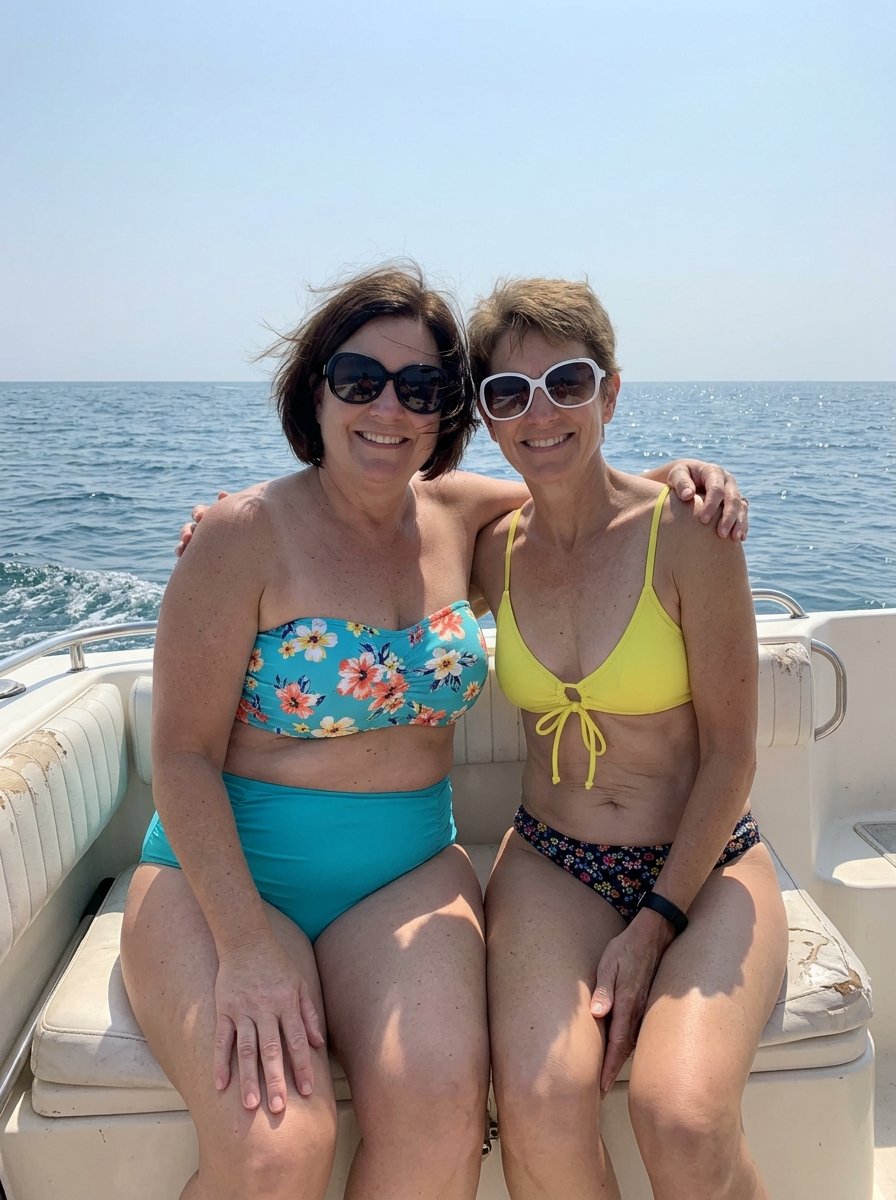
In the picture, Susan and I were sitting shoulder to shoulder, our faces turned toward the camera, with the ocean shining behind us.
Neither of us had been smiling very broadly that afternoon, and now I understood why.
We had both been afraid of losing something we believed we could never replace.
But the photograph no longer felt like a final goodbye.
It reminded me that friendship was not proved by never making mistakes, but by having the courage to face them honestly and decide what came next.
Susan had asked for one last photograph because she thought the truth might end our friendship.
I kept it because it reminded me that the truth had given us a chance to begin again.
And when I looked at Robert’s picture beside ours, I no longer felt that moving forward meant leaving him behind.
I could carry my husband’s love, acknowledge my friend’s mistake, and still choose a life that belonged to me.
After forty-two years, Susan and I were no longer the girls who believed that loving someone meant never hurting them.
We were two women who had learned that trust could be broken, forgiveness could take time, and even the oldest friendship sometimes needed the courage to begin again.